
Keyword Research: The Practical Guide to Search Demand, Topic Authority and Automated Execution
Keyword research is not a spreadsheet exercise. This guide explains how to turn search demand, existing rankings, competitor signals and topic gaps into approved SEO/AEO-friendly execution.
Executive summary
Keyword research is often described as the act of finding words people type into Google. That definition is too small. Good Keyword research is the operating system that connects search demand, existing website performance, competitor visibility, content gaps, topical authority, internal links, AI answer readiness and Approved Execution.
- Keyword research should start with real business context, not a random export from a keyword tool.
- Useful research combines search demand, Search Console data, ranking pages, competitor pages, intent, SERP Features and content gaps.
- The goal is not a huge keyword list. The goal is a prioritized map of pages to create, improve, merge, refresh or internally link.
- Modern keyword research must support SEO, AEO, GEO, AI Overviews and answer engines without pretending any system can guarantee inclusion.
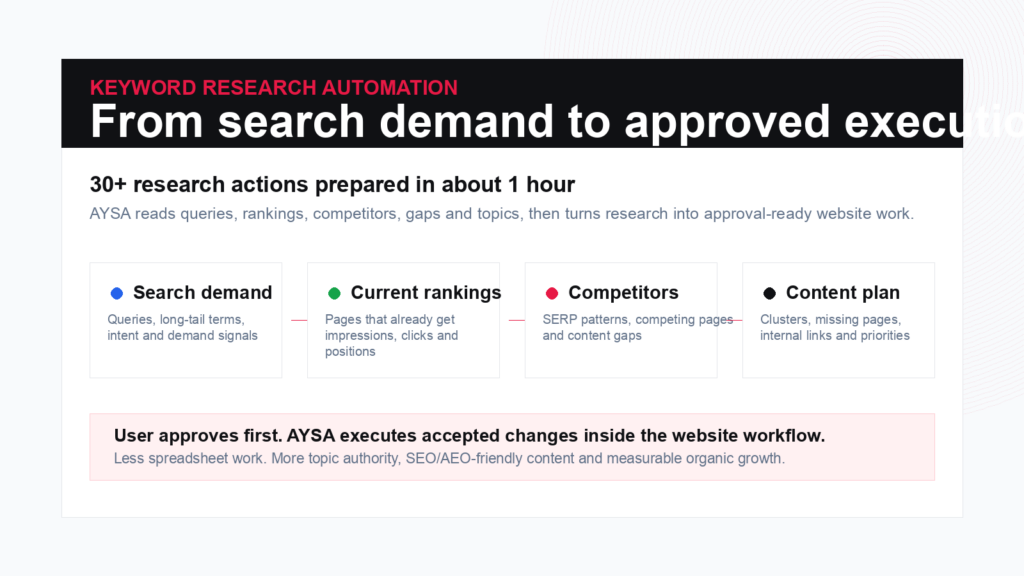
- AYSA automates more than 30 research actions that normally take days of manual work and prepares the research output in about 1 hour, with approval before execution.
Keyword research used to be a spreadsheet task. Export keywords, sort by volume, check difficulty, pick a few topics and write articles. That workflow still exists, but it is no longer enough for serious SEO. Search has become more fragmented, more entity-driven and more answer-oriented. Businesses now need to understand what people search for, what the website already earns, what competitors cover, what pages are missing, what topics deserve authority and what changes can actually be approved and published.
The problem is not that keyword research is unimportant. It is that most teams stop at the wrong output. They create a list. The business needs a plan. Even better, it needs a plan that can become execution: new pages, refreshed pages, better titles, clearer answers, stronger internal links, improved category content, FAQ sections, schema opportunities and monitoring.
This guide explains keyword research as an operating workflow. It is written for business owners, ecommerce teams, marketers, publishers, agencies and non-specialists who want organic growth without living inside SEO tools. It also explains how AYSA approaches research differently: the agent can run more than 30 research actions, compress work that normally takes days into about 1 hour, and turn the output into approval-ready website actions.

What keyword research really is
Keyword research is the process of discovering, organizing and prioritizing the search demand around a business, topic, product, service or audience. In practice, it answers a set of connected questions:
- What do people search for when they have this problem?
- Which searches show commercial intent, informational intent, local intent or comparison intent?
- Which pages on the website already receive impressions and clicks?
- Which pages rank but fail to attract enough clicks?
- Which competitor pages earn visibility for important topics?
- Which topics are missing from the website?
- Which existing pages should be improved instead of creating new pages?
- Which keywords belong together because they represent the same search intent?
- Which topics support AI search, answer engines and entity understanding?
- Which actions should be approved and executed first?
A keyword is not just a word. It is evidence of demand. Sometimes that demand is direct and obvious: “buy running shoes online” or “dentist near me.” Sometimes it is early-stage: “why do gums bleed” or “how to choose running shoes.” Sometimes it is comparison-driven: “Semrush alternative” or “best SEO automation software.” Sometimes it is local: “pediatric clinic Bucharest.” Sometimes it is answer-ready: “what is a canonical tag?”
The mistake is to treat all of these searches as equal. A keyword with high volume can be useless if the website cannot satisfy the intent. A keyword with low volume can be valuable if it sits close to purchase, local action or lead generation. Keyword research is not a hunt for the biggest numbers. It is a decision system.
Why keyword lists fail
Most keyword research fails because the final deliverable is a list. A list gives the illusion of progress. It can contain hundreds or thousands of rows, but the business still has to interpret it. Which page should target which term? Which terms belong together? Which topic is already covered? Which page should be refreshed? Which terms are too broad? Which require a new landing page? Which should become glossary pages? Which support a product page? Which are irrelevant?
A spreadsheet also hides the hardest part: implementation. Someone has to rewrite titles, plan pages, brief writers, publish content, add internal links, update schema, build FAQ sections and measure results. Without execution, keyword research becomes documentation of missed opportunity.
There are three common failure modes:
- Volume obsession: choosing keywords because they have big numbers, not because they match business value.
- Tool-only thinking: trusting a keyword export without checking real pages, SERPs, Search Console and website context.
- No execution bridge: finishing with recommendations but no approved path to publish improvements.
The better output is a keyword-to-execution map. It should say what already exists, what needs improvement, what is missing, what should be created, what should be merged, what should be internally linked and what deserves monitoring.
The data sources that matter
Keyword research becomes stronger when it combines multiple types of evidence. No single source tells the whole story.
Search demand databases
SEO platforms estimate keyword volume, keyword difficulty, parent topics, SERP features and related searches. These estimates are useful for discovery and prioritization, but they are still estimates. They should guide decisions, not replace judgment.
Google Search Console
Search Console is essential because it shows real queries, pages, impressions, clicks, CTR and average position for the actual website. Google’s Performance report can help identify queries where a site appears but does not earn enough clicks, pages that have demand but need better alignment, and topics where the site is already close to stronger visibility.
Current ranking pages
Ranking pages reveal what Google currently considers relevant. They show content formats, page types, answer depth, media use, local signals, review signals, product detail, schema, internal link patterns and authority. Competitor pages should not be copied, but they can reveal what the market expects.
Website crawl data
A crawl shows existing URLs, titles, headings, status codes, indexability, canonicals, duplicates, internal links and orphan risks. Keyword research without a crawl often creates recommendations for pages that already exist or ignores pages that need repair.
Business context
The business knows margin, service areas, product priorities, seasonality, operational constraints and customer language. A keyword tool does not know whether a lead is profitable or whether a product line matters this year. Research should learn the business before it builds the plan.
Intent, demand and business value
Search intent is the reason behind the query. It is one of the most important parts of keyword research because it determines what type of page should exist.
Common intent categories include:
- Informational: the user wants to learn, understand or solve a problem.
- Commercial investigation: the user compares options, tools, providers or methods.
- Transactional: the user is ready to buy, subscribe, book or request a quote.
- Navigational: the user wants a specific brand, product or website.
- Local: the user wants a nearby business, service or location-specific answer.
Intent affects content format. A query like “what is technical SEO” may need a glossary or guide. A query like “technical SEO audit tool” may need a product page. A query like “technical SEO checklist” may need a practical guide. A query like “SEO agency alternative” may need a comparison page. Publishing one generic article for all of these searches is usually weak.
Business value also matters. A keyword can bring traffic but no useful action. Another keyword can bring fewer visitors but stronger leads. A good research process scores opportunities by demand, relevance, difficulty, current position, page readiness, commercial importance and execution effort.
Clusters, topic authority and content architecture
Modern keyword research should group keywords into topics and clusters. A cluster is a set of related queries that share a topic, intent or page target. Clustering prevents three major problems:
- Creating multiple pages for the same intent.
- Stuffing one page with unrelated intents.
- Missing supporting content that helps a main page become authoritative.
Topic authority grows when a website covers a subject with depth, clarity and internal structure. For example, a site that wants to rank for “SEO automation software” may need pages about SEO automation, AI SEO tools, rank tracking, SEO audits, reporting, on-page automation, technical SEO, link building, AI visibility and approval-first execution. Each page should have a role.
This is where keyword research becomes architecture. The research should decide:
- Which topic deserves a pillar page?
- Which supporting guides should exist?
- Which glossary terms should be defined?
- Which commercial pages need comparison or use-case support?
- Which existing pages need stronger internal links?
- Which pages should be merged because they compete with each other?

Use the pages that already rank
One of the fastest ways to improve SEO is to study the pages that already receive impressions. Search Console can reveal queries where a page appears but underperforms. These are often easier wins than brand-new content because Google already associates the page with the topic.
Look for:
- Pages with high impressions and low CTR.
- Queries ranking between positions 4 and 20.
- Pages ranking for terms they do not answer clearly.
- Pages with many related queries but weak structure.
- Old content that still earns impressions but has lost freshness.
- Commercial pages that rank for informational queries but lack answer sections.
These findings can lead to practical actions: rewrite titles, improve meta descriptions, add missing sections, answer related questions, update outdated examples, add internal links, improve schema or create a supporting page. This is not glamorous work, but it is often where organic growth comes from.
AYSA treats this as part of research automation. The agent can read existing performance signals, detect mismatches between queries and page content, and prepare suggested updates for approval. That is different from simply showing a table of queries.
Competitor research without copying competitors
Competitor research should answer a practical question: what does the market already reward, and where can we build something better or more specific?
Good competitor analysis checks:
- Which pages rank for the target topic.
- What page type ranks: product page, guide, category, list, glossary, local page or video.
- How competitors structure headings and answers.
- What proof, examples, visuals or data they include.
- Which subtopics they cover.
- Which questions they answer.
- Where their content is thin, outdated, generic or missing business context.
- Which internal links and related pages support the ranking page.
The purpose is not to imitate. Copying competitors usually creates a weaker version of what already exists. The purpose is to understand expectations and build a more useful page. For AYSA, this means competitor signals become part of the recommendation, but the final work is adapted to the business profile, tone, offer and approval workflow.
Keyword research for AEO, GEO and AI visibility
Search is no longer only ten blue links. Google AI Overviews, AI-assisted search, answer engines and generative systems change how users discover information. This does not make keyword research obsolete. It makes it broader.
For AI search, keyword research should also identify:
- Questions that need direct, concise answers.
- Topics where the brand is not easy to identify or cite.
- Entity gaps: missing details about products, services, locations, people or credentials.
- Comparison and recommendation queries where AI systems may synthesize answers.
- FAQ opportunities that are useful to users, even if FAQ rich results are no longer the same opportunity they once were.
- Pages that need clearer definitions, steps, examples or evidence.
- Authority signals that support trust and source selection.
AEO focuses on answer readiness. GEO focuses on content that can be understood and synthesized by generative engines. AI visibility monitoring checks whether the brand appears, is cited or is absent where it should be present. Keyword research feeds all of these because it identifies the real questions and topics that matter.
The caution is important: no tool can guarantee inclusion in AI Overviews or answer engines. What a serious workflow can do is improve clarity, crawlability, content quality, structure, authority and monitoring. Those are the conditions that make a website more understandable and more useful across search surfaces.
Where AYSA changes the workflow
Traditional keyword research can take days because it is not one task. It is a chain of tasks: collect seed topics, pull query data, read Search Console, crawl the website, inspect ranking pages, compare competitors, classify intent, group terms, identify missing pages, detect cannibalization, map keywords to URLs, plan content, prioritize opportunities, estimate effort, prepare titles, suggest internal links and create an approval path.
AYSA compresses that workflow. The agent can run more than 30 research actions in the background and prepare an approval-ready research output in about 1 hour. The point is not speed for its own sake. The point is that speed changes behavior. Instead of waiting a week for a static audit, the business can get a working research plan quickly, review it, approve the important parts and move toward execution.
In an AYSA-style research workflow, the agent can:
- Learn the business profile, market, location, services, audience and tone of voice.
- Read what people search for around the business category.
- Extract queries the website already receives from Google Search Console.
- Identify pages that already rank but need better alignment.
- Compare competitor pages and SERP patterns.
- Detect missing pages and missing topics.
- Cluster related keywords into topic groups.
- Map keywords to existing or planned pages.
- Suggest SEO/AEO-friendly content plans.
- Plan internal links around topic authority.
- Prepare approval-ready actions rather than leaving the user with raw data.
The approval layer matters. AYSA should not blindly publish major content changes without user control. The product direction is autonomous execution after approval: the agent prepares the work, explains why it matters, asks for approval and executes accepted changes inside the website workflow.

A practical keyword research framework
Use this framework when planning research manually or when reviewing an automated research output.
1. Define the business objective
Do not start with keywords. Start with the outcome. Is the goal leads, ecommerce revenue, local visibility, authority, publisher growth, AI visibility, product education or support reduction? The objective changes the keyword priorities.
2. Build the seed topic list
List products, services, problems, customer questions, locations, categories, competitors, alternatives and use cases. This creates the starting universe for research.
3. Pull demand and current performance
Combine keyword tool data with Search Console. Estimated demand shows the market. Search Console shows what the website already touches. Both are needed.
4. Classify intent
Mark keywords as informational, commercial, transactional, local, comparison, navigational or answer-ready. Intent determines the page type.
5. Cluster terms
Group keywords that should be handled by the same page. Separate keywords that need different pages because the intent is different.
6. Map to existing URLs
Decide whether each cluster belongs to an existing page, an improved page, a new page, a glossary term, a guide, a comparison page or a product page.
7. Prioritize
Score by business value, relevance, demand, current position, competitor strength, content gap, technical readiness and execution effort.
8. Turn research into actions
Actions can include title rewrites, meta descriptions, content refreshes, new articles, landing pages, FAQs, schema, internal links, glossary definitions, local pages or authority-building tasks.
9. Approve and execute
Research does not create growth until work is published. Build an approval workflow so the right changes can move from plan to website without endless copy-paste.
10. Monitor and refresh
Search demand changes. Competitors publish. Google updates systems. AI answer surfaces evolve. Keyword research should be refreshed continuously, not once a year.
Keyword research checklist
Before approving a keyword research plan, check whether it includes these elements:
- Clear business objective and target audience.
- Seed topics based on real products, services and customer language.
- Search demand estimates from a reliable keyword data source.
- Search Console queries and page performance for the actual website.
- Competitor pages and SERP intent analysis.
- Intent classification for priority keywords.
- Keyword clusters, not only individual rows.
- Mapping between clusters and URLs.
- Missing page opportunities.
- Content refresh opportunities for existing pages.
- Internal linking recommendations.
- SEO/AEO/GEO and AI visibility considerations.
- Prioritization by business value and execution effort.
- Approval-ready actions, not just observations.
- Monitoring plan for rankings, clicks, CTR and conversions.
FAQ
What is keyword research?
Keyword research is the process of discovering, organizing and prioritizing the searches people use around a topic, business, product or service. Good keyword research connects search demand to real pages, intent, business value and execution.
Is keyword volume the most important metric?
No. Volume is useful, but intent, relevance, difficulty, current rankings, business value and execution feasibility are often more important. A low-volume keyword can be valuable if it attracts the right customer.
How often should keyword research be updated?
Important topics should be monitored continuously, while larger research refreshes can happen monthly, quarterly or when the market changes. Search Console, ranking movement and competitor activity can trigger updates sooner.
How does keyword research support AEO and GEO?
Keyword research reveals the questions, entities, comparisons and information needs that answer engines and generative systems may use. It helps shape content that is clearer, more complete and easier to understand.
Can AYSA do keyword research automatically?
AYSA can automate more than 30 research actions, including demand discovery, existing ranking analysis, competitor signals, clustering, missing page detection, keyword mapping and content planning. The output is prepared for review and approval before execution.
Does AYSA guarantee rankings?
No. No serious SEO platform can guarantee rankings or AI Overview inclusion. AYSA focuses on improving the quality, clarity, structure, monitoring and execution of SEO work.
The AYSA point of view
Keyword research should not end in a spreadsheet. A spreadsheet is a parking lot for opportunity. The business needs a system that understands the website, finds demand, identifies gaps, plans SEO/AEO-friendly content, asks for approval and executes accepted changes.
That is why AYSA treats keyword research as the beginning of execution. Less manual research work. More topic authority. More approved website action. More organic growth.
Sources and further reading
- Google Search Central: SEO Starter Guide
- Google Search Console Help: Performance report
- Google Search Central: Creating helpful, reliable, people-first content
- Google Search Central: Make your links crawlable
- Ahrefs: Keyword research guide
- Semrush: Keyword research guide
Continue the AI search topic inside AYSA.
Use these pages to connect the article with AI SEO tools, AI visibility monitoring, AI Overviews and approved website execution.
Turn this topic into a website action plan.
Use these AYSA hubs to move from reading to technical fixes, AI visibility monitoring, research, glossary context and approval-first SEO execution.

