Google Discover Publisher Profiles: Why Brand Control Is Becoming an SEO Surface
Google is giving more publishers control over Discover profiles. That small product change points to a larger SEO shift: recognizable source identity now matters across search, Discover and AI-assisted discovery.
Executive summary
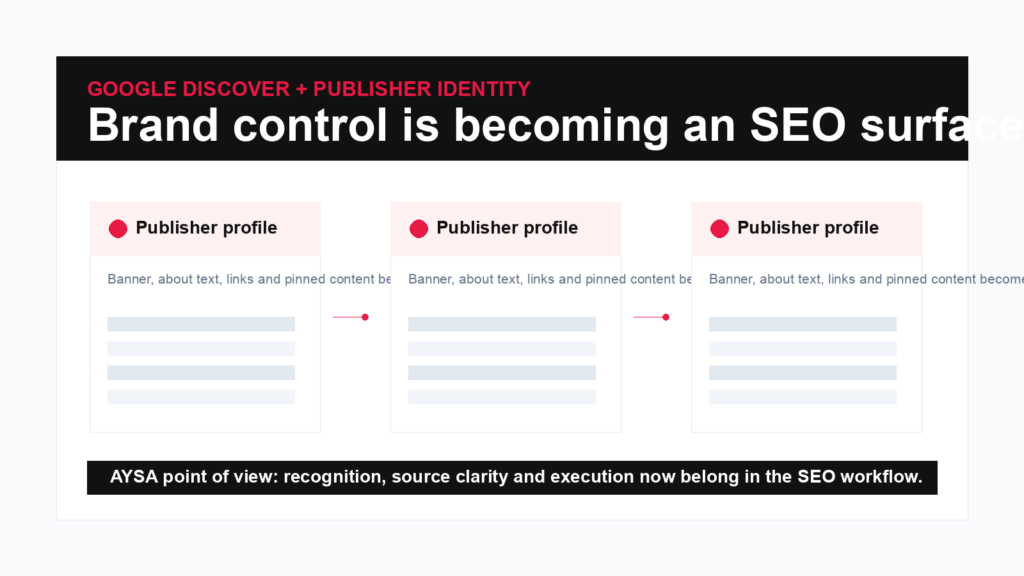
Google is expanding publisher control over Discover profiles, according to Search Engine Land. On the surface, this looks like a product administration update. In reality, it points to a bigger search trend: publisher identity, brand recognition and source clarity are becoming operational SEO assets, not only PR or design details.
- Google Discover is not a classic search results page, but it can influence how audiences encounter publishers, creators and brands.
- More publisher control over profiles means the identity layer around content matters more: logo, description, links, topical focus, trust signals and follow behavior.
- Publishers should not treat Discover as a traffic button. They should treat it as part of a broader recognition system across search, social, AI answers and returning audiences.
- For AYSA, the lesson is practical: SEO execution now includes content quality, Entity Clarity, author credibility, profile consistency, internal structure and Monitoring.
A recent Search Engine Land report says Google is giving more publishers control over their Discover profiles. That may sound like a small publisher tool update, but it deserves attention because it touches a larger change in search: Google is not only organizing pages. It is also organizing recognizable sources, creators, brands and content relationships.
For years, SEO teams mostly optimized pages: title tags, headings, content, internal links, schema, speed and backlinks. Those still matter. But the modern search ecosystem has widened. Google Search, Google Discover, AI Overviews, AI Mode, social references, author pages, publisher profiles and brand entities all shape how users and systems understand a source.
The important question is not “will a Discover profile make us rank?” That is the wrong frame. The better question is: if Google gives publishers more control over how they appear as sources, how should a serious SEO operation manage that identity layer?
What changed
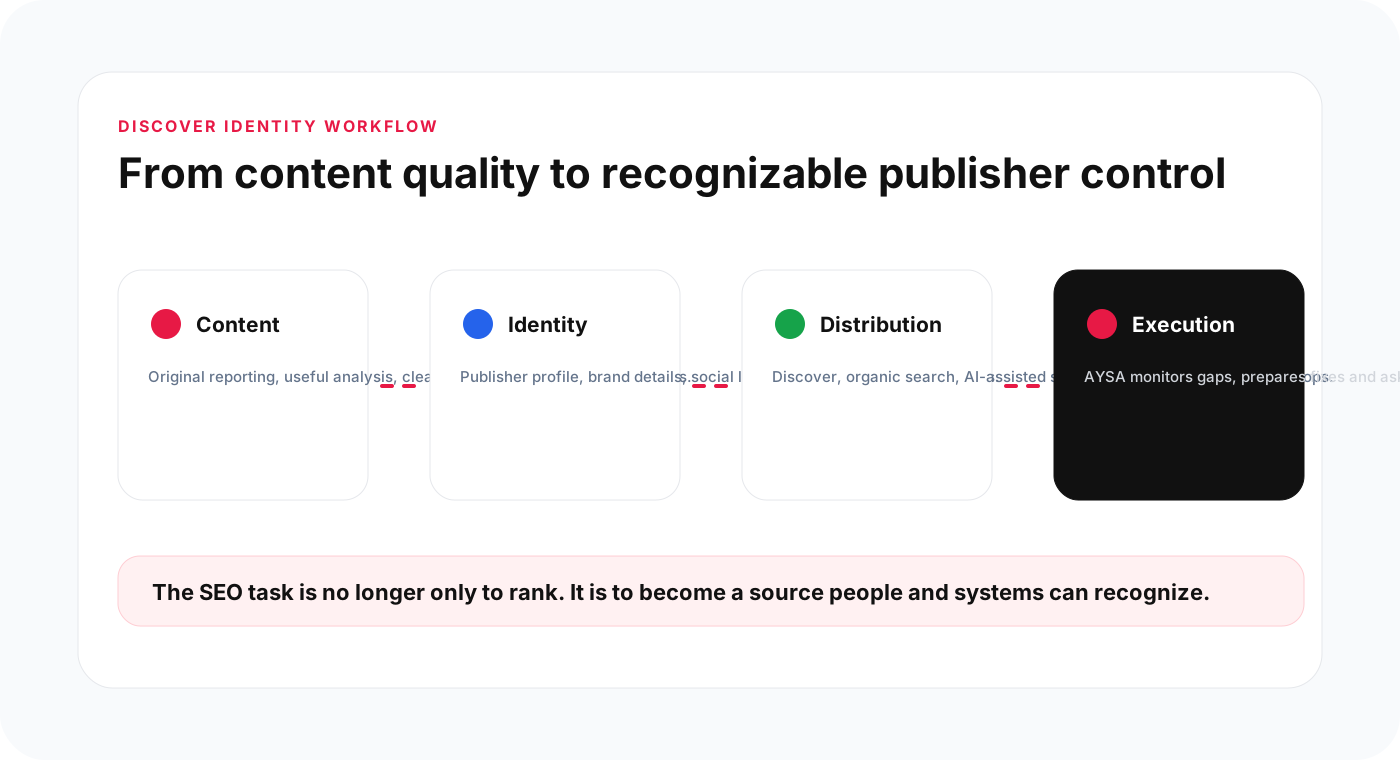
Search Engine Land reported that Google is allowing more publishers to control their Discover profiles. The exact available controls can vary by rollout and eligibility, but the direction is clear: publishers are getting more ability to manage how they appear in a Google surface that sits between search, content recommendation and audience follow behavior.
Discover is especially interesting because it is not driven by a typed query in the same way a normal search results page is. Users open a feed, Google recommends content based on interests and behavior, and publishers can appear before the user explicitly searches again. That makes Discover a visibility surface, but also a trust surface. If a user can follow or recognize a publisher, the publisher profile becomes part of the relationship.
Google’s own Discover documentation emphasizes that Discover content is automatically surfaced when it is indexed and meets content policies, with no special tags required for eligibility. Google also advises publishers to use compelling, high-quality images and publish helpful content. The new profile-control direction does not replace those foundations. It adds a stronger identity layer around them.
Why publisher profiles matter
A publisher profile is not just a name and a logo. It is a structured representation of a source. For users, it can answer: who is behind this content, what do they cover, can I recognize them, can I follow them and do they seem credible? For search systems, it can reinforce entity understanding, topical association and brand consistency.
This matters because the web has too much content. Search systems need signals to understand which sources are consistently useful around a topic. Users need shortcuts for trust. Publishers need ways to build repeat audiences instead of relying only on one-off search traffic.
In that context, profile control becomes a practical SEO issue. A weak or inconsistent publisher identity can create friction. A clear identity can support recognition across multiple surfaces.
For a publisher, that might include:
- a consistent brand name and logo;
- a clear description of editorial focus;
- accurate links to the main website and social profiles;
- author pages that explain expertise;
- topic clusters that make the publication’s coverage easy to understand;
- schema and metadata that reflect visible content;
- freshness and editorial maintenance;
- a monitoring workflow for Discover, Search and AI visibility signals.
Discover is not normal search
Google Search usually starts with a query. Discover starts with inferred interest. That difference changes the content strategy.
In classic SEO, a page may target “how to do Keyword research” or “best pediatric clinic Bucharest.” In Discover, the system may surface articles because it believes a user is interested in SEO, healthcare, parenting, ecommerce, AI Search or local news. The publisher has less control over a specific query, but more opportunity to build audience recognition through consistent quality and topic focus.
That does not mean publishers should chase clickbait. In fact, Discover can be risky when teams over-optimize for curiosity rather than usefulness. If the content promise is bigger than the content value, trust erodes. The safer long-term approach is to combine strong headlines and images with genuinely useful reporting, analysis or explanation.
For business websites, Discover may not always be the main channel. But the pattern still matters. Search is increasingly moving from direct response to contextual discovery. A user may encounter a brand in a feed, an AI answer, a Local pack, a comparison page, a social citation or a normal result. The brand has to be consistent across all of them.
The new publisher identity layer
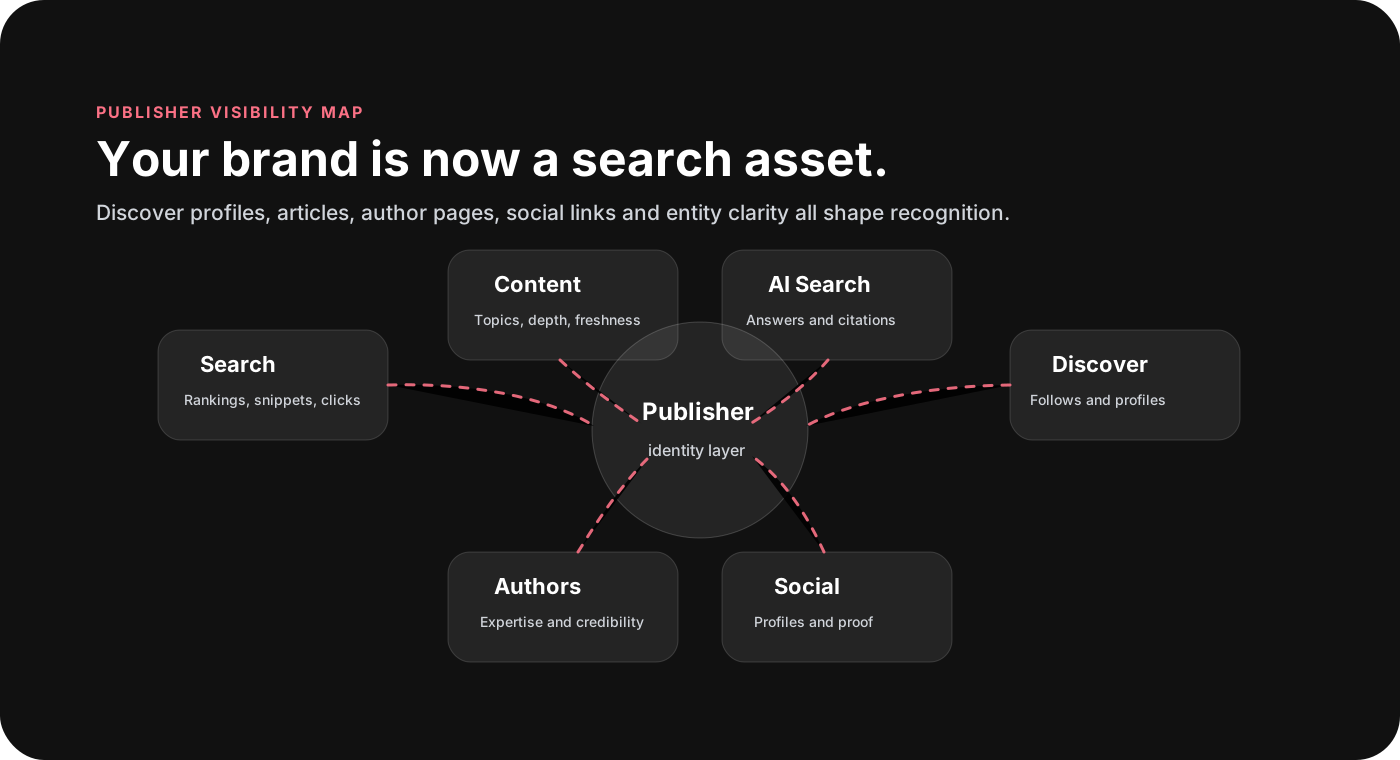
Publisher identity is the layer that connects content to a recognizable source. It includes visible branding, editorial positioning, author credibility, structured data, internal architecture, social profiles, external mentions and user follow signals.
This is where many SEO programs are still underdeveloped. They optimize individual articles but neglect the system around the article. A strong article on a weak identity layer can perform, but it is harder to build compounding trust. A strong identity layer makes each new article easier to understand in context.
Think of it as three levels:
- Page level: title, content, intent, headings, images, links and schema.
- Topic level: clusters, related articles, internal links, glossary terms, categories and authority depth.
- Source level: publisher profile, brand entity, authors, social profiles, editorial focus and external mentions.
Classic SEO often works at page level. Good content strategy works at topic level. Modern search visibility increasingly requires source-level consistency.
SEO implications for publishers and brands
The immediate temptation is to ask whether this update creates a new ranking factor. That is usually the least useful question. Google surfaces are complex, and profile controls should not be treated as a shortcut. The practical SEO implications are broader.
1. Brand consistency becomes execution work
Publisher names, descriptions, social links, author profiles and site metadata should be consistent. If the website says one thing, the social profiles say another, and the publisher profile says nothing useful, the identity layer is weak.
2. Author and founder pages matter more
When content is tied to recognizable people, author pages can help users understand who is speaking. This is especially important for expert content, business analysis, financial topics, health topics and technical guidance.
3. Topic clusters support source recognition
A publisher known for AI search should not have one isolated article about AI Overviews. It should have a connected body of work: AI visibility, answer engines, GEO, AEO, technical readiness, brand citations and monitoring.
4. Discover-ready content needs editorial discipline
Compelling headlines and images help discovery, but weak content harms trust. Publishers should build articles that are useful after the click, not only attractive before the click.
5. SEO needs monitoring beyond rankings
Rank tracking is still useful, but it is no longer the whole picture. Publishers should monitor Search Console performance, Discover performance where available, AI visibility, branded searches, referral patterns and engagement.
Why this connects to AI search
AI-assisted search makes source recognition even more important. AI Overviews, answer engines and generative search systems synthesize information. They need to decide which sources are relevant, trustworthy and useful enough to reference, cite or use as supporting context.
A publisher profile update is not an AI ranking update. But the direction is related: source identity is becoming more visible. The more search systems organize information by entities, brands, authors and topics, the more important it becomes to make those entities clear.
This means publishers should think about:
- clear organization and author schema where appropriate;
- visible editorial standards and author information;
- consistent social and external profile links;
- topic hubs that demonstrate depth;
- content that answers questions directly and accurately;
- internal links that connect related topics;
- monitoring for AI mentions, citations and absence from important answer surfaces.
The goal is not to manipulate AI systems. The goal is to make the website and publisher easier to understand, cite and recommend when the content genuinely deserves it.
The AYSA point of view
AYSA’s view is that SEO is moving from isolated optimization tasks to an execution system. Discover profile control is a good example. It is not enough to know that profiles exist. Someone has to review the brand identity, compare profile data, check author pages, identify missing entity signals, improve related content, add internal links, update metadata, monitor Discover/Search/AI visibility and keep the system consistent.
That work is operational. It is also exactly the kind of work that often gets ignored because it sits between SEO, content, branding and technical implementation.
AYSA can help by turning the issue into approved execution:
- detecting weak source or publisher identity signals;
- reviewing author and founder pages;
- finding content clusters that need stronger internal links;
- preparing profile, metadata and content improvements;
- monitoring Google Search, AI visibility and topic performance;
- asking for approval before public website changes are applied.
The key idea is simple: a modern SEO system should not only optimize pages. It should help the business become a recognizable source.
Practical checklist
If you are a publisher, media company, blog, ecommerce brand or expert-led business, use this checklist after reading about Google’s Discover profile controls.
- Check whether your publisher name is consistent across your website, social profiles and external mentions.
- Review your logo, favicon and social preview images.
- Make sure your About page explains who you are and what you cover.
- Improve author pages with real expertise, links and context.
- Connect social profiles where relevant.
- Create topic hubs for the areas where you want to be recognized.
- Review your article images and headlines for usefulness, not just clicks.
- Use structured data only where it reflects visible content.
- Monitor Search Console and Discover performance where available.
- Track AI visibility and branded mentions over time.
- Turn identity gaps into approved website actions.
FAQ
What is a Google Discover publisher profile?
A Google Discover publisher profile is a publisher-facing identity surface connected to how a source can appear in Discover. Profile controls can help publishers manage the way their brand is presented to users.
Does a Discover profile guarantee more traffic?
No. Discover visibility is not guaranteed. Profile control should be treated as part of source identity and audience recognition, not as a traffic guarantee.
Is Google Discover the same as Google Search?
No. Search is usually query-driven. Discover is feed-driven and based on user interests. Both can be important visibility surfaces, but they behave differently.
Why does this matter for SEO?
It matters because SEO is expanding beyond individual page optimization. Source identity, author credibility, topic authority and recognizable brand signals increasingly support visibility across search, Discover and AI-assisted surfaces.
Can AYSA help with publisher identity SEO?
AYSA can help monitor identity gaps, prepare content and metadata improvements, connect related pages, improve topical structure and turn approved recommendations into website actions.
Sources and further reading
- Search Engine Land: Google gives publishers more control over Discover profiles
- Google Search Central: Optimize for Discover
- Google Search Central: Creating helpful, reliable, people-first content
- Google Search Central: Intro to structured data markup
- Google Search Console Help: Performance report
Continue the AI search topic inside AYSA.
Use these pages to connect the article with AI SEO tools, AI visibility monitoring, AI Overviews and approved website execution.
Turn this topic into a website action plan.
Use these AYSA hubs to move from reading to technical fixes, AI visibility monitoring, research, glossary context and approval-first SEO execution.