Link Intent in 2026: How SMEs Earn Authority in Google and AI Search Without Spammy Link Building
Backlinks still matter—but the winning approach isn’t buying links or blasting outreach. Link intent blends genuinely cite-worthy content with targeted promotion so SMEs earn mentions, referral traffic, and AI search visibility—then keep that authority compounding.

Backlinks didn’t disappear. What disappeared is the shortcut.
For years, “Link Building” often meant one of two things: buying placements, or blasting a list of strangers with the same template email. That approach is increasingly ineffective, increasingly risky, and—most importantly—completely misaligned with how modern discovery works.
In 2026, authority shows up across more surfaces than the classic “ten blue links.” Your content competes inside traditional results, inside AI answers, inside publisher roundups, inside newsletters, and inside the citation habits of writers and creators. And while the surfaces changed, one underlying truth didn’t: credible third-party references still act like votes of confidence—for humans and for machines.
This is why I like the concept of link intent: creating content that is designed to be cited because it’s the best reference, and then pairing that content with Outreach that is editorial, relevant, and timed for how people actually write and publish.
Below is a practical, business-first guide to link intent: what changed, why it matters, how to build assets that earn mentions and Referral traffic, and how to operationalize it with an execution system like AYSA—so you’re not stuck with strategy decks and undone tickets.
Concise summary

Link intent is the practice of combining (1) genuinely reference-worthy content with (2) targeted distribution to the right publishers and communities. It’s not “get X links per month.” It’s “publish assets people need to cite.”
- Why it matters now: Search authority is being evaluated across more surfaces, including AI experiences. Links and mentions remain powerful trust signals.
- What changed: Generic outreach and manufactured links work less, while concentrated authority (a few definitive resources) compounds more.
- What to do: Build fewer, stronger assets that serve “reference intent,” then run smaller, higher-relevance outreach lists with clear editorial value.
- How AYSA fits: AYSA monitors, prepares improvements, asks for approval, and executes the on-site changes that make link-intent content easier to understand, cite, and rank—without months of backlog.
Key takeaways

- Links are an outcome, not a KPI. The KPI is becoming the page writers and AI systems rely on as the best reference.
- Reference intent beats “blog intent.” Statistics pages, benchmarks, buyer guides, glossaries, and “how it works” explainers attract citations better than generic tips.
- Outreach should look like pitching an editor. Fewer emails, more relevance, tighter positioning, and better timing.
- Referral traffic is underrated. When your content becomes a go-to citation, it can create a durable stream of qualified visitors from aligned audiences.
- Execution is the bottleneck. The biggest wins often come from basics: internal links, clear hubs, strong summaries, and Structured data—implemented fast and safely.
Table of contents
- What “link intent” really means (and why the old link-building playbook broke)
- The new search reality: authority now has more “surfaces” than ten blue links
- Why links and citations still matter (even in AI search)
- Where most businesses go wrong: content and links in different rooms
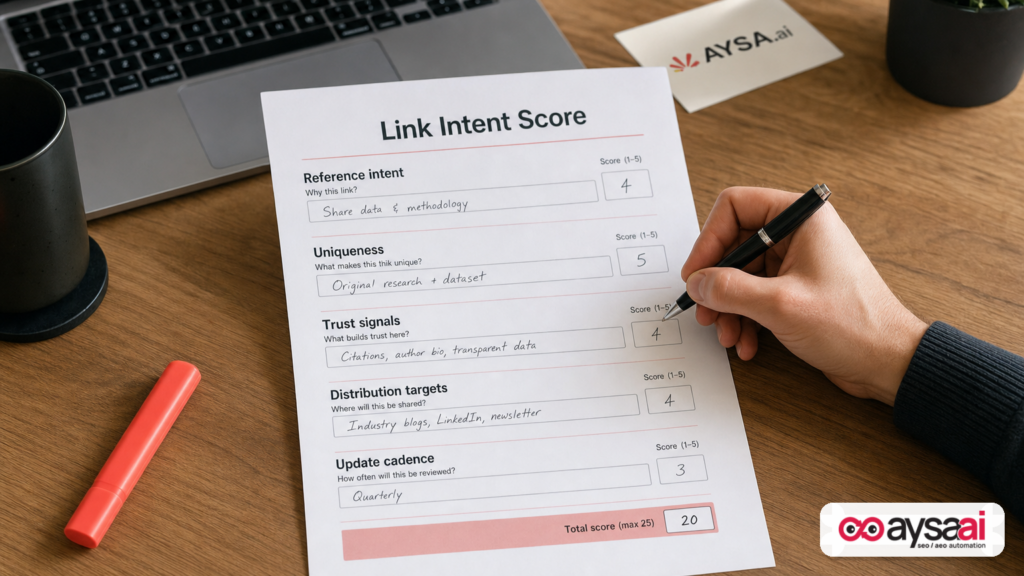
- A practical framework: the Link Intent Score (LIS) for picking topics that earn citations
- What content earns links now: 10 asset types that match reference intent
- Evergreen vs. news: when “newsjacking” helps—and when it wastes your budget
- The outreach that works now: smaller lists, higher relevance, better timing
- SME scenario: a local clinic turns one “reference page” into links, calls, and AI visibility
- How to measure link intent when clicks and attribution get messy
- What can go wrong: the risk checklist (and how to stay white-hat)
- An operating model for SMEs and agencies: roles, cadence, and production quality
- Where AYSA.ai fits: monitored strategy + approved execution
- What to do next: a 30-day action list
- Sources and further reading
What “link intent” really means (and why the old link-building playbook broke)
Link intent is simple to describe and hard to fake:
- Create content that someone would genuinely cite when they are trying to explain something, justify a claim, or support a decision.
- Then show it to the people most likely to need that citation—writers, editors, creators, researchers, community leaders, and partners.
That’s it. It’s not a secret tool. It’s not “100 links in 30 days.” It’s not a Backlink spreadsheet as the strategy.
The approach is heavily inspired by the original argument from Search Engine Land’s piece on combining great content with strategic outreach (external source link below). The important shift is a mindset shift: links are not the product—you are building a reference asset that naturally earns them as a side effect of being useful.
What broke in the old playbook?
- Volume-based outreach got ignored. People are overwhelmed. Editors and writers are trained to filter.
- Manufactured links stopped moving the needle consistently. Even when they “count,” they don’t build brand trust or referral demand.
- Businesses realized they were building links to content that doesn’t convert. The page might rank, but it doesn’t win customers.
Link intent fixes the misalignment. It forces you to answer one uncomfortable question before you publish: “If I were a journalist, creator, or industry writer, would I cite this?”
The new search reality: authority now has more “surfaces” than ten blue links
Search is no longer a single place. It’s an ecosystem of touchpoints where people ask questions and outsource decisions. Search Engine Land has been covering this expansion from multiple angles, including how people increasingly delegate decisions to AI systems (Delegation search: Why users outsource decisions to AI) and how Attribution can fall short when AI is involved (4 ways to track AI search visibility when attribution falls short).
For SMEs, the practical implication is straightforward:
- Customers still discover you through Google.
- They also discover you through AI answers that summarize sources.
- They also discover you through the sites those AI systems and writers choose to trust.
That puts Authority Building back at the center. Not authority as a vanity metric, but authority as a network of credible mentions that signal, “This business knows what it’s talking about.”
Why links and citations still matter (even in AI search)
Let’s be careful with claims here: I’m not going to pretend we have a complete public formula for how every large language model weighs backlinks. We don’t. What we do have is a long-running reality in SEO: links are among the strongest signals of authority and discovery. The Search Engine Land article makes the case that backlinks remain important signals for both Google and LLM-style search experiences because they represent third-party endorsement.
Even if you strip away the algorithm debate, links matter for three very business reasons that are easy to verify in the real world:
1) Links are durable distribution
A good editorial link can drive referral traffic for years. It’s an always-on recommendation.
2) Links create trust transfer
When a credible site references you, it reduces perceived risk. That matters in B2B and in local services where trust is the product.
3) Links drive discovery by crawlers and by humans
Links help search engines find content and help humans find answers. In an AI-heavy world, discoverability starts earlier: you want your page to be the one others quote and summarize.
If you want the shortest version: AI didn’t kill authority signals. It raised the bar for them.
Where most businesses go wrong: content and links in different rooms
The most common failure pattern I see—especially with small teams—is organizational:
- One person (or agency) is publishing content to “hit the calendar.”
- Another person (or vendor) is “building links” to hit a monthly number.
- No one owns whether the content deserves links, or whether the links support the business goals.
The result is predictable:
- Content that’s fine, but not cite-worthy.
- Outreach that’s broad, but not relevant.
- Links (if you get them) that don’t send qualified traffic.
- A growing sense that “SEO doesn’t work like it used to.”
Search Engine Land has also covered this broader frustration directly (Why so much SEO work no longer drives growth). Link intent is one way out: it reconnects content to distribution and business impact.
A practical framework: the Link Intent Score (LIS) for picking topics that earn citations
SMEs don’t need 200 articles. They need a handful of pages that become the best answer in their niche.
To do that consistently, you need a way to choose topics based on citation potential—not just keyword volume. Here’s a scoring framework I use to pressure-test ideas before spending weeks producing them.
The Link Intent Score (0–20)
Score each topic from 0–4 in five categories:
- Reference intent (0–4): Will a writer need to cite this to support a claim? (Stats, definitions, benchmarks, comparisons, step-by-step processes score high.)
- Uniqueness (0–4): Do you have something others don’t—data, real experience, a framework, a tool, a process, a curated dataset?
- Trust signals (0–4): Can you back it up with transparent methodology, expert review, sources, and clear authorship?
- Distribution fit (0–4): Can you name 20 specific sites/creators who would care? If not, the topic may be too vague.
- Update cadence (0–4): Can you keep it fresh? Evergreen + periodically updated assets compound.
Interpretation:
- 0–9: Fine for a blog, weak for link intent.
- 10–15: Potential—needs a sharper angle, better data, or better packaging.
- 16–20: Build it. This is a likely “citation magnet” if executed well.
This is not about perfection. It’s about discipline. If your topic can’t score well, you’re likely creating content that requires aggressive outreach—or worse, artificial link tactics—to get attention.
What content earns links now: 10 asset types that match reference intent
When people link, they’re usually doing one of four things:
- Supporting an argument
- Defining a concept
- Comparing options
- Sending readers to “the best explanation”
So your job is to build content that is the obvious destination for one of those jobs-to-be-done.
1) Statistics and benchmarks pages (with methodology)
Writers constantly need numbers, but they also need credibility. If you can create a clean, updated statistics page with transparent sourcing and definitions, you can become a default citation.
What makes it link-worthy: clear sourcing, freshness (“Updated for 2026”), scannable structure, and definitions of what the numbers mean.
2) “How it works” explainers for complex processes
Insurance, finance, healthcare, logistics, and B2B SaaS all have processes customers don’t understand. The best explainers get cited by other explainers.
3) Buyer’s guides and comparison frameworks (not just “best of” lists)
“Best X” posts are saturated. What earns links is a decision framework: criteria, tradeoffs, pitfalls, and who each option is for.
4) Original research (small is fine)
You don’t need a massive survey. A small dataset from your operations—sanitized and aggregated—can be enough if it’s unique and relevant.
Non-negotiable: be honest about sample size, methodology, and limitations.
5) Templates, calculators, and worksheets
Tools get linked because they save time. A printable checklist or simple calculator can be linkable if it solves a real task.
6) Glossaries that are actually useful
Not a dictionary. A glossary that includes examples, “why it matters,” and common misconceptions becomes a reference.
7) Industry “playbooks” with step-by-step SOPs
Show the process. If you can make something replicable, people will cite it when teaching or onboarding.
8) Curated directories (with standards)
Directories can be spam. But a curated directory with explicit inclusion criteria—“we only list vendors with X”—can become a trusted resource.
9) Visual, embeddable diagrams (with licensing clarity)
When you give writers a diagram they can use (with attribution), you make linking easy. Keep it simple and accurate.
10) “Definitive” landing pages that replace 10 thin posts
One reason link intent is efficient: instead of publishing 10 shallow posts, you consolidate into one authoritative hub. This aligns with the Search Engine Land point that concentrated authority can matter more than volume.
Evergreen vs. news: when “newsjacking” helps—and when it wastes your budget
News can earn bursts of links. Evergreen can earn years of links. The best strategy is a portfolio.
The Search Engine Land article highlights this tradeoff: news-focused content can generate short-term link clusters, while evergreen resources keep accumulating references long after a news cycle fades.
When news works
- You can publish fast with a genuinely new perspective.
- You have subject-matter expertise that improves the conversation.
- You can provide a quote, a checklist, a risk analysis, or a “what to do now” guide.
When evergreen wins
- Your customers ask the same questions every week.
- The industry needs stable definitions, benchmarks, or how-to references.
- You can maintain it and keep it accurate.
A practical hybrid: build an evergreen hub and use news moments to refresh it, add a new section, and re-promote it. That keeps your authority compounding while still participating in timely conversations.
The outreach that works now: smaller lists, higher relevance, better timing
Strategic outreach is not the opposite of great content—it’s how great content gets discovered. But it only works after you’ve done the relevance work.
Link-intent outreach should feel like an editor receiving a helpful reference, not like a marketer requesting a favor.
Four principles for modern outreach
- Start with who already writes about the topic. You’re not “creating demand,” you’re supporting existing demand for credible sources.
- Show the delta. What does your asset add that the writer’s current sources don’t—freshness, clarity, data, methodology, a framework?
- Make it easy. Include a short summary, key bullets, and the exact section that is cite-worthy.
- Respect timing. Outreach is more effective when tied to publishing cycles, seasonal relevance, or industry events.
A repeatable outreach process (without spam)
- Create a “best-fit 25” list. Not 500. Start with 25 writers, newsletters, industry blogs, or resource pages that already reference similar content.
- Map the angle. For each target, note what they cover and why your asset fits their audience.
- Pitch one idea. “Here’s a new benchmark + methodology you can cite,” or “Here’s a visual you can embed with attribution.”
- Follow up once. If it’s good, they’ll use it. If not, move on. Your brand reputation matters.
- Track responses and iterate. Your goal is learning: which angles earn mentions, which don’t.
Search Engine Land’s broader ecosystem includes strong examples of digital PR campaigns and strategies (Search Engine Journal: Digital PR benefits for links). Use those as inspiration, but keep your execution grounded: SMEs win by being the most helpful specialist, not by trying to out-stunt big brands.
SME scenario: a local clinic turns one “reference page” into links, calls, and AI visibility
Let’s make this concrete with a realistic scenario.
Business: A mid-sized allergy clinic in a metro area.
Problem: They publish blog posts about symptoms and treatments, but traffic is volatile. They’re also noticing that patients increasingly arrive saying, “I asked an AI tool what to do.”
Old approach: Write another “Tips for seasonal allergies” article and hope it ranks.
Link-intent approach: Build a single evergreen, cite-worthy asset:
- “Allergy Season Readiness Guide (2026): Symptoms, when to test, treatment options, and a decision checklist.”
- Includes a simple decision tree (“When to see a specialist”), a printable checklist, and citations to reputable medical guidance where appropriate.
- Has a clear medical reviewer bio and update date.
Outreach targets:
- Local news health writers when pollen counts spike
- Regional parenting blogs and newsletters
- Community resource pages (schools, local orgs)
- Relevant “seasonal wellness” roundups
Why this earns links: Those publishers need a credible, local, clear reference that helps their audience act.
Where AYSA fits: Once the page exists, the compounding effect depends on execution details SMEs often neglect:
- Internal links from related posts to the guide (and vice versa)
- Clear summaries and scannable sections for citation
- Schema where appropriate (see note below)
- Monitoring for content decay and updating seasonal sections
This is the core point: one good reference page can outperform 20 generic posts because it can win links, referrals, and customer trust simultaneously.
How to measure link intent when clicks and attribution get messy
Measurement is getting harder—especially as AI experiences reduce obvious click paths. Search Engine Land has explicitly addressed this attribution challenge (4 ways to track AI search visibility when attribution falls short).
So what should SMEs track without fooling themselves?
Metrics that actually reflect link-intent success
- Referring domains and quality of placements: Not just count; look at relevance and whether the page sends real visits.
- Referral traffic: Sessions, engagement, and conversions from those referring sites.
- Brand search lift: More people searching your brand name or branded services over time (imperfect but directional).
- Assisted conversions: Users who first arrive via a citation, then return later through another channel.
- AI visibility checks: Whether your brand and pages appear in AI-driven recommendations (tooling varies; treat as directional).
Important: Don’t confuse “ranked for a keyword” with “became a reference.” Link intent is about being cited as the best source, not just being indexed.
What can go wrong: the risk checklist (and how to stay white-hat)
Any time you talk about links, someone will ask, “What’s the fastest way?” Fast is usually where risk hides.
Here’s the risk checklist I want SMEs and agencies to use before spending money:
Red flags
- Guaranteed link counts with no discussion of content quality or target relevance.
- Private blog networks (PBNs) or “we own the sites.”
- Link swaps at scale (“you link to me, I link to you”) as a core strategy.
- Irrelevant placements on sites that don’t share your audience.
- Thin content created only as a link target (no conversion pathway, no business value).
Safe bets (that still require skill)
- Original research with transparent methodology
- Evergreen explainers with expert review
- Tools/templates that save time
- Editorial pitching with relevance and honesty
If a vendor can’t explain why a specific publisher would want to cite your page, you’re not buying strategy—you’re buying risk.
An operating model for SMEs and agencies: roles, cadence, and production quality
Link intent isn’t a one-off campaign. It’s a production system.
Minimal roles you need (even if one person wears multiple hats)
- Subject-matter owner: ensures accuracy and unique insight.
- Editor/strategist: shapes the asset for reference intent and distribution.
- Outreach lead: builds target lists and pitches appropriately.
- Technical/execution owner: makes sure the site structure, internal linking, and markup support discoverability.
A cadence that works for SMEs
- Monthly: publish or refresh one “reference asset” section; run targeted outreach.
- Quarterly: consolidate thin posts into hubs; update statistics, screenshots, and dated language.
- Ongoing: monitor mentions, broken links, and new opportunities.
The quality bar: “Would a competitor cite this?”
That’s the test. If the answer is “no,” you’re not building authority—you’re filling a calendar.
Where AYSA.ai fits: monitored strategy + approved execution
Most SMEs don’t fail because they don’t understand the theory. They fail because execution gets stuck:
- The content gets published, but internal links never get added.
- The hub page idea sits in a backlog for three months.
- The schema plan is “on the roadmap.”
- The outreach happens, but the cited section is hard to quote, poorly structured, or not updated.
This is where AYSA’s model matters. AYSA is built to monitor, prepare changes, ask for approval, and then execute accepted website changes—so the strategy actually becomes an on-site reality.
Practically, link intent pairs well with AYSA in four ways:
1) Monitoring authority signals and opportunities
Use monitoring to keep an eye on the pages that are supposed to become your “references” and catch decay early. Start here: AYSA Monitoring.
2) Connecting link intent to AI search visibility
If your goal includes visibility in AI-driven experiences, you need to treat authority as a product requirement. See: AI Search Visibility.
3) Turning strategy into repeatable execution
Link intent isn’t just writing. It’s also information architecture, internal linking, structured content, and clear summaries. AYSA’s AI SEO tooling is designed to help teams move from “we should” to “it’s live”: AI SEO Tools.
4) Making execution predictable for SMEs and agencies
SMEs need predictability: what will be done, when, and how it will be approved. If you’re evaluating whether an execution system fits your operating model: Pricing.
And if you want more of our thinking on how search is changing (and what to do about it): AYSA Blog.
What to do next: a 30-day action list
If you’re an SME owner, marketing lead, or agency, here’s a practical sprint you can run without boiling the ocean.
Days 1–3: Choose one link-intent asset
- List your top 20 customer questions and top 20 industry misconceptions.
- Pick one topic with clear reference intent (stats, framework, comparison, process).
- Score it with the Link Intent Score; refine until it’s at least 16/20.
Days 4–14: Build the asset to be cited
- Write a scannable structure with a strong summary and clear headings.
- Add definitions, methodology (if applicable), and “who this is for.”
- Create at least one embeddable element (simple diagram or checklist).
- Make it evergreen: include an update plan and a visible “last updated” date.
Days 15–21: Prepare the site for compounding
- Build internal links from related pages to the new asset.
- Create a small hub page or navigation pathway if needed.
- Improve snippet-readiness: short summaries, bullet points, clear sections.
- Consider structured data where appropriate. (If you need a guide, Search Engine Land has covered schema for the “agentic web”: How to use schema markup to optimize for the agentic web.)
Days 22–30: Run targeted outreach
- Create a list of 25 best-fit targets who already publish around the topic.
- Send 10 highly personalized pitches first; iterate based on replies.
- Follow up once, then move on.
- Track referrals and mentions; log what angle worked.
After day 30: refresh the asset monthly for 10 minutes (accuracy + freshness), and repeat the cycle with the next best topic.
Sources and further reading
- Search Engine Land: Link intent: How to combine great content with strategic outreach
- Search Engine Land: 4 ways to track AI search visibility when attribution falls short
- Search Engine Land: Delegation search: Why users outsource decisions to AI
- Search Engine Land: Why so much SEO work no longer drives growth
- Search Engine Land: How to use schema markup to optimize for the agentic web
- Search Engine Journal: Digital PR benefits for links
AYSA resources:
Continue the AI search topic inside AYSA.
Use these pages to connect the article with AI SEO tools, AI visibility monitoring, AI Overviews and approved website execution.
Turn this topic into a website action plan.
Use these AYSA hubs to move from reading to technical fixes, AI visibility monitoring, research, glossary context and approval-first SEO execution.