Multi-Channel Marketing In The AI Search Era: How To Make Every Channel Work Together (And Prove It)
Disconnected channels are expensive. In 2026, AI search, attribution limits, and shrinking organic click-through mean you need a channel system—not a channel list. Here’s a practical playbook to assign each channel a job, measure what matters, and use AYSA.ai to monitor, propose, and execute approved SEO/AEO changes that compound across paid, social, email, and search.

Multi-channel marketing used to be mostly a budgeting problem: pick the best channels, spread spend, report results. In 2026, it’s an integration problem. AI-driven discovery, fragmented attention, and imperfect Attribution have made it painfully easy to run “a lot of marketing” while building very little compounding growth.
This editorial is my practical playbook for turning disconnected channels into a coordinated system—one that you can measure honestly, improve continuously, and execute without chaos. It’s inspired by (but not a rewrite of) the Search Engine Journal discussion on making marketing channels work together, particularly the focus on clear channel roles, better awareness measurement, mid-funnel sequencing, attribution context, and AI workflows. Source: Search Engine Journal.
I’m writing this as Marius Dosinescu from AYSA.ai, and I’ll be direct: most teams don’t have a channel problem—they have an execution and handoff problem. Channels are only “working together” when each touchpoint makes the next touchpoint more likely to succeed. That requires intent-aware content, consistent messaging, clean measurement, and a system for shipping improvements.
Concise summary

- Stop judging every channel by conversions. Assign each channel a job across awareness, consideration, and decision.
- Measure awareness with the right signals (e.g., Branded Search lift, returning visitors, assisted conversions), not just CPA.
- Mid-funnel is where deals are won or lost. Build proof, differentiation, and objection handling—don’t just retarget.
- Keep last-click attribution, but contextualize it with multi-touch views and business reality (sales cycle, margin, repeat rate).
- Use AI for workflow speed—but only with guardrails, clean tracking, and human approval before changes go live.
Key takeaways (what to do differently starting this week)
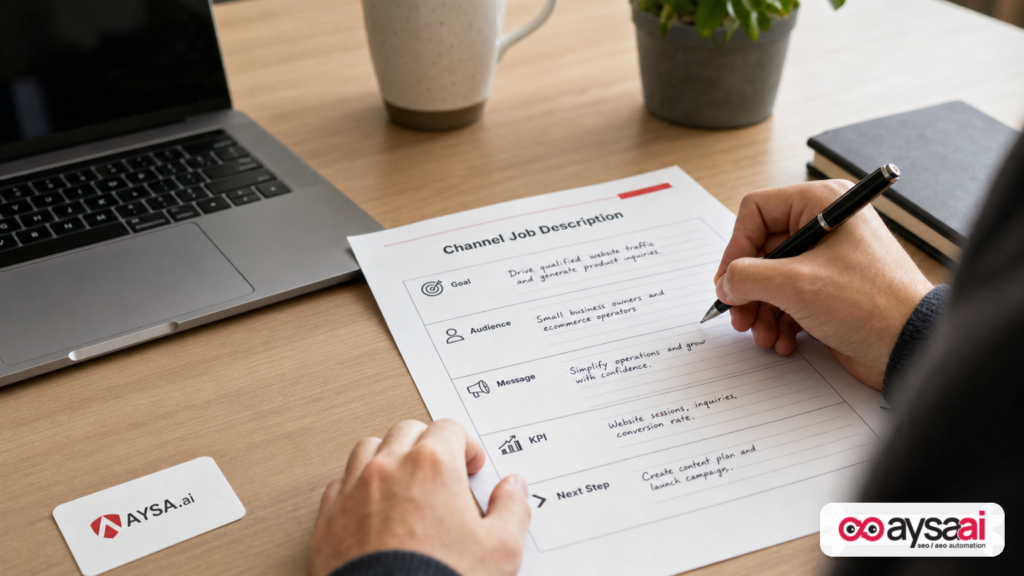
- Write a one-page “job description” for each channel: purpose, audience, message, KPI, and next step.
- Define 3–5 “handoff metrics” that prove channels are helping each other (not competing for credit).
- Create one mid-funnel asset per top objection (price, trust, switching cost, uncertainty) and distribute it across channels.
- Adopt an “attribution truth table”: what last-click can tell you, what it cannot, and what you’ll use instead.
- Implement an approved-execution workflow so insights reliably become shipped improvements.
Table of contents

- What changed in 2026 (and why your channels feel disconnected)
- The new problem: channels don’t compete—they hand off
- Step 1 — Assign every channel a job (or kill it)
- Step 2 — Measure awareness with signals that predict revenue
- Step 3 — Build mid-funnel to reduce uncertainty (not just retarget)
- Step 4 — Attribution: keep last-click, but stop worshipping it
- Step 5 — AI in the workflow: faster isn’t better without guardrails
- A concrete SME scenario: local clinic + ecommerce supplements
- What agencies should rethink (and how to sell the new model)
- What to monitor weekly (SME scoreboard)
- Where AYSA fits: monitoring → recommendations → approval → execution
- What to do next (30/60/90-day plan)
- Sources and further reading
What changed in 2026 (and why your channels feel disconnected)
Marketing didn’t suddenly become “harder” because there are more platforms. It got harder because the buyer journey became more non-linear and more compressed at the moment of decision.
Here’s what I mean:
- Discovery is everywhere. People discover brands via social video, forums, creator content, podcasts, AI assistants, email forwards, and yes—search.
- Validation happens outside your funnel. Prospects check reviews, Reddit threads, comparison pages, friend group chats, and “what does AI say about this?” prompts.
- Decision-making is more private. Fewer visible Clicks don’t mean less influence. AI summaries and SERP Features can reduce obvious traffic while still shaping preference.
So when leadership asks, “Which channel is working?” it’s the wrong question. The right question is: Which sequence of touchpoints is building confidence and converting intent?
This is the heart of the SEJ piece: channels need defined roles, better measurement, mid-funnel support, and attribution context—plus AI used where it strengthens workflow, not where it replaces strategy. Search Engine Journal’s recap is a solid starting point; I’m going to push it further into an execution-grade system you can run as an SME or agency.
The new problem: channels don’t compete—they hand off
Most channel planning still assumes a “winner”: whichever channel gets the conversion must be the best channel. That leads to predictable dysfunction:
- Paid search gets credit and keeps budget—even if it’s mostly capturing demand created elsewhere.
- Upper funnel gets cut because it doesn’t hit CPA targets designed for bottom funnel.
- SEO becomes a blog factory because “content” is treated as top-of-funnel only, instead of a full-funnel decision support system.
- Email becomes a discount engine because it’s measured only by immediate revenue, not by reactivation and retention lift.
A healthier model is to treat your marketing like a handoff system:
- Awareness channels create familiarity and category understanding.
- Consideration channels reduce uncertainty with proof, education, and differentiation.
- Decision channels capture existing intent and remove friction.
If you want channels to work together, you must design for the handoff. That means: “What should the prospect do next?” and “What must they believe next?”
Step 1 — Assign every channel a job (or kill it)
The most practical move you can make is to give each channel a single primary job and a small number of secondary jobs. If a channel is trying to do everything, it will do nothing well.
Use a one-page channel job description
For each channel you run (SEO, Google Ads, Paid Social, YouTube/CTV, email, affiliates, webinars, partnerships, etc.), write one page with:
- Primary job: Awareness / Consideration / Decision / Retention
- Target audience: New buyers, returning buyers, churned customers, local searchers, etc.
- Promise: The one sentence you want them to remember
- Proof: The evidence you’ll show (reviews, case studies, certifications, demos)
- Next step: What action should happen after this touchpoint?
- Success metrics: 2–4 metrics tied to that job
Example channel roles (a sane starting point)
- SEO: Consideration + Decision (answer questions, comparisons, “best X for Y,” and capture high-intent searches)
- YouTube/Video: Awareness + Consideration (demonstrate, educate, reduce fear)
- Paid search: Decision (capture intent; protect branded terms; fill gaps in organic)
- Paid social: Awareness + Consideration (target interests; build familiarity; retarget with proof)
- Email/SMS: Consideration + Retention (nurture; onboarding; reorder; winback)
Notice what’s missing: the idea that every channel must “generate leads” in the same way. That’s the trap SEJ calls out, and it’s the first thing to fix if you want cross-channel performance.
If a channel can’t be assigned a job, pause it
This is unpopular advice, but it’s true: a channel you can’t explain is a channel you can’t optimize. Put it on hold and redeploy the effort into strengthening your handoffs: landing pages, proof assets, tracking, and follow-up speed.
Step 2 — Measure awareness with signals that predict revenue
Awareness is often treated like a vanity stage. It isn’t. It’s the stage where you earn the right to be considered later.
The problem is measurement. If you judge awareness by bottom-funnel KPIs, awareness will always “lose.” The SEJ recap recommends more appropriate signals (branded search lift, returning visitors, direct traffic trends, video completion rates, first-party audience growth, assisted conversions). That’s directionally right. Now let’s make it operational.
Pick 3–5 handoff metrics (not 20 dashboards)
Choose a few cross-channel signals that indicate your awareness campaigns are improving downstream performance. Examples:
- Branded search trend (directional): Are more people searching for your brand name or branded product names?
- Returning visitors: Are you building familiarity that brings people back?
- Email list growth: Are you converting attention into permission?
- Assisted conversions: Are awareness touches showing up earlier in conversion paths?
- On-site engagement quality on “proof pages” (case studies, reviews, comparisons): Are people consuming the material that reduces uncertainty?
Important: these are not excuses for poor performance. They’re metrics aligned to the job.
Set expectations before launch (or you’ll lose budget later)
Upper funnel is usually the first budget to get cut because the story isn’t pre-sold to stakeholders. You have to align upfront:
- What the campaign is designed to do (and not do).
- What success looks like at 2 weeks, 6 weeks, and 12 weeks.
- Which metrics are diagnostic vs. decision-making metrics.
This is less about persuasion and more about preventing category errors—like comparing YouTube to branded search CPA.
Where GA4 fits (and where it doesn’t)
GA4 can help you track behavior and conversion paths, but it won’t magically solve attribution. Use it to build a consistent measurement layer across channels, and pair it with platform reporting as directional evidence.
If you need official GA4 references, start at Google’s GA4 documentation and help center. (This editorial won’t claim specific GA4 capabilities beyond what you can verify in your own property.) Google Analytics Help.
Step 3 — Build mid-funnel to reduce uncertainty (not just retarget)
If awareness creates interest, mid-funnel creates confidence. And confidence is what converts when offers are similar, pricing is close, and the buyer is anxious about making the wrong choice.
Mid-funnel is where most SMEs underinvest because it doesn’t feel as “creative” as awareness or as “measurable” as decision campaigns. That’s a mistake.
Name the uncertainties you must resolve
Every purchase has uncertainty. Your job is to surface it and address it systematically. Common uncertainties:
- Trust: “Will this work for someone like me?”
- Risk: “What if I waste money or time?”
- Fit: “Is this for my specific situation?”
- Differentiation: “Why you vs. the more famous competitor?”
- Implementation: “How hard is it to get started?”
Build proof assets that travel across channels
The best mid-funnel work is reusable across SEO, paid, social, and email. Focus on assets like:
- Comparison pages (you vs. alternatives, category comparisons)
- Case studies (plain-language, specific problem → approach → outcome; don’t invent numbers)
- FAQ and objection pages (pricing, insurance, shipping, returns, setup, integrations)
- “How it works” explainers (short, skimmable, visual)
- Review synthesis (summarize what customers consistently praise/criticize—truthfully)
Then distribute:
- SEO: publish and internally link them from high-intent pages.
- Paid social: run objection-specific creative to the relevant proof asset.
- Paid search: use them as landing pages for non-brand intent (“best,” “reviews,” “alternatives”).
- Email: sequence them based on user actions (visited pricing page → send proof; viewed comparison page → send differentiator).
Mid-funnel is not only retargeting
Retargeting is a tactic. Mid-funnel is a strategy. It includes:
- Non-brand search content that answers “which option is right?”
- Educational webinars/demos for complex decisions
- Nurture sequences that build understanding over time
- Partnership content that borrows trust appropriately
The key is sequencing: once someone has shown interest, they should not keep seeing the same introductory message.
Step 4 — Attribution: keep last-click, but stop worshipping it
Last-click attribution is popular because it’s simple and it feels decisive. It’s also biased toward the channel closest to the conversion: branded search, retargeting, and direct.
SEJ’s recap makes the right point: last-click is useful, but incomplete; you need multiple angles (balanced models, influence touchpoints, view-through context) depending on the business and sales cycle.
Create an “attribution truth table”
Here’s a framework you can adopt internally. For each reporting model, write:
- What it’s good at: fast feedback, budget guardrails, conversion capture
- What it misses: demand creation, offline conversations, delayed decisions
- What decisions you’ll use it for: e.g., “We use last-click to optimize keywords, not to decide if video should exist.”
Match attribution expectations to your sales cycle
A DTC ecommerce brand with quick purchases can rely more on shorter-window signals. A B2B company with a longer sales cycle needs a different evaluation approach. The point isn’t to pick a “perfect” model; it’s to prevent the organization from making bad cuts based on partial data.
Report numbers leadership can understand—plus context
Executives need clarity: pipeline, revenue, CAC/CPA, margin, payback, retention. Provide those—then add the context layer: what each channel’s job is and what handoff metrics show the system is healthy.
Step 5 — AI in the workflow: faster isn’t better without guardrails
AI is already part of modern marketing operations—research, summarization, ideation, clustering, creative variations, and performance analysis. SEJ’s recap frames it well: start with workflow wins, but don’t let AI outrun strategy.
My stronger take: the competitive advantage isn’t “using AI.” It’s building a repeatable loop where AI helps you see opportunities faster and ship improvements more reliably—without breaking trust, compliance, or brand clarity.
Where AI helps without risking strategy
- Customer research synthesis: summarize reviews and support tickets into themes (then validate with humans).
- Query and topic clustering: group search queries to find mid-funnel content gaps.
- Drafting variations: headlines, meta descriptions, ad copy starting points (human edit required).
- Anomaly detection: flag unusual performance changes for investigation.
- Content refresh suggestions: identify pages that are outdated or missing key FAQs.
The guardrails you need (especially as an SME)
- Clean tracking and naming conventions (or AI outputs will be based on messy inputs).
- Clear positioning and offers (AI can’t guess your margins, constraints, or differentiation).
- Compliance and brand rules documented (health, finance, legal, regulated industries).
- Human approval before publishing anything customer-facing.
This is where “Approved Execution” becomes a real advantage: AI can propose, but humans decide—and the system ships the accepted changes consistently.
A concrete SME scenario: local clinic + ecommerce supplements
Let’s make this real with a scenario that blends local intent, ecommerce revenue, and trust-heavy decisions.
The business
A regional physical therapy clinic with three locations also sells rehab tools and supplements online. They run:
- Local SEO pages for each clinic location
- Google Ads for “physical therapy near me” and branded terms
- Instagram and short-form video content
- Email for appointment reminders and product reorders
The problem (classic disconnected-channel symptoms)
- Paid search “wins” because it gets last-click appointment bookings.
- Social looks weak because it doesn’t convert directly.
- SEO focuses on blog posts but doesn’t support appointment conversion or product purchases.
- Email is underused beyond reminders.
The fix: channel jobs + mid-funnel assets + measurement
Channel jobs:
- Social video: awareness + trust (“Here’s what to expect in your first visit”)
- SEO: consideration + decision (condition pages, treatment explanations, local pages, FAQs)
- Paid search: decision capture (high-intent local terms; protect brand)
- Email: consideration + retention (pre-visit education; post-visit care plan; reorder flows)
Mid-funnel assets they build once and reuse:
- “What to expect” page (reduces anxiety)
- Condition comparison pages (e.g., back pain causes; when to see a PT)
- Clinician profiles and credentials (trust)
- Insurance/price FAQ (objection handling)
Handoff metrics:
- Branded search trend for clinic name + location
- Returning visitors to “Book appointment” and “Insurance FAQ” pages
- Assisted conversion paths that include social/video touchpoints
- Email capture rate from educational pages
Outcome logic (without inventing numbers): even if social doesn’t “close,” it reduces fear and creates familiarity; SEO captures mid-funnel questions; paid search converts the ready-to-book; email reduces no-shows and increases reorders. That’s channels working together.
What agencies should rethink (and how to sell the new model)
If you’re an agency, the hardest part isn’t strategy—it’s incentives. Clients often demand a single-channel ROI story, while modern growth requires a system story.
Sell the system, not the channel
Instead of “we manage Meta ads,” sell “we build and optimize the awareness → consideration → decision system.” That means your deliverables include:
- Channel job definitions
- Messaging and proof sequencing
- Landing page and content upgrades
- Measurement framework (handoff metrics)
Avoid the reporting traps that destroy trust
- Don’t overclaim view-through influence as “revenue driven.” Treat it as directional.
- Don’t hide behind attribution models the client doesn’t understand. Translate to plain language.
- Don’t run awareness without a mid-funnel plan—you’ll generate curiosity and lose it.
Execution is the product
The next agency advantage is operational: shipping improvements faster, with fewer errors. That’s why tools and systems that support monitoring and approved changes matter. If your team can spot issues early (broken pages, missing FAQs, outdated offers) and get fixes live quickly, you’ll outperform a “smarter” team that ships slowly.
What to monitor weekly (SME scoreboard)
If you’re running a small business, you don’t need 40 KPIs. You need a weekly scoreboard that tells you whether the system is healthy.
A practical weekly scoreboard
- Demand capture: conversions from high-intent pages and campaigns (bookings, demo requests, purchases)
- Demand creation (directional): branded search trend and returning visitors
- Mid-funnel engagement: traffic and engagement on proof assets (case studies, comparisons, FAQs)
- Conversion friction: top exit pages, form drop-off signals, page speed issues you can actually fix
- Execution velocity: how many meaningful site improvements shipped this week/month?
Execution velocity is the hidden KPI. The businesses that win aren’t the ones with the most ideas; they’re the ones that consistently ship the best ideas.
Where AYSA fits: monitoring → recommendations → approval → execution
AYSA.ai is built for the reality described above: marketing success now depends on continuous improvement across content, technical SEO, on-page clarity, and AI search visibility—and a workflow that turns insights into implemented changes.
Here’s how to think about AYSA in a cross-channel strategy:
- Monitor what’s happening to your search visibility and pages that support other channels. See: AYSA Monitoring
- Prepare recommendations for SEO/AEO/GEO improvements that strengthen handoffs (FAQs, structure, internal linking, clarity, entity signals, freshness). Explore: AI SEO Tools
- Focus on AI search visibility—because discovery and summarization are changing how people choose. Learn more: AI Search Visibility
- Ask for approval before anything goes live (brand safety, compliance, accuracy).
- Execute accepted website changes so SEO and AEO improvements actually ship and support paid, social, and email landing experiences.
In other words: AYSA helps teams do the part that most businesses fail at—turning strategy into reliable, compounding execution.
If you’re evaluating cost and fit, start here: AYSA Pricing. For more playbooks like this, visit: AYSA Blog.
What to do next (30/60/90-day plan)
If you want a realistic plan that doesn’t require hiring a 10-person growth team, use this.
Next 30 days: clarify roles and stop measurement lies
- Create channel job descriptions for your top 5 channels.
- Pick 3–5 handoff metrics and define them clearly.
- Identify your top 5 customer objections and map them to assets/pages.
- Audit your top landing pages for message match (ad/social promise → page proof → next step).
Next 60 days: build mid-funnel assets that travel
- Publish or improve 3–6 proof assets (comparisons, FAQs, case studies, “how it works”).
- Add internal linking from high-intent pages to proof assets (and back).
- Build one nurture sequence that mirrors your funnel stages.
- Run one test where awareness creative sends to a proof page (not a hard-sell page) and measure downstream changes.
Next 90 days: tighten attribution context and accelerate execution
- Create your attribution truth table and align leadership on what each model will be used for.
- Implement a weekly scoreboard and a monthly “handoff review” meeting.
- Adopt an approved-execution workflow (monitor → recommend → approve → ship) so site improvements don’t stall.
What to do next (action list)
- Write the channel jobs: one page each, no exceptions.
- Fix one handoff: pick the biggest drop-off stage and build one asset to address it.
- Stop comparing unlike channels: align metrics to role before you optimize or cut.
- Ship improvements weekly: treat execution velocity as a KPI.
- Use AI safely: AI for speed, humans for judgment, approvals for control.
Sources and further reading
- Search Engine Journal — 5 Ways To Make Your Marketing Channels Work Together
- Search Engine Journal — SEO section
- Search Engine Journal — PPC news
- Search Engine Journal — Social Media news
- Google Analytics Help Center (GA4 documentation)
Related AYSA resources:
Continue the AI search topic inside AYSA.
Use these pages to connect the article with AI SEO tools, AI visibility monitoring, AI Overviews and approved website execution.
Turn this topic into a website action plan.
Use these AYSA hubs to move from reading to technical fixes, AI visibility monitoring, research, glossary context and approval-first SEO execution.