Commercial SEO: How to Run Organic Search Like a Profit Channel (Not a Traffic Hobby)
Rankings and traffic are inputs. Businesses fund outcomes. Here’s how to rebuild your SEO strategy around revenue, margin, and ROI—plus a practical operating system to prioritize, execute, and report commercial impact without drowning in SEO busywork.

SEO teams have never been more skilled. We can audit Core Web Vitals, map entities, build topic clusters, and ship content at scale. Yet in boardrooms and budget meetings, SEO still too often sounds like a hobby: “We improved rankings,” “Traffic is up,” “We fixed some technical issues.”
Businesses don’t fund hobbies. They fund outcomes.
This editorial is about turning organic search into a commercially accountable growth channel—measured in revenue, margin, and ROI—so it can compete with paid media for attention, resources, and executive support.
I’m writing this from the perspective of building systems, not slides. At AYSA.ai, we care about the unglamorous middle: Monitoring, prioritizing, preparing changes, getting approvals, and executing updates on the website reliably. Strategy that can’t ship isn’t strategy—it’s theater.
Concise summary

- Traffic is not a goal. It’s an input. Commercial SEO optimizes for revenue, margin, and ROI.
- Prioritization must combine demand and business value (profitability, AOV, margin by category), not just Search volume and difficulty.
- The highest-leverage SEO work is often “unsexy”: refreshing decaying commercial pages, fixing Internal linking, and defending branded intent.
- Attribution will never be perfect. Choose a model leadership will accept, document limitations, and optimize against it consistently.
- Execution is the bottleneck. Systems that monitor, prepare, request approval, and then execute accepted changes reduce time-to-impact.
Table of contents
- What changed: SEO craft improved, commercial accountability lagged
- The real reason SEO budgets get stuck (and it’s not that leadership “doesn’t get SEO”)
- What “commercially aware SEO” actually means
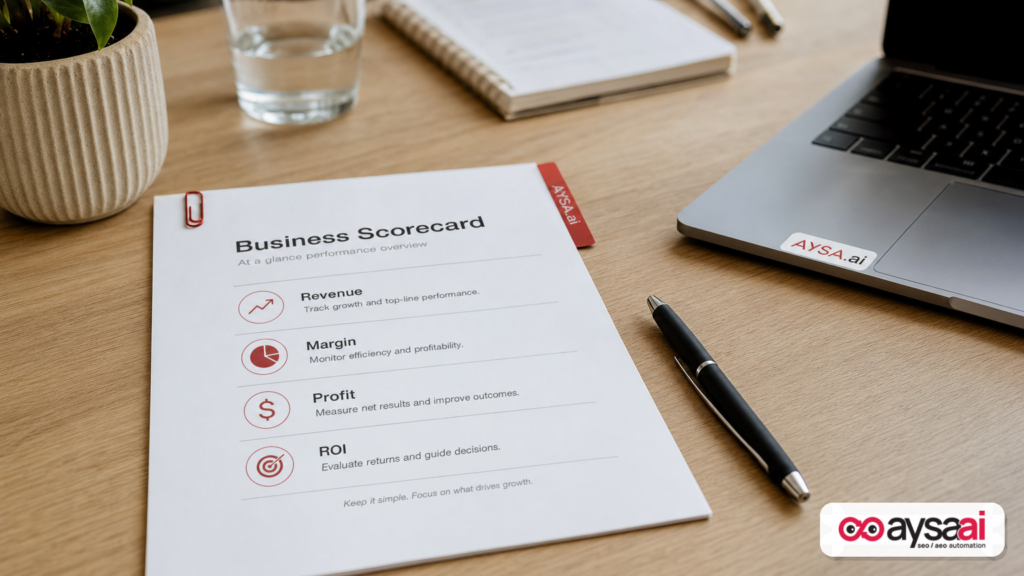
- Define commercial SEO metrics that a CFO won’t argue with
- Demand-side metrics vs. value-side metrics (and why most SEO plans are half-blind)
- A practical prioritization model: Demand × Value × Feasibility
- Stop publishing so much: refresh and re-win your commercial pages
- Internal linking as a margin lever (not a checklist)
- Borrow conversion intelligence from paid search—without starting an SEO vs PPC war
- The “positions 10–20” recovery play: the fastest path to incremental profit
- Digital PR with commercial architecture (links that actually support revenue)
- Branded search protection is a profit problem
- Attribution: choose a model you can run for a year
- Make budget a lever, not a constraint: how to manage SEO like an investment
- Concrete SME scenario: an ecommerce brand that fixes profit leaks with commercial SEO
- What agencies should rethink (or they’ll keep getting replaced by internal teams + automation)
- Where AYSA fits: monitoring → preparation → approval → execution
- What to do next (action list)
- Sources and further reading
What changed: SEO craft improved, commercial accountability lagged

We’re in a phase where SEO is simultaneously more advanced and more misunderstood than ever.
Advanced, because the industry now has mature approaches to technical hygiene, content engineering, topical authority, and scalable workflows. Misunderstood, because the way many SEO teams communicate value hasn’t kept pace with how businesses make decisions.
As Search Engine Land put it in a recent piece on making SEO strategies more commercially aware, SEO has become excellent at the craft but often fails to connect that craft to financial realities like revenue, profitability, and ROI. That gap doesn’t just cause “bad reporting.” It changes who wins internally: the teams that can explain outcomes get budget; the teams that can’t get deprioritized. (Source)
At the same time, search itself is shifting. AI-mediated experiences (think AI Overviews and AI Mode-style interfaces) can reduce traditional click patterns, complicate attribution, and push more decision-making into the results page. You don’t need panic. You need a strategy that is resilient because it is commercial, measurable, and executable.
The real reason SEO budgets get stuck (and it’s not that leadership “doesn’t get SEO”)
When an SEO program struggles to get funding, the default explanation is: “Leadership doesn’t understand SEO.” That’s comforting—and often wrong.
Leadership understands one thing extremely well: trade-offs. If they invest $X here, they can’t invest $X there. In that world, channels compete on clarity.
Paid search has clarity. You spend money, you see revenue, you decide whether to increase or decrease spend. Even when it’s inefficient, it’s legible. Organic search often isn’t.
Many SEO roadmaps are built around:
- Ranking improvements (sometimes for terms that don’t convert)
- Traffic growth (sometimes from audiences that never buy)
- Technical work (sometimes valuable, sometimes performative)
None of those are inherently bad. The problem is presenting them as the outcome rather than as the mechanism.
Commercial leaders want to answer:
- What does organic contribute to revenue?
- What does organic contribute to profit?
- What does it cost to run the channel (people, tools, content, PR)?
- What’s the ROI relative to alternatives?
If SEO can’t answer those questions with a straight face, it becomes politically weak. Not because it’s unimportant—but because it’s not accountable.
What “commercially aware SEO” actually means
Commercially aware SEO is a discipline of making organic decisions the way a business would make any other investment decision.
That requires two shifts:
1) Change the questions you ask before you plan work
Classic SEO questions sound like:
- Which keywords have the highest search volume?
- Which topics are easiest to rank for?
- Where can we publish more content?
Commercial SEO questions sound like:
- Which categories, services, or plans have the strongest margins?
- Which pages would create meaningful profit if they moved up 3–5 positions?
- Which customer segments stay profitable over time?
- Which “organic wins” reduce paid dependency or protect margin?
2) Redefine success in business terms
SEO teams often celebrate “more Impressions” or “more clicks.” Businesses celebrate “more cash” and “more durable advantage.” Commercial SEO translates organic work into those outcomes.
That doesn’t mean every blog post needs to convert this week. It means every major initiative has a credible path to commercial value—and the program is managed to maximize that value over time.
Define commercial SEO metrics that a CFO won’t argue with
You don’t need exotic measurement. You need alignment.
The Search Engine Land article emphasizes prioritizing SEO using business metrics such as revenue, profitability, and ROI—not just demand-side SEO metrics. (Source)
Here is a practical set of metrics that can make organic search “finance-readable”:
Core commercial metrics
- Organic revenue: Revenue from sessions attributed to organic search under your agreed model.
- Organic orders / sales: Count of transactions from organic sessions.
- Organic gross margin dollars: Organic revenue × gross margin rate (by product/category if possible).
- Organic contribution margin (optional): After variable costs (shipping subsidies, payment fees, returns allowance).
- Organic profit: Margin dollars minus channel costs (team, content, tools, PR).
- Organic ROI: (Organic profit ÷ organic channel cost) or (Organic margin dollars ÷ cost), depending on how finance prefers to evaluate.
Supporting metrics (still useful, but secondary)
- Conversion rate by landing page (organic segment)
- Average order value (AOV) from organic sessions
- New vs returning customers from organic
- Assisted conversions (if you use multi-touch reporting)
Why this metric set works internally
Because it answers the budget question directly: “If we invest more in organic, should we expect more profit?”
It also forces healthy behavior. For example, traffic that doesn’t convert stops being celebrated, and high-margin categories stop being ignored just because they have lower search volume.
If you’re an SME and you can’t calculate organic profit precisely yet, start with organic revenue and a simple margin estimate. Imperfect-but-consistent beats “perfect someday.”
Demand-side metrics vs. value-side metrics (and why most SEO plans are half-blind)
Most SEO workflows are built on demand-side inputs:
- Search volume
- Keyword difficulty
- Current rank
- Estimated traffic potential
Demand-side data matters. But it’s only half the story.
Value-side inputs are what turns an SEO strategy into a commercial strategy:
- Margin rate by category/service line
- Average transaction value (or LTV for subscription businesses)
- Refund/return risk by product type
- Operational capacity constraints (can you fulfill increased demand?)
- Strategic importance (e.g., pushing a new line, defending a legacy line)
A classic failure mode: the SEO plan targets the biggest volume keywords in the category… but the business makes its profit elsewhere. Your SEO team “wins” and your CFO still says no to budget because profit didn’t move.
Commercial SEO fixes the blindness by requiring value-side inputs in every prioritization decision.
A practical prioritization model: Demand × Value × Feasibility
Here’s a model I recommend for SMEs and agencies because it’s simple enough to run every month.
The DVF scoring approach
Score each opportunity (page, cluster, category) on three axes:
- Demand: search interest + SERP click potential + your current position
- Value: margin dollars, AOV/LTV, strategic importance, conversion rate potential
- Feasibility: effort, dependency (dev/design/legal), time-to-impact, authority gap
Then prioritize the intersection: strong demand, strong value, and feasible execution.
What this model prevents
- Content spam: publishing because “we need more top-of-funnel.”
- Ranking theater: celebrating movement on keywords that don’t affect profit.
- Over-engineering: months of technical projects with unclear commercial upside.
What about low-demand, high-value categories?
These can still be great bets. If margins are high, even modest traffic can outperform bigger categories. The key is not to confuse volume with value. Commercial SEO is comfortable making that distinction.
Stop publishing so much: refresh and re-win your commercial pages
If your site is older than 12 months, you almost certainly have pages that used to perform and now don’t.
This is one of the most predictable commercial leaks in organic search: commercial page decay. Competitors improve their pages, SERPs evolve, and your once-good content becomes “fine.” Fine doesn’t rank.
The Search Engine Land piece emphasizes updating commercial pages instead of only creating new content, using competitor research, clearer structure, and internal linking. (Source)
A commercial page refresh playbook (what to actually change)
Refreshing pages isn’t “add 500 words.” It’s rebuilding the page to compete for both rankings and conversions.
- Reconfirm intent: What is the user trying to decide? Compare? Buy? Book? Get a quote?
- Upgrade structure: Use clear sections that match decision steps (options, pricing factors, delivery/availability, FAQs, policies).
- Add extractable formats: Tables and bullet lists are easier for search systems and AI interfaces to parse and summarize.
- Close competitor gaps: If top-ranking pages answer questions you ignore, you’re choosing to lose.
- Strengthen internal linking: Move authority from informational pages to high-value commercial pages.
- Improve conversion friction: Make the next step obvious (book, buy, call) and reduce “confidence gaps.”
In a commercial SEO program, page refreshes are often the first test because they can create measurable impact without waiting for brand-new pages to earn trust.
Internal linking as a margin lever (not a checklist)
Internal linking is one of the most underpriced levers in SEO because it’s fully under your control and scales across the site.
But commercial SEO makes internal linking more deliberate.
A commercial internal linking strategy
- Identify your commercial clusters (categories, services, money pages).
- Identify your authority assets (guides, comparisons, tools, evergreen content) that earn links and visibility.
- Build internal pathways from authority assets to commercial clusters with context-rich anchor text and logical placement.
- Make navigation support the same architecture (not fight it).
The goal is simple: when your site earns attention and authority, you want that benefit to flow to the pages that generate profit.
This is especially useful for SMEs that can’t outspend competitors on digital PR or content volume. If you can’t win on sheer scale, you can win on distribution of authority.
Borrow conversion intelligence from paid search—without starting an SEO vs PPC war
Too many companies treat SEO and PPC like rival tribes. That debate is unproductive; both channels exist to acquire customers, and they often amplify each other.
Search Engine Land has separately argued the SEO vs PPC debate is “finally over,” reflecting the industry direction toward integrated search strategies. (Related context)
Commercial SEO can use paid search as a conversion lab.
Why paid data helps SEO
Organic keyword-to-conversion visibility is limited. You can see landing pages and queries in Google Search Console, but conversion by query is often incomplete or indirect. Paid search, however, provides a tighter loop between query intent and conversion outcomes.
What you can do:
- Pull the last 30–90 days of PPC search term data (adjust for seasonality where relevant).
- Identify terms that correlate with high-quality conversions (not just leads).
- Map those terms to organic landing pages and prioritize the pages that can capture similar intent.
This doesn’t require you to turn SEO into PPC. It’s simply using the clearest intent data you already have.
The “positions 10–20” recovery play: the fastest path to incremental profit
If you need a practical place to start, start here.
For many businesses, a meaningful set of transactional queries sits just outside the first page of results. You’re “in the conversation,” but you’re not capturing the click share that produces revenue.
Why this works faster than net-new content
- The page likely already exists.
- Google already associates you with the topic.
- Small improvements (structure, intent match, internal links) can move you into the click zone.
What to change for 10–20 recovery
- Refresh on-page content to match current SERP expectations.
- Strengthen internal linking from relevant authority pages.
- Improve snippets by making key answers and differentiators explicit (FAQs, comparisons, pricing factors).
- If appropriate, build a small amount of external authority to the cluster (not random links).
This is a commercially mature tactic because it targets pages with known demand and existing relevance, often producing a better time-to-impact profile.
Digital PR with commercial architecture (links that actually support revenue)
Digital PR can be powerful, but many campaigns are built as link-chasing exercises: earn coverage, get links, celebrate domain metrics.
The commercial problem: links are not the outcome. Profit is.
The Search Engine Land source recommends building PR campaigns with a deliberate “commercial architecture”: campaigns should be thematically aligned to the categories you care about and should route authority toward commercial clusters via internal linking. (Source)
What commercial PR architecture looks like
- Pick PR topics that connect naturally to profitable categories (not just “viral” ideas).
- Create an on-site campaign asset that is legitimately useful and can earn citations.
- Internally link from that asset to the relevant commercial cluster using logical pathways.
- Measure impact beyond links: movement of commercial pages, assisted conversions, and branded demand lift.
If you’re an SME, this approach helps you avoid spending on PR that looks good in marketing reports but doesn’t change your financial outcomes.
Branded search protection is a profit problem
Branded search is often the highest-converting intent you will ever see. When other parties (affiliates, coupon sites, resellers) intercept that demand, your margins can quietly erode.
The Search Engine Land article frames this correctly: if you pay commissions to affiliates for customers who were already likely to buy directly, you’re paying an avoidable acquisition cost. That’s not just a “marketing annoyance.” It’s a profit leak. (Source)
How to defend branded intent (without drama)
- Create or improve on-site pages that satisfy branded modifiers (brand + “discount”, brand + “reviews”, brand + “pricing”, brand + “returns”).
- Strengthen internal linking and navigational signals to those pages.
- Monitor branded click share and SERP composition regularly.
- Enforce affiliate program terms and paid bidding policies (this is operational, not theoretical).
If you do this well, you protect both conversion rate and margin.
Attribution: choose a model you can run for a year
Attribution is where commercial SEO often collapses—because teams chase a “perfect” model and end up with no model leadership trusts.
Organic traffic can be misclassified as direct, analytics tools disagree, and multi-touch journeys are messy. The Search Engine Land source advises choosing an attribution model the organization can agree on, being transparent about limitations, and then focusing on improving the revenue attributed to organic under that model. That is the right pragmatic posture. (Source)
Practical attribution options for SMEs
- Last non-direct click: common, simple, imperfect, often acceptable.
- Data-driven attribution (where available): can be useful but may be less transparent to stakeholders.
- Blended reporting: show both last-click revenue and assisted/contribution views.
The rule: stability beats sophistication
Pick a model, document it, keep it stable for long enough to manage the channel. When the goalposts move every quarter, SEO becomes impossible to govern commercially.
Make budget a lever, not a constraint: how to manage SEO like an investment
The healthiest way to think about SEO budget is not “how little can we spend?” but “how much can we invest profitably?”
Commercial SEO can be managed with a simple equation:
- Organic profit = (organic margin dollars) − (SEO program cost)
When leadership sees this, budget becomes a lever:
- If the business needs growth, invest more in content, digital PR, and execution velocity.
- If the business needs near-term profitability, control costs while protecting the most valuable rankings and pages.
This framing also makes SEO a peer to paid media. Paid search leaders talk in unit economics. SEO should too.
Winning CFO conversations (without buzzwords)
Search Engine Land has a separate piece on winning SEO budget conversations with a CFO. It’s worth reading because it reinforces the same idea: speak in financial outcomes. (Related context)
My practical advice for those conversations:
- Bring a one-page model: current organic revenue, margin estimate, program costs, ROI.
- Propose a test: a contained initiative with measurable commercial KPIs.
- Show competitive risk: where competitors outrank you on high-value terms.
- Commit to reporting cadence and governance, not vague promises.
Concrete SME scenario: an ecommerce brand that fixes profit leaks with commercial SEO
Let’s make this real with a scenario that looks like thousands of SMEs.
The business
A mid-sized ecommerce store sells home fitness accessories. They have:
- Hundreds of SKUs
- Strong seasonality (New Year spike)
- A mix of high-margin accessories and lower-margin bulky items
Their marketing reports say:
- “Organic traffic is up 18% YoY.”
- “We published 40 blog posts this quarter.”
But the CFO says:
- “Profit is flat.”
- “We’re paying more in ads to hit the same revenue.”
Commercial diagnosis
- The blog content is pulling traffic for informational queries with low purchase intent.
- High-margin accessory categories sit in positions 11–16 for valuable terms.
- Affiliate coupon pages rank for branded “discount” queries, siphoning margin.
- Internal links from the best-performing guides don’t point to the highest-margin collections.
Commercial SEO plan (90 days)
- Set commercial KPIs: organic revenue, organic margin dollars, ROI (with a documented attribution model).
- Refresh 10 high-margin collection pages: restructure content, add comparison tables, clarify shipping/returns, add FAQs.
- Internal linking sprint: link from top guides and blog posts to those 10 collections using relevant anchor text and placements.
- Branded protection: build/upgrade on-site “discount/pricing” pages; tighten affiliate policy enforcement.
- Paid intelligence: pull PPC search term insights to identify conversion-heavy modifiers and incorporate them into page sections and FAQs.
What success looks like
Not “we published more.” Success is:
- More margin dollars from organic
- Improved positions for high-value terms (as a leading indicator)
- Reduced commission leakage on branded traffic
- A repeatable operating cadence the CFO can trust
This is how you turn SEO from “content production” into “profit production.”
What agencies should rethink (or they’ll keep getting replaced by internal teams + automation)
Agencies are under pressure from two directions:
- Clients want commercial accountability (not vanity metrics).
- Execution is getting automated, and in-house teams can often manage vendors more tightly.
To stay valuable, agencies need to change what they sell.
Stop selling “SEO tasks,” sell commercial operating systems
Task lists are easy to copy. Systems are harder.
Commercial agency deliverables should look like:
- A monthly DVF-prioritized backlog tied to margin categories
- Revenue and margin reporting, with attribution assumptions documented
- Cross-channel insight integration (paid search terms, merchandising, CRM)
- Execution governance: what changes are proposed, approved, shipped, and validated
The agency execution gap
Even the best strategy fails if execution is slow. Agencies often get stuck waiting on approvals, dev resources, or CMS access. Meanwhile competitors ship.
This is why the future belongs to models that reduce the strategy-to-implementation delay—while keeping human approval in the loop.
Where AYSA fits: monitoring → preparation → approval → execution
Commercial SEO breaks when reality hits:
- Pages decay faster than teams refresh them
- Technical issues recur
- Competitors ship weekly
- Approvals take longer than the market
AYSA.ai is designed for that reality: an SEO/AEO/GEO execution system that monitors what’s happening, prepares the updates that matter, asks for approval, and then executes accepted website changes.
1) Monitoring that’s commercial, not just technical
Most monitoring tells you what changed. Commercial monitoring helps you see what changed that matters.
Start here:
- AYSA Monitoring to track site changes, performance signals, and issues that can affect visibility and outcomes.
- Pair that with your revenue/margin reporting so “visibility drops” are translated into “risk to profit.”
2) Visibility across classic search and AI-mediated discovery
As AI-driven interfaces change click behavior, businesses need to understand where they appear—and where they don’t—across more surfaces.
- AI search visibility is part of the broader picture of modern discoverability.
3) Tools that support execution, not tool collecting
SMEs don’t need 14 disconnected platforms. They need a workflow that produces shipped improvements.
- Explore AYSA AI SEO tools as part of an execution-first stack.
4) Approved execution: speed with governance
Commercial SEO demands velocity, but businesses also need control—especially on pages that affect pricing, claims, or compliance.
That’s why the model matters: prepare changes, request approval, then execute only what’s accepted. It’s a way to move fast without letting automation freeload on your brand risk.
How to start with AYSA in a commercial SEO program
- Start with monitoring and a prioritized backlog tied to margin categories.
- Run one contained 30–60 day test: commercial page refresh + internal linking.
- Review outcomes and expand scope as ROI proves out.
- For pricing and plan options, see AYSA Pricing.
- For more operating guidance, browse the AYSA blog.
What to do next (action list)
If you want your SEO strategy to be commercially aware, do these in order:
- Pick your commercial definition of success: organic revenue + margin estimate + program cost + ROI.
- Agree on attribution with leadership (document assumptions; don’t chase perfection).
- Build a value map: margin by category/service, AOV/LTV, operational constraints.
- Run DVF prioritization: demand × value × feasibility for your top 50 opportunities.
- Execute a contained test: refresh 5–15 commercial pages and do a focused internal linking sprint.
- Defend branded SERPs where margin leakage exists (coupon/affiliate interception, resellers).
- Use paid search as an intent lab: extract high-converting patterns and feed organic priorities.
- Instrument reporting so every month you can answer: “What profit did organic drive, and what did it cost?”
- Close the execution gap with an approval-based workflow so improvements actually ship.
Sources and further reading
- Search Engine Land: How to make your SEO strategy more commercially aware
- Search Engine Land: How to win SEO budget conversations with your CFO
- Search Engine Land: Why the SEO vs. PPC debate is finally over
- Search Engine Land: How to move beyond lead volume in B2B PPC
- Search Engine Land: Google clarifies canonicalization fixes can take up to two weeks to resolve
- Search Engine Land: 4 types of content decay and how to fix each one
- Search Engine Land: Google is AI Mode’s No. 2 most-cited domain: Report
Note: This editorial references additional topics (AI-mediated search, attribution challenges) as analysis based on industry direction; if you need primary documentation for a specific feature or measurement method, validate with your analytics documentation and internal finance definitions before locking reporting.
Continue the AI search topic inside AYSA.
Use these pages to connect the article with AI SEO tools, AI visibility monitoring, AI Overviews and approved website execution.
Turn this topic into a website action plan.
Use these AYSA hubs to move from reading to technical fixes, AI visibility monitoring, research, glossary context and approval-first SEO execution.