
Next-Question Intent: The New Content Standard for AI Search Visibility (and How to Execute It at Scale)
In AI search, it’s not enough to “answer the query.” Visibility increasingly goes to the pages that help people make the next decision. Here’s how to map next-question intent, turn it into decision-ready content, and operationalize updates with approved execution using AYSA.

AI Search is forcing a hard reset on what “good content” means. In classic SEO, you could win by matching the query better than the next page. In AI-driven experiences—like Google’s AI Overviews and other synthesized answer interfaces—visibility increasingly goes to content that helps someone make the next decision, not just understand the topic.
This editorial is my practical take (Marius Dosinescu, AYSA.ai) on a concept that Search Engine Land recently framed well as next-Question intent: the follow-up questions people ask once they’ve opened the door with an initial search. If your pages don’t support those follow-ups, you may still “rank,” but your brand becomes less useful to the system assembling the answer—and less persuasive to the human reading it.
Primary research inspiration: Search Engine Land: Why next-question intent matters for AI search visibility.
Concise summary
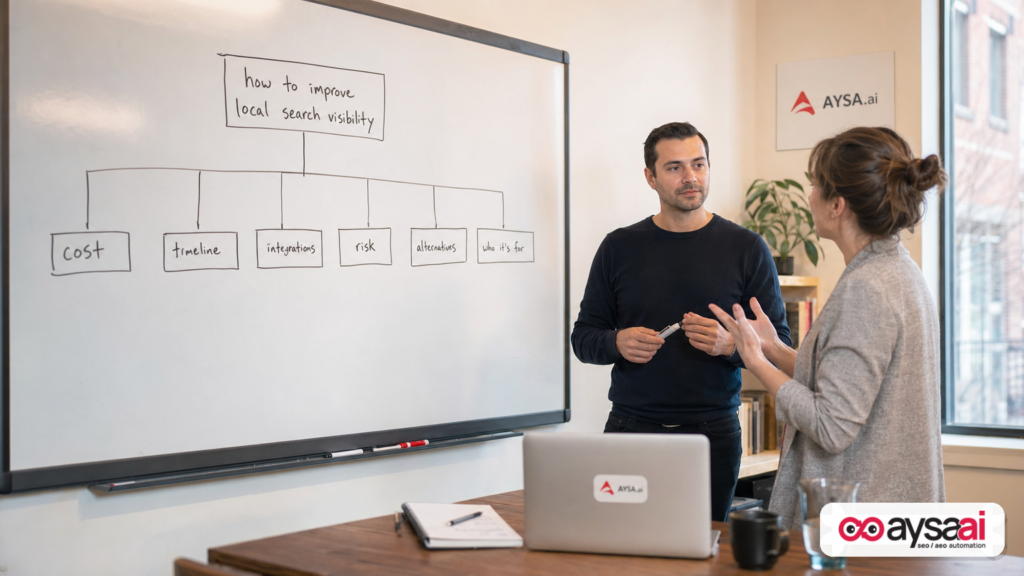
Next-question intent is a content standard: answer the query and provide the decision-critical context that comes right after (constraints, comparisons, objections, proof, and “is this for me?”). In AI search, that context is what makes your page “answer-ready”—and more likely to be cited, summarized, or recommended.
Key takeaways (read this if you’re busy)

- AI search is less about blue links and more about assembled answers. Pages that don’t contain decision-ready details are easier to ignore.
- Next-question intent is not “write more.” It’s “write what buyers/users ask next,” using specific, verifiable, extractable details.
- Generic claims are visibility debt. Phrases like “custom,” “best-in-class,” or “for small businesses” create ambiguity for humans and AI alike.
- Your best inputs aren’t Keyword tools—they’re your business conversations. Sales calls, support tickets, returns, reviews, and onsite search logs reveal the real decision path.
- Execution is the moat. Most teams can identify what to improve; fewer can ship improvements weekly with governance. That’s where AYSA’s Approved Execution loop matters.
Table of contents

- What “next-question intent” actually is (and what it is not)
- What changed in search: from ranked links to synthesized answers
- Why “I answered the query” is no longer enough
- Where most content goes thin (and how to spot it fast)
- How to audit pages for next-question intent
- The decision assets AI and humans both need
- A practical SME scenario: the local clinic that “answers” but doesn’t convert
- Next-question patterns by industry (local, ecommerce, SaaS, agencies, publishers)
- How to write decision-ready sections (templates you can steal)
- How to measure progress when clicks get messy
- How to operationalize next-question intent with AYSA: monitor → prepare → approve → execute
- What to do next (action list)
- Sources and further reading
What “next-question intent” actually is (and what it is not)
Search intent asks: “What is the user trying to do right now?”
Next-question intent asks: “What will the user need to know next to confidently decide, compare, buy, book, or act?”
This is not a semantic trick. It’s a practical test: does your page provide enough context for a real person to keep moving without opening five more tabs?
It’s also not an excuse to inflate pages with endless FAQs. The goal is decision coverage, not word count for its own sake. A decision-ready page anticipates the most common constraints and objections and answers them with specifics—so both humans and AI systems can reuse that information accurately.
My rule of thumb: if a page can’t help a customer self-qualify (“Is this for me?”), it’s not ready for AI-first discovery.
What changed in search: from ranked links to synthesized answers
Traditional search is built around a results page: a list of ranked links that users scan and interpret. Your job was to win the click by being relevant, credible, and compelling.
AI search experiences increasingly provide synthesized answers—summaries drawn from multiple sources. That changes the competitive unit from “my page vs your page” to “my content fragments vs your content fragments.”
When systems summarize, they need content that is:
- Extractable (clear statements rather than fluffy claims)
- Comparable (details that allow trade-offs)
- Contextual (who it’s for, when it’s not, what to consider)
- Trust-supporting (evidence, policies, credentials, limitations)
Search Engine Land’s framing is directionally right: visibility is no longer just being found. It’s being usable once found. See the original piece here: Why next-question intent matters for AI search visibility.
And this doesn’t happen in a vacuum. The same publication has been tracking how AI experiences cite and recommend content, including:
- Google AI Overviews cite self-serving listicles, but recommend competitors 69% of the time (a useful reminder: even if you publish “best X” content, AI may still recommend someone else)
- USA Today vs. Google AI Overviews: A World Cup battle for breaking news traffic (publishers are feeling the shift first)
- Pew: 60% of Americans read AI summaries in search results (behavioral adoption changes the funnel even before you measure it cleanly)
Even if you don’t agree with every conclusion in those pieces, they point to the same operating reality: more users will consume answers inside search, and fewer will click through unless the experience compels them or the question requires deeper action.
Why “I answered the query” is no longer enough
Many businesses still build pages like this:
- Definition of the service/product
- A few benefits
- A generic CTA (“Contact us”)
- Optional FAQ (often copied from sales scripts, not decision logic)
That can still rank. But it often fails the “next decision” test. The user’s real journey isn’t just “what is X?” It’s:
- Is X right for my situation?
- What will it cost (and what changes the cost)?
- How long will it take?
- What are the risks and trade-offs?
- How does it compare to Y?
- What proof exists that this works?
In classic search, users could stitch those answers together across multiple sites. In AI search, the system tries to stitch them together for the user. If your site doesn’t contain the needed details, you become easier to omit from the assembled narrative.
Where most content goes thin (and how to spot it fast)
Most pages aren’t “bad.” They’re incomplete in ways that matter to decision-making. Here are the most common thin spots I see in SME and mid-market sites:
1) Over-broad positioning
“Built for small businesses.” “Perfect for teams.” “For any industry.”
These phrases attempt to increase total addressable market, but they reduce clarity. A better approach is to define primary fit and non-fit.
2) Benefits without mechanisms
“Increase revenue.” “Save time.” “Improve visibility.”
How, specifically? What actions, what inputs, what outputs? AI systems and skeptical buyers both need mechanisms, not slogans.
3) Proof without verification hooks
Vague “trusted by” claims, testimonials without context, or case studies that skip constraints (“we grew traffic”) but not the conditions (budget, timeframe, baseline).
4) Missing comparison logic
If you don’t explain how you differ from alternatives, the AI answer will do it for you—and it may not do it in your favor.
5) Hidden constraints
Implementation time, minimum contract length, geographic limitations, excluded services, inventory realities, eligibility rules—often omitted because teams fear “friction.”
But here’s the truth: friction doesn’t disappear. It just appears later, after wasted calls, refunds, bad reviews, or churn. Next-question content moves that friction to the right place—before the buyer commits.
How to audit pages for next-question intent
You can run a next-question audit without new tools. You need honesty, customer data, and a structured checklist.
Step 1: Define the page’s “job”
- What decision is this page trying to support?
- What would “success” look like (call, booking, add-to-cart, demo request)?
- What is the target persona’s context (budget, urgency, sophistication, risk tolerance)?
Step 2: List the next five questions
Do this with input from sales/support, not just marketing. For each page, write the next five questions a serious buyer asks.
Examples for “best CRM for small business” might include:
- Does it integrate with QuickBooks?
- How hard is setup with a two-person team?
- What does it cost after year one?
- What happens if we outgrow it?
- Is there a simple mobile workflow?
Step 3: Identify blockers (objections) and qualifiers
- What would stop the buyer from acting?
- What risk are they worried about?
- What would make them say “this isn’t for me”?
Step 4: Add proof requirements
- What evidence would make this believable?
- What policies reduce risk (returns, guarantees, cancellations, data handling)?
- What credentials matter (licenses, certifications, experience)?
Step 5: Fix vague language
Circle every broad claim (“custom,” “affordable,” “fast,” “secure,” “eco-friendly”) and force it into specifics: what does it mean, what are the boundaries, what can a buyer expect?
Where to find the real next questions
Keyword tools help, but the best insights often come from:
- Sales call notes and demo recordings
- Support tickets and chat transcripts
- Returns reasons and negative reviews
- Internal site search terms
- Competitor comparisons your prospects bring up unprompted
These are “decision artifacts,” and they translate directly into content sections.
The decision assets AI and humans both need
Think in terms of assets that can be extracted and reused in summaries, comparisons, and recommendations. Here are the highest-leverage assets to build:
1) Fit / not-fit statements
Fit: “This is best for…”
Not fit: “This is not ideal if…”
This reduces wasted leads and increases trust.
2) Constraints and ranges (not just “pricing”)
Most SMEs avoid pricing because it’s variable. Fine—publish ranges and the variables that move them.
- “Typical projects range from…”
- “Costs increase when…”
- “If you need X, expect Y.”
3) Timelines and what affects them
Time is a decision factor in almost every industry: shipping, installation, onboarding, recovery, hiring, deployment.
4) Comparisons and alternatives
Not trash-talking—honest trade-offs. If you won’t do it, the market (and AI) will do it for you.
5) Proof blocks
Case studies, certifications, methodology, process steps, “what happens after you book,” and references to reputable guidance where appropriate.
6) Safety and compliance details for higher-trust categories
In medical, legal, finance, and other sensitive areas, decision readiness depends on scope, credentials, and when to talk to a qualified professional. Be careful not to overpromise, and ensure content is reviewed appropriately.
A practical SME scenario: the local clinic that “answers” but doesn’t convert
Let’s make this concrete. Imagine a local clinic offering a popular service (say, a recurring treatment). Their page ranks for “treatment near me” and “what is treatment X,” but bookings are flat.
The page answers the initial query: what it is, a few benefits, and a “Book now” button. But the phone lines tell the truth. Every day, staff answer the next questions:
- Who is eligible?
- Is it safe for people with condition Y?
- How many sessions do I need?
- What does it cost if insurance doesn’t cover it?
- What are the side effects and downtime?
- How soon can I be seen?
If those answers aren’t on the page, the clinic forces visitors into a higher-effort path (call, wait, ask) and makes AI summaries weaker or less likely to cite them. A competitor with clearer eligibility, pricing ranges, and appointment windows becomes the easier recommendation.
This is next-question intent in the wild: your staff already knows what to publish. The website just hasn’t caught up.
Next-question patterns by industry (local, ecommerce, SaaS, agencies, publishers)
Next-question intent isn’t one-size-fits-all. The follow-ups differ by business model and risk level.
Local services (HVAC, plumbers, electricians, dentists, clinics)
- Service area boundaries
- Emergency availability and response windows
- Pricing ranges and what changes them
- Licensing, insurance, and guarantees
- What happens after booking (arrival, preparation, cleanup)
Ecommerce
- Fit guidance (sizing, compatibility, “works with…”)—and non-fit
- Shipping speed by region, cutoffs, backorder rules
- Return policy clarity, warranty terms, repair process
- Comparisons across models (A vs B)
- Materials, safety, care instructions, lifecycle details
B2B SaaS
- Integrations and data migration
- Implementation timelines and roles required
- Security posture (high-level, verifiable statements)
- Pricing logic (seats, usage, tiers) and expansion costs
- Support model and SLAs (where applicable)
Agencies and professional services
- Who you’re best for (industry, maturity, budget level)
- What you don’t do (and why)
- Process: from kickoff to reporting to outcomes
- What clients must provide to succeed
- How you measure success beyond vanity metrics
Publishers and content businesses
Your next question is often: “What’s the action?” If the article answers a question but omits the next step—tools, checklists, thresholds, examples, cautions—it becomes summary fodder rather than a destination.
Search Engine Land has also covered how these changes affect the broader search ecosystem and workflows, such as how AI merges paid and organic visibility (How AI is merging paid and organic visibility) and what replaces the “ultimate guide” in AI search (What replaces the ultimate guide in AI search). Even if you’re not a publisher, the same lesson applies: the format that worked for ranking isn’t always the format that wins in AI-mediated discovery.
How to write decision-ready sections (templates you can steal)
Below are content blocks I recommend for most money pages. You won’t need all of them everywhere, but you’ll almost always need some.
Template 1: “Best for / Not for” (self-qualification)
- Best for: [specific segment + condition + desired outcome]
- Not ideal for: [segment/condition where results or fit are weaker]
- If you’re unsure: [quick diagnostic checklist]
Template 2: “Pricing range + drivers”
- Typical range: $X–$Y
- Higher when: [driver 1], [driver 2], [driver 3]
- Lower when: [driver 1], [driver 2]
- What’s included: [bullets]
Template 3: “Timeline + what happens next”
- Step 1: [what happens + duration]
- Step 2: [what happens + duration]
- Common delays: [bullets]
- What you need from the customer: [bullets]
Template 4: “Alternatives and trade-offs”
Write this like a buyer’s guide, not a takedown.
- Alternative A is better if…
- We’re better if…
- Consider both if…
Template 5: “Proof block”
- Case study (with constraints, timeframe, baseline)
- Credentials and experience
- Method or process snapshot
- Policies (returns, cancellations, guarantees) that reduce risk
Notice what’s missing from these templates: empty adjectives. The game is clarity, not cleverness.
How to measure progress when clicks get messy
In AI-mediated search, your measurement stack will feel less stable—especially if more users consume summaries without clicking through.
So what should you measure?
1) Lead quality and conversion efficiency
If next-question content is working, you should see:
- More qualified inquiries
- Fewer “basic” questions on calls
- Lower refund/return/churn pressure due to better expectation setting
2) On-page behavior (with caution)
Time on page and scroll depth can be directional, but don’t worship them. Some pages succeed by answering quickly and driving action.
3) Search visibility signals across AI surfaces
We’re early in standardized reporting here. Search Engine Land has noted emerging reporting features, such as Bing’s additions around intents/topics/citation share in Webmaster Tools (Bing Webmaster Tools updates AI reporting with Intents, Topics, Citation Share and Compare). Tools and platforms will evolve, but the direction is clear: visibility will be about more than blue-link rankings.
At AYSA, we treat this as a monitoring problem as much as a content problem: track what pages drive outcomes, where visibility changes, and what competitors publish that answers the next decision step better than you do. (More on that below.)
How to operationalize next-question intent with AYSA: monitor → prepare → approve → execute
Most teams don’t fail because they can’t think of improvements. They fail because improvements don’t ship reliably.
AI search raises the execution bar: the environment changes faster, competitors iterate faster, and the “good enough” page decays faster. This is exactly why we built AYSA as an execution system, not just a reporting layer.
1) Monitor what matters
Start by continuously monitoring your most valuable pages and your category presence:
- Which pages are key conversion paths?
- Where are rankings/visibility shifting?
- Which competitors are publishing decision-ready sections you lack?
AYSA’s monitoring is designed for this operational reality: AYSA Monitoring.
2) Prepare changes that are actually shippable
Next-question intent isn’t a brainstorming exercise; it’s a backlog. AYSA helps prepare proposed changes as concrete updates—new sections, rewritten copy, structured improvements—so the next step is a decision, not more meetings.
Explore our approach to AI SEO tooling and workflows: AI SEO Tools.
3) Ask for approval (governance without paralysis)
Most SMEs and agencies need controls: legal review, brand tone, clinical accuracy, pricing approvals, and so on. AYSA is built around an approved execution model: we prepare recommended updates and ask for explicit approval before applying changes.
4) Execute accepted website changes
This is the part that makes strategy real. If you accept the changes, AYSA executes them—so the site improves continuously rather than quarterly.
If you want the big-picture “why,” start here: AI Search Visibility.
5) Align costs with impact
Execution systems need to be practical for SMEs, not built only for enterprise. Pricing and packaging matter: AYSA Pricing.
And for additional context and playbooks, we publish ongoing guidance here: AYSA Blog.
AYSA perspective: next-question intent is the content moat
My opinion: next-question intent will become the dividing line between brands that are “present” in AI search and brands that are preferred by it.
Why? Because the easiest content to generate is the initial answer. AI can write definitions all day. What AI cannot safely invent (and what users actually need) is the business-specific reality:
- Your constraints
- Your policies
- Your actual process
- Your boundaries and non-fit cases
- Your trade-offs vs alternatives
That’s not “SEO content.” That’s operational truth, published clearly. It’s the hardest thing to fake and the most valuable thing to make extractable.
What to do next (action list)
- Pick 10 pages that matter. Not your blog archive—your money pages and top traffic landing pages.
- For each page, write the next five questions. Use sales/support input and real customer language.
- Add one decision-ready block per page. Fit/not-fit, pricing drivers, timeline, comparisons, proof—choose the one that removes the biggest friction.
- Replace vague claims with specifics. Define “custom,” “fast,” “secure,” “eco-friendly,” “for small business,” etc.
- Create one comparisons page that you can stand behind. “Us vs alternatives” with honest trade-offs.
- Set a cadence. One to three meaningful updates weekly beats a quarterly content sprint.
- Operationalize execution. Use a system (like AYSA) to monitor, prepare updates, route approvals, and execute changes consistently.
Sources and further reading
- Search Engine Land — Why next-question intent matters for AI search visibility
- Search Engine Land — Google AI Overviews cite self-serving listicles, but recommend competitors 69% of the time
- Search Engine Land — Bing Webmaster Tools updates AI reporting with Intents, Topics, Citation Share and Compare
- Search Engine Land — How AI is merging paid and organic visibility
- Search Engine Land — What replaces the ultimate guide in AI search
- Search Engine Land — Pew: 60% of Americans read AI summaries in search results
- Search Engine Land — USA Today vs. Google AI Overviews: A World Cup battle for breaking news traffic
Note on sourcing: The Search Engine Land page references a Pew finding, but the primary Pew URL is not provided in the supplied research context. For that reason, I’m linking to the Search Engine Land coverage rather than asserting additional details beyond what’s cited there.
Continue the AI search topic inside AYSA.
Use these pages to connect the article with AI SEO tools, AI visibility monitoring, AI Overviews and approved website execution.
Turn this topic into a website action plan.
Use these AYSA hubs to move from reading to technical fixes, AI visibility monitoring, research, glossary context and approval-first SEO execution.

