
AI + hreflang at scale: How to turn messy multilingual URLs into reliable XML sitemaps (without losing your mind)
Hreflang is easy in theory and painful in real life—especially when you inherit years of inconsistent slugs, multiple domains, and mixed language folders. Here’s a practical, AI-assisted workflow to build hreflang XML sitemaps at scale, reduce risk, and operationalize ongoing updates with approved execution.

International SEO looks straightforward on a slide: translate pages, add Hreflang, and Google shows the right page to the right person. In production, it’s closer to plumbing. The smallest inconsistency—redirect chains, mismatched slugs, mixed folders, stale canonicals—turns “global growth” into wasted Crawl budget, wrong-language rankings, and duplicated work.
This editorial is my practical take on how to build hreflang XML sitemaps at scale using an AI-assisted workflow—while keeping the process safe, auditable, and sustainable. The spark for this piece was a case study published by Search Engine Land that shows how iterative prompting plus Python in Google Colab can turn a messy multilingual mapping project into a repeatable system. I agree with the core lesson: AI is most valuable when you treat it like a collaborator and keep humans accountable for strategy and QA.
My goal here is to go deeper than “here’s a script.” You’ll get the decision-making framework, the gotchas that break hreflang in real life, and an Execution Plan that SMEs and agencies can actually run. I’ll also explain where AYSA fits: not as a magic button, but as an Approved Execution system that monitors, prepares changes, asks for approval, and ships what you accept—so your hreflang doesn’t rot the moment your site publishes new pages.
Concise summary

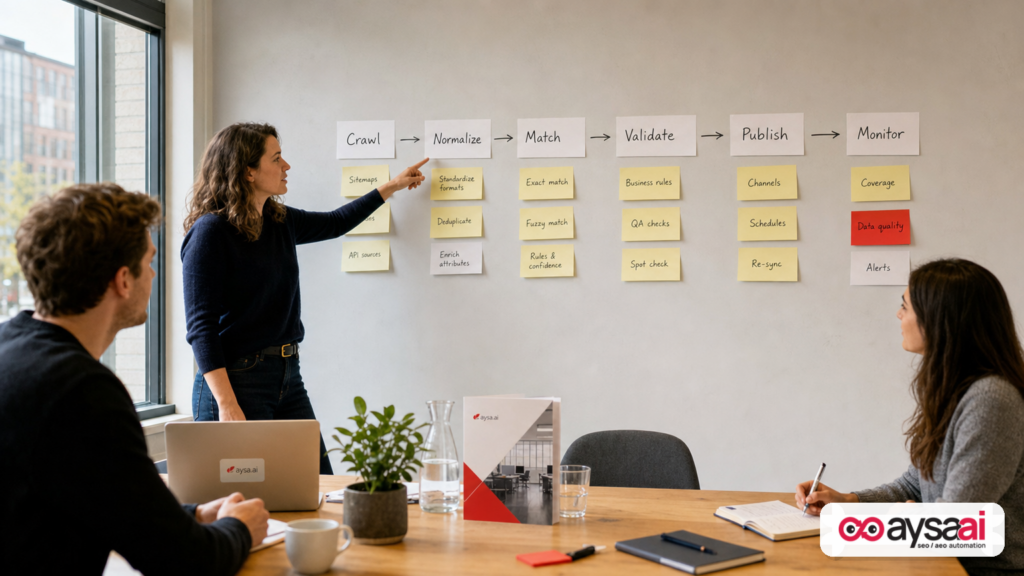
Hreflang isn’t hard because of syntax—it’s hard because you must reliably map equivalent pages across languages and regions. AI can help you normalize URLs, propose matches, and generate XML sitemaps quickly, but only if your inputs are clean and your QA rules are strict. The winning approach is a pipeline: crawl → filter indexable pages → normalize URLs → cluster exact matches → apply cautious fuzzy matching → validate with rules and spot checks → publish and monitor. Businesses should treat hreflang as ongoing infrastructure, not a one-time project.
Key takeaways (read this if you’re busy)
- Hreflang success is mapping success. The technical format (HTML tags vs. XML sitemap) matters less than building correct “equivalence clusters” across markets.
- Garbage in, garbage out is real. If your crawl includes 404s, redirected URLs, canonical conflicts, or non-indexable pages, AI will confidently generate a broken mapping.
- Start with deterministic logic, then add AI. Exact matching and rule-based normalization should handle the majority; AI helps with the messy remainder.
- Fuzzy matching needs guardrails. Without constraints, AI will pair the wrong pages. With overly strict constraints, you’ll get orphan pages. Tuning is iterative.
- Governance beats heroics. The most valuable outcome is a workflow you can rerun monthly/weekly—especially after migrations, reorgs, or translation updates.
- AYSA’s advantage is “approved execution.” Monitoring + prepared change sets + approval gates is how Technical SEO stays correct as your site evolves.
Table of contents

- What changed: AI made technical SEO automation accessible
- Hreflang basics (only the part that matters)
- The real hreflang problem: it’s not the tags, it’s the mapping
- XML sitemap vs. on-page hreflang: how to choose
- A scalable AI-assisted workflow (crawl → normalize → match → validate → publish)
- Data requirements: how to avoid “AI-made nonsense”
- Normalization rules that unlock scale
- Matching strategy: exact first, fuzzy second
- Where AI helps (and where it absolutely doesn’t)
- QA and validation: the checklist that protects revenue
- A concrete SME scenario: a multilingual ecommerce brand
- What agencies should rethink
- How AYSA turns one-off hreflang work into a living system
- What to do next
- Sources and further reading
What changed: AI made technical SEO automation accessible
For a long time, technical SEO automation required one of two things:
- Specialized enterprise tools that were expensive and sometimes rigid, or
- A team member who could write scripts, maintain environments, and debug edge cases.
What’s changed is not that “AI can do SEO,” but that AI can help build the tooling for SEO. That’s the most valuable use case I see for SMEs: not generating content, not replacing strategy—just accelerating operational work that used to take days in spreadsheets.
The Search Engine Land case study is a good example of this shift: an SEO needed to map thousands of URLs across many sites, languages, and even English dialects, then generate hreflang XML sitemaps. They used an AI model (Google Gemini) to iteratively help develop a Python script in Google Colab, improving it as edge cases were discovered and fed back into prompts. Source: How AI helped build hreflang XML sitemaps at scale.
That’s the key: the win wasn’t a single prompt. The win was an iterative loop—crawl, run, audit, refine, rerun—until the automation matched the reality of a human-managed web ecosystem.
Hreflang basics (only the part that matters)
Hreflang is a signal that helps search engines understand which URLs are equivalent versions of the same content for different languages and/or regions. It reduces the chance that the “wrong” version ranks in the “wrong” market.
In practice, it helps with problems like:
- A UK user landing on a US page with the wrong spelling, pricing, shipping info, or legal language.
- A Spanish-speaking user in Mexico getting the Spain (es-ES) version that uses different terms and currency.
- Google treating translated pages as duplicates instead of alternates.
Hreflang isn’t a ranking boost by itself. It’s more like a routing mechanism—an attempt to get the correct page in front of the correct user. And that means the hard part is not outputting tags; the hard part is deciding which pages truly match.
If you want the official reference, Google’s documentation is the safest primary source to use. The Search Engine Land article didn’t include a direct link, so I won’t pretend I pulled it from their page; but in your implementation process, you should cross-check rules against Google’s own hreflang documentation before publishing.
The real hreflang problem: it’s not the tags, it’s the mapping
When hreflang fails, it’s rarely because someone typed the wrong attribute name. It fails because the underlying website is messy in ways that feel normal to humans:
- Different teams wrote slugs over years (“/about-us/” vs “/company/”).
- Blog restructures happened in one market but not another (folders added/removed).
- Translation isn’t one-to-one: titles change, idioms change, and product naming evolves.
- Regional teams add “2024” or “2025” to URLs independently.
- Some markets are missing pages entirely, or replaced them with different local content.
At a small scale, you can brute-force mapping in a spreadsheet. At scale, spreadsheets become a liability: slow, error-prone, hard to rerun, and usually detached from what’s actually live on the site.
This is why the most important concept is the hreflang cluster: a set of URLs that represent the same intent and should be treated as alternates. Your job is to build those clusters consistently and defensibly.
XML sitemap vs. on-page hreflang: how to choose
You can implement hreflang using:
- On-page tags in the HTML head, or
- XML sitemaps that declare alternates.
Both can work. The format choice is usually an operational decision, not a philosophical one.
When XML sitemaps are often the right call
- You have a lot of URLs and you need a centralized place to manage alternates.
- Your CMS makes it hard to inject correct hreflang tags across templates.
- You want to regenerate and republish hreflang as a repeatable job.
When on-page tags can be simpler
- You have a smaller site, fewer languages, and consistent templates.
- Your pages are created from a structured translation workflow where every page has a clear “parent” and “children.”
In the Search Engine Land example, scale and inconsistency pushed the project toward an automation-first approach using XML sitemaps and a scriptable pipeline. That’s typical when you inherit multiple regional sites with divergent architecture.
A scalable AI-assisted workflow (crawl → normalize → match → validate → publish)
Here’s the workflow I recommend if you want something you can rerun and improve over time. It aligns with the approach described in the Search Engine Land case study (crawl, process in Python/Colab, match, iterate), but expands the operational detail and governance.
Step 1: Crawl each market and build a unified dataset
You need a list of live URLs per domain/subfolder, along with metadata that helps match pages:
- URL
- Status code
- Canonical URL (if you can extract it)
- Title tag
- H1
- Indexability signals (noindex, robots blocked, etc.)
The source example used Screaming Frog to collect this data, then exported to CSV. That’s a practical approach because it reflects what’s actually accessible to crawlers, not what your CMS thinks exists. (Source context: the Search Engine Land article explicitly cites Screaming Frog for crawling and CSV export.)
Step 2: Filter to indexable, canonical, final URLs
This is where most “AI automation” projects go wrong: they feed AI a dump of everything and hope the model sorts it out.
Before matching, remove or handle:
- 4xx pages
- 5xx pages
- Non-canonical URLs (where the canonical points elsewhere)
- URLs that only redirect (unless you purposely resolve redirects to final destinations)
- Noindex pages (usually excluded unless you have a specific reason)
The Search Engine Land piece calls this out clearly: if your dataset includes 404s or redirects, “exact match” mapping can fail and the automation will produce incorrect clusters. That principle is evergreen: clean inputs create clean outputs.
Step 3: Normalize URLs (make them comparable)
Normalization means transforming URLs into a standardized representation so that matching logic can operate reliably. Examples include:
- Removing trailing slashes consistently
- Lowercasing paths (where safe)
- Stripping tracking parameters
- Removing date suffixes like “-2023” or “/2024/” if that’s a known pattern
- Flattening folders that changed between markets (e.g., “/blog/industry/slug” → “/blog/slug”)
The case study highlights a “directory flattening problem” where one market reorganized its blog into topical folders while others did not. The solution was a behind-the-scenes URL flattener so matching could focus on the slug identity rather than the folder structure. That’s the kind of real-world nuance that makes automation worth it—because it’s tedious to handle manually, but it’s consistent once encoded.
Step 4: Build clusters in layers (deterministic first)
Don’t start with AI fuzzy matching. Start with what’s provable:
- Exact match clustering: group URLs that share the same normalized slug pattern across markets.
- Near-exact rule matches: handle known transformations (e.g., “/colour/” vs “/color/”, or a known prefix difference).
Only after you’ve harvested the obvious wins should you use AI to handle the remainder.
Step 5: Use cautious fuzzy matching for the leftovers
Once deterministic logic is exhausted, you will still have “orphans”—pages that exist in one market but aren’t matched to alternates.
This is where AI can help by proposing equivalence based on similarity signals like:
- Title similarity across languages (using multilingual embeddings)
- H1 similarity
- Normalized URL tokens (including translated slug hints)
- Page type classification (product vs category vs blog vs support)
The Search Engine Land article mentions using semantic models (e.g., SentenceTransformers as an example research lead) for fuzzy matching. Whether you use that library or another approach, the important point is that AI should propose matches—not silently enforce them.
Step 6: Validate, then generate XML sitemap output
Once you have clusters, generate hreflang entries in XML sitemap format. But do it only after passing validation rules (we’ll cover those in the QA section).
Step 7: Publish + monitor + rerun
Hreflang is not “set and forget.” Your site changes weekly. New pages ship. Old pages redirect. Blog structures evolve. Translation teams update URLs. If you don’t monitor and rerun, your mapping accuracy decays.
This is the operational gap AYSA is built to address—more on that below.
Data requirements: how to avoid “AI-made nonsense”
If you want AI to help you build a reliable hreflang system, your dataset needs to represent the truth of your website. That sounds obvious, but teams often start with internal lists:
- CMS exports (which may include drafts, duplicates, or outdated URLs)
- Old spreadsheets (rarely updated)
- Analytics landing pages (biased toward already-visited URLs)
A crawl-based dataset is typically closer to “what search engines can actually see.” That’s why the Search Engine Land workflow started with a crawl and CSV export. It’s also why their results improved as they tightened the dataset to only indexable content.
Practical rule: if you can’t explain why a URL is included in your mapping dataset, don’t include it.
Normalization rules that unlock scale
Normalization is where you turn a chaotic multilingual web presence into something a computer can reason about. Here are the normalization patterns I see most often in the wild.
1) Resolve redirects (or exclude them)
If “/es/producto” redirects to “/es/productos/producto”, you must decide which URL is authoritative. For hreflang, you usually want the final, canonical, indexable destination. Mixing both in clusters is how you create broken alternates.
2) Strip non-semantic parameters
Marketing parameters (UTMs) don’t define unique pages; they define campaigns. They should not appear in hreflang mappings.
3) Handle folder divergence
One market adds “/resources/”, another uses “/blog/”. Or one market nests by topic while another stays flat. If your underlying content is truly equivalent, folder divergence is “noise” that should be normalized away for matching.
4) Normalize dates and revision suffixes carefully
Dates in URLs are common for editorial teams. But the same piece might exist as “/guide-to-x-2023” in one market and “/guide-to-x” in another. You can normalize by stripping known date tokens—but only if you confirm you’re not merging genuinely different editions.
5) Standardize language/country code mapping
If you operate multiple domains or subfolders, you need a single source of truth that maps each site segment to its hreflang code (e.g., en-US, en-GB, es-MX). This mapping is a foundation for correct output.
The Search Engine Land case study describes a domain-mapping routine in Python to assign language codes. That’s exactly the type of “small but essential” logic that becomes easy to maintain once coded.
Matching strategy: exact first, fuzzy second
Most teams reverse this: they jump to AI matching first because it feels powerful. But accuracy comes from restraint.
Layer 1: Exact matches
Exact matches catch the obvious alignments and should form the majority of your clusters if your sites are reasonably consistent.
Layer 2: Rule-based near matches
This is where you encode known differences:
- American vs British spelling variants
- Known folder reorganizations
- Locale prefixes
- Known product naming differences
Layer 3: AI semantic matches (the “orphans” layer)
After layers 1–2, you’ll have pages that don’t match because they’re translated with different slugs and titles. The Search Engine Land example describes a key insight: translated slugs often correspond phrase-by-phrase (“behind-the-scenes” → “detras-de-escenas”). By adding a combined semantic signature (a blended representation of slug + title that includes translated phrase hints), the automation improved match rates without manual mapping for hundreds of pages.
This is a smart pattern, but here’s the governance lesson: fuzzy matching should always produce a confidence score and a reason. If you can’t explain the match, you can’t trust it.
Where AI helps (and where it absolutely doesn’t)
AI is excellent at accelerating certain parts of technical SEO work. It’s dangerous when you let it decide business logic without constraints.
Where AI is genuinely helpful
- Drafting code scaffolding: A model like Gemini can draft a Python notebook structure quickly, saving you setup time. (This is central to the Search Engine Land workflow.)
- Iterative debugging: When you provide concrete examples of mismatches, AI can propose targeted changes faster than a typical search-and-stackoverflow loop.
- Creating normalization functions: Things like URL flatteners, tokenizers, and language-code mappings are tedious to write from scratch.
- Assisting fuzzy matching design: AI can suggest features (title embeddings, slug token similarity) and guardrails to prevent obvious wrong matches.
Where AI is not trustworthy by default
- Choosing equivalence without rules: “These pages look similar” is not enough. Similarity is not equivalence.
- Overconfident output: AI will happily output XML that is syntactically correct but logically wrong.
- Ignoring edge cases: Pagination, faceted navigation, print views, and internal search pages can poison your dataset if not filtered.
- Replacing QA: No model cares about your revenue, your legal pages, or your conversion paths. Humans do.
The strongest advice from the Search Engine Land case study is also the simplest: treat AI like a junior developer. Give it architecture and examples. Check its work. Iterate until it matches reality. Source: Search Engine Land.
QA and validation: the checklist that protects revenue
Publishing hreflang at scale without QA is like shipping a pricing update without checking the checkout. Here’s a practical QA checklist you can use whether you build hreflang manually, with scripts, or with AI.
Cluster integrity checks
- One URL per locale per cluster: A cluster shouldn’t have two “en-US” URLs competing.
- Reciprocal relationships: If A lists B as alternate, B should list A (implementation details depend on format, but reciprocity is a classic requirement).
- Same page type: Product ↔ product, category ↔ category, blog ↔ blog. Mixing types is a red flag.
Indexability checks
- All URLs in hreflang should be 200 OK (or at least resolve to a 200 OK final destination).
- All URLs should be indexable (not blocked, not noindex).
- All URLs should be canonical to themselves (or to the intended canonical URL that is in the cluster).
Content parity checks (lightweight but essential)
- Do the titles describe the same intent?
- Do the pages target the same product/service/guide topic?
- Are there regulatory differences that make the pages non-equivalent?
Spot checks by “high risk” templates
- Checkout, cart, booking pages (often should not be indexed at all)
- Legal pages
- Support knowledge base pages with region-specific policies
Search Console validation (ongoing)
After publishing, you should use Google Search Console to monitor for international targeting and hreflang-related issues if they appear in reports. The source context provided doesn’t include a specific GSC documentation link, so I won’t cite one here. The key operational point is that publishing is the start of monitoring, not the end of work.
A concrete SME scenario: a multilingual ecommerce brand
Let’s make this real with an SME-friendly example.
Scenario: You run a mid-size ecommerce brand selling premium skincare. You operate:
- US site in English (USD)
- UK site in English (GBP)
- Mexico site in Spanish (MXN)
- France site in French (EUR)
You expand quickly. Over time:
- The US team reorganizes the blog into “/blog/skin-concerns/…” folders.
- The UK team keeps “/blog/…” flat.
- The MX team translates slugs (good), but not always titles (sometimes they rewrite for cultural tone).
- The FR team launches later and has only 60% of the products translated.
What goes wrong without a scalable approach:
- Google ranks the US product page in the UK, users bounce because shipping and returns don’t match.
- Spanish-speaking users land on English blog posts that are “close enough,” cannibalizing the Spanish versions that exist.
- Teams waste time translating content that already exists because they can’t reliably see what’s missing.
What a scalable AI-assisted hreflang workflow does:
- Crawls all four sites, filters to indexable pages.
- Normalizes URLs to remove the folder divergence.
- Clusters exact matches for products and categories (often consistent).
- Uses fuzzy matching for blog posts where slugs are translated and titles are rewritten.
- Flags missing alternates (FR missing products) as “intentionally missing” vs “mapping failure.”
- Generates XML sitemaps and publishes them.
- Monitors changes weekly: new products, redirects, removed pages.
This is where the business value is obvious: you reduce wrong-market traffic, protect conversions, and make content operations more efficient.
What agencies should rethink
If you’re an agency, hreflang is often sold as a technical deliverable: “we implemented hreflang.” That framing is outdated.
In 2026, the client doesn’t need a one-time implementation. They need a system:
- That survives migrations
- That adapts to new page launches
- That detects when regional teams diverge
- That has governance: who approves changes, who owns exceptions
The Search Engine Land workflow demonstrates the modern direction: build internal automation tools with AI assistance, then iterate until the tool matches your website’s quirks. I’d go one step further: the agency’s competitive advantage becomes how well it operationalizes maintenance and execution, not how clever the initial mapping is.
Related research leads from Search Engine Land (useful for broader operational context):
I’m citing these as reputable industry context from the same publication list surfaced in the source page; they’re not required reading for hreflang, but they help frame why “process + execution” matters more than one-time deliverables.
How AYSA turns one-off hreflang work into a living system
Here’s my blunt take: most hreflang projects fail over time because nobody owns the ongoing change stream. Your site changes. Your hreflang doesn’t. Drift accumulates.
AYSA is designed to close that gap with an execution model that fits how SMEs actually operate:
- Monitor: Track site changes that impact international SEO (new URLs, redirects, template changes, canonical changes, missing alternates).
- Prepare: Produce proposed fixes (updated hreflang mapping, sitemap regeneration suggestions, or on-page tag corrections) based on your rules.
- Ask for approval: Nothing ships silently. You review proposed changes, accept or reject.
- Execute accepted changes: Deploy what you approve, then keep monitoring.
This is not theoretical for us—it’s the only way technical SEO stays aligned with business reality. If you want to explore how this model works across SEO and AI search visibility initiatives, start here:
And for SMEs or agencies evaluating operational fit and cost, these are the pragmatic next steps:
Where AYSA fits specifically for hreflang: once you’ve defined the mapping rules and output format, AYSA can help you keep the implementation correct over time—especially after content changes, URL restructures, and market expansions. The strategic work remains yours (what is equivalent, what is intentionally different). The execution becomes reliable.
What to do next
If you’re an SME founder, marketing lead, or agency operator, here’s a practical action list you can run in order.
1) Decide your “international architecture truth”
- Are you using separate domains, subdomains, or subfolders per locale?
- Do you have language-only, country-only, or language+country targeting?
- Do you have multiple English dialects (en-US vs en-GB)?
2) Crawl and build an indexable URL dataset
- Crawl each locale site.
- Export URL + status + title + H1 (minimum viable).
- Filter to 200, indexable, canonical URLs.
3) Normalize URLs with rules, not vibes
- Write down your known divergences (folders, date patterns, spelling).
- Encode them as transformations so you can rerun later.
4) Match in layers and track confidence
- Exact match first.
- Rule-based next.
- AI fuzzy matching last, only for orphans, with guardrails and confidence thresholds.
5) Validate clusters before publishing
- One URL per locale per cluster.
- Indexable, canonical, final URLs only.
- Spot-check high-traffic pages and high-risk templates.
6) Publish hreflang via XML sitemap (or tags) and monitor
- Submit sitemaps in Search Console where appropriate.
- Set a cadence to rerun mapping (monthly, or weekly for fast-moving sites).
7) Operationalize with approved execution
- Use a system (like AYSA) to monitor for drift, propose fixes, and deploy only what you approve.
Sources and further reading
- Search Engine Land: How AI helped build hreflang XML sitemaps at scale
- Search Engine Land: Turn your SEO process into AI-powered tools
- Search Engine Land: What breaks when content operations scale
- AYSA: Monitoring
- AYSA: AI SEO Tools
- AYSA: AI Search Visibility (AEO/GEO)
- AYSA: Pricing
- AYSA: Blog
Note on claims: This editorial intentionally avoids hard performance statistics and tool benchmarks because they weren’t provided in the supplied source context. Where official documentation links (e.g., Google hreflang docs) are useful but not included in the provided research context, I’ve referenced them conceptually and recommend verifying implementation details against primary sources before deploying.
Continue the AI search topic inside AYSA.
Use these pages to connect the article with AI SEO tools, AI visibility monitoring, AI Overviews and approved website execution.
Turn this topic into a website action plan.
Use these AYSA hubs to move from reading to technical fixes, AI visibility monitoring, research, glossary context and approval-first SEO execution.

