
Agentic Commerce for Small Merchants: The Specs Don’t Matter (Your Store Setup Does)
ACP, UCP, AP2… small merchants don’t need to chase protocol specs. If you’re on Shopify, WooCommerce, Wix, Squarespace, BigCommerce—or you use Stripe or PayPal—your real job is to turn on the right switches, fix product data and schema, and monitor AI-referred revenue before it shows up at scale.

Agentic commerce is already arriving on small-merchant storefronts—quietly, through the platforms and payment processors most of you already use. That’s the part that should calm you down.
The part that should focus you is this: when AI agents start sending purchase-ready customers (or completing purchases on a customer’s behalf), they will punish sloppy product data, inconsistent availability, broken schema, and confusing checkout UX faster than traditional SEO ever did.
Over the last year, the industry has produced a new vocabulary: ACP, UCP, AP2, “agent-ready checkout,” “shared payment tokens,” and more. Small merchants are understandably asking: Which protocol spec do I implement?
My answer (and AYSA.ai’s operating philosophy) is blunt: if you’re an SME on Shopify, BigCommerce, Wix, Squarespace, WooCommerce, Stripe, or PayPal, the spec is not your job. Your job is readiness: configuration, Structured data, catalog cleanliness, and measurement.
This editorial builds a practical decision tree, explains what changed and why it matters, and gives you a 90-day action plan—plus how AYSA can monitor, prepare, request approval, and execute the fixes that keep your store “agent-ready” without turning your quarter into a protocol project.
Concise summary
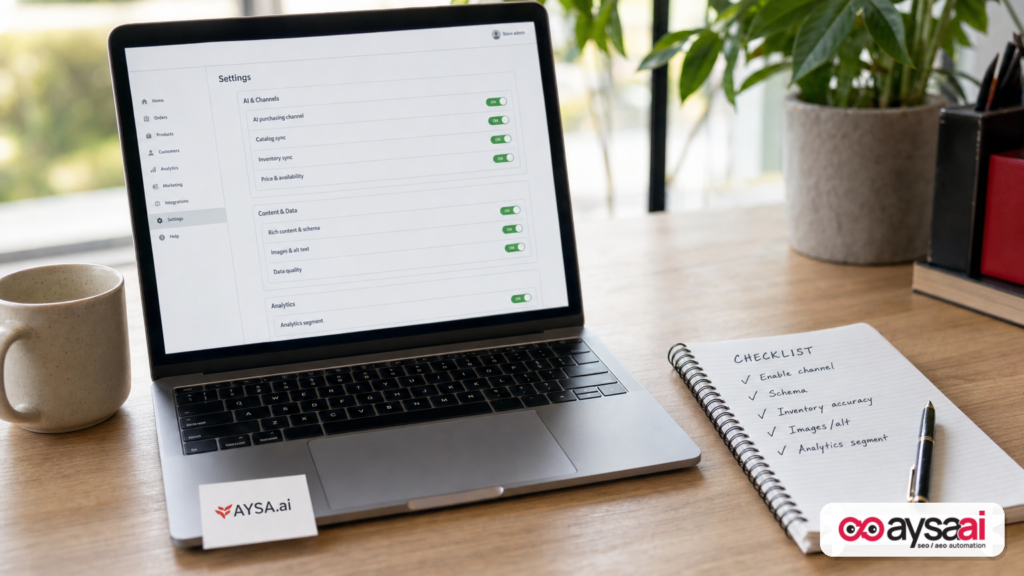
- Small merchants usually don’t implement agentic commerce protocols directly. Your platform/payment provider is rolling support into admin settings and integrations.
- The work that matters is upstream: product data quality, Product/Offer schema, inventory and pricing integrity, shipping/returns clarity, and a checkout that’s easy for both humans and automated flows.
- Expect new traffic patterns: more visitors arriving “pre-sold,” fewer pageviews, and a higher penalty for missing or inconsistent data.
- Measure AI-referred performance separately so you can fix what’s broken before you scale spend or expand catalog distribution.
- AYSA fits this moment because agentic commerce readiness is an ongoing system: Monitoring + prioritized recommendations + Approved Execution—not a one-time SEO audit.
Key takeaways (for owners who want the checklist first)

- Find the AI/agentic commerce toggle(s) in your platform and payment admin. Turn on what’s relevant, and document what changed.
- Validate Product + Offer structured data on representative product pages (simple product, variant product, out-of-stock product, sale product).
- Normalize catalog fields: titles, descriptions, SKUs/GTINs where applicable, variant attributes, price, stock, images, and alt text.
- Audit your “decision friction” pages: shipping policy, returns, warranty, contact, and any required disclosures.
- Segment AI-referred traffic in analytics and compare Conversion rate, revenue/session, refund rate, and customer support load.
- Set a cadence: weekly monitoring, monthly schema regression checks, quarterly catalog QA.
Table of contents

- The biggest mistake I see: merchants hunting protocol specs instead of fixing store readiness
- What actually changed in 2025–2026 (and why it changes buyer behavior)
- The small-merchant decision tree: platform first, specs second
- ACP vs. UCP vs. everything else: what you need to know (without reading the spec)
- Where agentic commerce breaks in the real world (and how to prevent it)
- The practical readiness checklist (90% is product data, 10% is setup)
- Schema that matters: Product + Offer, and the common errors that kill AI shopping visibility
- Analytics: how to measure AI-referred traffic like an operator, not a tourist
- A concrete SME scenario: the “500-SKU home goods store” and what changes first
- What agencies should rethink: services that will matter, and services that won’t
- Where AYSA.ai fits: monitoring → preparation → approval → execution
- What to do next (action list)
- Sources and further reading
The biggest mistake I see: merchants hunting protocol specs instead of fixing store readiness
When a new channel emerges, the market immediately creates two things: a technical spec and an agency pitch.
Specs matter—just not to most small merchants.
If you’re running on a major SMB ecommerce platform, you’re not choosing between protocols in the way a custom enterprise stack would. Your platform and payment provider decide the implementation path, and you decide whether your store is ready to benefit from it.
This distinction is important because it determines where you should spend your limited time:
- Enterprise mindset: “We need to implement protocol X.”
- SME mindset: “We need to ensure our catalog, schema, checkout, and policies are machine-consumable and consistent.”
Agentic commerce is not just another acquisition channel. It’s a Compression of the buyer journey. If a shopper asks an AI assistant to “buy the best lint-free microfiber towels under $25 that ship fast,” the assistant will heavily filter who even gets a chance. And once the shopper is sent to you (or the purchase happens through an integrated flow), the tolerance for ambiguity drops.
That’s why “reading the spec” is a low-return activity for most SMBs. Your real leverage is data and execution.
What actually changed in 2025–2026 (and why it changes buyer behavior)
Traditional ecommerce discovery looked like this:
- User searches (“best running shoes for flat feet”).
- User browses a few pages.
- User compares, returns later, maybe buys.
Agentic commerce pushes the process toward:
- User expresses intent (“buy X with constraints Y”).
- An assistant narrows choices and validates constraints.
- The assistant routes to a merchant—or completes checkout using an approved payment method.
In the Search Engine Journal piece, the core idea is practical: for small merchants, agentic commerce is already being implemented by major SMB platforms and processors. Your preparation is configuration and data quality, not spec engineering.
Here’s what that means in plain business terms:
- Fewer “window shoppers,” more “mission shoppers.” AI assistants tend to send traffic with constraints already decided: budget, shipping speed, compatibility, colors, sizing, and return expectations.
- Less tolerance for inconsistent pricing and availability. If your product page says “in stock” but the cart says “out of stock,” humans shrug; agents fail the task.
- Higher value on machine-readable policies. Returns, shipping thresholds, handling times, and warranty terms become selection criteria.
- More emphasis on product attributes, not marketing copy. Materials, dimensions, compatibility, and care instructions will matter more than adjectives.
In other words: agentic commerce rewards operational clarity.
The small-merchant decision tree: platform first, specs second
Here’s the decision tree I use for SMEs. It’s intentionally boring—because boring is what scales.
Step 1: What platform and payment stack are you on?
- Shopify / BigCommerce / Wix / Squarespace: assume agentic commerce support is being integrated at the platform level; you’re confirming settings and data readiness.
- WooCommerce: likely plugin-based enablement (especially for Stripe); readiness includes plugin maintenance and theme compatibility.
- Direct Stripe or PayPal: you may have a light lift (settings and minimal code) but you own more implementation and QA.
- None of the above: you have a real strategy decision—migrate platform, add a supported processor, or invest in custom implementation.
Step 2: Confirm admin-level enablement before you change anything else
Why? Because it stops you from doing weeks of cleanup for a feature you haven’t actually turned on—or can’t access yet.
Make it a habit: every new “AI channel” should have a single internal document with:
- Where the setting lives
- Whether it’s enabled
- What it affects (catalog, checkout, payment authorization, etc.)
- How you’ll measure it
Step 3: Then do the boring work: catalog + schema + policy clarity
This is where most revenue gets won or lost. Not in the protocol layer—upstream.
ACP vs. UCP vs. everything else: what you need to know (without reading the spec)
Two protocol names show up repeatedly in merchant conversations:
- ACP (associated in the SEJ article with OpenAI and Stripe)
- UCP (associated in the SEJ article with Google and Shopify)
Both are described as open standards that define how AI agents can complete purchases on a shopper’s behalf: catalog access, cart creation, checkout steps, payment authorization, and fulfillment handoff.
For SMEs, the practical point isn’t which acronym wins. It’s this:
- If your platform supports one (or both), you’ll typically enable a channel/integration and then your store becomes reachable in those AI purchasing surfaces.
- If your platform doesn’t support them and you’re not on Stripe/PayPal, then you’re in custom territory—and you should treat it as a product project with cost, risk, and ongoing maintenance.
What to track but not “implement” as an SME
The SEJ article calls out a useful “don’t get distracted” list: items like AP2, a draft cart layer, and other protocol-adjacent initiatives that are likely to be handled by payment service providers rather than small merchants directly.
I’ll generalize that into a rule:
- If it’s a payment-rail or identity standard, it’s usually a processor problem, not a merchant problem.
- If it’s a draft spec, don’t build against it unless your revenue depends on being first.
SMEs win by being ready, not by being early.
Where agentic commerce breaks in the real world (and how to prevent it)
When you compress the buying journey, you compress the tolerance for bad data. These are the failure modes I expect more SMEs to hit as AI-driven shopping grows.
1) Variant chaos (size, color, bundles, and “same product, different reality”)
Humans can navigate confusing variants. Agents struggle when:
- Variant names are inconsistent (“Blue,” “Navy,” “Midnight” all meaning the same thing).
- Out-of-stock variants still appear selectable without clear messaging.
- Bundles and multipacks don’t clearly state unit counts and dimensions.
Fix: enforce controlled attributes, standard naming, and variant-level availability. If your platform supports it, store canonical attributes (material, dimensions, compatibility) at the variant level where needed.
2) Price integrity issues (sale price, currency, fees, and “surprise at checkout”)
Agentic commerce surfaces will prefer merchants that keep pricing consistent. If your product page says $19.99 but checkout adds mandatory fees without warning, the assistant can’t reliably satisfy the shopper’s constraint.
Fix: display total cost expectations clearly (shipping thresholds, typical handling times, taxes where appropriate). Maintain accurate structured data for offers (price, currency, availability).
3) Weak product identity (missing SKU/GTIN/brand signals)
If your catalog doesn’t clearly communicate what the product is—especially for commodities—AI shopping assistants may struggle to differentiate you from competitors or match exact requirements.
Fix: standardize SKUs; add brand where relevant; include GTINs if you have them (don’t invent them). Ensure the title is descriptive, not just cute.
4) Policy ambiguity (returns, warranty, shipping, support)
When a user says “buy it if returns are free within 30 days,” assistants need policy clarity. If your returns policy is buried, vague, or contradictory, you’ll be excluded or you’ll lose conversion.
Fix: rewrite policies in plain English, publish them on dedicated URLs, keep them consistent across Footer Links, product pages, and checkout.
5) Front-end UX regressions that block automated flows
Even if you don’t “build for bots,” your store still needs predictable interactions. Small theme changes can break click targets, disable buttons, or hide crucial information behind non-semantic UI elements.
Fix: run recurring QA on core flows (add to cart, select variant, apply coupon, checkout). If you change themes or add apps, re-test structured data and conversion steps.
The practical readiness checklist (90% is product data, 10% is setup)
If you’re an SME, this is the work that compounds. It also maps cleanly to what AYSA can monitor and execute with approval.
A) Admin and integration readiness
- Confirm whether your platform has an “AI/agentic commerce” or catalog syndication setting enabled.
- Confirm payment methods are active and stable (Stripe/PayPal, etc.).
- Confirm inventory sync cadence (real-time vs. delayed updates).
- Confirm shipping settings reflect reality: carriers, handling time, regions served, restrictions.
B) Catalog data quality (what assistants actually need)
- Titles: include the product type, key attribute, and differentiator (“Organic Cotton Bath Towel, 30×56, White”).
- Descriptions: prioritize materials, dimensions, compatibility, care instructions, and what’s included in the box.
- Images: high-quality, multiple angles, consistent background where possible.
- Alt text: describe what the image shows (not keyword stuffing).
- Availability: accurate stock status; don’t hide backorder logic.
- Shipping expectations: handling times and regions clearly stated.
- Returns/warranty: clear, scannable, consistent.
C) Conversion UX essentials (still matters, even in “agentic” flows)
- Add to cart and buy buttons are clearly visible and usable.
- Variant selectors are accessible and don’t rely on ambiguous UI.
- Cart and checkout show price breakdown transparently.
- Contact and support pathways are easy (email, form, phone where applicable).
D) Guardrails (brand, compliance, and risk)
- Make sure your policies align with local regulations and your actual operations.
- Don’t allow apps or theme updates to silently change pricing display or checkout behavior.
- Document who approves changes that impact checkout, taxes, shipping, and returns.
Schema that matters: Product + Offer, and the common errors that kill AI shopping visibility
Structured data isn’t new. What’s changing is the cost of being wrong.
At minimum, product pages should expose clean Product structured data and nested Offer information: price, currency, availability, and seller details. This is the schema layer that helps machines reliably understand what you’re selling and under what conditions.
Google provides tooling to validate structured data. Use the Rich Results Test to check representative product pages.
Common schema problems (and why they matter more now)
- Missing offers: Product exists, but no price/availability in structured data. Assistants can’t validate constraints.
- Mismatch between visible price and schema price: Looks like bait-and-switch to machines.
- Availability not updated: In-stock schema while product is out of stock at checkout.
- Incorrect currency: Cross-border confusion, especially for international stores.
- Thin or templated descriptions: Agents can’t differentiate products; users lose confidence.
A process that doesn’t rot
Schema validation can’t be a one-time “SEO task.” It needs to be part of your release hygiene. Theme update? App install? New product template? You re-check.
This is exactly the kind of recurring technical QA that should be automated as monitoring, with human approval for changes that alter storefront output.
Analytics: how to measure AI-referred traffic like an operator, not a tourist
When a new channel appears, most teams measure the wrong thing first: “Did visits go up?”
The questions that matter:
- Did revenue go up?
- Did conversion rate improve?
- Did refunds, cancellations, or support tickets increase?
- Are these customers more profitable after shipping and returns?
Segment AI traffic
The SEJ article suggests setting up segments for AI-referred visits (some sources may append identifiable parameters). Whether those exact parameters apply to your setup will vary, so don’t hardcode assumptions. But the principle is correct: AI traffic should be analyzed separately because intent and behavior can differ from traditional search or paid traffic.
If you’re using GA4, create:
- A traffic segment for referrals you recognize as AI assistants.
- A landing page report for AI segments (which pages do they start on?).
- A funnel comparison: view item → add to cart → begin checkout → purchase.
Why this matters: you need to know whether “agent-ready” is paying you
It’s easy to celebrate visibility (“we show up in AI answers”). It’s harder—and more valuable—to confirm outcomes. If AI-referred users bounce at checkout, you don’t have a visibility problem; you have an execution problem.
A concrete SME scenario: the “500-SKU home goods store” and what changes first
Let’s make this real.
Imagine a small home goods ecommerce business:
- 500 SKUs, many variants (sizes, colors, multipacks)
- Running on a major SMB platform
- Team is a founder + one ops person + a part-time marketer
They hear “agentic commerce is coming” and assume they need a developer to implement ACP or UCP. What they actually need is to prevent three predictable revenue leaks:
Leak #1: Titles and attributes aren’t constraint-friendly
Many products are titled like “The Cloud Towel” instead of “Microfiber Bath Towel, 30×56, Gray, Quick-Dry.” Humans enjoy the branding; assistants need the attributes.
Fix: keep the brand name, but add descriptive attributes. This improves classic SEO and AI selection.
Leak #2: Variant availability is inconsistent
Some variants show in stock but fail in cart due to inventory sync delays.
Fix: tighten inventory rules and suppress variants properly. If you can’t guarantee real-time, be conservative with availability claims.
Leak #3: Policies exist but aren’t decision-ready
The returns policy is a dense wall of text. Shipping times are implied, not stated. Support hours aren’t listed.
Fix: publish a scannable shipping page and returns page. Add summary blocks at checkout. Keep it consistent.
A realistic 90-day plan for this store
- Week 1–2: confirm platform settings; establish AI traffic segment; validate schema on representative templates.
- Week 3–6: clean top 50 revenue products (titles, attributes, images, alt text, variant logic).
- Week 7–10: fix policy pages and checkout messaging; re-test structured data after changes.
- Week 11–12: expand catalog hygiene to next 150 products; set a quarterly QA cadence.
What agencies should rethink: services that will matter, and services that won’t
Agentic commerce will reshuffle agency value. Not because “SEO is dead,” but because the deliverables change.
What won’t matter as much (for SMB clients)
- “We implement ACP/UCP for you” as a generic service when the merchant is on a platform that already supports it.
- Vanity visibility reporting that doesn’t connect to conversion and operational outcomes.
- One-time audits that don’t include a system for ongoing regression monitoring.
What will matter more
- Merchant data engineering (lightweight): turning messy catalogs into clean, constraint-friendly data.
- Structured data governance: keeping schema correct through theme/app changes.
- Conversion QA + technical SEO: preventing small UX regressions that break automated flows.
- Measurement and attribution: segmenting AI-referred traffic and proving profit impact.
This is not glamorous work. It is compounding work.
Where AYSA.ai fits: monitoring → preparation → approval → execution
At AYSA, we’re building for the reality that most businesses don’t fail because they lack recommendations. They fail because recommendations don’t get executed—or they get executed without guardrails.
Agentic commerce readiness is a perfect example. It’s not a single project. It’s a moving system:
- Platforms update templates.
- Apps change front-end behavior.
- Catalogs grow and drift.
- Inventory and pricing fluctuate.
That’s why our model is not “reporting.” It’s execution with control.
1) Continuous monitoring
AYSA can help you monitor the signals that tend to break agentic commerce outcomes:
- Structured data validity and regressions
- Indexing/visibility changes tied to product templates
- On-page content drift (titles, descriptions, missing attributes)
- Technical changes that affect usability and crawling
Explore the monitoring philosophy here: AYSA Monitoring.
2) Preparation: recommendations that map to revenue
Recommendations should be prioritized by business impact: top revenue products first, then systemic template fixes, then long-tail cleanup.
AYSA’s focus is to prepare clear, actionable changes aligned with AI search visibility and ecommerce outcomes: AI Search Visibility.
3) Approval: humans stay responsible for brand and risk
Pricing display, shipping copy, and policy language are sensitive. You should approve these changes—even if the underlying system proposes them.
This is what I mean by “agentic, but not reckless.” Machines help you move faster; humans keep you honest.
4) Execution: accepted changes go live
The last mile is where most SEO and ecommerce optimization dies. AYSA is designed to execute accepted changes, not just describe them.
If you’re evaluating how this fits your team size and workflow, start here: AYSA AI SEO Tools, then check pricing.
A note on learning and operational cadence
If you want ongoing editorial guidance on AI-driven search and execution systems, the best place to follow is the AYSA blog. The goal isn’t to chase every acronym; it’s to build an operating system that keeps your store ready as the channel evolves.
What to do next (action list)
- Locate and document your platform’s agentic/AI commerce settings (or your processor’s relevant settings). Take notes on what you turned on and when.
- Run structured data validation on 3–5 representative product pages using Google’s Rich Results Test. Fix systemic template issues before editing hundreds of products.
- Clean your top sellers first: titles, attributes, images, alt text, price/availability accuracy.
- Rewrite shipping/returns pages so a rushed buyer (and an AI assistant) can understand them in 30 seconds.
- Create an AI traffic segment in analytics and track conversion rate, revenue/session, refunds, and support tickets separately.
- Set a recurring QA cadence after theme updates, app installs, or major catalog imports.
- Implement a monitoring + execution loop so improvements don’t decay—this is where AYSA is designed to help.
Sources and further reading
- Search Engine Journal: Agentic Commerce For Small Merchants: Which Protocol Spec Actually Matters For Your Website
- Google Rich Results Test
Note: The SEJ source references multiple platform- and processor-level initiatives. This article does not claim access to private roadmaps or features beyond what is described in the cited source. If you need confirmation for your specific platform account, check your admin dashboard and official documentation from your platform or payment provider.
Continue the AI search topic inside AYSA.
Use these pages to connect the article with AI SEO tools, AI visibility monitoring, AI Overviews and approved website execution.
Turn this topic into a website action plan.
Use these AYSA hubs to move from reading to technical fixes, AI visibility monitoring, research, glossary context and approval-first SEO execution.

