Performance Max vs. Separate Google Ads Campaigns: The Real Decision Framework (And Why Your SEO/AEO Needs To Be In The Room)
Performance Max isn’t “better” by default—and separate campaigns aren’t automatically “more strategic.” The right structure depends on budget density, constraints, and the level of control your business truly needs. Here’s a practical framework to decide, plus what to monitor across SEO, AEO, and AI search visibility so growth doesn’t get trapped inside a black box.

Google Ads managers love this argument because it sounds like a clean fight: “Is Performance Max actually better than running separate campaigns?”
But the real world doesn’t reward clean fights. It rewards systems that match your budget density, your business constraints, and your ability to measure what matters. That’s why the honest answer is uncomfortable: sometimes Performance Max (PMax) is the fastest path to stable growth, and sometimes it’s a black box that quietly reroutes spend away from your priorities.
I’m writing this as Marius Dosinescu from AYSA.ai, with a bias toward what actually gets implemented and what actually holds up under scrutiny. I’m not interested in “automation good” or “control good.” I’m interested in what keeps your pipeline full and your margins intact.
This editorial is inspired by the pragmatic question posed in Search Engine Journal’s Ask A PPC column: Is Performance Max Actually Better Than Running Separate Campaigns?. We’ll use that as a research lead—then go deeper: what changed in consumer behavior, what changed in Google Ads, what can go wrong operationally, and what small-to-mid-sized businesses (SMEs) and agencies should do next.
Concise summary
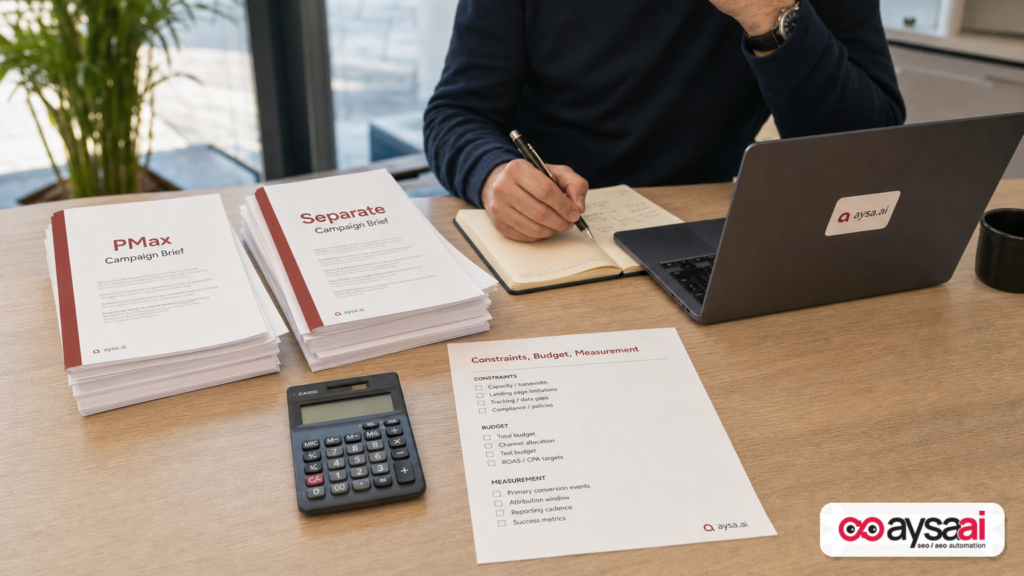
- PMax is often the right tool when budgets are small, conversion volume is low, and your account is overbuilt with too many thin campaigns.
- Separate campaigns often win when you have compliance constraints, strict messaging, product-level margin differences, or you need channel-level visibility and guardrails.
- Hybrid is the default for mature accounts: protect high-intent Search (brand and key non-brand terms) while using PMax for incremental demand capture and cross-network reach.
- The real fight is measurement and governance: conversion definitions, lead quality feedback loops, URL control, and creative approvals determine whether automation helps or hurts.
- SEO/AEO/GEO (AI Search visibility) is now a paid performance variable: weak landing pages, unclear entities, and inconsistent local signals reduce both paid efficiency and AI-driven discovery.
Table of contents

- The concise answer: there’s no universal winner (and that’s the point)
- What actually changed: why “control-first” PPC management broke down
- What Performance Max is trying to do (in plain English)
- A practical decision framework: choose structure based on budget density and constraints
- When PMax tends to drive better efficiency
- When separate campaigns and control matter
- The hybrid play: how mature accounts combine PMax + Search without chaos
- Measurement reality: what to compare (and what not to)
- Where most teams get burned: common failure modes (and how to prevent them)
- A concrete SME scenario: local clinic vs. ecommerce brand (and how the decision differs)
- What agencies should rethink in 2026: packaging, reporting, and accountability
- Where AYSA.ai fits: approved execution for SEO/AEO/GEO that makes paid perform better
- What to do next: a 30-day action list
- Sources and further reading
The concise answer: there’s no universal winner (and that’s the point)

Performance Max is not “better.” Separate campaigns are not “more professional.”
They’re different ways to solve two competing problems:
- Efficiency and learning speed (which require conversion volume and consolidated signal).
- Control and accountability (which require segmentation, rules, and clear measurement boundaries).
Search Engine Journal’s Ask A PPC framing is the right one: the decision depends on budget, goals, and constraints—not ideology. If your budget is spread across six campaign types and none of them gathers enough data to learn, you get the illusion of control and the reality of instability. If you consolidate everything into PMax when your business needs strict messaging and channel separation, you may get volume at the expense of brand safety, lead quality, or margin.
The goal isn’t to pick a side. The goal is to build a structure that your budget can power and your organization can govern.
What actually changed: why “control-first” PPC management broke down
There was a time when PPC best practice looked like this:
- Tight Keyword control (even SKAG-style segmentation).
- Manual query mining and negatives as a core weekly ritual.
- Channel silos for reporting clarity (Search vs Display vs YouTube vs Shopping).
- Landing pages mapped cleanly to intent buckets.
That system worked better when user journeys were simpler and the ad ecosystem was less blended. Today, the journey is messy:
- A user discovers you in a video, not a search result.
- They compare options on mobile, then return on desktop.
- They search brand + category, then convert days later through a different entry point.
In that environment, “control” can become a tax: too many small campaigns, too little signal per campaign, and a constant feeling of busywork without performance lift.
Google’s automation push is, in part, a response to this reality. It isn’t purely altruistic and it isn’t always aligned with your business goals. But the direction is clear: more automation, more cross-network blending, more emphasis on conversion signals and creative assets.
The managerial skill now isn’t only optimization. It’s governance: defining outcomes, validating data, and setting guardrails so the machine doesn’t optimize your business into a corner.
What Performance Max is trying to do (in plain English)
Performance Max is a campaign type that uses Google’s automation to serve across Google’s inventory (rather than you manually building separate campaigns for each network). Instead of you deciding, “This budget slice goes to Search, this slice goes to YouTube,” the system reallocates based on signals and predicted conversion outcomes.
That means PMax behaves less like a single campaign and more like a budget allocation engine with creative and targeting inputs.
For an SME, here’s the simplest way to think about it:
- You give Google your goals, budget, conversion signals, creative assets, and (optionally) audience hints.
- Google decides where to show, who to show to, and which assets to combine in which placements.
That can be powerful when you have too little data to run five separate campaigns effectively. It can be dangerous when your organization requires strict segmentation, strict messaging, or predictable allocation by product line.
A practical decision framework: choose structure based on budget density and constraints
If you want one takeaway that’s actually usable, it’s this: don’t decide based on preference. Decide based on budget density and constraints.
Use this framework as a starting point.
Step 1: Assess budget density (not total budget)
Total monthly spend is a blunt instrument. The more useful question is: does each campaign have enough conversion volume to learn and stabilize?
Signs your budget is too thin for separate campaigns:
- Each campaign produces sporadic conversions (or none) week to week.
- You’re constantly “resetting learning” through frequent structural changes.
- You can’t tell if performance changes are real or just noise.
In those cases, consolidation (often via PMax) can be less about “automation” and more about “stop starving your own data.” This aligns with the point raised in the SEJ column: smaller advertisers frequently build structures designed for much larger budgets, and it backfires.
Step 2: List real constraints (not preferences)
Constraints are non-negotiables. Preferences are habits.
Examples of real constraints that often justify separate campaigns (or heavy segmentation):
- Regulatory/compliance review (health, legal, finance, claims you can’t improvise).
- Brand safety requirements (where and how your ads can appear).
- Distinct messaging by product line (different value props, different legal disclaimers, different audiences).
- Profit/margin differences requiring explicit allocation (some SKUs can’t afford the same CPA/ROAS goals).
- Operational routing (leads must go to different teams, locations, or qualification pipelines).
If these are true constraints, separate campaigns aren’t “old school”—they’re responsible management.
Step 3: Evaluate your measurement capability (can you close the loop?)
The more automated your media buying becomes, the more dangerous weak measurement becomes.
Ask:
- Do we agree internally what a “conversion” means?
- Do we have a way to measure lead quality (not just lead quantity)?
- Can we feed back outcomes (qualified leads, revenue) into our decision-making?
If your measurement is fragile, separate campaigns may feel safer because at least you can isolate variables. But the better move is usually to fix measurement, not to cling to complexity.
A simple decision matrix
- Low budget density + low constraints → test PMax sooner.
- High budget density + high constraints → separate campaigns, strict governance.
- High budget density + mixed constraints → hybrid model.
- Low budget density + high constraints → you need a careful hybrid or highly simplified separation (and excellent landing pages), because neither extreme will “solve” the physics of limited data.
When PMax tends to drive better efficiency
Performance Max tends to shine when your problem is signal starvation and your organization can tolerate a more blended approach.
1) You have limited budget and your structure is “too sophisticated for its own good”
This is the most common SME failure pattern: Branded Search, non-brand Search, Display remarketing, YouTube, Shopping, and a few experiments—on a budget that can’t support stable learning anywhere.
In that environment, PMax can function as a stabilizer by consolidating data and letting the system allocate where it can actually find conversions.
2) Conversion volume is low and you need the system to find pockets of demand
If you only generate a small number of conversions per month, micro-segmentation makes reporting feel clean but makes optimization weak. PMax can sometimes uncover incremental volume across placements you wouldn’t manually fund at the start.
3) Your goal is growth and you’re willing to trade some channel-level visibility
If the business priority is “grow efficiently” rather than “report perfectly by channel,” PMax is often worth testing. SEJ notes that channel-level reporting has improved, but the core tradeoff remains: automation can reduce your ability to attribute performance cleanly to specific slices.
4) You can support PMax with strong assets and landing pages
PMax is creative- and landing-page-sensitive. If your site is thin, confusing, slow, or inconsistent, automation won’t fix that—it will simply spend more money finding the least-bad path to a conversion.
This is where SEO and site execution become paid performance levers. More on that later.
When separate campaigns and control matter
Separate campaigns still win—often decisively—when your business requires intent separation, messaging separation, or risk controls.
1) Highly regulated or high-risk messaging environments
If your ads go through legal review, you often need predictable creative rotation, stable landing pages, and clear placement boundaries. That’s not a “PPC manager preference.” It’s a governance requirement.
2) You need explicit control over where budget goes
Some businesses must guarantee investment in certain lines (e.g., a high-margin service, or a strategic product category). PMax can reallocate away from those priorities if it finds cheaper conversions elsewhere.
3) Lead gen with strict qualification rules
If “conversion” is a form fill but only 30% of those are qualified, PMax may chase low-friction leads unless you have strong qualification steps and feedback loops. Separate campaigns can help you isolate and fix lead quality issues.
4) You require channel-level clarity for decision-making
If your leadership team makes channel-specific decisions (e.g., YouTube for awareness, Search for capture, Shopping for ecommerce), you may need the transparency of separate campaigns to run the business responsibly.
Yes, you can still run PMax in these environments. But you’ll likely run it as a bounded experiment, not the central nervous system.
The hybrid play: how mature accounts combine PMax + Search without chaos
In practice, “PMax vs. separate campaigns” is a false binary for many mature accounts. The default endgame is hybrid.
A typical hybrid philosophy looks like this:
- Search campaigns protect and control the highest-intent terms you can’t afford to lose visibility on (brand, top converting non-brand, mission-critical queries).
- PMax is used to find incremental conversions across networks, capture new demand, and scale when you have enough signal and creative assets.
Why this works: Search is where intent is explicit. PMax is where discovery and cross-network optimization can compound—if measurement and assets are solid.
But hybrid only works if you’re disciplined about:
- Conversion definitions (what counts and what doesn’t).
- Landing page mapping (which pages should be eligible and which shouldn’t).
- Creative governance (what messaging can be remixed, what must be fixed).
Measurement reality: what to compare (and what not to)
Most PMax debates are really measurement debates. Here’s what to get right before you declare a winner.
1) Make sure you’re comparing the same outcome
If PMax is optimized to “leads” but Search is optimized to “qualified leads,” your comparison is meaningless. You’re measuring two different definitions of success.
At a minimum, align on:
- Primary conversions vs secondary conversions.
- What counts as a lead (calls, forms, chats) and what counts as revenue.
- Whether you’re optimizing for volume, CPA, or value.
2) Beware of “conversion dilution”
If you add easy conversions (e.g., newsletter signups) into the same conversion bucket as revenue-driving actions, automation will often chase the easy win. That can make PMax look “efficient” while the business gets poorer-quality outcomes.
3) Attribution isn’t the business
Channel-level Attribution is useful, but it’s not the business outcome. It’s a model. Use it to ask better questions, not to declare victory.
For SMEs, the most practical approach is:
- Measure incrementality when possible (holdouts, geo tests, controlled budget changes).
- Track lead quality downstream in CRM where possible.
- Keep reporting simple enough that decisions actually get made.
4) Reporting clarity vs performance reality
Separate campaigns often produce cleaner reports—and that can be a trap. Clean reporting is comforting, but it can hide the fact that each campaign lacks enough signal to learn. PMax can create messy reporting while delivering more stable performance. Your job is to decide which tradeoff is acceptable for your business stage.
Where most teams get burned: common failure modes (and how to prevent them)
Whether you choose PMax, separate campaigns, or hybrid, these are the failure modes that consistently destroy results.
Failure mode 1: Overbuilding on a small budget
Too many campaigns, too many ad groups, too many “tests” running simultaneously. The system never gets enough data in any one place to learn. The fix is uncomfortable but simple: consolidate, simplify, and let one or two engines gather signal.
Failure mode 2: Treating automation like autopilot
PMax is not set-and-forget. It’s set, observe, and govern. If you don’t have a feedback loop—lead quality, seasonality notes, inventory constraints—you’re delegating business decisions to a system that can’t feel the consequences.
Failure mode 3: Weak landing pages (this is where SEO and paid collide)
If your landing pages don’t clearly answer:
- What you sell
- Who it’s for
- Why you’re credible
- What to do next
…then neither PMax nor Search will deliver stable efficiency. You’ll pay more for the same outcomes, and your lead quality will suffer.
Failure mode 4: Letting creative sprawl without guardrails
PMax can combine and remix assets. If you don’t control your inputs, you can accidentally create messaging combinations you would never approve in a manual campaign. The fix is an approval workflow for assets and a strict QA process for URLs and messaging.
Failure mode 5: Making conclusions too early (or too late)
Teams often panic during learning phases or cling to a structure long after it stops working. The right approach is a testing plan with a predefined evaluation window, aligned conversion goals, and a short list of leading indicators (CTR is rarely one of them).
A concrete SME scenario: local clinic vs. ecommerce brand (and how the decision differs)
Let’s make this real with two examples you can picture without being a PPC expert.
Scenario A: Local clinic (lead gen, compliance-aware)
Business: A multi-location physical therapy clinic.
Constraints:
- Messaging must be consistent and often medically sensitive.
- Locations matter; calls and forms must route correctly.
- Lead quality matters more than raw volume.
What I’d lean toward:
- Separate Search campaigns for core services + location intent (to protect high-intent capture).
- A carefully bounded PMax test (if any) with strict landing page eligibility and tightly governed assets.
- Measurement that reflects qualified appointments, not just form submissions.
Why: This is a constraint-heavy environment. Control is not a comfort blanket; it’s a safety requirement.
Scenario B: Ecommerce brand (broader inventory, scaling goals)
Business: A niche home goods store with a few hero categories and strong creative assets.
Constraints:
- Less regulatory risk.
- Clear conversion (purchase) and measurable revenue.
- Creative iteration is feasible.
What I’d lean toward:
- PMax as a core growth engine (especially if conversion volume supports it).
- Separate Search campaigns for brand protection and select high-margin categories where query intent is valuable.
- Landing page optimization and product/category page clarity to improve both paid efficiency and organic visibility.
Why: This is closer to the “efficiency and scale” sweet spot where PMax can compound.
What agencies should rethink in 2026: packaging, reporting, and accountability
If you run an agency, PMax creates a business model problem:
- Clients still pay for expertise and control.
- Platforms are pushing automation and consolidation.
The agency value shifts from “I moved the levers” to:
- I define the right outcomes (conversion architecture).
- I build the guardrails (assets, URLs, exclusions, brand safety).
- I ensure measurement integrity (lead quality, CRM feedback loops).
- I improve the site (landing pages, content, technical performance) because that’s where a lot of efficiency now lives.
That last bullet is the one most PPC teams underinvest in. Yet it’s often the difference between a PMax account that “kinda works” and one that scales profitably.
Agencies should also rethink reporting. If you’re still selling “channel-by-channel perfection” as the core deliverable, you will be in friction with how platforms behave. Instead, sell what businesses actually need:
- Incremental revenue and qualified pipeline
- Controlled risk
- Repeatable creative testing
- Landing page and site improvements that lower acquisition costs across channels
Where AYSA.ai fits: approved execution for SEO/AEO/GEO that makes paid perform better
Here’s my view: the best Google Ads structure in the world can’t save a site that doesn’t communicate clearly, doesn’t load well, and doesn’t match user intent. And in 2026, that site weakness also shows up in AI search surfaces where people discover brands without ever clicking a blue link.
That’s why we built AYSA.ai as an execution system—not a “tips” platform.
AYSA monitors your site and visibility, prepares improvements, asks for your approval, and then executes accepted changes. This approved-execution model matters because:
- Paid performance depends on landing page clarity (message match, scannability, conversion friction).
- AI search visibility depends on structured, credible, consistent information (entities, locations, services, FAQs, policies).
- Most SMEs don’t have time to run a separate SEO sprint for every paid insight.
If you want to connect these dots in your business, start here:
- AI search visibility (how discovery is changing and what to monitor)
- Monitoring (so you’re not guessing what changed)
- AI SEO tools (practical execution capabilities)
- Pricing (so you can size effort to reality)
- AYSA blog (ongoing editorials and playbooks)
How this ties back to PMax vs separate campaigns:
- If you consolidate into PMax, you must improve your site and content so the system has strong destinations and strong signals to work with.
- If you keep separate campaigns, you still need landing pages that reflect each intent bucket—otherwise segmentation is theater.
- In both cases, execution speed matters. The best strategy is worthless if improvements sit in a doc for 60 days waiting for dev time.
What to do next: a 30-day action list
If you want a practical plan that doesn’t require becoming a PPC expert, do this over the next month.
Week 1: Make the decision measurable
- Write down your primary conversion (the thing that creates revenue) and separate it from secondary actions.
- Confirm you can measure it consistently (forms, calls, purchases).
- List your non-negotiable constraints (compliance, messaging, margin, routing).
Week 2: Simplify or bound your structure
- If your budget is thin, consolidate campaigns that are starving for conversions.
- If you need control, keep separate campaigns—but cut segmentation that exists only for “clean reporting.”
- If you’re testing PMax, define what it’s responsible for (incremental growth, new customer acquisition, cross-network reach) and what it’s not.
Week 3: Fix the site pages that paid traffic actually hits
- Audit the top landing pages for clarity, speed, and intent match.
- Remove friction (unclear CTAs, confusing navigation, missing trust signals).
- Strengthen page content so it can support both paid conversion and AI-driven discovery.
If you want an execution system for this, use AYSA’s monitoring and prepared changes workflow: AYSA Monitoring.
Week 4: Establish guardrails and a decision cadence
- Create an asset approval checklist (claims, offers, disclaimers, landing page eligibility).
- Set a weekly review cadence focused on a short list of leading indicators tied to revenue/quality.
- Decide in advance what “success” looks like for your test window.
What to do next (quick checklist)
- Stop debating ideology. Write down your constraints and conversion definition.
- Check budget density. If you can’t feed your campaigns enough data, simplify.
- Choose one of three plays: PMax-first (small budget), Separate-first (high constraints), or Hybrid (mature accounts).
- Upgrade landing pages. This is where paid efficiency and AI discovery meet.
- Implement an approval workflow. Automation without governance is just outsourced risk.
Sources and further reading
- Search Engine Journal (Ask A PPC): Is Performance Max Actually Better Than Running Separate Campaigns?
- Search Engine Journal PPC coverage hub (research lead): PPC News
- Search Engine Journal SEO hub (research lead for landing page/SEO implications): SEO
- AYSA.ai: AI Search Visibility
- AYSA.ai: AI SEO Tools
- AYSA.ai: Monitoring
- AYSA.ai: Pricing
- AYSA.ai: Blog
Note: This editorial intentionally avoids asserting specific Performance Max feature details or numerical benchmarks beyond what’s provided in the supplied research context. If you want a version tailored to your account, the right next step is to review your constraints, conversion architecture, and landing pages—then test with a defined measurement plan.
Continue the AI search topic inside AYSA.
Use these pages to connect the article with AI SEO tools, AI visibility monitoring, AI Overviews and approved website execution.
Turn this topic into a website action plan.
Use these AYSA hubs to move from reading to technical fixes, AI visibility monitoring, research, glossary context and approval-first SEO execution.