
Google’s Preferred Sources Expands Into AI Search: What It Changes (and How SMEs Can Win AI Citations Without Losing Control)
Google is bringing user-chosen “Preferred Sources” into AI Overviews and AI Mode, adding new article/perspectives carousels, and expanding “Highly Cited” labels. Here’s what changed, why it matters for AI visibility and clicks, and the practical playbook SMEs and agencies can execute—safely—using an approval-first system like AYSA.

Google is steadily moving from “ten blue links” to a world where search results are assembled, summarized, and cited by AI. The latest update pushes that transition further: user-selected Preferred Sources now surface inside AI Overviews and AI Mode, alongside new link carousels and expanded “Highly Cited” labeling across results.
That’s not just a UI tweak. It’s a shift in incentives: the brands that earn loyalty, references, and citations—while making it easy for Google to trust and extract their information—will increasingly win visibility even before the click.
This editorial unpacks what changed, why it matters for SMEs and agencies, and how to build a practical “AI citation engine” without gambling your website on rushed changes. I’ll also explain where AYSA fits as an Approval-First Execution system that monitors opportunities, prepares improvements, asks for approval, and executes changes you accept.
Concise summary
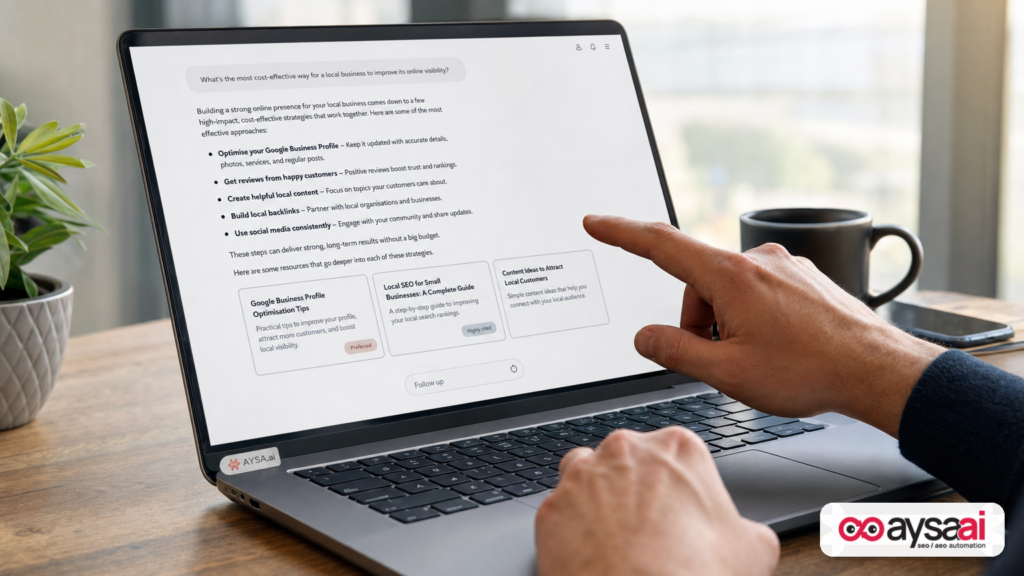
- Preferred Sources (a user setting) is now visible inside AI Overviews and AI Mode link citations, not just Top Stories.
- Google reports users have selected 345,000 unique Preferred Sources—up sharply from earlier reported levels—suggesting growing user awareness and publisher promotion.
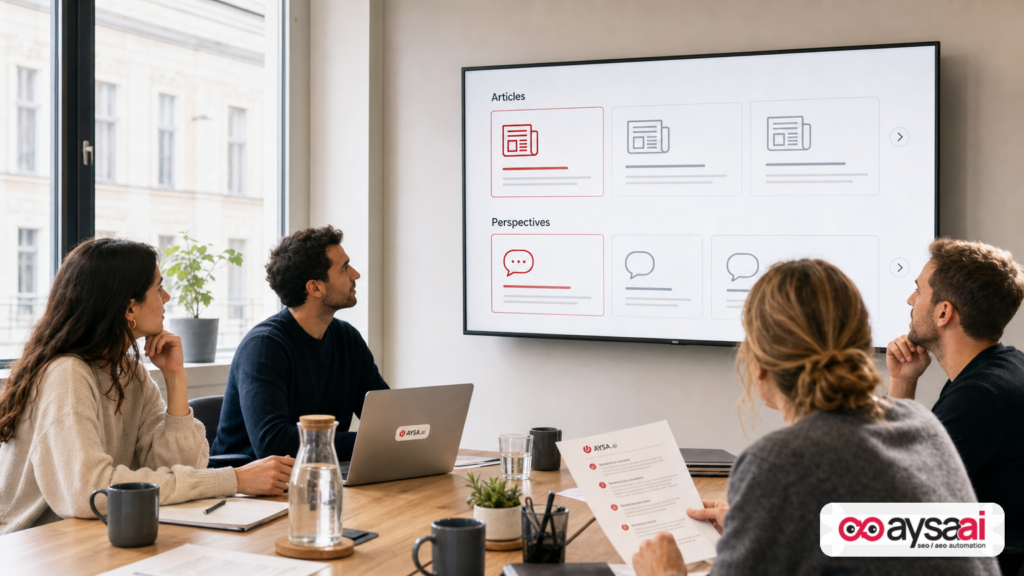
- Google is adding article carousels for developing topics and a forthcoming perspectives carousel for forums/social content—creating more “surfaces” to win (or lose).
- “Highly Cited” labels are expanding beyond their original placement, and Google will also flag articles that explicitly reference a Highly Cited source—making citation relationships more visible.
- For businesses, AI visibility increasingly depends on being cited (and being selected) as much as “ranking.”
Key takeaways (what to do differently starting now)
- Stop treating AI answers like a black box. Treat them like a distribution channel with inputs you can influence: clarity, provenance, citations, and audience loyalty.
- Build “citation-ready” pages. Create pages that are easy to quote accurately: definitions, policies, pricing logic, comparisons, original research, and location-specific proofs.
- Earn references, not just backlinks. In an AI-first SERP, being referenced across the web (and properly attributed) becomes a competitive moat.
- Instrument your brand for trust signals. About pages, author bios, editorial policies, and transparent sourcing are no longer “publisher stuff”—they influence whether AI wants to cite you.
- Adopt approval-first execution. AI-era SEO moves fast; the safe way to keep up is a system that drafts changes and ships only after human approval (how we built AYSA).
Table of contents
- What Changed: Preferred Sources Enters AI Overviews & AI Mode
- Preferred Sources Explained (in plain English)
- Why Google Is Doing This (and what it implies)
- The New Carousels: Articles & Perspectives
- “Highly Cited” Expansion: A Quiet Incentive Shift
- How This Changes Search Behavior (Clicks, trust, and defaults)
- Where This Can Go Wrong: Risks for Businesses and Publishers
- SME Scenario: A Local Clinic vs. Reddit in AI Answers
- The Strategic Shift: From SEO Rankings to AI Citations (AEO/GEO)
- A Practical Playbook to Earn AI Citations
- What to Monitor Weekly (SME + Agency checklists)
- An Execution-First Playbook: How AYSA Helps You Win AI Visibility Safely
- What to do next
- Sources and further reading
What Changed: Preferred Sources Enters AI Overviews & AI Mode
According to reporting by Search Engine Journal, Google has expanded its Preferred Sources feature so that the user’s chosen sources can now be highlighted within links shown in AI Overviews and AI Mode answers, not only in Top Stories. Google also introduced new link carousel treatments for developing topics and broadened the “Highly Cited” label across more results.
The core change is simple but consequential: a user preference now affects which sources stand out in AI-generated results.
Google also shared a scale signal: users have selected 345,000 unique sources as Preferred Sources. SEJ notes that this is up significantly from earlier public figures shared by Google as the feature expanded globally and into more languages. (Google’s exact measurement methodology for the click behavior mentioned in the report isn’t detailed; treat it directionally rather than as a precise benchmark.)
Why this matters: Once the result is an AI answer, the “winner” is often not the site that ranks #1 in classic search—it’s the site that the AI chooses to cite, and that the user chooses to trust. Preferred Sources adds a loyalty dimension to that selection and visibility layer.
Preferred Sources Explained (in plain English)
Preferred Sources is a Google Search feature that lets individuals pick publications/sites they want Google to treat as preferred in certain contexts. Until recently, this was mostly a news-adjacent experience (labels in Top Stories). Now, that preference label appears inside AI-driven answers as well.
For a business owner who doesn’t live in the SEO world, here’s the practical translation:
- Users can “favorite” sources they trust.
- When Google shows AI answers, it can visibly mark links that come from those favorites.
- That label can influence clicks, trust, and which sources stand out—even when multiple sources are cited.
Importantly, Google has indicated (via commentary referenced in the SEJ report) that Preferred Sources works alongside ranking/quality systems rather than overriding them. That’s a key nuance: this isn’t a “pay-to-win” or “toggle-to-win” button. But it is a new advantage layer for sources that already meet quality thresholds and have earned user loyalty.
What this means for businesses (not just publishers)
At first glance, Preferred Sources seems “for news.” But the expansion into AI Overviews/AI Mode makes it relevant to any brand that publishes information people rely on, such as:
- Clinics publishing treatment explainers and insurance/payment guidance
- Ecommerce brands publishing sizing guides, care instructions, and comparisons
- Local services publishing pricing models, licensing info, and FAQs
- SaaS brands publishing documentation, integration guides, and best practices
If your customers already trust you enough to subscribe, bookmark, or repeatedly visit your site, Google is now signaling it wants to bring that trust into the AI results experience.
Why Google Is Doing This (and what it implies)
Google is trying to solve a hard balancing act in AI Search:
- Users want speed. AI Overviews and AI Mode reduce the work of clicking and synthesizing.
- Users also want trust. If the AI answer feels ungrounded, adoption stalls.
- Publishers and creators want credit and traffic. If AI answers remove incentives to publish, the ecosystem breaks.
Preferred Sources is one lever among many that tries to preserve trust. It also gives Google something valuable: explicit preference data. In the AI era, implicit signals (clicks, dwell time) are noisier because the user may not click at all. So explicit signals—like “I prefer this source”—become more attractive.
And there’s a deeper implication: the future of SEO won’t be purely algorithmic. It will be algorithmic + relationship-driven:
- Relationship with your audience (they prefer you, seek you out, and recognize your brand)
- Relationship with the web (others reference and cite you)
- Relationship with machines (your content is structured, unambiguous, and attributable)
The New Carousels: “Articles” and “Perspectives” and Why They’re a Big Deal
SEJ reports two carousel directions that matter for visibility strategy:
- Article carousels for developing topics, with brief context and highlighting Preferred Sources within the carousel.
- A forthcoming Perspectives carousel that will surface content from forums and social media—essentially formalizing the role of firsthand/UGC content in the SERP.
Why you should care (even if you’re not a publisher)
Carousels change competition in two ways:
- They introduce “format competition.” You’re not just competing against another website. You’re competing against another type of content: a forum thread, a social post, or a quick opinion snippet.
- They compress attention. Users scan carousels fast. Brands that already have recognition, clear titles, and unmistakable relevance win that scan.
For SMEs, the perspectives carousel is the bigger wake-up call. If your category is the kind where people ask “what would you do?” (home services, health, travel, parenting, pets, local recommendations), the SERP will increasingly elevate lived experience. If your brand isn’t present in those conversations—or if the narrative is negative—AI search may summarize that reality whether you like it or not.
“Highly Cited” Expansion: A Quiet Incentive Shift
The “Highly Cited” label is Google’s way of signaling that an article is widely referenced by other coverage. SEJ reports it’s now expanding beyond its earlier footprint, and Google will also show when an article explicitly references a Highly Cited source—surfacing a chain of attribution in the SERP.
This is more than a badge. It’s an incentive system that nudges creators toward:
- Original reporting and primary sources (become the thing others cite)
- Clear attribution practices (cite the primary source explicitly)
What “Highly Cited” means for non-news businesses
Your business may never be “Highly Cited” in the journalism sense, but the underlying concept applies: become the canonical reference in your niche.
Examples of “canonical references” for SMEs:
- A dentist’s clinic publishing a well-sourced explainer on a common procedure, including aftercare and evidence-based guidance
- An ecommerce brand publishing the most accurate sizing conversion and fit guidance for a niche product category
- A B2B SaaS company publishing integration docs that other blogs and consultants reference
- A local HVAC company publishing a transparent pricing model and permitting checklist for their region
When other sites, forums, and social posts point back to your explanation, you’re no longer “just another result.” You’re the source.
How This Changes Search Behavior (Clicks, trust, and defaults)
AI results already reduce clicks for many queries because the answer appears immediately. But clicks don’t disappear—they become more selective. Users click when they need:
- Verification (“Is this true?”)
- Depth (“Show me details.”)
- Action (“Book, buy, call, sign up.”)
- Local certainty (“Are they near me, open now, covered by insurance?”)
Preferred Sources and Highly Cited labels influence which link becomes the verification click. In other words, the click that’s left becomes more valuable—and more brand-biased.
The rise of “default sources” inside AI answers
Historically, Google tried to feel neutral: you search, it ranks, you choose. AI answers are different: the system selects and synthesizes first, then offers citations second. That makes the cited links feel like “supporting documentation” for the AI response.
Now add Preferred Sources. Over time, users may develop a habit:
- Read AI answer
- Click only the link marked as preferred (or that they recognize)
- Ignore the rest
For brands, the goal isn’t just “be present.” It’s to become the default verification source in your niche.
Where This Can Go Wrong: Risks for Businesses and Publishers
Whenever a new Google feature introduces a new “lever,” the market rushes to pull it. That creates predictable failure modes. Here are the big ones I see.
Risk #1: Chasing Preferred Sources instead of earning preference
Yes, publishers can encourage audiences to select them as preferred. But if businesses push aggressively—popups, dark patterns, constant nags—they risk damaging trust. The irony is brutal: you can win a “preferred” label and lose a customer.
Editorial stance: treat Preferred Sources like an extension of your brand relationship, not a growth hack. Your best “ask” is a simple one: if you consistently publish helpful content, ask loyal customers to subscribe, bookmark, or choose you as their preferred source because it improves their experience. No gimmicks.
Risk #2: Over-optimizing content for AI and breaking human clarity
Some teams will rewrite every page to sound like an LLM: overly structured, repetitive, sterile. That might make extraction easier, but it can destroy conversion. Your site still needs to persuade humans.
The correct target is dual clarity:
- Humans: clear offers, proof, and next steps
- Machines: clear entities, definitions, and provenance
Risk #3: Citation without conversion (visibility that doesn’t pay)
Being cited is not automatically valuable. If the citation points to an informational page with no clear action path, you may gain brand impressions but not revenue.
In AI search, the funnel often looks like:
- AI answer → informational citation → brand trust → later branded search → conversion
That’s longer and harder to measure. SMEs need to design content so that when the click does happen, it can convert—without turning every informational page into a sales pitch.
Risk #4: Agencies selling “AI visibility” without governance
AI search shifts fast, which tempts agencies to ship constant changes. But most SMEs can’t afford a broken site, inconsistent messaging, or legal/policy mistakes.
That’s why governance matters: monitoring is not enough; execution must be controlled. The approval-first model is how you keep speed without chaos.
SME Scenario: A Local Clinic vs. Reddit in AI Answers
Let’s make this real.
Business: a local allergy clinic with two locations. They have solid SEO: pages for services, doctors, and locations. They rank well for “allergy testing near me” and similar queries.
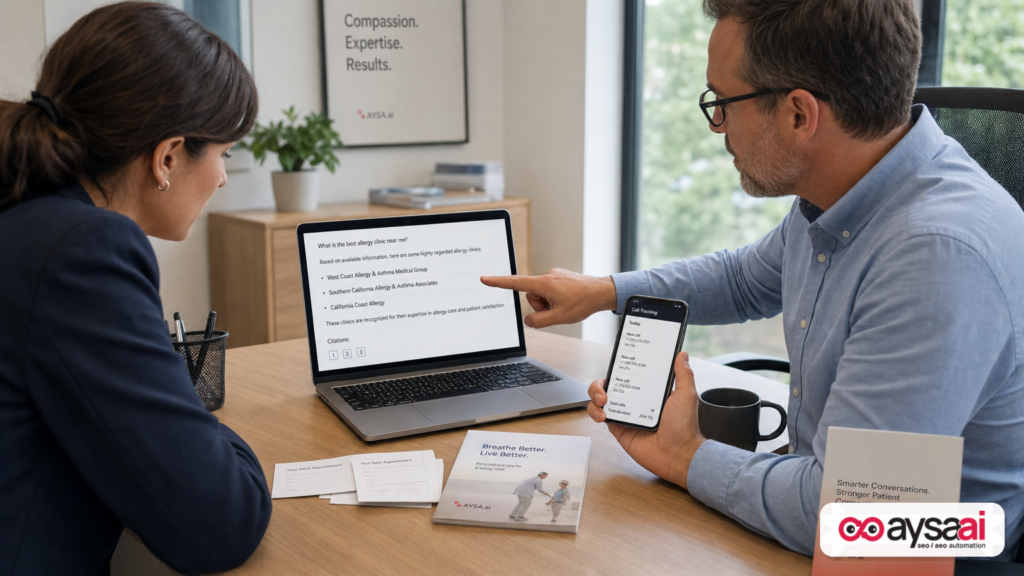
Problem in AI search: In AI Mode or AI Overviews, the user asks: “Is allergy testing painful? What should I expect?” The AI answer summarizes a mix of medical sites and—crucially—threads from forums where people share experiences. The clinic is not cited, even though they offer the service. The click goes to a national publisher or a forum, not the local clinic.
Why the clinic loses the citation battle
- The clinic’s service page is written like a brochure, not an explainer.
- There’s no page that answers the question with structured clarity: step-by-step process, who it’s for, what it feels like, aftercare, safety, contraindications, and what varies by patient.
- They don’t provide citations to reputable medical references (even if they are a reputable provider).
- They have minimal “proof” content: no physician-reviewed educational hub, no editorial policy, no update dates.
What winning looks like now
They create an Allergy Testing: What to Expect guide that is:
- Physician-reviewed (with a clear reviewer bio and credentials)
- Updated with a visible “last reviewed” date
- Structured with direct answers, bulleted steps, and clear definitions
- Includes a short “What varies by patient” section (helps AI avoid overgeneralizing)
- Includes internal links to locations and booking options
Then they amplify it:
- Share it with local partners (pediatric offices, schools) who may reference it
- Encourage existing patients to bookmark the educational hub
- Make it discoverable in onsite navigation
Result: the clinic becomes a citeable local authority—not only a place to book.
The Strategic Shift: From SEO Rankings to AI Citations (AEO/GEO)
In the last two decades, SEO rewarded teams who could:
- Target keywords
- Build pages
- Earn links
- Improve technical performance
That still matters. But AI search adds an extra layer: the model must be able to extract and trust a specific claim from your content. That’s the heart of AEO/GEO (Answer Engine Optimization / Generative Engine Optimization): optimize not just for ranking, but for being used as an answer source.
Rankings vs citations: the new mental model
- Ranking is about your page being positioned among options.
- Citation is about your content being used as evidence in a synthesized answer.
In AI search, citations can matter more than rank for two reasons:
- The user may never scroll to classic results.
- The user may treat cited links as “the truth sources.”
Preferred Sources adds a third element: user preference can increase the visibility of a citation. So the formula becomes:
AI visibility = eligibility (quality) + extractability (clarity) + authority (references) + preference (loyalty)
A Practical Playbook to Earn AI Citations
This is the section most businesses need: what to do that is concrete, safe, and actually aligned with how AI-driven search appears to be evolving.
1) Build “citation-ready” content, not just blog posts
AI systems cite content that is easy to quote accurately. That tends to be:
- Definitions (what something is)
- Processes (how something works, step-by-step)
- Comparisons (A vs B, pros/cons, who it’s for)
- Policies (returns, warranties, privacy, shipping, guarantees)
- Specifications (dimensions, materials, compatibility)
- Original research (even small-scale: survey, benchmarks, methodology)
Most SME sites are missing these as dedicated, well-structured pages. They bury them in a paragraph of marketing copy.
2) Make claims provable (show your work)
If you state something that sounds like advice, support it. That doesn’t mean turning your website into a research paper. It means adding lightweight provenance:
- “Reviewed by” (with a real person, role, and credentials)
- “Last updated” dates where accuracy matters
- Primary references when relevant (industry standards, regulatory pages, manufacturer docs)
When you can’t cite a primary source, write in a way that is clearly framed as guidance, not a universal fact.
3) Engineer internal linking for AI journeys
AI citations often land on informational pages. Those pages must smoothly route users to action:
- Local pages (if the intent is local)
- Product pages (if the intent is purchase)
- Booking/contact flows
- Pricing explainers
This is classic SEO, but the priority changes: the informational page becomes an entry point more often than before. Treat it like a landing page—without ruining it with aggressive sales tactics.
4) Pursue authority through references and attribution chains
Highly Cited labels and citation relationships are a reminder that the web runs on references. For SMEs, the practical version is:
- Get mentioned in reputable local or industry publications
- Publish resources that partners reference (not just “guest posts”)
- Be the source people point to when they explain your niche
And when you cite others (standards bodies, regulators, manufacturers), cite them clearly. Google is making citation chains more visible in standard results; that can reward responsible attribution behaviors over time.
5) Encourage loyalty in ways that map to Preferred Sources
You can’t force preference. But you can create the conditions for it:
- Email newsletters that consistently deliver value
- Member/subscriber content (where it makes sense)
- A habit-forming resource hub (calculators, checklists, how-to guides)
Then, use a light-touch ask: “If you find our guides helpful, add us as a preferred source in Google so you see our work in AI results.”
Note: Google’s documentation on “how websites can encourage visitors to select them” is referenced by SEJ, but the primary doc URL is not included in the provided research context. If you use guidance here, verify against Google’s official documentation directly before implementing.
6) Treat forums/social as a surface area you can influence (carefully)
The upcoming perspectives carousel underscores an uncomfortable truth: the internet’s conversation about you is part of your search presence.
What to do (without being cringe):
- Identify the top 3-5 communities where your customers ask questions
- Have an authentic subject-matter expert participate periodically
- When appropriate, link to your best resource page (not your homepage)
- Address complaints publicly and respectfully; don’t litigate in threads
AI systems love firsthand experiences. If you ignore them, you concede that ground.
What to Monitor Weekly (SME + Agency checklists)
The fastest way to fall behind in AI search is to treat it as “something we’ll look at later.” AI surfaces change frequently. You need a lightweight monitoring habit.
SME weekly monitoring checklist (60–90 minutes)
- Brand queries in Google: what does AI show? Which sources are cited?
- Top 10 non-brand queries: do AI Overviews appear? Are you cited?
- Reputation scan: are forums/social posts showing up for key questions?
- Content freshness: which top pages should be updated for clarity or accuracy?
- Conversion paths: do informational pages have clear next steps?
Agency monitoring checklist (client-safe)
- Track AI citation presence by query cluster (informational vs transactional vs local)
- Log which competitors are cited and why (format, structure, authority)
- Audit whether client pages are quoteable without caveats
- Identify missing “canonical reference” assets (policy pages, how-it-works, comparisons)
- Maintain a change log with approvals (who approved what, when)
Monitoring is the difference between “we hope the AI cites us someday” and “we can explain why we gained or lost citations this month.”
An Execution-First Playbook: How AYSA Helps You Win AI Visibility Safely
Most teams don’t fail because they don’t understand what to do. They fail because they can’t execute consistently without breaking things.
That’s the philosophy behind AYSA: an AI-assisted system that monitors opportunities, prepares recommended website changes, asks for approval, and executes the changes you accept.
If you want the short version: AI search is moving too fast for “quarterly SEO.” But it’s too risky for uncontrolled automation. Approval-first execution is how you scale without gambling.
1) Monitor AI search visibility like a channel, not a curiosity
AYSA supports continuous monitoring so you can see visibility shifts early and respond while it still matters. Explore the monitoring approach here: AYSA Monitoring.
2) Build toward AI citations with an AI visibility system
Winning in AI Overviews/AI Mode is not a single optimization; it’s a system. Start with the framework we publish around AI search visibility: AI Search Visibility.
3) Use AI SEO tools—but keep humans in charge
Tools are necessary for speed, but businesses need controls. See how we think about AI SEO tooling and workflows: AI SEO Tools.
4) Approved execution: ship improvements without site roulette
The operational win is simple: AYSA can propose improvements like:
- Clarifying headings and definitions for extraction
- Strengthening internal links and navigation
- Improving content structure for common AI questions
- Creating or expanding reference-style pages (FAQs, comparisons, “how it works”)
But it doesn’t just “push changes.” It asks for approval before execution—keeping stakeholders aligned and reducing risk.
5) Make it financially viable for SMEs
AI-era optimization can’t require an enterprise team. If you’re evaluating what this looks like operationally, pricing and packaging live here: AYSA Pricing.
6) Keep learning (because this landscape will keep moving)
We publish ongoing guidance and editorials on where AI search is headed and how businesses can adapt: AYSA Blog.
What to do next
- Pick 10 priority queries customers ask (mix informational + local/transactional). Search them and document: does AI appear, and who is cited?
- Identify your “citation gaps.” For each query, ask: do we have a page that answers this clearly enough to quote?
- Create 3 citation-ready assets this quarter: (a) a definitive explainer, (b) a comparison page, (c) a policy/process page that removes uncertainty.
- Upgrade trust signals on key content: author/reviewer, update dates, references where appropriate.
- Build internal paths to conversion from informational pages (location, booking, product selection).
- Set up monitoring so you notice when citations shift—then respond with controlled, approved execution.
Sources and further reading
- Search Engine Journal: Google Preferred Sources Hit 345K, Expand Into AI Search (primary research input for this editorial)
- Search Engine Journal – Latest News (context on ongoing Google/AI search changes)
- Search Engine Journal – SEO coverage (broader industry context)
- Search Engine Journal – Local SEO (useful for multi-location and local visibility implications)
Editorial note on sourcing: The supplied research context references Google statements, a product manager comment, and mentions Google documentation and a John Mueller clarification, but does not include direct URLs to those primary sources. Where primary documentation is required to implement changes, verify directly with Google’s official documentation before shipping updates.
Continue the AI search topic inside AYSA.
Use these pages to connect the article with AI SEO tools, AI visibility monitoring, AI Overviews and approved website execution.
Turn this topic into a website action plan.
Use these AYSA hubs to move from reading to technical fixes, AI visibility monitoring, research, glossary context and approval-first SEO execution.

