
Preferred Sources, “Highly Cited,” and the New Rules of AI Search: A Practical Playbook for SMEs
Google is pulling “who you trust” and “who gets cited” directly into AI Overviews and AI Mode. Here’s what changed, why it will reshape click behavior, and the concrete steps SMEs and agencies should take—plus how AYSA turns strategy into approved execution.

Author: Marius Dosinescu (AYSA.ai)
Google is pushing a simple idea deeper into the product: Search should help you find information you trust from the sources you value. In May 2026, Google announced that “Preferred Sources” is coming directly into AI Overviews and AI Mode, along with new “fresh perspectives” link carousels and expanded “Highly Cited” labels that help people identify influential, primary coverage.
If you run a small or midsize business, this isn’t “publisher news.” These interface decisions will shape which brands get clicked, which pages become default references inside AI answers, and which websites are treated as firsthand sources rather than interchangeable commodity pages.
This editorial is a practical playbook: what changed, why it matters, what can go wrong, and what you should do next—whether you’re an SME, a marketing lead, or an agency. I’ll also explain where AYSA’s AI Search Visibility approach fits: monitor what’s happening, prepare specific improvements, ask for your approval, and execute accepted changes safely.
Concise summary
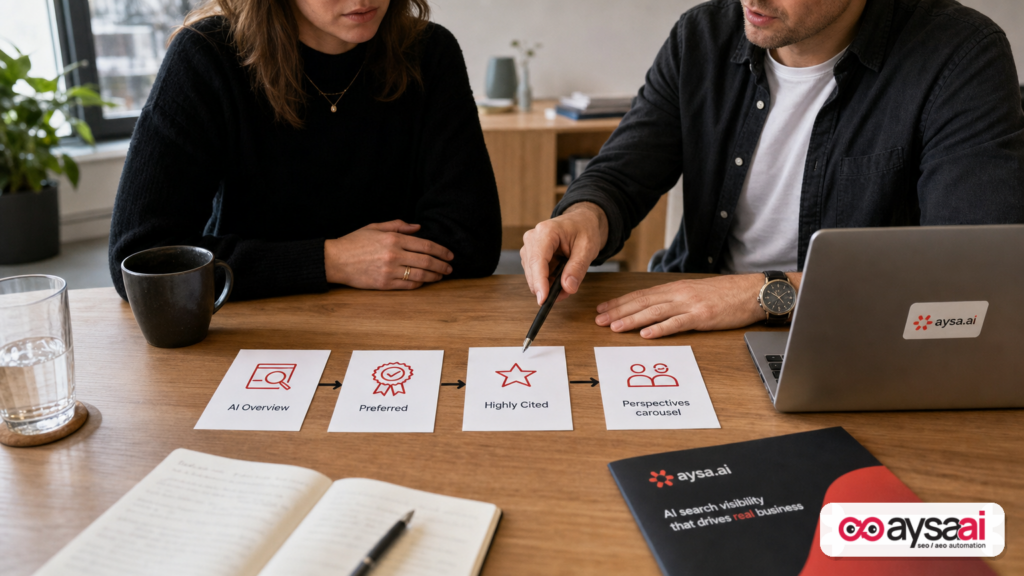
- Preferred Sources (user-selected sites) now appears inside AI Overviews and AI Mode with clear labels, making “brand preference” a visible layer in AI answers.
- Google is adding prominent link carousels for developing topics and for “perspectives” from forums/social discussions, making the SERP more like an editorial hub than a list of blue links.
- Highly Cited labels expand across web article results to help people spot reporting that many other stories cite—rewarding being the source of record, not the paraphrase.
- For SMEs, the game shifts from “rank a page” to “become a cited, preferred, and dependable source” across AI interfaces.
Key takeaways (the business version)
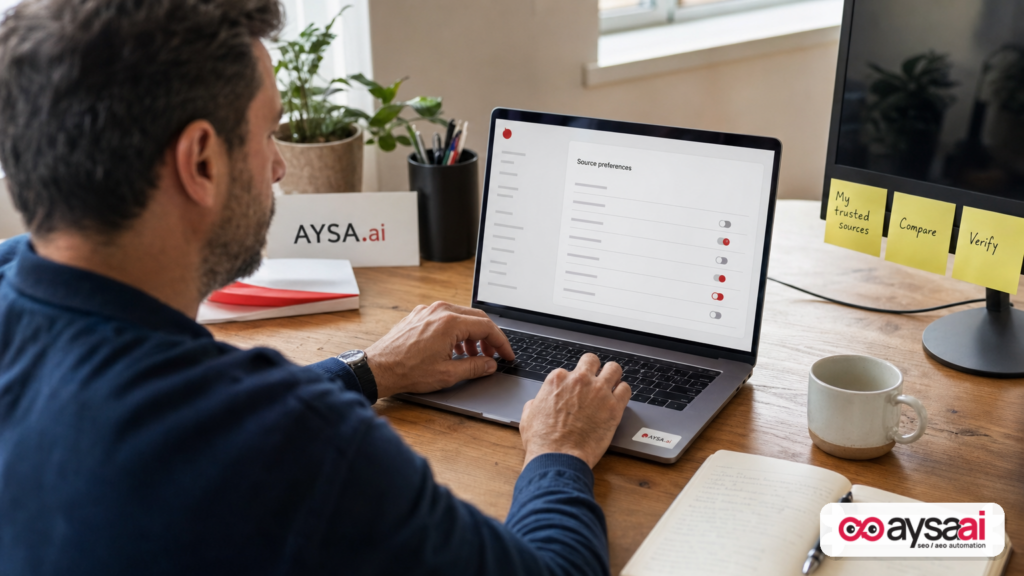
- Demand for trust signals will rise. AI answers compress the journey; users need fast ways to choose what to click. Google is providing those shortcuts.
- Brand gravity matters again. Preferred Sources introduces an explicit “I trust this” input that can make your links stand out in AI answers.
- Originality becomes measurable in practice. “Highly Cited” is an interface label that implicitly rewards primary sources and influential coverage.
- Execution speed becomes a moat. The winners will be the teams that monitor changes, ship improvements, and keep content fresh and attributable.
- AI Search Optimization is not just SEO. It’s AEO/GEO plus brand, editorial rigor, and technical reliability.
Table of contents

- What actually changed in Google’s AI Search (and why it’s different this time)
- The bigger context: why Google is elevating sources, citations, and perspectives
- Why “Preferred Sources” is a behavioral change, not a feature
- Fresh perspectives and prominent links: how SERP real estate is being reallocated
- The “Highly Cited” label: what it rewards (and what it can accidentally punish)
- What can go wrong: failure modes for SMEs and agencies
- A concrete SME scenario: a local clinic and an ecommerce brand competing in AI answers
- What you should monitor weekly (not quarterly) now
- What to publish (and how to publish) to become a preferred, cited source
- Technical foundation for AI Search: the boring work that suddenly pays
- Agency reset: how retainers and reporting need to change
- Where AYSA fits: from monitoring to approved execution
- What to do next (30/60/90-day action list)
- Sources and further reading
What actually changed in Google’s AI Search (and why it’s different this time)
Google’s announcement is not a new model release. It’s a distribution change. Distribution changes are where markets shift because they change what people see and click by default.
According to Google’s Search team, three related updates are rolling into the AI Search experience:
1) Preferred Sources is now inside AI Overviews and AI Mode
Preferred Sources was previously associated with surfaces like Top Stories. Now it is explicitly integrated into AI responses so users can “easily spot links” from sites they’ve chosen, with labels that make those links stand out.
Google also describes how users can manage these preferences in Search personalization settings and notes that any website that publishes fresh content can be eligible. (That eligibility line matters for SMEs: this is not reserved for major publishers.)
2) A prominent link carousel for developing topics and “perspectives”
For some queries about developing topics, Google says it will show a carousel after providing initial context, helping searchers quickly access timely articles. A similar carousel is planned for queries where users want “insights from others,” pulling from online discussions, forums, and social media.
3) “Highly Cited” labels expand in results
Google is adding “Highly Cited” badges to more web article links on the search results page. The intent: make it easier to identify coverage that many other stories cite and, in some cases, indicate when an article references a Highly Cited source.
Why this is different: It moves source preference and citation influence from background ranking signals into front-of-house UI. When UI changes, user behavior changes—even if the underlying ranking systems didn’t move much.
Primary source: Google Search Blog, “New ways to find your favorite sources and original content in AI Search” (Read the source article on blog.google).
The bigger context: why Google is elevating sources, citations, and perspectives
To understand why these changes matter, zoom out from “features” to “incentives.” Google is balancing multiple pressures at once:
- AI interfaces compress attention. When an AI Overview gives a synthesized answer, fewer people need to open ten tabs. That makes the remaining Clicks more valuable—and more contested.
- Trust is the limiting factor. In AI answers, users quickly ask: “Who says this?” Google is making the “who” more visible.
- The web needs incentives. Google’s product depends on the web continuing to publish original content. Highlighting original reporting and firsthand perspectives is a way to keep creators and publishers in the loop.
- Personalization is a safe middle ground. Letting users choose Preferred Sources shifts part of the “trust decision” to the user, which can help satisfy different needs without Google declaring one source universally best for every person.
From an SME perspective, this is a familiar pattern: when an industry moves from “infinite shelf space” to “curated shelf space,” the winners are those that become default picks—the brands that get remembered, re-cited, and re-selected.
Why “Preferred Sources” is a behavioral change, not a feature
Preferred Sources sounds like a preference toggle. But in practice, it’s closer to a new distribution channel:
- It rewards brand relationships, not just rankings. If a user chooses you as a preferred source, your link can visually stand out in AI responses, even when competing content exists.
- It turns “trust” into an action. Historically, users expressed trust by clicking repeatedly over time. Now they can formalize it.
- It creates a “sticky” advantage. Once preferred, you’re not re-competing from scratch on every query; you’re competing for a spot with a badge.
Google’s post suggests this change increases click propensity toward preferred sources. I won’t add numbers beyond what Google stated in their announcement, but the direction is obvious: if a user is already inclined to trust you, the UI can amplify that choice.
What this means for SMEs
SMEs often think: “We can’t beat the big sites.” Preferred Sources is an example of where that assumption can break down—because preference is personal. A regional business publication, a niche industry blog, a local specialist clinic, or a focused ecommerce brand can become a favorite within a specific audience.
But you don’t get preferred by accident. You earn it by being consistently useful, consistently original, and consistently current.
Practical moves to earn “preferred” status
- Ask directly. If you have an email list, community, or customer base, consider educating readers on how to set Preferred Sources in Search personalization settings. Do it in a helpful way, not a manipulative one.
- Publish “fresh content” in your lane. Google’s post emphasizes freshness eligibility. For SMEs, “fresh” doesn’t mean daily news—it means timely updates: pricing changes, policy changes, new regulations, seasonal guides, new product drops, and “what changed this year” comparisons.
- Make your pages easy to identify and trust. Clear authorship, clear update dates when relevant, clear about pages, clear citations. (More on this in the technical and content sections.)
AYSA angle: earning preferred status is a system, not a one-off. You need monitoring and steady improvements. That’s the gap between strategy decks and outcomes—one AYSA is designed to close.
Fresh perspectives and prominent links: how SERP real estate is being reallocated
Carousels are not neutral design. They change what people see first, and they compress the “consideration set” into a small strip of choices.
Google describes two carousel patterns:
- Developing topics carousel: For some searches about a developing topic, users get initial context and then a prominent set of links—also highlighting Preferred Sources.
- Perspectives carousel: For some searches seeking “insights from others,” Google plans to show a similar set of links to discussions, forums, and social content that reflect firsthand experiences.
Why this matters for your business
These carousels do two things at once:
- They legitimize new kinds of sources. Forums and social posts become part of the “answer package,” not a side quest.
- They shift competition from rankings to selection. It’s less “can I rank #3?” and more “can I be one of the 6 visible links someone considers?”
That means your business content strategy should expand beyond “blog posts that rank” into “assets that get selected.” Assets that get selected tend to be:
- Specific (answers a narrow question clearly)
- Attributable (clear author/business identity)
- Current (updated when things change)
- Tested (backed by firsthand experience, data you collected, or clear methodology)
The opportunity (and risk) of perspectives content
For SMEs, perspectives are an opportunity because you can produce firsthand insight at a lower cost than a national publisher. You already have real customers, real delivery constraints, real seasonality, real inventory, real service boundaries—things generic content farms can’t replicate honestly.
The risk: “perspectives” can also reward low-quality hot takes. Businesses should resist that temptation. Your best move is to create useful, verifiable experiences that people can reference.
The “Highly Cited” label: what it rewards (and what it can accidentally punish)
The “Highly Cited” label is simple: it highlights articles that many other stories cite, helping users find the primary reporting that others reference. Google also says it may indicate when an article explicitly references a Highly Cited source.
Even if you’re not a newsroom, this concept should ring alarms (in a good way): AI Search is leaning into citation-based authority as a user-visible signal.
Why SMEs should care about a label that sounds like “news”
Because “cited” is not limited to breaking news. In many industries, the most valuable pages are the ones that become reference points:
- “2026 shipping restrictions for lithium batteries” (ecommerce logistics)
- “Insurance coverage changes for X procedure” (clinics)
- “State-by-state licensing checklist” (local services)
- “Compatibility matrix” (SaaS/integrations)
- “Annual pricing benchmarks” (B2B)
When other sites, bloggers, journalists, or community threads reference the best explanation, that explanation becomes a citation hub. Google making “highly cited” visible nudges users—and AI systems—toward those hubs.
What the label effectively rewards
- Original work: primary reporting, primary experiments, primary documentation, or truly unique explainers.
- Clarity: pages others can reference confidently.
- Stability: URLs and content that remain accessible and consistent over time.
What it can accidentally punish
- Fast-followers and paraphrasers. If your strategy is “rewrite what’s trending,” you’re training the web to cite someone else.
- Thin SEO pages. If your content is interchangeable, it’s less likely to be cited—even if it ranks today.
- Businesses with messy attribution. No author, no date context, no references, unclear claims—harder to cite responsibly.
Important note: Google’s post doesn’t describe the exact thresholds or mechanisms behind “Highly Cited,” and we shouldn’t speculate. But we can still act on the underlying incentive: be the source worth citing.
What can go wrong: failure modes for SMEs and agencies
Whenever Google redesigns the “choices layer” of Search, the market overreacts in predictable ways. Here are the failure modes I’d expect to see as Preferred Sources and Highly Cited labels become more visible in AI experiences.
Failure mode 1: Treating AI Search like a snippet hack
SMEs and agencies will chase templates: “Write in Q&A format,” “add more lists,” “stuff definitions.” Those tactics may help readability, but they don’t create preference or citations.
Fix: Create assets that are provably better: updated guides, comparison tables that reflect real inventory or real service constraints, and pages that cite primary sources appropriately.
Failure mode 2: Confusing “perspective” with “opinion”
A firsthand perspective is not a rant. It’s a report from lived experience: what happened, what was tried, what worked, what failed, what you’d do differently.
Fix: Use a repeatable editorial format: problem → constraints → approach → outcome → lessons → references. That structure is both human-credible and machine-legible.
Failure mode 3: Ignoring distribution to chase publication volume
If Preferred Sources and carousels are changing selection behavior, then distribution tactics matter: newsletters, customer onboarding emails, receipts, QR cards in-store—every touchpoint can educate customers to return to your content.
Fix: Treat your best pages as products and market them.
Failure mode 4: Agencies keep selling rankings while clients experience “visibility loss”
AI Overviews and AI Mode can satisfy intent quickly. Clients may see fewer clicks even when rankings are stable. If your reporting is still “positions and impressions,” you’ll lose trust.
Fix: Track AI visibility indicators and brand demand signals, and shift KPI conversations toward outcomes: qualified leads, revenue, assisted conversions, and repeat visits from trusted audiences.
A concrete SME scenario: a local clinic and an ecommerce brand competing in AI answers
Let’s make this real with two SMEs that are not publishers:
- Business A: a multi-location physical therapy clinic in a metro area.
- Business B: a niche ecommerce brand selling ergonomic office chairs and accessories.
Clinic: how AI Search shifts patient acquisition
A patient searches: “Is dry needling covered by insurance this year?” or “What’s the recovery timeline after rotator cuff rehab?”
In an AI Overview world, the patient may get a high-level summary instantly. The click now happens only if the clinic’s page is seen as:
- Trustworthy (clear credentials, clear authorship, transparent limitations)
- Specific (state-by-state coverage realities, what to ask your insurer, typical care pathways)
- Current (updated this year with clear date context)
If the clinic becomes a Preferred Source for a subset of patients (or local community members), its links could be visually highlighted in AI answers. That’s a brand flywheel: trust → preference → visibility → more trust.
Ecommerce: how AI Search shifts product discovery
A buyer searches: “Best ergonomic chair for lower back pain under $500” or “mesh vs foam seat for long hours.”
AI Mode can synthesize tradeoffs and show a link carousel of “fresh perspectives.” The ecommerce brand that wins will be the one that offers:
- Original comparisons (not manufacturer copy)
- Fit guidance (height/weight ranges, desk setup compatibility)
- Real-world constraints (shipping, returns, assembly difficulty, warranty details)
- Firsthand content (engineers, product team notes, customer service learnings)
And if reviewers, bloggers, or community threads start citing the brand’s comparison guide as the clearest explanation, it becomes “citable.” That’s how a non-media brand can benefit from citation dynamics.
What you should monitor weekly (not quarterly) now
AI Search changes fast. The businesses that win are the ones that treat it like a product surface that needs ongoing QA, not an annual SEO project.
Here’s a weekly monitoring checklist that’s realistic for SMEs:
1) Your top 20 intent queries and how AI answers behave
- Do you see AI Overviews / AI Mode behavior for these queries?
- Are there prominent carousels? Are forums/social links featured?
- Which domains show up repeatedly as cited sources?
2) Brand + category queries
- Search: “your brand + reviews,” “your brand + alternatives,” “your brand + warranty/returns.”
- Is the AI narrative accurate?
- Are the links going to your official pages or to resellers/third parties?
3) SERP feature shifts
When Google adds UI labels like “Highly Cited” or Preferred badges, clicks can move even with stable rankings. Watch:
- Which pages are losing clicks without losing impressions?
- Which competitor pages are now visually emphasized?
4) Freshness gaps
- Which of your top pages haven’t been reviewed in 6–12 months?
- Do they include outdated claims, old product lines, old policy language?
If you want a system for this, that’s exactly what AYSA Monitoring is built to support: ongoing checks that turn into prioritized recommendations you can approve and ship.
What to publish (and how to publish) to become a preferred, cited source
If AI Search is elevating preferred sources and citation signals, then your content roadmap should aim for three outcomes:
- Be selected (carousels and AI answers)
- Be trusted (preference and repeat usage)
- Be cited (influence beyond your own site)
Content types that earn preference and citations
For SMEs, the highest ROI formats are typically:
- “What changed this year” updates in your category (regulations, pricing, best practices, compatibility changes).
- Comparison pages built from your real constraints (inventory, shipping zones, service scope, outcomes).
- Checklists and decision frameworks that reduce risk for the buyer (questions to ask, red flags, timelines).
- Firsthand case notes (anonymized where needed) with methodology and lessons learned.
- Glossaries only if they include unique interpretation, examples, and “why it matters in practice,” not dictionary definitions.
How to write for AI Search without writing “for the machine”
The best AI-friendly content is actually human-friendly editorial discipline:
- Make the claim testable. If you say “most,” define the boundary. If you can’t, qualify responsibly.
- Show your work. Explain how you know: customer support volume patterns, return reasons, technician notes, or clearly cited external references.
- Separate facts from recommendations. AI answers can blur these; you must not.
- Update visibly. Add “Last reviewed” and update notes where appropriate (and keep them honest).
Distribution: how to actually become a Preferred Source
You become preferred by showing up repeatedly in someone’s life. Practical channels SMEs can control:
- Customer onboarding emails (“Here’s our maintenance guide / buyer’s checklist”)
- Post-purchase flows (“Bookmark this troubleshooting page”)
- Support macros that link to your best explanations
- Community posts where you answer with substance and link to deeper guidance
- Receipts, packaging inserts, appointment follow-ups with “read this next”
This is where SEO turns into business operations. And it’s why execution systems matter: if you’re updating guides monthly, you need a repeatable workflow, not heroics.
Technical foundation for AI Search: the boring work that suddenly pays
Most “AI Search strategy” conversations ignore the basics: crawlability, canonicalization, structured information, and page hygiene. But when your content is being selected and summarized, the foundation matters more, not less.
Here’s what I’d prioritize for SMEs without pretending we can reverse-engineer Google’s internal AI pipelines:
1) Keep URLs stable and canonical
- Avoid multiple URLs for the same content (tracking params, duplicate category pages, printer versions).
- Ensure canonical tags are consistent.
2) Make authorship and accountability clear
- Add author bios where appropriate (especially for YMYL-adjacent topics like health or finance).
- Include editorial review processes when relevant.
3) Keep page experience clean
- Don’t bury the answer under popups.
- Don’t require cookie walls to read essential guidance (where possible).
- Ensure mobile readability and fast loading.
4) Structure content for scanning
- Clear headings that match real questions.
- Tables where comparisons matter.
- Summaries and “next steps” sections.
If you want a system to operationalize these improvements, this is where AYSA AI SEO tools and Monitoring fit: detect issues, propose fixes, route them for approval, and implement accepted changes.
Agency reset: how retainers and reporting need to change
Agencies are about to face a credibility squeeze.
When AI Overviews and AI Mode satisfy intent quickly, your client may see:
- Stable rankings
- Stable impressions
- Lower clicks
If you keep selling “we’ll get you to position #1,” you’ll be arguing about a metric that no longer maps neatly to business outcomes.
Deliverables that will matter more
- AI visibility tracking (presence in AI answers, link inclusion patterns, competitor source dominance)
- Content governance (update cadence, ownership, review workflow)
- Authority building through originality (research, unique comparisons, practitioner content)
- Execution velocity (ship improvements weekly, not quarterly)
Why operations is the new competitive advantage
Most agencies can write a content brief. Fewer can deploy improvements consistently across dozens of client sites with quality control.
That’s the “approved execution” gap: clients want change, but they fear breaking the site. They also hate endless ticket loops. A system that prepares changes and asks for approval before executing is a practical compromise.
If you run an agency, you’ll want to explore how AYSA supports that model through plans built for execution and a workflow that aligns stakeholders.
Where AYSA fits: from monitoring to approved execution
At AYSA.ai, we’re building for the reality that AI Search creates: more surfaces, more volatility, and more need for trustworthy, current content.
Our stance is simple: strategy without execution is theater. And execution without governance is dangerous.
Here’s how AYSA fits the Preferred Sources / Highly Cited / Perspectives era:
1) Monitor what matters
Use Monitoring to keep a pulse on your pages, issues, and opportunities—so you’re not discovering problems after traffic drops.
2) Prepare improvements that map to AI Search behavior
AI Search rewards clarity, freshness, and credible sourcing. AYSA is designed to recommend changes that make pages more useful and more likely to be selected and trusted—without pretending there’s a single “AI SEO trick.”
3) Ask for approval (always)
SMEs and agencies need guardrails. AYSA prepares changes, then asks you to approve them. You stay in control.
4) Execute accepted changes on the website
Execution is the hard part. AYSA is built to implement accepted updates so teams don’t get stuck in backlog hell. This is how you maintain the cadence needed in AI Search.
If you’re just starting, see AI Search Visibility for the broader framework, and browse tactical guidance in our blog.
What to do next (30/60/90-day action list)
You don’t need to overhaul everything. You need a sequence. Here’s a practical plan that SMEs can execute without hiring a newsroom.
Days 0–30: Protect and clarify
- Identify your top 20 money queries (the queries that lead to revenue or leads).
- Audit your top 20 landing pages: are they current, attributable, and specific?
- Add or improve “last reviewed” signals where it’s honest and useful.
- Create one “reference page” you want others to cite (a checklist, framework, or comparison).
- Set up a monitoring cadence so you catch breakage and drift early.
Days 31–60: Become worth citing
- Publish 2–4 firsthand perspective pieces (case notes, experiments, or “what we learned”).
- Upgrade 5 existing pages with clearer structure, better comparisons, and explicit limitations.
- Build a small outreach loop: share the best guide with partners, suppliers, associations, and communities that would genuinely benefit.
Days 61–90: Drive preference and repeat visits
- Instrument distribution: add your best guides into onboarding/support/post-purchase communications.
- Educate your audience (lightly) on how to follow your content and return to it—without spamming.
- Standardize editorial updates: assign owners, set quarterly reviews for key pages, create a “what changed” template.
What to do next (quick list)
- Pick one topic where your business has genuine expertise.
- Create the best, most current “reference page” in your niche.
- Update it monthly for 90 days (small changes count if they’re real).
- Distribute it through support, sales, and customer success flows.
- Monitor which competitor sources appear in AI answers for your top queries.
- Use a system (like AYSA) to turn findings into approved website changes.
My perspective: AI Search is reintroducing editorial economics
For years, many SMEs experienced SEO as a technical contest and a volume game: publish more, target more keywords, build more links, wait for rankings.
AI Search is pulling the market back toward older, more human economics:
- People want to know who to trust.
- They prefer sources that consistently help them.
- They cite the clearest explanation.
Preferred Sources, perspectives carousels, and Highly Cited labels are interface-level mechanisms that make those economics visible. That’s why this update matters.
And it’s why I’m bullish on “execution systems” over “strategy PDFs.” Monitoring, preparing, approving, and shipping improvements—week after week—is how SMEs and agencies will win the next chapter of Search.
Sources and further reading
- Google Search Blog (The Keyword): New ways to find your favorite sources and original content in AI Search (primary source for Preferred Sources in AI Overviews/AI Mode, link carousels, and Highly Cited labels)
- Google DeepMind blog: deepmind.google/blog (official Google AI research and product context)
- Google Research blog: research.google/blog (official research context)
- Google Developers Blog: developers.googleblog.com (official technical updates; useful when Search-related tooling/documentation is referenced)
- Google Cloud blog: cloud.google.com/blog (official infrastructure/AI context)
Related AYSA resources:
Continue the AI search topic inside AYSA.
Use these pages to connect the article with AI SEO tools, AI visibility monitoring, AI Overviews and approved website execution.
Turn this topic into a website action plan.
Use these AYSA hubs to move from reading to technical fixes, AI visibility monitoring, research, glossary context and approval-first SEO execution.

