
No “GSC for ChatGPT”: How To Prove Your Page Can Be Retrieved In AI Search (And What To Fix When It Can’t)
AI search visibility starts before you ever earn a citation: your page must be discoverable, fetchable, and retrievable inside the chatbot’s search pipeline. Here’s a practical workflow to test retrieval with exact-match snippets, diagnose failures like blocking and orphaning, and turn the results into an execution plan—plus how AYSA operationalizes monitoring and approved fixes.

There’s a new kind of visibility question showing up in every board meeting and every agency QBR:
“Why aren’t we showing up in ChatGPT?”
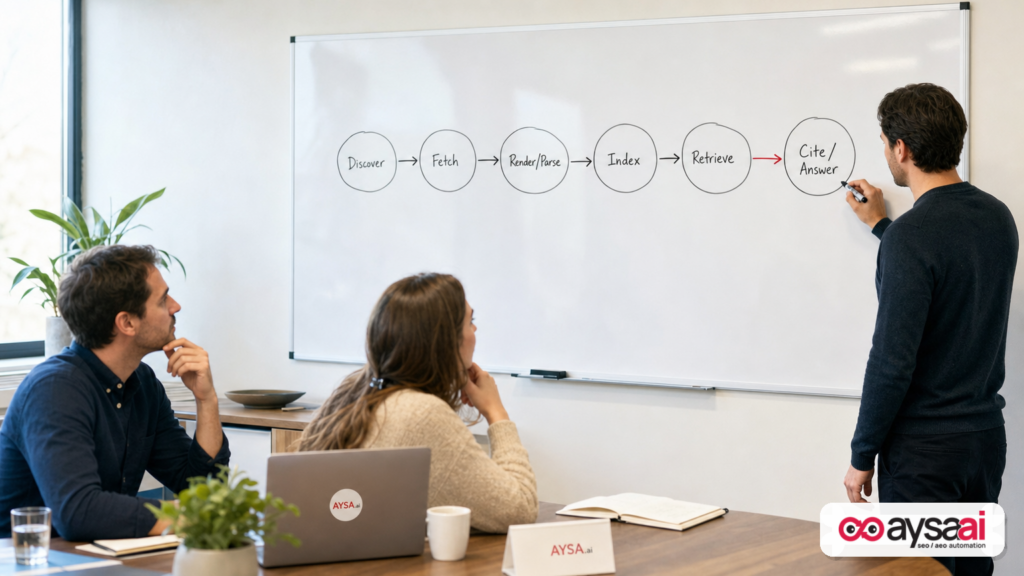
The uncomfortable truth is that AI Search has a pipeline—discovery, fetching, parsing, Indexing, retrieval, and then (maybe) a citation—but it doesn’t come with the familiar instrumentation we’ve relied on for 15+ years. There is no universal “Google Search Console for chatbots.”
That doesn’t mean you’re powerless. It means you need a more operator-style workflow: prove whether your content can be retrieved, then fix the bottleneck.
This editorial is inspired by a practical idea highlighted by Chris Green at Search Engine Journal: use distinctive exact-match snippets to test whether a page is appearing in the retrieval sources a chatbot can access. If your URL comes back, retrieval likely isn’t the problem; if it doesn’t, you have a short list of technical and content causes to investigate. (Source: Search Engine Journal.)
Concise Summary (What This Article Covers)
- AI visibility is a pipeline problem: before you worry about “ranking in ChatGPT,” confirm your page can be discovered and retrieved.
- You can test retrieval today: paste a distinctive 20–30 word passage into a chatbot with search and request exact matches.
- Failed tests are usually fixable: orphaning, blocking (WAF/robots), rendering issues, canonicals/Noindex, weak or non-distinct content.
- Passing retrieval doesn’t guarantee citations or Clicks: authority, usefulness, and competitive context still decide whether you get referenced.
- AYSA’s role: turn these checks into continuous Monitoring and Approved Execution—identify issues, prepare fixes, ask for approval, and ship changes.
Table of Contents
- What Changed: From Indexing To Retrieval Pipelines
- The New Reality: AI Search Has A Retrieval Pipeline, But Not A Console
- Why “Can It Be Retrieved?” Is The First Question To Answer
- A Practical Retrieval Test You Can Run Today (No Special Tools)
- How To Pick A Snippet That Actually Works
- How To Interpret Results Without Over-Trusting The Bot
- When The Test Fails: A Diagnostic Tree For SMEs (Discoverability → Fetching → Indexing → Competitiveness)
- If Retrieval Works But You Still Don’t Get Cited (Or Clicks)
- How To Structure Content So LLMs Can Use It Reliably
- Measurement Reality: What You Can Track (And What You Can’t Yet)
- A Concrete SME Scenario: Local Clinic vs. AI Search
- What Agencies Should Rethink In The AI Search Era
- How AYSA Turns Retrieval Checks Into Approved Execution (Not Just Reports)
- What To Do Next (Action List)
- Sources And Further Reading
What Changed: From Indexing To Retrieval Pipelines
Traditional SEO trained an entire industry to think in one dominant mental model:
- Googlebot discovers a URL.
- Google crawls it, renders it, indexes it.
- Your page ranks for queries; you measure impressions and clicks.
Even when the algorithm felt mysterious, the workflow was testable. You could:
- Check indexing coverage in Google Search Console (if you had access).
- Inspect URLs, validate sitemaps, and spot
noindexor canonical issues. - Use server logs and crawl tools to see what bots actually did.
Now, AI search adds two realities:
- Multiple retrieval sources: different chatbots and “AI answers” can pull from different indexes and providers.
- Different output incentives: the goal isn’t always “ten blue links.” The goal is an answer—often a synthesized one—where citations are optional.
This is why business owners feel like visibility has become foggier. Not because it’s impossible, but because the instrumentation is immature and fragmented.
That’s the gap Chris Green’s SEJ piece addresses: when you can’t access a console, you can still run a practical retrieval check using an exact-match snippet prompt. (Again, source: Search Engine Journal.)
The New Reality: AI Search Has A Retrieval Pipeline, But Not A Console
Let’s make this plain-English:
An AI system cannot cite or use what it cannot retrieve.
“Retrieval” here means: when the chatbot (or AI answer system) uses some form of search tool to pull in web documents, does your page show up as a candidate source?
Conceptually, the pipeline looks like this:
- Discovery: can the system find your URL via links, sitemaps, feeds, or other sources?
- Fetching: can it request the page successfully, without being blocked or redirected into oblivion?
- Rendering/Parsing: can it extract the main content (not just navigation and boilerplate)?
- Indexing/Storage: does it store it in whatever index or cache it relies on?
- Retrieval: can it pull the right passage back when prompted?
- Use: does it trust the information enough to cite or paraphrase it?
In classic SEO, Google Search Console gives you clues about steps 1–4. In AI search, the controls and reporting are scattered, often absent, and sometimes proprietary.
So we work backwards: if we can force an exact-match retrieval of a distinctive passage, we can infer that earlier steps are working well enough.
Why “Can It Be Retrieved?” Is The First Question To Answer
Businesses waste time when they jump straight to tactics like:
- rewriting content for “GEO” without fixing basic crawl access,
- publishing dozens of AI-generated pages that are orphaned and undiscoverable,
- arguing about prompt strategies while their WAF blocks non-browser user agents.
Here’s the operator logic:
- If your page cannot be retrieved, then debates about “authority” and “helpfulness” are premature.
- If your page can be retrieved but isn’t cited, then the problem is more likely relevance, authority, competition, formatting, or the chatbot’s citation behavior.
Retrieval is the first gate. Clear it before you spend money on everything else.
A Practical Retrieval Test You Can Run Today (No Special Tools)
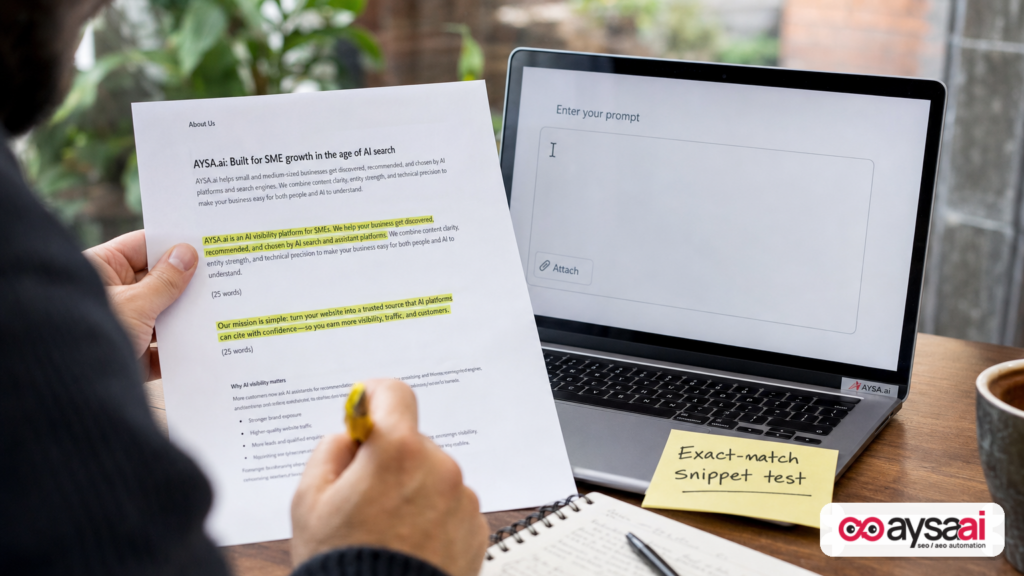
The core workflow, adapted from the SEJ article, is simple:
- Pick a distinctive snippet from the page (20–30 words is a useful range).
- Use a chatbot that can browse/search the web (capability varies by product and settings).
- Ask it to search for exact matches only and return results that contain that exact text.
- Check whether your URL is returned, and whether the content is correctly attributed.
Example prompt pattern (customize it):
Search for: “PASTE DISTINCTIVE SNIPPET HERE”
Return: results that contain that exact text only, and include the source URL.
If your URL appears consistently, you’ve proven something valuable: at least one retrieval source the chatbot uses can find and fetch your page, extract the text, and attribute it to your URL.
This is not a replacement for Search Console. But it’s a strong diagnostic test when you have no console at all.
How To Pick A Snippet That Actually Works
Most people sabotage this test by choosing generic marketing copy.
Bad snippet examples:
- “We deliver best-in-class solutions for your business.”
- “Contact us today to get started.”
- “We’re committed to quality and service.”
Those phrases appear on thousands of pages. If the chatbot returns nothing—or returns random competitors—that tells you nothing.
Good snippet traits:
- Specific nouns: product model names, service names, location names, standards.
- Numbers: pricing tiers (if public), dimensions, dates, steps, ingredient lists, policy thresholds.
- Unique claims that are verifiable: not hype, but factual statements (e.g., “We repair X brand compressors in Y city”).
- Procedural language: checklists, “if/then” conditions, step-by-step instructions.
Practical trick: choose a snippet that includes two anchors of uniqueness—for example, a location + a specific service term, or a product name + a measurement.
Also: don’t choose text inside images, sliders, or interactive widgets unless you know it is actually present as HTML text. If the content is visually on the page but not extractable, retrieval can fail even when humans can read it.
How To Interpret Results Without Over-Trusting The Bot
AI systems are not “truth engines.” They are systems that may call search tools, summarize results, and sometimes make mistakes in attribution or omission.
So interpret your snippet test like a technical SEO test: repeat it, vary it, and look for consistency.
Run multiple tests
- Test 4–5 times if results are inconsistent.
- Use 2–3 different snippets from different sections of the page.
This matters because, as noted in the SEJ piece, a chatbot may call different sources at different times; your goal is not to “win one run,” but to determine whether retrieval is reliably possible. (Source: Search Engine Journal.)
If the test passes (your URL shows)
You can infer:
- The content exists in at least one search index the chatbot used.
- The page is accessible enough to be fetched and parsed.
- Attribution to your URL is working (at least in that run).
That’s not the same as “you will be cited for competitive prompts.” But it clears the first gate.
If the test fails (your URL does not show)
You have a short list of suspects:
- the page isn’t discoverable,
- the page is blocked (WAF, bot protection, robots),
- the page is non-indexable (noindex/canonical),
- the page content can’t be extracted (rendering/JS),
- the snippet is too generic,
- the page is new and hasn’t been indexed yet.
Next section: how to troubleshoot in a way SMEs can actually execute.
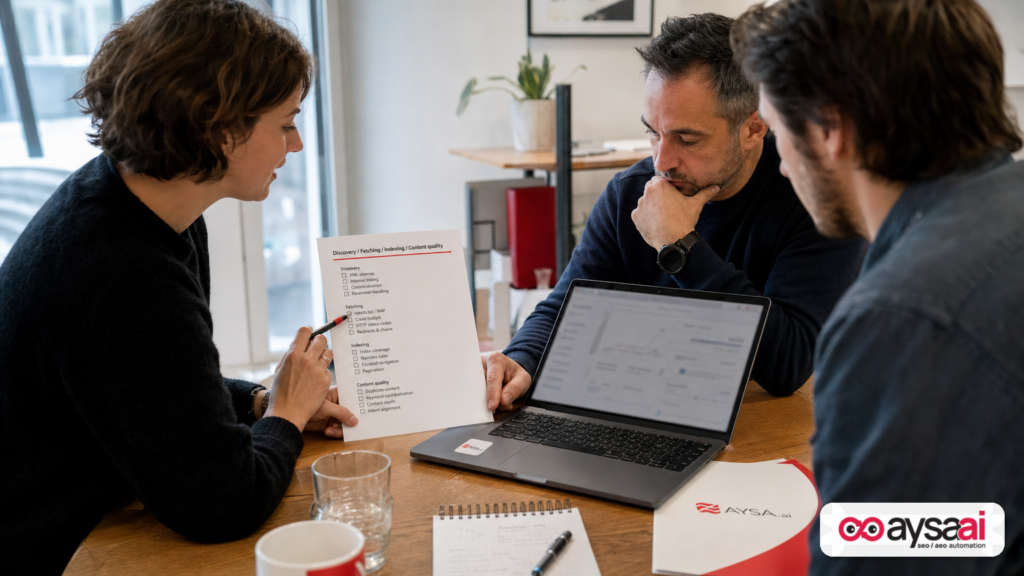
When The Test Fails: A Diagnostic Tree For SMEs (Discoverability → Fetching → Indexing → Competitiveness)
If you’re an SMB owner or a marketing manager without a deep technical team, you need a diagnostic tree that maps to actions you can take (or delegate) without guessing.
1) Discovery: can anything find the URL?
Common failure modes:
- Orphaned pages: a page exists but has no internal links pointing to it.
- Sitemap missing or outdated: new pages aren’t in
sitemap.xmlor the sitemap isn’t referenced. - Generated pages that aren’t published “into” the site: content created in a CMS draft state, preview URLs, or hidden sections.
What to do:
- Add at least one contextual internal link from a relevant page.
- Ensure the URL is included in your sitemap and that the sitemap is accessible.
- Avoid “shadow content” that lives behind parameters, previews, or gated flows unless that’s intentional.
Even before AI search, these were SEO basics. Now they’re also AI retrieval basics.
2) Fetching: can a bot request the page without being blocked?
The #1 modern culprit is security tooling. Many sites have:
- WAF rules that challenge or block unknown user agents,
- bot protection that requires JavaScript to pass,
- rate limiting that silently returns partial content,
- geo/IP restrictions that affect datacenter traffic.
What to do (high level):
- Audit bot security settings with your dev/security vendor.
- Confirm you’re not blocking legitimate crawlers in
robots.txt. - Check that the HTML response contains the main content without requiring heavy client-side rendering.
Note: without access logs, you won’t fully prove what a specific AI crawler did. But your snippet test failing consistently is a strong reason to investigate access and rendering.
3) Indexability signals: are you telling systems not to index?
Common issues:
noindexmeta tags carried over from staging or templates,- canonical tags pointing to a different URL (or to the homepage),
- duplicate pages where canonicals consolidate away the page you care about.
What to do:
- Verify meta robots tags and canonical tags on the live page.
- Make sure you’re not canonicalizing unique, valuable pages into a generic category page.
4) Rendering/extraction: is your content “visible” to machines?
A page can look perfect to humans but be hard for machines if:
- the content is injected client-side and isn’t present in server-rendered HTML,
- key content is embedded in images or PDFs without accessible text,
- the main content is drowned in boilerplate and repeated template blocks.
What to do:
- Ensure important content exists as actual HTML text.
- Use clear headings and structured sections (more on that later).
- Reduce boilerplate duplication across pages where possible.
5) Content distinctiveness: is your snippet too generic?
Sometimes the technical pipeline is fine; your test fails because the snippet doesn’t uniquely identify your page.
What to do:
- Pick a more specific snippet.
- Rewrite sections to include concrete details customers care about (e.g., service areas, constraints, steps, policies).
6) Time/recency: is the page simply new?
Discovery and indexing can take time—especially if your site has low crawl frequency or if the page is buried.
What to do:
- Strengthen internal links.
- Include it in your sitemap.
- Be patient—but don’t confuse patience with inaction if you suspect blocking or indexability mistakes.
If Retrieval Works But You Still Don’t Get Cited (Or Clicks)
This is where many teams get stuck: “We can retrieve the page, but we aren’t getting mentions.”
Two important points:
- Retrieval is not ranking. It’s eligibility.
- Citations are not guaranteed. Some systems summarize without citations; others cite selectively.
If you’ve proven retrievability, focus on:
Authority and credibility
AI systems and their retrieval sources tend to favor credible, corroborated information. For you, that translates to classic fundamentals:
- Clear company identity and expertise signals (who wrote it, why you’re qualified).
- Consistent brand mentions and citations across reputable sites (earned, not spammed).
- Content that matches real customer language and intent.
Notably, SEJ’s broader AI Search coverage is a helpful research lead if you’re building an internal playbook: SEJ: AI Search.
Usefulness relative to the competition
If ten pages answer the same question, the system will gravitate to the one that is:
- most specific,
- most up-to-date,
- best structured for extraction,
- and easiest to verify.
Query fit (the prompt you want to win)
Many brands measure AI visibility by asking vanity prompts that don’t reflect how customers ask questions.
Example:
- Vanity: “What’s the best dentist?”
- Customer reality: “Emergency dentist open Saturday near me that accepts Delta Dental.”
If you don’t have content that matches the second query, you won’t show—no matter how “optimized” your homepage is.
How To Structure Content So LLMs Can Use It Reliably
When people say “optimize for AI,” they often mean “write like a chatbot.” That’s not the goal.
The real goal is: make your information easy to extract, quote, and verify.
That looks like:
1) Put the answer near the top (then the nuance)
If a page answers a specific question, lead with a direct answer in 1–3 sentences. Then support it with details, exceptions, and examples.
2) Use scannable sections with explicit headings
Prefer:
- clear H2/H3 headings,
- short paragraphs,
- lists for steps and requirements.
This isn’t just for bots; it improves human comprehension and conversion too.
3) Be explicit about entities
Ambiguity kills retrievability. Clarify:
- the product/service name,
- the location served,
- the audience (SME vs enterprise),
- the constraints (lead times, pricing range, eligibility).
4) Include unique proof points you can stand behind
No invented stats, no exaggerated claims. But do include specifics that make the page distinct:
- process steps,
- policy details,
- compatibility lists,
- examples and scenarios.
5) Maintain and refresh
In AI answers, stale content can be ignored—even if it ranks in classic search. Make maintenance part of operations, not a quarterly scramble.
AYSA’s approach here is operational: monitor pages, detect issues and opportunities, prepare changes, request approval, and execute them. If you want the product view, start here: AI Search Visibility.
Measurement Reality: What You Can Track (And What You Can’t Yet)
Let’s set expectations: AI search measurement is messy today.
You can generally track:
- Classic SEO health signals: crawlability, indexability, internal linking, on-page structure.
- Outcomes: branded search demand, referral traffic from known sources, conversions and assisted conversions in analytics.
- Manual AI visibility checks: prompt-based audits, snippet retrieval tests, citation monitoring.
You often cannot reliably track (yet):
- a complete impression/click report for “all chatbots,”
- a single source of truth for “AI rank,”
- consistent attribution when answers are synthesized without citations.
So what should a practical business do?
Build credible proxies
- Track whether key pages are retrievable via snippet tests.
- Track classic search performance for the same topics (it’s still correlated with authority and content quality).
- Track conversion rate improvements from better content structure and intent alignment.
And operationalize it. Monitoring without execution is performance theater. That’s why AYSA centers “approved execution” as the final step: AYSA Monitoring.
A Concrete SME Scenario: Local Clinic vs. AI Search
Let’s make this real with a scenario I see constantly in the market.
Business: a regional dermatology clinic with three locations and a growing cosmetic services line.
Problem statement: The owner says, “When people ask ChatGPT about laser hair removal near me, we don’t show up.”
We run a retrieval-first workflow:
Step 1: Choose a distinctive snippet
We grab a 25-word passage from the clinic’s “Laser Hair Removal” page that includes a device name, a pre-care instruction, and the city name.
Step 2: Run the exact-match test
The chatbot returns multiple results—but not the clinic’s URL.
Step 3: Diagnose
- The page exists, but it’s only accessible through a JavaScript-driven appointment widget pathway.
- It is not included in the sitemap.
- There are no internal links to it from the main services page.
- Security tooling challenges some crawlers.
Step 4: Fix the pipeline
- Add a standard HTML services hub page that links to the laser hair removal page.
- Include the URL in the sitemap.
- Confirm robots/WAF allow legitimate crawling.
- Rewrite the top of the page to lead with clear eligibility, pricing ranges (if appropriate), and location-specific availability.
Step 5: Re-test retrieval
Now the exact-match snippet returns the clinic’s URL consistently. Only then do we start the “citation competitiveness” work: building supporting content around customer questions, improving local pages, and strengthening credibility.
The point: if you skip retrieval diagnostics, you can spend months optimizing content no AI system can reliably access.
What Agencies Should Rethink In The AI Search Era
Agencies are being forced into a new posture: from “we optimize for Google” to “we optimize for a multi-surface discovery ecosystem.”
Three changes matter:
1) From rankings to eligibility + usefulness
Rank trackers won’t tell you whether your page is retrievable in a chatbot pipeline. Agencies need a new layer of diagnostics, starting with snippet retrieval tests and technical access checks.
2) From reporting to execution
AI search questions create urgency. “We’ll add it to a roadmap” doesn’t satisfy founders. Agencies that win will be the ones who can safely ship changes with approvals—fast.
3) From generic content to intent-specific content systems
Publishing “ultimate guides” is not enough. Winning in AI answers often requires content that maps to the exact constraints customers specify: location, availability, compatibility, policies, pricing thresholds, and edge cases.
If you want a broader SEO baseline from the same publisher that ran the original idea, SEJ’s SEO sections are useful references for teams building internal training: SEJ: SEO and SEJ: Technical SEO.
How AYSA Turns Retrieval Checks Into Approved Execution (Not Just Reports)
At AYSA.ai, we treat AI search visibility as an execution problem, not a buzzword.
Here’s the operating model:
1) Monitor what matters (continuous, not ad-hoc)
Retrieval checks, crawl/index health signals, and content structure issues shouldn’t live in someone’s notes app. They should be monitored like uptime.
Start with: AYSA Monitoring.
2) Prepare fixes as concrete change sets
“Your page might be blocked” is not a deliverable. A deliverable is:
- the exact robots rule to change (if safe),
- the canonical tag correction,
- the internal link additions (from which pages, with which anchors),
- the sitemap update plan,
- the content rewrite segments with clear before/after.
3) Ask for approval (because businesses need control)
Most SMEs do not want “autopilot SEO” touching critical pages blindly. They want governance. AYSA is built around an approve-then-execute loop.
4) Execute accepted website changes
This is the difference between “insights” and outcomes. Approved changes ship, and you re-test retrieval to confirm the bottleneck is removed.
To understand how AYSA fits into AI search workflows specifically, explore: AI Search Visibility and the broader tools hub: AI SEO Tools.
Where to start
If you’re evaluating whether this operational approach fits your team size and risk tolerance, pricing is here: AYSA Pricing.
And if you want more editorials like this, the AYSA blog is here: AYSA Blog.
What To Do Next (Action List)
- Pick 10 money pages (services, categories, product lines, key guides).
- Create 2–3 distinctive snippets per page (20–30 words; include specifics).
- Run exact-match retrieval tests in a chatbot with search capability; repeat runs for consistency.
- Classify each page:
- Retrievable (good): move to competitiveness and content usefulness work.
- Inconsistent: investigate source variability, snippet quality, and access.
- Not retrievable: run the diagnostic tree (discovery → fetching → indexability → extraction).
- Fix the bottleneck (internal links, sitemaps, robots/WAF, canonicals/noindex, rendering).
- Re-test and document before/after results so the business can learn what changed.
- Operationalize it—set monitoring and an approval-based execution loop so this doesn’t become a quarterly fire drill.
Sources And Further Reading
- Search Engine Journal — Checking A Page Is Part Of A Retrieval Pipeline For AI
- Search Engine Journal — AI Search
- Search Engine Journal — SEO
- Search Engine Journal — Technical SEO
Note: AI search tooling, citation behaviors, and retrieval sources change frequently. Where official documentation is not available in the provided research context, this article treats specifics as operational analysis rather than hard claims.
Continue the AI search topic inside AYSA.
Use these pages to connect the article with AI SEO tools, AI visibility monitoring, AI Overviews and approved website execution.
Turn this topic into a website action plan.
Use these AYSA hubs to move from reading to technical fixes, AI visibility monitoring, research, glossary context and approval-first SEO execution.

