
Google Discover’s “Dive Deeper” Test: Why Topic Overviews (Starting With Video) Could Reshape AI Clicks, Citations, And Measurement
Google is testing a “Dive deeper” button in Discover that opens an AI-labeled topic overview with links to related stories—starting with videos. Here’s what’s changing, why it matters for SMEs, publishers, and agencies, and how to build content and measurement systems that win in a Discover feed that’s becoming more AI-navigated.

Google is quietly turning Discover into something bigger than a feed. The latest experiment—an in-card “Dive deeper” button that opens an AI-labeled topic overview with multiple source links—signals a shift from “one card → one click” to “one card → overview → many possible Clicks.” That matters because Discover is one of the most consequential attention surfaces on mobile, especially for publishers, brands with strong topical authority, and any SME that relies on content-led demand.
Google says the test starts with videos, and the example shown includes an AI-generated summary, prominent source cards, and sub-topic groupings that lead users to additional stories. This is not just a UI tweak. It’s a new navigation layer that could change how traffic is distributed, how brands earn visibility, and how teams measure performance.
This editorial breaks down what changed, why it matters, what can go wrong, and what businesses should do next—plus how AYSA fits as an execution system that monitors visibility, prepares site improvements, asks for approval, and executes accepted changes.
Concise Summary

- What’s new: Google is testing a “Dive deeper” button in Discover that opens a short topic overview with links to related coverage, starting with videos.
- Why it matters: It adds an AI-mediated layer between attention and clicks, potentially changing who gets traffic and how users explore a topic.
- Measurement risk: If Impressions are counted but not separated by feature, Discover reporting becomes harder to interpret for growth decisions.
- What to do: Build “source-worthy” pages, strengthen topical clusters, align video with on-site coverage, and set up Monitoring that catches shifts early.
Key Takeaways For Busy Operators

- Discover may be moving toward a hub-and-spoke discovery model: one piece of content becomes the entry point to a curated overview.
- Video is the test bed because it’s high-engagement and easy to attach an AI summary to—expect expansion if results are positive.
- Winning in this environment likely means being a credible source that can be safely linked in an overview, not just a clickbait headline that wins a single tap.
- Agencies and in-house teams should prepare for more impressions without proportional clicks in some cases, and adjust reporting narratives accordingly.
- Execution speed matters: when a surface changes, the brands that monitor, adapt, and ship improvements fastest tend to capture the upside.
Table Of Contents
- What Google Is Testing In Discover (And Why It’s Not “Just A Button”)
- What Actually Changed: The User Journey, Not The Feed
- Why Start With Videos?
- How This Fits With Discover’s Existing AI Features
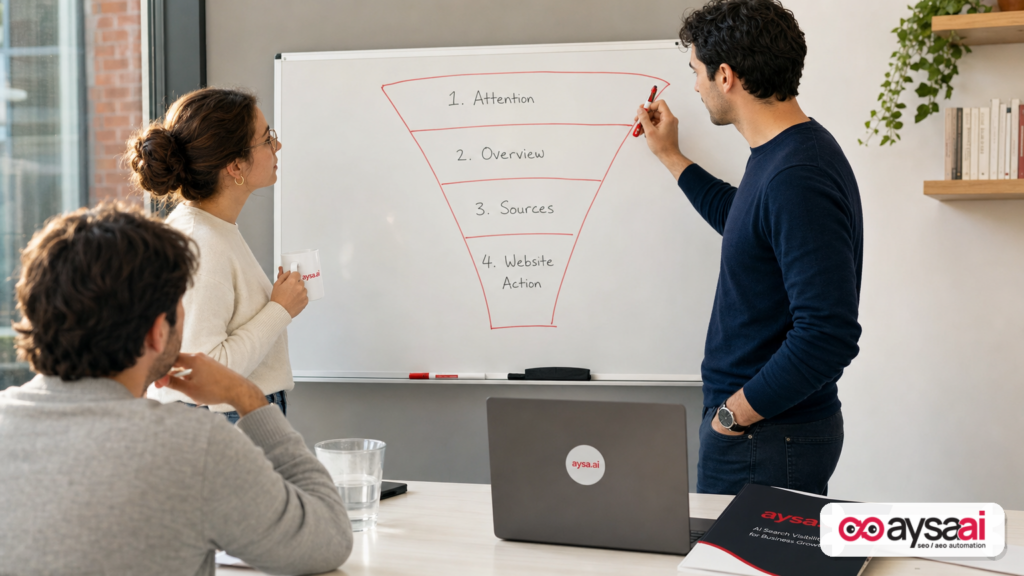
- The New Discover Funnel: From Attention → Overview → Sources → Action
- Why This Matters For SMEs, Publishers, And Agencies
- Measurement Challenges: What Search Console Might Not Tell You
- What Can Go Wrong (And How To Reduce Risk)
- How To Win: Practical Content, Site, And Brand Moves
- A Practical SME Scenario: How A Local Clinic Could Win (Or Lose) With “Dive Deeper”
- Agency Playbook: Reporting, Retainers, And Deliverables In An Overview-First World
- Where AYSA Fits: Monitoring + Approved Execution For AI Discovery Surfaces
- What To Do Next (Action List)
- Sources And Further Reading
What Google Is Testing In Discover (And Why It’s Not “Just A Button”)
According to reporting by Search Engine Journal, Google is experimenting with a “Dive deeper” button in Discover. The button opens a short topic overview containing an AI-generated summary and prominent links to related stories, community reactions, and original reporting—starting with videos. Google’s stated goal is to make exploring a topic and discovering related web content easier within Discover.
Here’s the strategic signal: Discover is evolving from “a stream of individual items” into “a stream of entry points.” The entry point might be a video, a story, or a trend, but the experience increasingly routes users through an AI-organized topic layer before they choose which sources to visit.
That is exactly how modern AI Search is behaving elsewhere: summarize first, cite sources second, then let the user branch into deeper reading. Discover is now testing a similar behavior pattern—inside the feed.
Source: Search Engine Journal coverage of the Discover “Dive deeper” test.
What Actually Changed: The User Journey, Not The Feed
Most commentary about feed experiments misses the point. The change isn’t the presence of a new button; it’s the introduction of a new middle step between the feed card and the external web.
Before: One card, one decision
- User sees a card.
- User taps the publisher/video source.
- Traffic goes directly to the destination (YouTube, a publisher site, etc.).
Now (if this test expands): One card, multiple possible paths
- User sees a card with a summary.
- User taps Dive deeper.
- User lands in an overview (summary + grouped subtopics + multiple source cards).
- User chooses which source to open—or keeps scrolling inside the overview.
That “overview layer” is where distribution dynamics can change:
- It can increase the number of sources a user considers.
- It can reduce the direct click-through to the original card’s destination.
- It can create a winner-take-more scenario for sources that Google’s systems deem reliable, readable, and strongly relevant to the topic.
In other words: the feed item becomes the hook; the overview becomes the router.
Why Start With Videos?
Google reportedly started this test with videos. That choice is practical and strategic.
1) Video is already a “container” for context
Users expect a video card to come with a description and related content. Adding an AI topic overview feels like a natural extension of “watch + learn more,” rather than a jarring change to a traditional article card.
2) Video attention is high-value
Discover is an attention engine. Video often outperforms text in time-on-surface and engagement. If Google wants to test new exploration patterns, video provides enough interaction volume to learn quickly.
3) Video topics are easier to branch into subtopics
Many videos are inherently “overview-ish” (weather events, product explainers, how-tos, breaking news). That makes it straightforward to generate subtopic clusters and suggest “Explore more stories” groupings.
4) It may be a distribution balancing move
When a single video dominates attention, other high-quality sources can get sidelined. A “Dive deeper” overview offers a way to re-route discovery toward additional coverage without the user having to open a search tab.
Important nuance: none of the above requires a conspiracy theory. It’s consistent with Google’s broader push toward AI-assisted exploration experiences that keep users moving through topics while still linking out to the web.
How This Fits With Discover’s Existing AI Features
This is not happening in isolation. Discover has already been moving in an AI direction.
Search Engine Journal notes that Google rolled out AI previews on trending topics in Discover in 2025, and that Search Console includes a generative AI performance report for Discover that counts impressions of links shown in generative AI features in Discover—though public documentation appears limited in terms of feature-level breakdown.
Two implications:
- Discover is becoming “overview-native”: AI previews plus “Dive deeper” suggests a consistent product direction—users see a summary and then choose sources.
- Reporting may lag product changes: If Search Console aggregates impressions across multiple generative Discover surfaces, operators can struggle to diagnose what’s driving changes.
Discover is increasingly aligned with the pattern we see across AI search: summarize → cite → let users drill down. Businesses should treat Discover as part of the “AI search” ecosystem, not a separate channel.
Where this intersects with AEO and GEO
Whether you call it AEO (Answer Engine Optimization) or GEO (Generative Engine Optimization), the underlying requirement is similar: your content must be easy to interpret, easy to cite, and credible enough to include. The “Dive deeper” overview is effectively a citation opportunity surface.
To learn how AYSA approaches visibility across AI-driven surfaces, see AYSA’s AI Search visibility and AI SEO tools.
The New Discover Funnel: From Attention → Overview → Sources → Action
Most SMEs evaluate Discover like this: “Did we get traffic?” That was already incomplete. Now it’s potentially misleading.
With an overview layer, the user journey becomes a funnel with distinct optimization goals:
1) Attention (feed card)
- Goal: Earn the initial impression and stop the scroll.
- Levers: relevance, timeliness, compelling creative, accurate headlines, and strong topical alignment.
2) Comprehension (AI summary / overview)
- Goal: Be represented correctly and grouped into the right subtopic context.
- Levers: clear page structure, unambiguous language, strong entity clarity (who/what/where), and consistent on-site coverage.
3) Selection (source cards)
- Goal: Be one of the sources users choose.
- Levers: credibility signals, brand recognition, titles that match user intent, and content that looks like it will answer the next question.
4) Action (on your site)
- Goal: Convert attention into email signups, bookings, sales, or lead captures.
- Levers: landing page clarity, internal linking, fast performance, and a direct path from informational content to commercial outcomes.
In an overview-first world, you can “win” stage 1 (attention) but lose stage 3 (selection) if your brand and pages don’t look source-worthy. That’s the new game.
Why This Matters For SMEs, Publishers, And Agencies
Let’s get practical about who is affected and how.
For SMEs: Discover may become a new kind of top-of-funnel
SMEs often assume Discover is “for publishers.” In reality, Discover can drive meaningful visibility for any business producing helpful content—especially local services, ecommerce brands with educational content, and SaaS companies with strong topical expertise.
But topic overviews can shift the value exchange:
- You may get more exposure (impressions) via being included as a cited source in an overview.
- You may get fewer direct clicks from the original card if users branch into alternative sources.
- You may need to optimize for being selected in the overview, not just earning the first card view.
For publishers: distribution can become more “portfolio-like”
Publishers live and die by feed distribution. If Discover leans harder into topic overviews, the competition shifts from “win the card” to “win the cluster.”
That can benefit publishers that:
- Cover topics comprehensively (not just one-off articles).
- Have clear editorial structure and consistent updates.
- Offer original reporting that’s easy for systems to distinguish from rewrites.
For agencies: the reporting conversation changes
Agencies need to prepare clients for a reality where the platform adds more intermediate layers. This can create scenarios where:
- Impressions rise but sessions don’t.
- Traffic becomes more volatile across topics.
- Attribution becomes murky because feature-level reporting is limited.
The agency that wins isn’t the one that complains about “Google stealing clicks.” It’s the one that can explain the new funnel, show what’s happening in reporting, and implement a plan to become a top cited source in the overview layer.
Measurement Challenges: What Search Console Might Not Tell You
Search Engine Journal highlights a core issue: Search Console’s generative AI reporting for Discover appears to focus on impressions and does not clearly break down which generative features those impressions came from.
Even without making assumptions about the final reporting structure, operators should plan for measurement friction:
1) Mixed impressions = mixed narratives
If a single metric lumps together different AI experiences (trending AI previews, “Dive deeper” overviews, and future experiments), then “Discover impressions” becomes less actionable as a decision signal.
2) Click-through rate interpretation may degrade
Adding intermediate steps can change CTR dynamics. A user might:
- See your content in the feed (impression),
- Open the overview,
- Choose another source,
- And never visit your site.
From your perspective, impressions existed but traffic didn’t follow. That doesn’t necessarily mean your content is bad—it might mean the overview experience changed how users explore.
3) The “visibility vs. value” gap grows
Teams will need to separate:
- Visibility metrics: impressions, inclusion as a source, topical presence.
- Value metrics: sessions, assisted conversions, bookings, revenue.
This is one reason AYSA focuses on monitoring and execution loops rather than one-off audits. When the surface is changing, you need a system that continually adapts. See AYSA Monitoring and AI Search visibility monitoring.
4) Don’t overreact to a single week
Because Google is testing multiple designs (as reported), behavior can shift during the experiment. If you change strategy based on a short window, you risk chasing noise. Build a baseline, track topic clusters, and look for sustained shifts.
What Can Go Wrong (And How To Reduce Risk)
AI topic overviews are promising, but they add new failure modes. Businesses should proactively reduce risk—especially those in regulated or sensitive categories.
1) Summaries can be wrong or oversimplified
The example reportedly includes a disclaimer like “Generated with AI, which can make mistakes.” That’s a reminder: your brand could be adjacent to a summary that’s incomplete or misleading.
Mitigation: publish clear, structured, up-to-date pages that explain the topic accurately, using plain language and explicit definitions. If you’re a business with compliance constraints, consider adding a well-written disclaimer on relevant informational pages.
2) Your content can be “present” but not “chosen”
You might appear in a cluster but lose the click to a stronger-looking competitor.
Mitigation: strengthen the selection layer: titles, meta descriptions (where applicable), and on-page intros that make it obvious you answer the user’s next question.
3) One video can “own” the entry point while websites fight for leftovers
If the entry point is a video, the overview might keep users in video consumption longer, delaying or reducing web clicks.
Mitigation: connect video topics to on-site resources. If you produce videos, publish companion pages that contain the same key facts, FAQs, and next steps. If you don’t produce videos, publish pages that are so clearly useful that they’re included as a source anyway.
4) Measurement confusion can lead to the wrong budget decisions
If reporting becomes noisier, teams might cut content investment precisely when the channel is evolving in their favor.
Mitigation: update reporting to include leading indicators (topic presence, cluster coverage, query themes) and lagging indicators (leads/revenue). Treat Discover as a brand + demand capture channel, not just a traffic faucet.
How To Win: Practical Content, Site, And Brand Moves
If Discover is adding topic overviews, the brands that win will look like the best “sources” in a multi-source environment. That requires practical, buildable assets—not vague advice.
1) Build “topic clusters” that match how overviews group subtopics
The example described by SEJ includes sub-topic headlines under an “Explore more stories” area. That implies Google is clustering coverage.
For your business, that means:
- Pick 3–7 core topics you want to own (not 50).
- Create a hub page (a guide, a glossary, a “learn” page) and supporting pages that answer the most common sub-questions.
- Interlink them so both users and systems can navigate the cluster.
Example (ecommerce): instead of a single “How to choose running shoes” post, build a cluster: sizing, pronation, trail vs road, durability, injury prevention, care, and a buyer’s guide.
2) Make pages citation-friendly (clarity beats cleverness)
AI summaries and topic overviews rely on content that is easy to parse and attribute. Practical steps:
- Use descriptive headings (H2/H3) that match user questions.
- Answer the question early on the page, then expand.
- Use consistent terminology for your products/services.
- Add short definitional paragraphs where confusion is likely.
3) Strengthen credibility signals on-site
In a multi-source selection screen, trust becomes a conversion factor before the click even happens. Without inventing a secret “trust score,” we can say this: pages that look legitimate are easier to choose and easier to cite.
Practical upgrades:
- Clear author or organization attribution.
- About/contact information that signals a real business.
- Editorial or update notes where applicable (especially for time-sensitive topics).
- Internal links to deeper supporting information.
4) Align video content with web content (even if you don’t “do YouTube”)
Because the test starts with videos, it’s smart to treat video topics as keyword/topic research inputs.
- If you publish video: create a companion article that expands the key points and includes FAQs and next steps.
- If you don’t publish video: monitor the topics that video cards are surfacing in your niche and publish best-in-class pages that answer the follow-up questions.
5) Optimize for “next-step intent,” not just top-level curiosity
Overviews often satisfy the top-level question. Your page should win the click by promising the next layer of value:
- Templates, checklists, and decision trees.
- Local applicability (pricing ranges, timelines, what to expect).
- Process transparency (how it works, what’s included, outcomes).
6) Build an execution loop, not a one-time project
When Google experiments, the winning strategy is not “publish and pray.” It’s: monitor → learn → update → repeat.
That’s the operational gap AYSA is designed to close: monitor visibility changes, prepare recommended improvements, ask for approval, then execute accepted website changes. Explore: Monitoring, AI SEO tools, and Pricing.
A Practical SME Scenario: How A Local Clinic Could Win (Or Lose) With “Dive Deeper”
Let’s make this real with a scenario that mirrors how Discover is actually used: on a phone, in small moments, with fast decisions.
The business
A local dermatology clinic wants more bookings for acne treatment and eczema consultations. They publish occasional blog posts, but their site is mostly service pages.
The Discover moment
A user sees a short video in Discover about “heat wave skin irritation” or “adult acne causes.” Under the card, the user sees a summary and a Dive deeper button. They tap it and land on a topic overview with subtopics like:
- Common triggers
- When to see a doctor
- Home care vs professional treatment
- Community reactions
How the clinic loses
- The clinic has a generic service page with marketing copy but no clear Q&A, no clinician attribution, and no practical guidance.
- In the overview, the sources that look most useful are major health publishers (or better-prepared local competitors).
- The clinic never becomes a “selected source,” so they don’t get the click—even if they might have been the best local option.
How the clinic wins
- They publish a cluster: “Adult acne causes,” “Eczema flare-ups in hot weather,” “When to see a dermatologist,” “What to expect at your first visit,” and a short “treatment options” explainer.
- Each page answers a specific sub-question with clear headings, concise definitions, and locally relevant next steps.
- The pages have clinician review/attribution and link to appointment booking.
Now the clinic has a shot at appearing as a credible, local, practical source in the overview. Even if only a fraction of users click, those clicks are high-intent and closer to booking than pure curiosity traffic.
This is the deeper point: overview experiences reward preparedness. You don’t need a huge brand—just pages that deserve to be chosen.
Agency Playbook: Reporting, Retainers, And Deliverables In An Overview-First World
If you run an agency (or you’re an in-house marketer managing one), this Discover test is a preview of the conversation you’ll need to lead.
1) Update your KPI stack
Don’t rely on a single “Discover traffic” number. Use a layered approach:
- Visibility: impressions and presence for priority topics.
- Engagement: sessions, scroll depth, returning users from Discover traffic (where you can measure).
- Outcomes: leads, purchases, bookings, assisted conversions.
2) Sell “topic ownership,” not just content volume
In overview-driven discovery, one-off posts are less defensible than clusters. Package deliverables around:
- Topic map and content architecture
- 3–6 supporting pages per topic
- Internal linking and updates
- Conversion path refinement
3) Build a rapid iteration cadence
When Google says it will test multiple designs over weeks, that’s your cue: ship improvements on a rhythm (weekly/biweekly), not quarterly.
AYSA’s model supports this operationally by keeping a continuous queue of monitored insights and prepared changes that can be approved and executed without the typical bottlenecks. If you want to see how AYSA frames this, start at AI Search visibility and browse additional strategy resources on the AYSA blog.
4) Prepare clients for “more zero-click-like behavior” without panic
Overviews can satisfy curiosity. That doesn’t mean SEO is dead; it means your role is to:
- Make your client a cited source.
- Capture the clicks that still happen by offering next-step value.
- Track downstream conversions and brand lift indicators.
Where AYSA Fits: Monitoring + Approved Execution For AI Discovery Surfaces
When a surface like Discover changes, most teams do the same thing: they wait for clarity. By the time clarity arrives, the early winners have already adapted.
AYSA is built for the opposite approach: operate in uncertainty with disciplined execution.
1) Monitor what’s changing
Discover volatility often shows up as sudden swings. The right move isn’t to guess; it’s to monitor consistently and correlate changes with topic coverage, publishing cadence, and page upgrades. AYSA helps teams maintain that cadence: AYSA Monitoring.
2) Prepare improvements tied to outcomes
In an overview-first environment, the improvements that tend to matter are concrete:
- Clearer page structure for comprehension
- Stronger internal linking for topical clustering
- Updated content for timeliness and trust
- Better conversion paths for the clicks you do earn
AYSA’s job is to turn monitoring insights into prepared changes—so your team is reviewing a plan, not starting from a blank doc. Explore capabilities: AI SEO tools.
3) Approval-first execution (so changes actually ship)
Many SEO programs fail at the “last mile”: changes get stuck in backlogs. AYSA is designed around approved execution—recommendations are proposed, you approve what you want, and accepted website changes get executed. That’s how you keep up with evolving SERP and feed experiences without burning out your team.
4) Make AI Search a managed channel, not an anxiety source
If you’re trying to understand how this fits into your budget and ops, start with pricing and then go deeper on the strategy side via AI Search visibility.
What To Do Next (Action List)
- Pick 3–5 topics you want to own in your category (not 30). Write them down.
- Audit your current coverage: do you have a hub page and supporting pages that match subtopic questions?
- Upgrade one cluster first: add clear headings, definitions, FAQs, and internal links. Make it “source-worthy.”
- Connect video and web content: if you publish video, create companion pages; if you don’t, publish the best follow-up answers users will want after watching.
- Fix your reporting narrative: separate visibility (impressions/presence) from value (leads/sales). Don’t overreact to one-week swings.
- Set up monitoring so you catch Discover changes early and respond quickly: AYSA Monitoring.
- Operationalize execution: use a system that prepares changes and ships them after approval rather than letting insights pile up: AYSA AI SEO tools.
Sources And Further Reading
- Search Engine Journal: Google Discover Test Adds Topic Overviews, Starting With Videos
- Search Engine Journal: AI Search category (context and related coverage)
- Search Engine Journal: SEO category
- Search Engine Journal: SEO News
AYSA resources:
Note: Google’s experiment details (countries, languages, rollout scope, and final reporting behavior) are not fully specified in the source coverage. Treat this as a directional signal: Discover is becoming more overview-driven and multi-source, and teams should prepare for changes in click distribution and measurement.
Continue the AI search topic inside AYSA.
Use these pages to connect the article with AI SEO tools, AI visibility monitoring, AI Overviews and approved website execution.
Turn this topic into a website action plan.
Use these AYSA hubs to move from reading to technical fixes, AI visibility monitoring, research, glossary context and approval-first SEO execution.

