
Rank vs. AI Citations: Why Your Dashboard Lies (And How to Measure AI Search Without Fooling Yourself)
Traditional rankings and AI citations look like comparable metrics—but they’re produced by different machines doing different jobs. Here’s how prompt decomposition, query shape, and missing “prompt volume” can mislead reporting, plus a practical measurement system SMEs and agencies can run today with AYSA.

Concise summary: Rankings and AI citations look like the same kind of metric because they’re both “a number next to a query.” They’re not. Classic search is an index-matching operation; AI Search is an interpretation-and-retrieval operation that often rewrites your prompt into multiple short retrieval queries before it ever touches an index. That single difference can quietly ruin reporting, mislead stakeholders, and push teams into chasing the wrong work.
This editorial breaks down what changed, why it matters for SMEs and agencies, and how to build an AI search measurement system that’s honest about uncertainty—then actually execute improvements through an approve-first workflow like AYSA.
Key takeaways (read this if you’re short on time)
- Rank and AI citations are not comparable metrics. They’re produced by different systems performing different operations on the “same” input.
- Prompt length is a distraction. In AI search, the long prompt is frequently decomposed into multiple short retrieval queries, so the thing you typed is often not the thing retrieved.
- Query shape can bias both columns at once. Teams that track conversational questions can appear to “win” versus teams tracking short noun phrases—even when real visibility is similar.
- Search volume disciplines rank; it does not discipline citations. There is no equivalent, reliable “prompt volume” metric available to marketers today.
- AI visibility must be measured directionally and repeatedly. Single-run screenshots are not strategy; they’re noise.
- Execution is the leverage. Monitoring without an approved way to ship changes turns AI search into a permanent debate instead of an operating system.
Table of contents
- What changed: why one input box now produces two different truths
- The core mismatch: an index matches strings; an LLM interprets intent
- The hidden step that breaks reporting: prompt decomposition into retrieval queries
- The two ends of the curve: why very short and very long queries behave differently
- Why this becomes a measurement problem (not a language problem)
- The “volume guardrail” only works on one side
- What to measure instead: stability, coverage, and directional lift
- A concrete SME scenario: the local clinic that ‘ranks’ but doesn’t get cited
- What agencies should rethink in 2026 (deliverables, not buzzwords)
- What to change on the site: practical moves that help both SEO and AI citations
- The AYSA approach: measure directionally, then execute with approval
- What to do next
- Sources and further reading
What changed: why one input box now produces two different truths

For most of the modern web, “search reporting” had a clean mental model:
- A user types a query.
- A search engine matches it against an index.
- Results appear, ordered by relevance, authority, and dozens of other signals.
- If you rank higher, you tend to get more Clicks.
That model was never perfect, but it was stable enough to operationalize. SEO became a discipline of building discoverability in an index-driven marketplace.
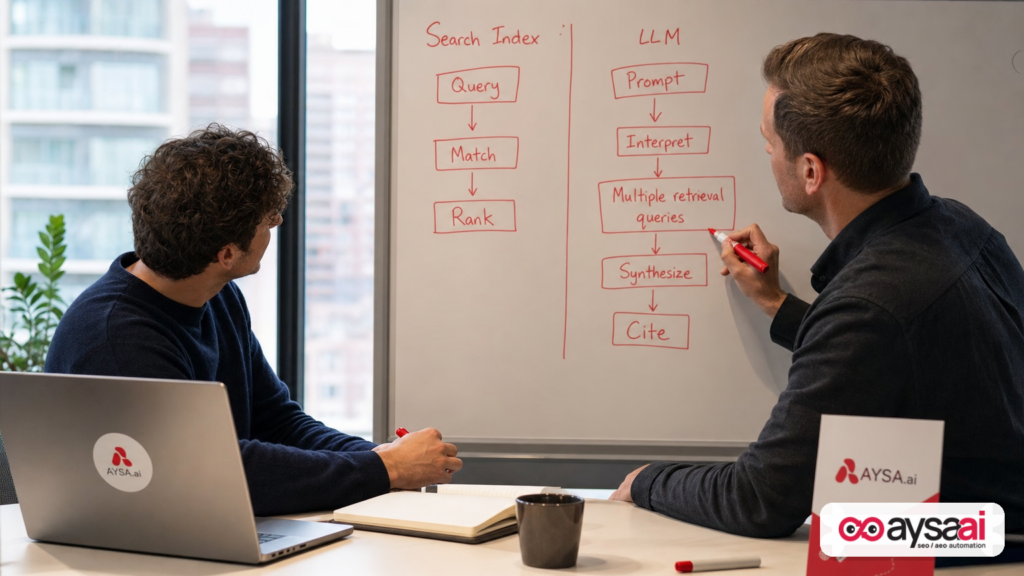
Now AI search has inserted a second surface into the same workflow. Users still “search.” But the system in front of them may:
- Interpret the prompt as a request for an answer, not a request for documents.
- Decide what information it needs to retrieve to support that answer.
- Run multiple retrieval queries (not necessarily the user’s words).
- Synthesize a response.
- Optionally cite sources (and not always the ones you’d expect from classic rankings).
Duane Forrester’s analysis at Search Engine Journal is the cleanest framing I’ve seen: the operational difference is the story, not the character count. Your prompt is interpreted, decomposed, rewritten, retrieved, then filtered back into an answer—meaning the metric you get (a citation, or a lack of one) is not the same kind of output as a rank position in an index-driven system. (Source: Search Engine Journal)
If your dashboard places “Rank” and “AI Citations” side-by-side as if they are parallel KPIs, you’re not seeing two readings of the same phenomenon. You’re seeing two different phenomena that share an input box. That distinction changes how you measure, how you prioritize work, and how you communicate outcomes to stakeholders.
The core mismatch: an index matches strings; an LLM interprets intent
Here’s the simplest useful model for non-SEOs:
- Classic search (index-first): “I will find documents that match the words and implied intent of your query.”
- AI search (model-first): “I will interpret what you want, then I will decide what to retrieve, then I will answer.”
Those two systems reward different input shapes:
- In classic search, a longer, more specific query can reduce competition—sometimes making ranking easier because fewer pages target that exact phrasing.
- In AI search, more context can help the model narrow intent and choose sources that support the answer it’s constructing.
So if you feed the same phrase into both systems, you’re not running a fair “A/B test.” You’re running two different operations and then comparing outputs as if they share a unit.
That’s why “rank” and “citation” can diverge even when your content quality is strong. They aren’t measuring the same underlying mechanism.
The hidden step that breaks reporting: prompt decomposition into retrieval queries
The most important practical detail in the SEJ piece is the one most dashboards cannot show you: the model may split a single user prompt into several short retrieval queries—queries that are often much shorter than the prompt, and not always phrased the same way.
From a measurement standpoint, this matters for three reasons:
- You didn’t choose the retrieval query; the model did. If your reporting assumes you’re “tracking queries,” you may actually be tracking a model-authored paraphrase.
- Multiple retrieval queries may run per prompt. Your “one prompt” is potentially many retrieval events.
- Citation selection is another filtering step. Even if your page is retrieved, the model may decide not to cite it, or cite a different supporting source.
This is why prompt length alone tells you almost nothing about what’s happening downstream. The prompt is not the retrieval query, and the retrieval query is not the citation.
Operationally, you’re looking at a pipeline like this:
- Prompt (user language)
- Interpretation (intent + constraints)
- Retrieval queries (model language)
- Retrieved sources (candidate documents)
- Synthesis (answer composition)
- Citations (optional references)
Classic search mainly exposes the “retrieved sources” and their order. AI search often exposes “the answer” and sometimes a subset of sources. That difference is why metrics that look similar are not.
The two ends of the curve: why very short and very long queries behave differently
There’s a trap at both extremes of query shape.
Extremely short queries: the double-negative problem
A one-word query like “insurance” or “shoes” is:
- Too broad for AI search to confidently infer what the user wants (plan comparison? local provider? definitions? pricing?). The answer becomes generic.
- Too competitive for classic search for most SMEs to rank for without massive authority and brand demand.
So you get an ugly dashboard reading: low rank and no citations. It looks like failure, but it’s often just an input that’s too vague to diagnose anything.
Extremely long queries: the false-positive problem
A very specific, long query like “best waterproof trail running shoes for plantar fasciitis under $150” can:
- Help AI search by giving it constraints and intent, increasing the likelihood it will cite specific pages that satisfy those constraints.
- Help classic search by reducing competition on that exact phrasing.
Now the dashboard can look great: higher rank and more citations. But that doesn’t necessarily mean your overall visibility improved. It may mean you selected prompts that naturally produce clearer intent and easier ranking conditions.
This is the measurement pitfall Forrester describes: two teams can track different query shapes and appear to have radically different performance, even if their real market position is similar. The query selection becomes a hidden lever that changes the story your reporting tells.
Why this becomes a measurement problem (not a language problem)
Most businesses don’t choose Keyword sets scientifically. They choose them culturally:
- Some teams write keyword lists like they learned in SEO 101: short noun phrases (“crm software,” “tax accountant”).
- Other teams write prompts the way they talk to a chatbot: full questions with context (“what’s the best crm for a small construction company with 5 reps?”).
Those habits bias both classic Rank tracking and AI citation tracking—just in different ways.
This is where I’m going to be direct: many “AI visibility” reports are currently measuring the phrasing style of the person who built the query set as much as they’re measuring the brand’s real visibility.
That’s not a minor technicality. It’s a boardroom problem because it changes budgets, priorities, and confidence. If your VP believes “we’re winning AI search,” but the win is mostly a function of prompt selection, you will underinvest in the work that actually creates durable visibility.
Forrester’s warning is the right one: lining rank up beside citation and treating them as comparable is an error—because each number was produced by a different machine, doing a different job, reading the same string on different terms. (SEJ source)
The “volume guardrail” only works on one side
Classic SEO has a built-in reality check: search volume.
Rank #3 for a keyword with no demand is not a win; it’s often a sign you picked something too narrow or too uncontested. Volume helps you avoid celebrating empty rankings.
But here’s the hard part: there is no equivalent, reliable “prompt volume” for AI search. Platforms do not expose how often users ask specific prompts in a standardized way. And in many cases, AI interfaces blend search, chat, and browsing behaviors—making “volume” both unavailable and conceptually messy.
So a common reporting error is to take a search-volume number from classic keyword tools and place it next to AI citations as if it disciplines citations the same way it disciplines rank.
It doesn’t.
- Search volume is an index/search-surface measurement.
- AI citations are an output of a multi-step interpretation and retrieval process.
When you pretend those are parallel, you create false certainty. You can end up optimizing for citations on prompts that look “high volume” in classic search, even though citation behavior may be driven more by intent constraints, content type, and source trust patterns than by that keyword’s monthly search volume.
The correct conclusion isn’t “don’t measure citations.” It’s: use a different kind of guardrail.
What to measure instead: stability, coverage, and directional lift
If you can’t measure “how many people asked,” you can still measure “how consistently you appear” and “how broad your coverage is.” That means shifting from single-point precision to directional measurement.
Here’s a practical measurement framework that SMEs and agencies can run today without pretending to have data nobody has.
1) Build a prompt panel (not a keyword list)
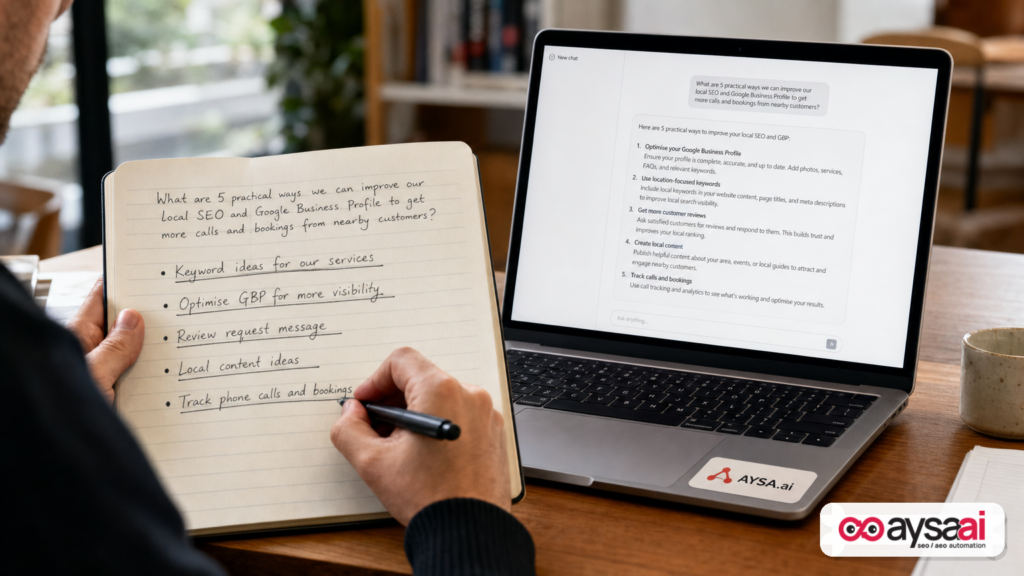
Stop calling it a keyword set. Build a prompt panel that represents the real ways customers express intent:
- Decision prompts (“Which is better for X: A or B?”)
- Local prompts (“Best near me” + constraints)
- Comparison prompts (alternatives, competitors, “vs”)
- Problem/solution prompts (“How do I fix…”)
- Compliance prompts (“Is it legal to…” / “Does it qualify…” where relevant)
Then include two versions for some intents:
- Compact version (more search-like)
- Context version (more conversational)
The goal isn’t to “pick the winner.” It’s to detect where your visibility is sensitive to phrasing—because sensitivity is a signal that your brand/entity/content coverage is fragile in that area.
2) Run it repeatedly (because AI outputs vary)
A single run is a screenshot. Repeated runs create a measurement instrument.
Track:
- Citation frequency: in how many runs did your domain appear as a cited source?
- Position-in-citations (if exposed): were you the first citation or buried?
- Answer inclusion: were you mentioned even without a link?
- Competitor co-citation: who appears alongside you?
Read the result as directional: stable presence versus incidental presence. That’s the AI equivalent of using volume to separate “real wins” from “empty wins.” It’s not perfect—but it’s honest.
3) Measure coverage by intent cluster, not by query count
Classic SEO encouraged “more keywords tracked” as a proxy for rigor. In AI search, more tracked prompts can actually increase noise.
Instead, measure:
- Coverage: for each intent cluster, do you show up consistently?
- Weak spots: which cluster has inconsistent citations?
- Content alignment: do the cited pages match the intent, or is the model pulling the wrong page from your site?
That last point matters. If AI search cites the wrong page, you don’t just lose a link—you lose conversion probability because the user lands on content that doesn’t satisfy the question that generated the answer.
4) Track the rank–citation gap as a diagnostic, not a scorecard
Forrester suggests a nuanced idea: even if both rank and citations are distorted by phrasing, the gap between them might be a more stable signal than either number alone—because some phrasing effects may cancel out when compared on the same prompt. He’s careful to frame this as reasoning rather than proven fact, and that’s the right posture. (SEJ source)
In practice, the gap is useful when you treat it as a diagnostic:
- High rank, low citations can indicate: content is discoverable but not “answer-shaped,” not trusted, not structured, or not aligned to the model’s retrieval preferences.
- Low rank, high citations can indicate: you’re being used as a supporting source even if you don’t win the classic SERP—possibly due to specificity, unique data, clearer definitions, or stronger entity signals.
Either pattern tells you what to fix. Neither pattern should be turned into a simplistic KPI.
A concrete SME scenario: the local clinic that ‘ranks’ but doesn’t get cited
Let’s make this real with a scenario I see constantly in SME marketing.
Business: a multi-location physical therapy clinic (or dentist, or med spa—any local service with high-intent leads).
Current state:
- They rank well locally for “physical therapy [city]” and a few service pages.
- They publish blog posts answering common questions (“how long does a sprained ankle take to heal?”).
- They see steady organic traffic.
New problem: their marketing manager tests an AI search interface and asks:
- “Where should I go in [city] for PT after ACL surgery? I want someone who works with runners and takes [insurance type].”
The AI answer:
- Mentions two hospital systems and a national chain.
- Cites a few authoritative medical pages and review/community sources.
- Does not cite the clinic that ranks #2 locally for “physical therapy [city].”
Did the clinic “lose SEO” overnight? Not necessarily. They may still rank. But they are now losing a category of demand: people who ask the AI interface for “what should I do?” rather than typing a short transactional query.
Why might this happen? Common reasons that have nothing to do with “word count” and everything to do with machine behavior:
- The clinic’s location pages are thin and not specific about specialties (e.g., post-surgery rehab, runners, return-to-sport protocols).
- Insurance information is unclear or only available behind a call-to-action.
- The site doesn’t present clinician expertise in a structured, consistent way.
- Content answers exist, but they are not connected to locations/services with internal linking that makes retrieval easy.
So the AI system retrieves and cites other sources that are “easier to justify” in an answer.
The measurement mistake would be telling the clinic: “Don’t worry, you still rank.” That’s classic-surface thinking in a split-surface world.
What agencies should rethink in 2026 (deliverables, not buzzwords)
Agencies are being pulled into a new set of client questions:
- “Why aren’t we showing up in AI answers?”
- “Why did we show up last week but not this week?”
- “Is this GEO, AEO, or just SEO?”
Forrester’s closing line is blunt and important: SEO and GEO are complementary but not identical. The systems diverge; conflating them is expensive. (SEJ source)
From an agency-deliverables standpoint, here’s what I believe has to change:
1) Stop selling single-run AI screenshots as outcomes
If your “AI visibility report” is a handful of prompts run once, you are selling theatre. AI outputs vary. You need repeated runs, prompt panels, and stability scoring—or you need to clearly label the work as exploratory, not definitive.
2) Separate “discoverability” from “citation-worthiness”
Classic rank improvements can come from technical fixes, relevance targeting, links, internal linking, and content depth. AI citations can correlate with some of those—but citations also depend on whether your content is:
- Answerable (clear, scoped, factual, structured)
- Attributable (who wrote it, why they’re qualified)
- Retrievable (pages that match the model’s retrieval query variants)
That means you must add new deliverables: content structure, entity clarity, author/expert representation, and intent coverage.
3) Build an “intent coverage map” instead of only a keyword map
Keyword maps still matter, but they are incomplete. Agencies should add a layer:
- What questions do customers ask before they know what to search for?
- What comparisons do they ask when they’re close to choosing?
- What constraints do they include (budget, location, compliance, compatibility)?
Then tie those intents to specific pages that are designed to be cited—not just to rank.
What to change on the site: practical moves that help both SEO and AI citations
Let’s get tactical. If citations are a different operation, what do you actually do on Monday?
Without inventing “guaranteed” tactics (nobody can honestly promise citations), here are practical moves that consistently improve your odds of being retrieved and used as support across AI-driven experiences—while still helping classic SEO.
1) Create “answer-shaped” sections on key pages
AI systems thrive on content that is:
- Specific
- Scannable
- Unambiguous
- Supported by definitions, steps, constraints, and examples
That doesn’t mean turning your site into an FAQ farm. It means adding short, high-clarity blocks on service/product pages that answer:
- Who it’s for
- When it’s not a fit
- How pricing works (ranges, drivers, not necessarily exact prices)
- Timelines and process
- Compatibility / requirements
These sections also improve conversion because they reduce uncertainty.
2) Fix internal linking so retrieval lands on the right page
In classic SEO, internal linking distributes authority and clarifies topical structure. In AI search, internal linking also helps a retrieval system find the best “supporting page” for a specific sub-question.
Common fixes:
- Link informational articles to the most relevant service/product page (and vice versa where it helps the user).
- Create hub pages for major topics with clear subtopic links.
- Ensure location pages link to the exact services offered at that location (for local SMEs).
3) Make expertise explicit (don’t assume the machine infers it)
Many businesses have expertise but hide it in PDFs, bios that aren’t indexable, or a generic “About” page that says nothing.
Make it explicit:
- Author pages (who they are, qualifications, what they cover)
- Editorial standards (how content is reviewed/updated, if applicable)
- Clear company identity (leadership, locations, contact details)
This is not about gaming. It’s about making the web legible.
4) For local businesses: treat each location as a complete entity
Local visibility is increasingly “entity-driven.” If each location is real and distinct, your site should reflect that with:
- Unique location pages with real details (services, staff, photos, parking, hours)
- Clear service availability per location
- Consistent NAP information (name, address, phone) across the site
Even when AI answers don’t cite you, these improvements increase the chance the model can confidently recommend you because the facts are clear and consistent.
5) Refresh and maintain: AI answers reward “current” clarity
Classic SEO already rewards freshness in many categories. AI answers can be especially sensitive to outdated details, especially for:
- Policies and compliance
- Pricing and availability
- Local hours and service areas
- Software features and compatibility
Build a maintenance cadence. If you don’t, you’ll experience the most frustrating AI pattern: you appear once, then disappear because the system finds a “more current” or “more specific” source next run.
The AYSA approach: measure directionally, then execute with approval
At AYSA, we treat AI search as an operational problem: monitoring plus execution. If you only monitor, you learn. If you monitor and execute, you improve.
Our philosophy fits the reality Forrester describes:
- AI visibility is noisy.
- Prompt shape matters.
- Single-run “precision” is fake.
- What wins is a steady system that identifies directional signals and ships improvements safely.
That’s why AYSA is built as an execution system that:
- Monitors your visibility across AI and search surfaces (AYSA Monitoring).
- Prepares website improvements tied to the gaps you see (content structure, internal linking, entity clarity).
- Asks for approval before changes go live (so the business stays in control).
- Executes accepted changes cleanly—turning “insight” into outcomes.
If you’re new to this space, start here:
If you’re deciding whether the investment makes sense, review:
And if you want more practical editorials like this, we publish ongoing guidance at:
How AYSA reporting should be read (so you don’t fool yourself)
Even with better monitoring, the discipline is in interpretation:
- Read AI citations as stability signals, not as demand counts.
- Read classic rank with volume context where appropriate.
- Use the rank–citation gap to choose what to fix next, not to declare victory.
The win condition isn’t “a number went up.” The win is: “we can explain why it moved, and we can repeatedly move it with controlled changes.”
What to do next
If you’re a founder, marketer, or agency lead trying to get this right without drowning in hype, here’s the most practical action list I can give you.
Action list (do this in order)
- Audit your current dashboard language. Anywhere you present “Rank” and “AI Citations” as comparable KPIs, add a note: different systems, different operations.
- Replace your keyword list with a prompt panel. Keep it small (20–50 prompts), intent-based, and representative of real customer decision-making.
- Run prompts repeatedly on a schedule. Weekly at minimum; more often if you operate in a fast-changing category. Track stability.
- Cluster results by intent. Stop averaging everything into one score. Identify which intent clusters are fragile.
- Pick one cluster and fix the site. Add answer-shaped blocks, improve internal linking, clarify expertise, and tighten location/entity details.
- Measure again. Look for directional lift and increased stability, not instant domination.
- Operationalize execution. Use an approve-first system so changes ship consistently without introducing risk.
If you want an execution layer that supports this loop—monitoring, preparation, approval, and clean implementation—start with AYSA Monitoring and our AI Search Visibility guidance.
Sources and further reading
- Search Engine Journal — Rank And AI Citation Aren’t The Same Number (Duane Forrester)
- Search Engine Journal — SEO coverage (category page)
- Search Engine Journal — Latest news (category page)
- Search Engine Journal — Webinars (category page)
- Search Engine Journal — Local SEO coverage (category page)
AYSA internal resources:
Continue the AI search topic inside AYSA.
Use these pages to connect the article with AI SEO tools, AI visibility monitoring, AI Overviews and approved website execution.
Turn this topic into a website action plan.
Use these AYSA hubs to move from reading to technical fixes, AI visibility monitoring, research, glossary context and approval-first SEO execution.

