Don’t Trust Reddit Tool Talk Blindly: A Practical Framework For Choosing AEO Platforms When Promoters Flood The Thread
Reddit can be useful for AEO tool research—but it’s also an incentive machine for stealth promotion. Here’s a practical, business-safe way to vet accounts, test “visibility scores,” and pick tools based on outcomes you can verify—plus how AYSA turns monitoring into approved execution.

Reddit can be one of the fastest ways to discover new AEO (Answer Engine Optimization) tools. It’s also one of the fastest ways to get manipulated by them.
A recent analysis summarized by Search Engine Journal highlighted a problem many of us have felt for a while: a meaningful share of Reddit accounts discussing AEO tools may be promoters, and among the non-promotional users, “accuracy” complaints—especially about visibility scores—rise to the top.
This matters because AEO tools are becoming part of the core marketing stack. They influence what you prioritize, what you change on your site, and how you report progress to stakeholders. If your inputs are biased and your metrics are fuzzy, you don’t just waste money—you ship the wrong work.
I’m writing this from the perspective of building and operating AYSA.ai: a system designed to monitor AI Search visibility, prepare changes, ask for approval, and execute accepted updates on your website. That workflow forces a discipline most tool selection processes lack: you can’t hide behind a score if you have to implement changes and validate outcomes.
Concise summary
- Reddit is a lead generator, not a truth engine. Treat tool recommendations as starting points, then verify the account and test the claim.
- AEO “visibility scores” can be directionally useful but fragile. AI answers vary by run, user, and context; you must validate with a repeatable manual check.
- Buy AEO tools like infrastructure. Define use cases, datasets, decision gates, and a measurement plan before you look at pricing.
- The real risk isn’t a bad tool—it’s bad execution. AEO requires content, technical, and Structured data work that must be implemented and governed.
- AYSA fits where teams get stuck. Monitoring is step one; AYSA helps you go from insights to approved site changes and shipped work.
Table of contents
- What changed: why Reddit AEO threads are suddenly high-risk
- The Reddit promoter problem (and why AEO tool threads are especially vulnerable)
- Why this matters to real businesses (not just SEO people)
- Why “visibility scores” trigger the most frustration (and how to sanity-check them)
- Citations, sources, and what’s actually useful in AEO platforms
- A procurement-grade evaluation framework for AEO tools (that Reddit can’t give you)
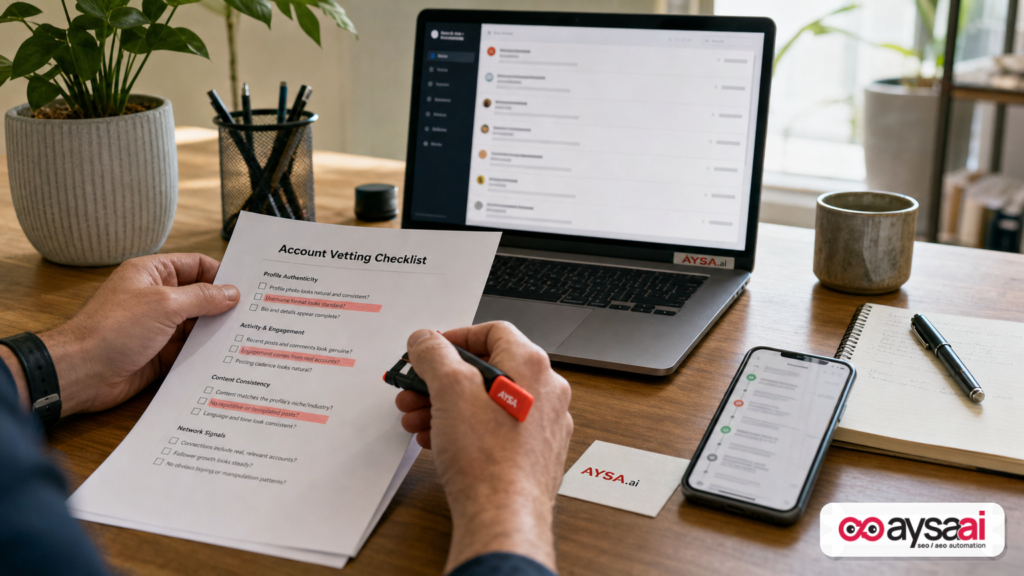
- A practical way to vet Reddit accounts without becoming paranoid
- A repeatable manual test you can run before renewing or buying
- What agencies should rethink: incentives, reporting, and reputational risk
- SME scenario: local clinic vs. ecommerce brand—two different AEO realities
- Where AYSA fits: from AI search monitoring to approved execution
- What to do next (action list)
- Sources and further reading
What changed: why Reddit AEO threads are suddenly high-risk
Reddit has always had promotion. The difference now is structural.
AEO tools are competing in a market where:
- The category is new and definitions are fuzzy. AEO, GEO (Generative Engine Optimization), AI search visibility, AI mode optimization—teams are still arguing over naming, which makes buyers easier to influence.
- Metrics are hard to verify. When a tool claims “+18 visibility points,” it can sound scientific even if it’s built on assumptions you can’t inspect.
- Buyers are under pressure. AI answers are changing discovery. Leadership wants a tool now. Procurement steps get skipped.
- Community trust is the marketing channel. For early-stage SaaS, Reddit is cheaper than enterprise sales and faster than content marketing.
The SEJ write-up points to an analysis that flagged a large share of accounts discussing AEO tools as likely promoters and found that, among the rest, accuracy complaints were the most common feature criticism—especially around visibility scores. That combination is toxic: you’re getting more biased input on a category where the core metric is already contested.
If you’re a founder, a marketing lead, or an agency owner, you don’t need to “quit Reddit.” You need a decision system that assumes Reddit is compromised and that assumes many AEO metrics are probabilistic—then builds safeguards around both.
The Reddit Promoter Problem (And Why AEO Tool Threads Are Especially Vulnerable)
When people ask, “Which AEO tool should I use?” they rarely ask a follow-up question that matters more:
“Who is answering, and what do they gain if I believe them?”
The analysis referenced by SEJ describes patterns that will be familiar to anyone who has moderated communities or done competitive research:
- Accounts that repeatedly recommend the same lesser-known product across many threads.
- Weird timing patterns (bursts of comments in minutes, or coordinated mentions over weeks).
- Copy-like phrasing that appears across multiple accounts.
- Stories that change (e.g., “I switched from competitor X” and soon after “I’m thinking of buying tool Y”).
I’ll add the uncomfortable truth: AEO tool buyers unintentionally reward this behavior. If you create a thread, then shortlist what gets upvoted, you are literally incentivizing stealth promotion. The thread becomes a commission structure.
There’s a second reason AEO tool threads are uniquely vulnerable: most readers can’t validate claims quickly. If someone recommends a Keyword rank tracker, you can often verify the basics. But if someone recommends an AEO tool because “it nails ChatGPT visibility,” you may not know what “nails” means, or how to reproduce it.
So the thread becomes a theater of confidence. And confidence performs well on Reddit.
Why this matters to real businesses (not just SEO people)
AEO isn’t a hobby. For many businesses, it’s turning into:
- A pipeline lever (buyers researching via AI-generated answers instead of ten blue links).
- A reputation lever (AI answers summarizing your brand with or without your consent).
- A conversion lever (AI surfaces “best option” lists that shape shortlist decisions).
That means tool decisions affect more than reporting. They affect:
- What pages you build and prioritize.
- How you allocate content budget.
- What technical work gets done (schema, crawlability, internal linking, page templates).
- How your agency justifies fees and renewals.
If you choose a tool because Reddit says so—and the advocates were promoters—you’re not just overpaying. You’re also adopting that tool’s worldview: its prompts, its scoring system, its dashboards, its suggested actions. If those are wrong, you execute the wrong plan.
The SEJ piece also mentions a reality I agree with: many teams treat visibility scores as estimates due to variation in AI answers. That’s sensible—if you operationalize “estimate” correctly. Most teams don’t. They either:
- Over-believe the metric (it becomes a KPI and a performance contract).
- Under-believe the metric (they stop acting, because “AI is random”).
The winning approach is in the middle: treat scores as a sensor, not a verdict. Use them to detect movement, then validate and execute changes that you can audit.
Why “Visibility Scores” Trigger The Most Frustration (And How To Sanity-Check Them)
The SEJ summary notes that, among non-flagged users, accuracy complaints were the top issue—particularly around visibility scores.
Let’s unpack why this is happening, without assuming any tool is lying.
1) AI answers are not a static SERP
Traditional SEO rank tracking assumes a relatively stable environment: same query, same location, similar SERP. It’s never perfectly stable, but the concept holds.
AI-generated answers behave differently:
- Non-determinism: the same prompt can produce different wording and sometimes different sources across runs.
- Context sensitivity: the model may weigh different sources depending on subtle phrasing changes.
- User personalization: some experiences vary by account state, history, geography, or experimentation frameworks.
Even if an AEO tool is doing its best, it is trying to measure something that can move even when you changed nothing.
2) “Visibility” can mean several different things
When a tool says “visibility,” it could mean:
- Frequency of your brand being mentioned in answers.
- Frequency of your pages being cited/linked.
- Position within a cited list (top vs. bottom).
- Presence in certain answer types (comparisons, recommendations, how-to, local results).
- Share of voice across a prompt set.
Two tools can both be “accurate” and still disagree because they measure different constructs.
3) Prompt sets and sampling bias
A visibility score is only as good as the prompt set behind it.
If your prompts are skewed toward “best software for X,” your score will reward listicle-style citations and aggregator sources. If your prompts are skewed toward “how do I fix Y,” your score will reward documentation-style content and forums.
Most buyers never ask: “Is this prompt set representative of our real buyer journey?”
How to sanity-check a visibility score
Here’s the rule I use: if you cannot manually reproduce a sample of the metric, you cannot use it to make budget decisions.
You don’t need to reproduce 100% of runs. You need a repeatable sampling method that tells you whether the tool is directionally aligned with reality.
Later in this article, I’ll outline a manual test protocol you can run before renewal or purchase.
Citations, sources, and what’s actually useful in AEO platforms
One detail in the SEJ summary is worth emphasizing: users viewed citation data more positively than visibility scoring.
That makes sense because citations are closer to an auditable artifact. You can often answer:
- Did the AI answer reference our site (or not)?
- Which URL was cited?
- Was the cited URL the best page, or a random one?
- What competitors were cited instead?
This is where AEO gets real and operational: citations tell you what to fix.
However, even citation data needs scrutiny:
- Is the citation extracted from the AI interface, from an API, or inferred?
- Does the tool track changes over time?
- Can you export and review citations at URL-level?
- Can you map citations back to pages you can actually improve?
If you’re building a shortlist, citations and source analysis are often more actionable than a single index score—especially for SMEs who need to know exactly what to change on the site next week.
A Procurement-Grade Evaluation Framework For AEO Tools (That Reddit Can’t Give You)
Reddit can help you discover tools. It cannot run your procurement process.
Here’s a procurement-grade framework you can use whether you are an SME buying your first AEO platform or an agency standardizing across clients. It’s intentionally structured to reduce the impact of promotion, hype, and metric ambiguity.
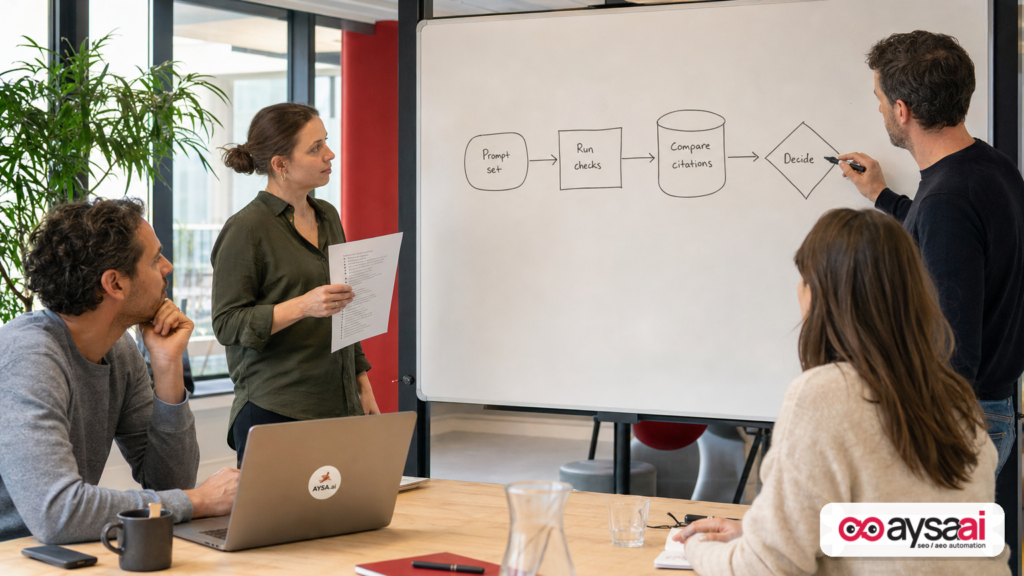
Step 1: Define your use case in one sentence
Examples:
- Ecommerce: “Increase the likelihood our product category pages are cited for ‘best X’ prompts and reduce returns by improving pre-purchase education.”
- Local clinic: “Ensure our treatments, insurance info, and clinician expertise show up correctly in AI answers and referrals for condition-based prompts.”
- B2B SaaS: “Win shortlist inclusion in comparison prompts and improve trial conversion by aligning docs and landing pages with AI-referred intent.”
If you can’t write the sentence, you’re not ready to buy a tool. You’re buying anxiety relief.
Step 2: Inventory the assets you can actually change
AEO tools often assume you can update:
- Landing pages and templates
- Editorial content
- Schema markup
- Internal linking/navigation
- Technical accessibility (crawl/render)
If your website is locked behind a dev queue, the best tool in the world becomes a reporting subscription. Tools don’t create outcomes; changes do.
Step 3: Decide your governance model (who approves changes?)
AEO work touches brand claims, medical/legal language, pricing, and product positioning. You need a simple governance model:
- Who can publish?
- Who must approve factual claims?
- What is the rollback plan?
- How are changes documented?
This is one reason we built AYSA around approved execution: monitoring isn’t useful if nobody can ship.
If you want to see how we position this, start here: AYSA Monitoring.
Step 4: Pick 3 metric types—one must be auditable
Use a mix of:
- Auditable artifacts: citations, referenced URLs, extracted snippets, competitor sources.
- Directional sensors: visibility scores, share of voice indices, prompt coverage.
- Business outcomes: qualified leads, assisted conversions, branded search lift, demo requests, phone calls.
Reddit debates metrics; your business needs a measurement stack that survives those debates.
Step 5: Evaluate tools on five dimensions
When you demo tools, score them (internally) across:
- Data credibility: Can we understand where results come from?
- Reproducibility: Can we manually verify a sample?
- Actionability: Does it translate insights into specific page-level tasks?
- Workflow fit: Can we assign, approve, execute, and document changes?
- Total cost of ownership: Tool cost + team hours + implementation friction.
Most teams only compare the first and the last—and then wonder why nothing improves.
Step 6: Use decision gates to avoid “tool hopping”
A practical set of gates:
- Gate A (2 weeks): Tool can ingest our site, track our prompt set, and export citations.
- Gate B (30 days): We can reproduce 20–30% of tracked prompts manually with similar directional results.
- Gate C (60–90 days): We shipped at least 10 meaningful site changes and can show movement in auditable artifacts.
If a vendor can’t pass Gate A, don’t negotiate price. If you can’t pass Gate C internally, don’t blame the tool.
A Practical Way To Vet Reddit Accounts Without Becoming Paranoid
You don’t need an AI model to do basic due diligence on a Reddit recommendation. You need a checklist and 3–5 minutes.
Account signals that should trigger skepticism
- Repeat plugs: the account recommends the same tool across multiple threads, especially to unrelated businesses.
- Phrase fingerprints: identical wording used across different accounts (copy patterns).
- Thin history: very limited posting outside tool mentions or marketing subreddits.
- Inconsistent story: claims of switching tools, then later acting like they’re considering buying that tool.
- One-sided comparisons: always bashes one competitor while praising one product.
- Timing bursts: multiple comments about the same product in a short window.
- Non-specific praise: “It’s amazing” without any detail you can test (what prompts, what citations, what workflow?).
Green signals that increase credibility
- Concrete limitations: the person mentions what the tool doesn’t do well.
- Reproducible method: they describe how they tested (prompt list, manual checks, time window).
- Context disclosure: they say if they are a vendor, affiliate, or agency and for whom the tool fit.
- Varied contributions: posting history includes non-tool topics and practical problem solving.
How to use Reddit the right way for AEO tool research
Use Reddit to:
- Discover tool names you hadn’t heard of.
- Identify common pain points to test (e.g., score accuracy, citation export, pricing complaints).
- Collect real-world use cases to ask vendors about in demos.
Do not use Reddit to:
- Decide a winner based on upvotes.
- Adopt a prompt list you didn’t design.
- Assume an “industry consensus” exists.
A Repeatable Manual Test You Can Run Before Renewing Or Buying
The SEJ piece recommends checking account histories and testing tool numbers by hand. That’s exactly right. Here is a concrete protocol you can use.
Goal: Validate whether an AEO tool’s outputs are directionally reliable and operationally useful for your business.
Test setup (one-time)
- Build a 30-prompt set that represents your buyer journey.
- 10 “best / top / compare” prompts
- 10 “how / what / explain” prompts
- 10 “near me / local / service” prompts (if applicable)
- Map each prompt to a target page on your site (or note “no good page exists”).
- Define what counts as a win:
- Brand mentioned?
- URL cited?
- Correct page cited?
- Competitor cited instead?
Test run (weekly for 4 weeks)
- Run the prompt set through your AEO tool and export results (citations and any score outputs).
- Manually run a sample of 10 prompts yourself on the relevant AI experiences you care about (keep conditions consistent as best you can; document date/time and any location context you can observe).
- Record:</n
- Was your site cited?
- Which URL?
- Which competitors were cited?
- Did the tool match your observed reality directionally?
Decision criteria
- Pass: Tool’s citation outputs and trends broadly align with your manual checks; the tool helps you identify fixable page-level work.
- Conditional pass: Tool is inconsistent on scoring but reliable on citations; use it as a citation/workflow system, not a KPI machine.
- Fail: Tool outputs regularly contradict manual checks and can’t explain why; or it can’t tie insights to specific actions.
This is not about perfection. It’s about whether you can trust the tool enough to make decisions and ship changes confidently.
What Agencies Should Rethink: Incentives, Reporting, And Reputational Risk
If you run an agency, Reddit’s promoter problem isn’t just “someone else’s ethics issue.” It’s a risk to your business model.
1) Your tool stack can become a credibility liability
When clients learn that “community recommendations” are partially manufactured, they start questioning everything else: your reporting, your vendor partnerships, your affiliate links, your margins.
The correct defense is not “we don’t do that.” It’s: we validate tools with a documented methodology.
2) Score-first reporting is an easy target
If your monthly report leads with a proprietary visibility score, you’re making your work look like a black box. That invites skepticism—especially when clients see Reddit debates about score accuracy.
Better: lead with auditable artifacts (citations, URL changes shipped, content improvements published), then show directional trend metrics second.
3) AEO requires execution capacity, not just monitoring
Most AEO tools are great at telling you something changed. Fewer help you change your site. Even fewer help you do it with governance.
This is the gap AYSA is designed to fill: monitor what AI search is doing, prepare recommended fixes, ask for approval, then execute changes. If your agency is strong in strategy but bottlenecked in implementation, that model matters.
SME Scenario: Local Clinic vs. Ecommerce Brand—Two Different AEO Realities
Let’s make this concrete with two realistic examples.
Scenario A: A local physical therapy clinic
Business reality: New patients ask AI questions like “What helps sciatica pain?” or “Is dry needling effective?” and then search for a local provider.
What can go wrong with Reddit-led tool selection:
- The clinic buys a tool optimized for “best software” prompts, not health education or local discovery.
- They obsess over a visibility score while their actual pages lack clear service details, clinician bios, FAQs, and structured signals.
What to do instead: prioritize citation tracking and page-level recommendations that improve service pages, FAQs, and clarity. The “tool” is less important than the ability to ship compliant edits under approval.
Scenario B: An ecommerce brand selling specialty cookware
Business reality: Buyers ask “best carbon steel pan for eggs” or “cast iron vs carbon steel,” then click through to compare products.
What can go wrong with Reddit-led tool selection:
- The brand overweights Reddit sentiment (which is strong in cookware communities) and buys the tool that was “most recommended,” without verifying promoters.
- The tool’s prompt set doesn’t match the brand’s margin priorities (it tracks the wrong categories).
What to do instead: build a prompt set tied to revenue-driving categories, then evaluate whether the tool can map citations to category pages and buying guides you can improve. You want a loop: monitor → change → validate.
Where AYSA Fits: From AI Search Monitoring To Approved Execution
Most teams are building an AEO stack backward. They start with a tool, then try to invent a workflow.
At AYSA.ai, we think the workflow is the product:
- Monitor: track AI search visibility and changes over time.
- Prepare: generate specific, page-level recommendations (content, technical, structured data) that map to your site.
- Ask for approval: nothing ships without a human decision-maker signing off.
- Execute: implement accepted changes on the website, with documentation.
You can explore these components here:
What AYSA changes in the tool selection conversation
When your system is designed to execute, it naturally forces a higher standard for “accuracy.” Not because we worship metrics, but because:
- If a tool insight is wrong, you waste engineering/content time shipping the wrong change.
- If a recommendation is vague, it doesn’t survive an approval workflow.
- If a metric can’t be explained to a business owner, it can’t become a KPI.
That’s why I’m skeptical of any AEO approach that stops at monitoring or score reporting. Scoreboards don’t grow businesses. Shipped improvements do.
Approved execution as a hedge against hype
Reddit hype pushes you toward tool-chasing. Approved execution pushes you toward disciplined iteration:
- Small changes you can verify
- Clear approvals and accountability
- Documented before/after
- A durable learning loop for your specific market
That loop is how you win in AI search over time, regardless of which tool category name wins (AEO vs GEO vs “AI SEO”).
What to do next (Action list)
- Stop shortlisting tools from Reddit upvotes. Use threads only to build an initial list of names and pain points.
- Vet the recommending accounts. Look for repeat plugs, phrase fingerprints, thin histories, and inconsistent stories.
- Write your one-sentence AEO use case. If you can’t define it, don’t buy anything yet.
- Build a 30-prompt set tied to revenue. Map prompts to pages you can improve.
- Demand auditable outputs. Prioritize citations and URL-level exports over a single index score.
- Run the 4-week manual validation protocol. Sample prompts weekly; compare to tool outputs; document variance.
- Create a shipping plan. Identify 10 changes you can realistically implement in 60–90 days.
- If you need execution capacity, choose a system—not just a dashboard. Consider workflows that turn monitoring into approved site changes, like AYSA.
Sources and further reading
- Search Engine Journal: Reddit’s AEO Tool Recommendations Have A Promoter Problem
- Search Engine Journal: AI Search coverage
- Search Engine Journal: SEO coverage
- Search Engine Journal: Technical SEO coverage
- Search Engine Journal: Local SEO coverage
- Search Engine Journal: Paid media coverage
Closing perspective
Reddit can still be valuable—if you treat it like what it is: a noisy market of opinions with incentives attached.
The bigger lesson from the promoter problem isn’t “don’t trust Reddit.” It’s “don’t outsource procurement to vibes.” AEO is too important, and too execution-dependent, for that.
Build a validation habit, prioritize auditable artifacts like citations, and choose a workflow that ends in shipped improvements. If you want to see what that looks like in practice, start with AI Search Visibility and Monitoring, then decide whether your team needs a monitoring tool—or an approved execution system.
Continue the AI search topic inside AYSA.
Use these pages to connect the article with AI SEO tools, AI visibility monitoring, AI Overviews and approved website execution.
Turn this topic into a website action plan.
Use these AYSA hubs to move from reading to technical fixes, AI visibility monitoring, research, glossary context and approval-first SEO execution.