
Reddit Search Ads Are Here: What This Means For “Search Intent,” Brand Safety, And The Next Era Of Paid + Organic Visibility
Reddit is testing ads inside its own search results. That sounds like a small product tweak—until you realize it changes how “search intent” gets monetized, how brands show up next to messy conversations, and how SMEs should measure visibility across paid, organic, and AI answers. Here’s the practical playbook for marketers and operators.

Reddit is testing ads inside its own search results pages. On the surface, that sounds like a predictable monetization move: a fast-growing platform finds another high-intent surface and sells placements. But in practice, it’s a signal that “search” is fragmenting—again—and that advertisers will need to earn visibility across a mix of paid placements, organic posts, and AI-driven summaries that people increasingly trust more than blue links.
This is not a think piece about whether ads are “good” or “bad.” It’s an operator’s guide to what changes when a platform like Reddit starts monetizing searches inside its ecosystem: how intent behaves, where brand risk lives, why measurement gets harder, and what small and mid-sized businesses (SMEs) should do next.
Primary source for the announcement and details: Search Engine Journal coverage of Reddit’s search ads test. I’ll reference it for what’s confirmed, and I’ll clearly label anything else as analysis.
Concise Summary
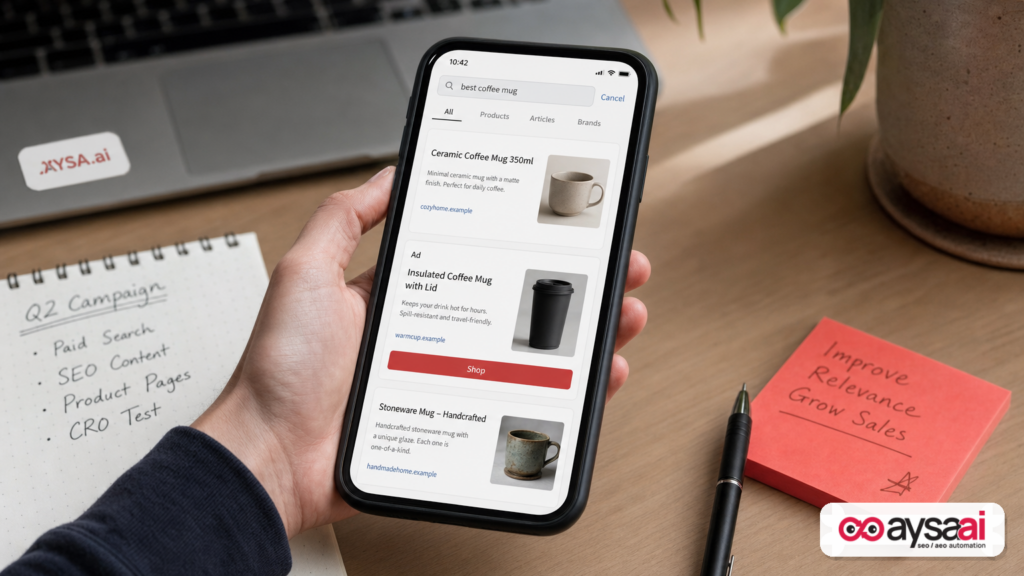
Reddit says it’s testing ads in its own search results with a select group of eligible advertisers, and that ads may appear based on factors including relevance to the Search query. It’s a meaningful change because Reddit search behavior is often deeper-funnel research (“what should I buy?” “what do real people think?”) than traditional social browsing. For advertisers, it introduces a new set of considerations: creative that matches research intent, landing pages that answer comparison questions, tighter brand-safety guardrails, and measurement that can separate “search placements” from other inventory.
Key Takeaways (For Busy Operators)

- Reddit search ads are a new paid search surface, not just “another social placement.” Queries can be high-intent, but they’re often “help me decide” intent, not “buy now” intent.
- The targeting logic is partly contextual (relevant to the query), but Reddit hasn’t publicly detailed all ranking factors, pricing models, or rollout scope.
- Brand safety is the tax: on Reddit, the best conversations are often messy. If you don’t define adjacency rules, you’ll eventually pay for it.
- Measurement will be the biggest trap for many SMEs. If reporting doesn’t clearly segment search placements, you’ll optimize on noise.
- Winning requires operational speed: aligning creative, landing pages, and content with what people are researching—and shipping improvements weekly, not quarterly.
- AYSA fits here as an execution system: monitor, prepare changes, request approval, and implement accepted updates to keep your site and content aligned with how people search across platforms and AI experiences.
Table of Contents

- What Reddit Is Testing (And What We Actually Know)
- Context: Reddit Search Is Growing, And Reddit Needs More Monetization Surfaces
- Why This Matters: Reddit Queries Are Different From Google Queries
- When Search Isn’t “Search” Anymore (But It’s Still Search)
- What Can Go Wrong: Brand Safety, Trust, And The “Forum Tax”
- Creative And Landing Pages: Build For Research Intent, Not Just CTR
- The Measurement Problem: Search Ads Create A New Reporting Blind Spot
- An SME Scenario: “Home Office Setup” For A DTC Ecommerce Brand
- Agency Implications: New Placement, New Processes, Same Accountability
- Where AYSA Fits: Approved Execution For The New Search Reality
- What To Do Next: A Practical Action Plan
- Sources And Further Reading
What Reddit Is Testing (And What We Actually Know)
According to Reddit’s announcement as reported by Search Engine Journal, Reddit is testing ads in its own search results pages with a select group of eligible advertisers. Reddit also says ads in search may appear based on a range of factors, including contextual relevance to the user’s search query. The stated goal is to evaluate user response and refine the experience over time.
Search Engine Journal’s write-up includes examples like a query for “espresso station” potentially triggering ads for coffee beans, mugs, or espresso machines, and “home office setup” triggering ads for desks, chairs, or monitors. The examples shown are in a mobile context, with an “Ad” card and a call-to-action such as “Shop Now.”
What’s not confirmed publicly (as of the source coverage):
- How advertisers were selected, and how (or if) others can opt in.
- Which markets the test covers.
- Pricing models and auction mechanics (CPC/CPM/CPA, bidding, etc.).
- All ranking/selection factors beyond contextual relevance.
- Whether the test is limited to the app UI shown or includes desktop web search results too.
- A timeline for expansion or an end date for testing.
That ambiguity matters. When a platform introduces a new ad surface, early tests often evolve quickly: placements shift, reporting changes, and what works at launch may not work after scale.
Context: Reddit Search Is Growing, And Reddit Needs More Monetization Surfaces
The SEJ coverage connects this test to a broader narrative: Reddit search usage has been growing, and leadership has publicly acknowledged that search is a high-growth surface that historically had less direct ad monetization. In the SEJ report, comments referenced from investor calls suggest Reddit has been “eyeing” search ads and has infrastructure “queued up” for it. (Those investor-call details are summarized in the SEJ source; I’m not restating them as direct quotes beyond what SEJ reported.)
Here’s the practical operator takeaway: if search behavior inside Reddit is increasing, ads will follow. Platforms monetize user intent. And search queries—especially product and comparison queries—are among the clearest expressions of intent on the internet.
Reddit also has another advantage: search inside a community platform can show not only content, but context—subreddits, discussions, opinions, and lived experience. That can be powerful for users. It also changes what advertisers are competing against: not just other ads, but real people’s stories.
Why This Matters: Reddit Queries Are Different From Google Queries
Many business owners lump all “search” into one bucket: Google, maybe Bing, maybe YouTube. But Reddit search is a different kind of intent stream. In my view, it’s often not the last click before purchase—it’s the decision-shaping phase.
1) Reddit search is often “social proof intent”
On Google, someone searches “buy standing desk” and expects a Category page. On Reddit, the same person searches “standing desk worth it” or “best standing desk under $500” because they want a human filter: what broke, what shipped late, what felt unstable, what customer support actually did.
This is why ads in Reddit search are both attractive and dangerous:
- Attractive because the user is actively researching.
- Dangerous because the user may distrust marketing by default and value peer commentary more.
2) Reddit query language is long-tail and scenario-based
Users frequently include context: “for apartment,” “for back pain,” “for coding,” “for ADHD,” “for small kitchen,” “for travel,” “for hot climate,” etc. That context is gold for advertisers—if your creative and landing pages reflect it.
3) Your real competitor is the thread, not the ad next to you
On Google Search, your competitor is another website ranking above you or another ad with a better offer. On Reddit search, your competitor is a high-karma comment that says, “Don’t buy X, it’s a scam—buy Y.”
That doesn’t mean Reddit search ads won’t work. It means you’re buying entry into a conversation, not buying the conversation itself.
When Search Isn’t “Search” Anymore (But It’s Still Search)
We’re living through a definition shift. Search used to mean: type keywords into a search engine, click a list of links. Now “search” includes:
- In-app search (Reddit, TikTok, YouTube, Amazon)
- Marketplace search (Etsy, Airbnb, App Store)
- AI answer experiences (summaries, copilots, assistants)
- Community discovery (subreddits, forums, Discord-like spaces)
For SMEs, this fragmentation creates two problems:
- Visibility is harder to measure: you may be “winning” in one surface while losing in another.
- Execution is harder to coordinate: creative teams, web teams, and analytics teams have to move together.
This is exactly where an execution system matters. Strategy is cheap. Shipping is the bottleneck.
If you’re building for AI-driven discovery and platform search at the same time, you should be thinking in terms of AEO (Answer Engine Optimization) and GEO (Generative Engine Optimization) alongside classic SEO. That’s not a buzzword upgrade. It’s a content and structure upgrade: clear entities, clear claims, clear proof, and pages that answer questions without forcing people to dig.
If you want a deeper primer on how we frame this at AYSA, start here: AI search visibility.
What Can Go Wrong: Brand Safety, Trust, And The “Forum Tax”
Reddit is valuable because it isn’t polished. That’s also the risk. When you place ads in a community environment, you inherit a “forum tax”—extra work you must do to protect brand trust.
1) Ad adjacency: appearing next to content you wouldn’t choose
If your ad shows up next to a heated thread, misinformation, or just deeply negative sentiment about your category, you may pay for Impressions that actively harm conversion. Even if the placement is “relevant” contextually, relevance doesn’t equal suitability.
Because Reddit hasn’t publicly detailed the control set for search placements (per the SEJ write-up), advertisers should assume the usual early-stage reality: controls may be limited at first, and reporting may lag.
2) The “ad label” problem: users are trained to distrust
In communities, people value authenticity. A generic “Shop Now” ad with stock imagery can underperform not because the product is bad, but because the message doesn’t match the environment. The best-performing creative in these contexts often:
- Leans into specificity (“Designed for small spaces” vs. “Best desk ever”)
- Matches the query language (use the scenario, not just the product category)
- Uses proof points carefully (warranty, materials, shipping times) without hype
3) You can’t outbid a bad reputation
Here’s the hard truth: if your product already has negative thread history, buying search ads is like turning up the volume on a song people hate. Before you scale spend, you need to understand what the community already believes about you and your category.
That starts with monitoring—brand mentions, category complaints, and competitor narratives. At AYSA, monitoring is foundational: AYSA Monitoring.
Creative And Landing Pages: Build For Research Intent, Not Just CTR
If Reddit search ads behave the way I expect (based on how people use community search), most advertisers will lose money in the first month—not because the platform is bad, but because they’ll run “conversion creative” to “research intent.”
Creative shift: from benefits to decision support
Instead of leading with generic benefits (“ergonomic,” “premium,” “best”), lead with decision support:
- Use-case framing: “For small apartments,” “for 8+ hour workdays,” “for under-$X budgets.”
- Comparison framing: “What’s different vs. traditional desks” (without naming competitors if that’s risky).
- Objection handling: “Ships in 48 hours,” “30-day trial,” “parts available.”
- Proof framing: clear materials, clear specs, clear policies—no exaggerated claims.
Landing page shift: from product page to “answer page”
If your ad is triggered by “home office setup,” sending traffic to a generic product page is a mismatch. You need a landing experience that feels like a helpful guide:
- A “setup” page with bundle logic (desk + chair + lighting)
- A short buying guide (“How to choose a chair if you have back pain”)
- Clear “who this is for / who it’s not for” sections
- Internal links to deeper FAQs
This is also where SEO and paid search stop being separate teams. The same page that converts paid traffic should be structured to earn organic visibility and AI citations over time.
AYSA’s tooling is designed to help teams ship these improvements continuously, with review and approval built in: AYSA AI SEO tools.
Make creative “AI-ready,” even for paid
Even though we’re talking about ads, not AI answers, the same discipline applies: clarity wins. Vague marketing language doesn’t just underperform with users; it also fails to create consistent interpretation across systems and surfaces. Treat every headline and description as a claim that must be supported on the landing page.
Practical checklist for AI-ready (and human-ready) ad-to-page alignment:
- One primary promise per ad group
- One matching H1 on the landing page
- Three supporting proof points above the fold
- One FAQ section that mirrors the query language
- One comparison section that clarifies tradeoffs
The Measurement Problem: Search Ads Create A New Reporting Blind Spot
When a platform introduces a new placement type, reporting is often behind the product. That’s not a criticism; it’s a reality of iteration. But it creates risk for advertisers—especially SMEs who can’t afford to spend for “learning” that never becomes clarity.
1) If you can’t segment search placements, you can’t optimize
You need to know, at minimum:
- How many impressions/clicks came specifically from search results pages
- Which queries (or query themes) triggered impressions
- How search placement performance differs from feed/conversation placements
SEJ notes that advertisers can ask their Reddit rep whether they’re in the test and how search impressions would show up in reporting. That’s the right move. Your first job is to make sure you can see what you’re buying.
2) Search ads may cannibalize organic discovery (or vice versa)
If your brand is already being discussed positively on Reddit, you may find that paid search ads capture clicks you would have earned anyway through organic threads. That’s not automatically bad—paid can still control messaging and landing experience—but it changes how you evaluate ROI.
Recommendation: run geo or time-based holdouts when feasible, even if small. If you can’t do formal experiments, at least annotate spend changes and compare conversion rate changes against baseline volatility.
3) Choose downstream metrics that match research intent
For Reddit search traffic, especially early on, you may see lower immediate conversion rates than Google Shopping or brand search. That doesn’t mean it’s unprofitable. It means the traffic is earlier in the decision.
Consider tracking:
- Engaged sessions (time on page, scroll depth—if you measure it responsibly)
- Email capture or “save this guide” actions
- Return visits (within a reasonable attribution window)
- Assisted conversions (with caution—assists can be inflated)
This is where many teams get stuck: they lack a clean measurement model, and then they argue about opinions. Strong analytics turns arguments into decisions. If you’re rebuilding your visibility measurement for the AI era, keep your internal reporting simple and decision-oriented.
An SME Scenario: “Home Office Setup” For A DTC Ecommerce Brand
Let’s make this tangible with a realistic scenario.
Business: A small-to-mid DTC ecommerce brand selling desks and ergonomic chairs.
Goal: Grow sales without relying entirely on Google Shopping and Meta retargeting.
Opportunity: Reddit users search “home office setup,” “chair for back pain,” “standing desk wobble,” “desk for small apartment.”
Step 1: Build an intent map (not a keyword list)
Instead of exporting thousands of keywords, group intent into a few human categories:
- Setup intent: “home office setup,” “minimalist desk setup,” “work from home essentials”
- Pain/problem intent: “back pain chair,” “neck pain monitor height,” “wrist pain keyboard”
- Constraint intent: “small space,” “under $500,” “easy assembly,” “renters”
- Trust intent: “is [brand] legit,” “shipping time,” “warranty experience”
Step 2: Write creative that speaks like a guide
Example (conceptual) ad angles:
- “Small space desk setups: sturdy, cable-friendly, ships fast.”
- “Back pain? Here’s how to pick a chair (with a 30-day trial).”
- “No wobble standing desk: what stability actually depends on.”
No hype. No “best ever.” Just helpful specificity.
Step 3: Create one ‘Setup Guide’ landing page that can rank and convert
This page should include:
- A 5-minute checklist for building a home office
- Bundles or recommended combinations
- Short sections answering the common objections pulled from customer service logs
- A “why people choose us” section with verifiable proof points (policies, materials, assembly time estimates)
This page is not just for Reddit ads. It’s also a long-term asset for organic search, AI answers, and email nurture.
Step 4: Monitor what people say before and during the test
Before scaling spend, monitor:
- Brand mentions (positive and negative)
- Competitor comparisons
- Category pain points (“wobble,” “returns,” “delivery damage”)
In AYSA terms, this is where ongoing monitoring and fast iteration win. You can’t “set and forget” in a community environment.
Step 5: Iterate weekly with approved execution
Most teams fail here. They see performance issues and say: “We need to redesign the site.” Then nothing ships for 8 weeks.
A better model:
- Week 1: ship a new FAQ section and one comparison block
- Week 2: add a “who it’s for / not for” section
- Week 3: improve internal linking to deeper guides
- Week 4: refine ad copy to match the best-performing page section
This is exactly how AYSA is built to operate: prepare changes, ask for approval, then execute accepted updates. Learn more on the AYSA blog and product pages: AYSA Blog and Pricing.
Agency Implications: New Placement, New Processes, Same Accountability
If you run an agency, Reddit search ads create an uncomfortable truth: you can no longer treat “social” and “search” as separate scopes with separate reporting rhythms. In-app search is both. And clients will increasingly ask one question: “Where are we visible when people research us?”
1) Expect scope creep unless you define deliverables
Clients will say, “We’re running Reddit search ads, can you also improve our landing pages?” If you don’t bundle conversion content and technical hygiene into your paid scope, performance will stall and you’ll get blamed anyway.
2) Creative ops must speed up
Reddit-style intent needs more variants: scenario-based messaging, objection-handling angles, and proof-led copy. Agencies that still run one static creative set for a quarter will lose.
3) Reporting must evolve from platform metrics to business outcomes
If you can’t explain what the placement is doing in the journey—awareness, research, conversion—you’ll chase shallow CTR and call it success. That’s how budgets get cut.
Agencies should consider adopting an “approved execution” workflow internally: strategy + prepared changes + client approval + shipping. That reduces bottlenecks and makes results more repeatable.
Where AYSA Fits: Approved Execution For The New Search Reality
At AYSA, we treat this Reddit move as part of a bigger trend: visibility is no longer won in one place. It’s won through an operating system that can coordinate signals across:
- On-site content and technical SEO
- Paid placement traffic and landing experience
- Brand and category narratives across communities
- AI answer visibility (AEO/GEO), where clarity and credibility are the currency
That’s why AYSA is built as an execution system, not just analytics:
- Monitor what’s happening (visibility, issues, changes): AYSA Monitoring
- Prepare recommended site/content improvements
- Ask for approval so humans control brand risk
- Execute accepted changes so improvements actually ship
If you want the strategic overview of how we think about AI-era visibility, start here: AI Search Visibility. If you’re evaluating tooling for continuous optimization, see: AI SEO Tools.
And if you’re an SME trying to decide whether this is “for you,” the answer is simple: if Reddit is where your customers research (or where your category gets debated), you need a way to monitor and respond—fast. Not with panic, not with reactive PR, but with systematic improvements to what you publish, how you present proof, and how you convert intent into outcomes.
What To Do Next: A Practical Action Plan
This is the checklist I’d use if I ran growth for an SME and wanted to be early—but not reckless—on Reddit search ads.
Phase 1: Get “search-ready” in a community context (1–2 weeks)
- Audit your category reputation: What do people complain about? What do they praise? Capture themes.
- Define brand safety rules: Topics you want to avoid, tone constraints, claims constraints.
- Build 1–2 answer-style landing pages: “How to choose,” “best for X,” “setup guide,” or “pricing explained.”
- Align promises: Every claim in your ad must be supported clearly on the landing page.
Phase 2: Run a disciplined test (2–4 weeks)
- Segment placements in reporting as much as the platform allows (ask your rep, per SEJ guidance).
- Run multiple creative angles tied to intent groups (setup, pain, constraint, trust).
- Optimize for learning first: which intent groups produce engaged sessions and add-to-carts.
- Use tight budgets and caps until you trust the adjacency and reporting.
Phase 3: Operationalize what works (ongoing)
- Weekly landing page iteration based on user questions and performance.
- Expand content coverage around the highest-intent themes you discover.
- Build a “proof library”: policies, specs, comparisons, and FAQs you can reuse across ads and pages.
- Monitor narrative drift: if the community changes its mind, your messaging must change too.
If you want an execution framework for this kind of cadence, explore AYSA’s monitoring and tooling pages: Monitoring, AI SEO tools, and Pricing.
Sources And Further Reading
- Search Engine Journal: Reddit Begins Testing Ads In Its Own Search Results
- Search Engine Journal: Paid Media category
- Search Engine Journal: AI Search coverage
- Search Engine Journal: SEO coverage
- AYSA: AI Search Visibility
- AYSA: AI SEO Tools
- AYSA: Monitoring
- AYSA Blog
- AYSA Pricing
Note on certainty: Reddit’s public details about search ads (selection factors, pricing, reporting) are limited in the source coverage. Where specifics aren’t confirmed, I’ve treated them as operational risks and planning assumptions—not facts. As Reddit expands the test and publishes more documentation, the tactical recommendations (especially measurement and controls) should be revisited.
Continue the AI search topic inside AYSA.
Use these pages to connect the article with AI SEO tools, AI visibility monitoring, AI Overviews and approved website execution.
Turn this topic into a website action plan.
Use these AYSA hubs to move from reading to technical fixes, AI visibility monitoring, research, glossary context and approval-first SEO execution.