
Google’s UCP Direct Checkout In AI Mode (Canada): What It Changes For Ecommerce SEO, Paid Media, And Conversion Strategy
Google is bringing UCP-powered direct checkout into AI Mode and the Gemini app for Canadian shoppers—compressing discovery and purchase into one conversation. Here’s what that means for feed quality, attribution, CRO, and how SMEs should prepare before Merchant Center UCP integration expands next year.

Google is starting to let Canadian shoppers complete purchases inside AI Mode in Search and in the Gemini app—powered by the Universal Commerce Protocol (UCP). If you run ecommerce, this is not just “another feature.” It’s a shift in where conversion happens, what product data becomes mission-critical, and how marketing teams prove they drove revenue when fewer people ever reach your website.
This editorial breaks down what changed, why it matters, what could go wrong, and what practical steps Canadian retailers (and agencies managing them) should take now—before UCP integration becomes a self-serve Merchant Center setting next year.
Concise summary

Google is expanding UCP-powered direct checkout to Canadian shoppers across AI Mode in Search and the Gemini app, starting with a limited set of retail partners and select Shopify merchants. Google Pay + Google Wallet power payment and shipping details, while the merchant remains the seller of record. Next year, Google plans to offer a simplified UCP integration inside Merchant Center—potentially turning “direct checkout from AI answers” into a broadly accessible distribution channel.
Key takeaways
- AI conversations are becoming the storefront. Discovery, comparison, and checkout are compressing into one interface—often without a website click.
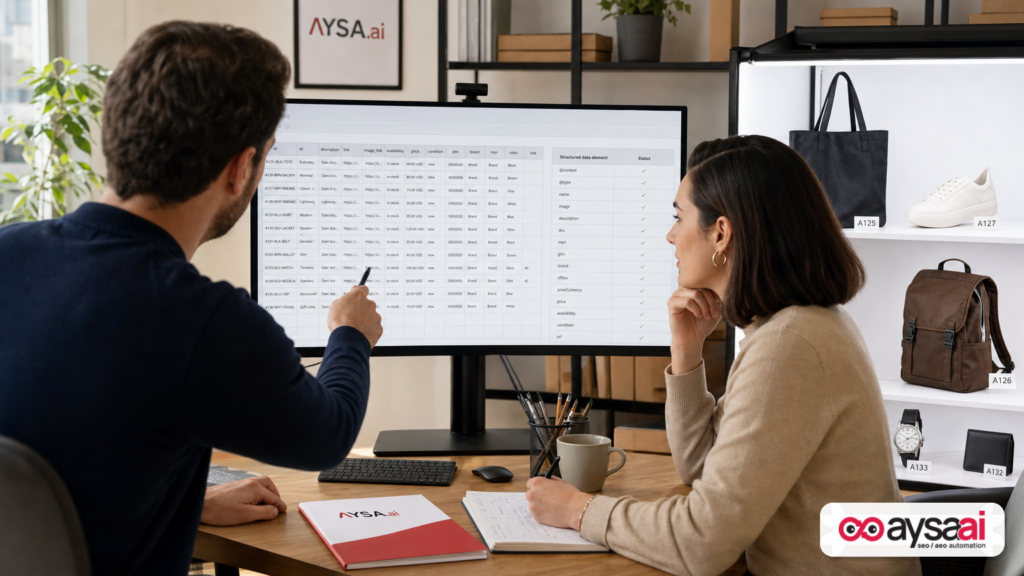
- Merchant Center feed quality becomes your “AI inventory system.” If your data is wrong, AI surfaces will either skip you or misrepresent you.
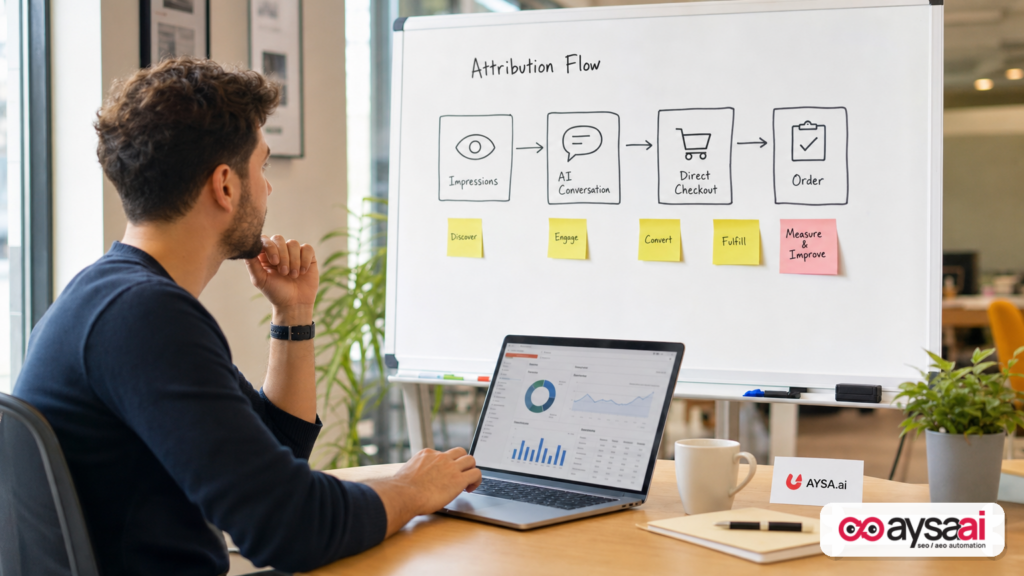
- Attribution will get harder before it gets easier. Google has not yet clarified how UCP direct checkout orders will be reported or attributed across Merchant Center and Google Ads.
- Ops and finance now matter as much as SEO. Refunds, taxes, shipping, customer support, and loyalty programs must align with AI-surface checkout realities.
- Execution speed becomes a competitive advantage. Teams that can monitor, prepare changes, get approvals, and ship updates quickly will win visibility and conversion share.
Table of contents
- What Changed: Direct Checkout Inside AI Mode And Gemini For Canadian Shoppers
- UCP In Plain English: Why An “Open Standard” Matters
- The Invisible Backbone: Why Merchant Center Feeds Become Your “AI Inventory”
- Why Google Is Doing This: Fewer Clicks, More Completed Purchases
- Implications For Ecommerce SEO: Visibility Shifts From Pages To Product Entities
- Implications For Paid Media: Performance Max, Shopping, And The New Conversion Path
- Measurement & Attribution: The Hard Part Nobody Has Solved Yet
- Operational Risks: Returns, Support, Fraud, And The Loyalty Gap
- A Practical SME Scenario: A Canadian Retailer Preparing For AI Checkout
- Action Plan: What To Audit, Fix, And Build Before Merchant Center UCP Arrives
- Where AYSA Fits: Monitoring, Preparation, Approved Execution
- What To Do Next (Checklist)
- Sources And Further Reading
What Changed: Direct Checkout Inside AI Mode And Gemini For Canadian Shoppers
According to reporting from Search Engine Journal, Google is expanding UCP-powered direct checkout to shoppers in Canada across AI Mode in Google Search and the Gemini app. At launch, Google cited a small set of partners/merchant groups, including lululemon, Shoppers Drug Mart, Simons, and select Shopify merchants.
Here’s the behavior change that matters: shoppers can research products in an AI conversation and complete purchase without leaving that conversation. Checkout uses Google Pay, pulling saved payment methods and shipping details from Google Wallet, while Google states the retailer remains the seller of record.
That combination—AI discovery plus native checkout—creates a new “conversion surface” where the customer’s decision is made and executed before your site has a chance to persuade, upsell, or even pixel the visitor.
What this is not
- It’s not a small UX tweak. It’s a new distribution channel with platform-controlled UX and data visibility.
- It’s not purely a paid media feature. Organic product visibility, Structured data, and feed integrity are central.
- It’s not a guarantee you’ll get access immediately. Google indicated broader access depends on Merchant Center integration planned for next year.
UCP In Plain English: Why An “Open Standard” Matters
UCP (Universal Commerce Protocol) is described by Google as an open standard created with industry partners to support “agentic commerce”—where AI agents help users discover products, complete purchases, and handle post-purchase needs without bespoke integrations for every platform pairing.
You don’t need to be technical to understand the strategic implication: standards reduce friction. When something becomes easy to integrate, more merchants join. When more merchants join, more shoppers see it. When more shoppers see it, “AI-native checkout” becomes normalized. And once normalized, your marketing strategy has to assume it’s a core path—not an edge case.
In previous eras, the winner in ecommerce was often the business with the best website and the best Conversion rate optimization (CRO). In an AI-checkout era, the winner may be the business with:
- the cleanest product data,
- the most reliable inventory and shipping promises,
- the strongest brand recall, and
- the fastest execution loop for feed/site updates.
The Invisible Backbone: Why Merchant Center Feeds Become Your “AI Inventory”
Even before the promised Merchant Center UCP integration arrives, Merchant Center is already the supply chain for many Google commerce surfaces. Google has also published guidance indicating generative AI results can include product listings and product information “where appropriate,” and Merchant Center feeds can contribute to presence across shopping experiences and AI surfaces (as cited in the SEJ piece).
The practical translation: your Merchant Center feed isn’t just for Shopping ads anymore. It’s becoming the dataset AI uses to decide:
- what you sell,
- what it costs right now,
- whether it’s in stock,
- which variant is relevant (size/color),
- what shipping looks like, and
- whether the item is a good match for the user’s query and constraints.
Feed quality is positioning
Historically, “feed cleanup” was treated like a quarterly chore. In AI shopping, feed quality becomes positioning. If your title structure is sloppy, if variants are confusing, if pricing updates lag, or if inventory is wrong, AI surfaces will either:
- avoid recommending you (risk reduction), or
- recommend you but create a poor experience (returns, cancellations, brand damage), or
- recommend a competitor whose data is easier to trust.
If you’re an SME, this is good news in one way: you don’t have to outspend big brands to compete everywhere. You can out-execute them on data hygiene and operational truthfulness.
Why Google Is Doing This: Fewer Clicks, More Completed Purchases
This rollout is consistent with a larger arc: Google is reformatting search from “ten blue links” into a set of task-completion surfaces—answers, comparisons, summaries, shopping modules, and now conversational checkout.
From Google’s perspective, direct checkout inside AI Mode reduces abandonment in the messy middle between “I found the right item” and “I actually purchased it.” Every extra step—site load time, popups, account creation, checkout friction—drops conversion. Platform-native checkout is a solution to that friction.
From a merchant perspective, it’s both an opportunity and a risk:
- Opportunity: higher-intent shoppers can buy faster, potentially improving conversion rate and reducing funnel leakage.
- Risk: you surrender parts of the relationship-building layer (site experience, bundling, email capture patterns, some analytics visibility).
When a platform owns the interface, you must win in the layers you still control: product truth, brand, customer service, fulfillment reliability, and post-purchase experience.
Implications For Ecommerce SEO: Visibility Shifts From Pages To Product Entities
For years, Ecommerce SEO was “rank category pages and product pages.” That still matters—but AI surfaces are accelerating a shift toward entity-level representation:
- Products as entities: an item with attributes (brand, price, availability, size, color, shipping) rather than just a URL.
- Retailers as entities: store reputation, policies, support quality, and consistency across channels.
- Constraints as entities: “arrives by Friday,” “fits wide feet,” “works with iPhone,” “under $150,” “available in Vancouver.”
AI Mode is built to satisfy constraints conversationally. That means your SEO work must ensure your products can be confidently matched to constraints.
The new ecommerce SEO stack (simplified)
- Product data correctness: feed + on-site Product schema consistency, accurate variants, pricing, and stock.
- Operational credibility: shipping promises, returns policy clarity, contact/support signals, and fulfillment reliability.
- Content that answers pre-purchase questions: sizing guidance, compatibility guides, ingredient/material disclosures, care instructions—written for humans but structured so AI can cite it.
- Brand demand: people asking for you by name is still the ultimate insulation.
If your strategy is still “publish more blog posts,” you’re going to feel the squeeze. AI-driven shopping prioritizes clarity and decision support over volume.
AEO/GEO becomes ecommerce work, not just SEO jargon
Whether you call it AEO (answer engine optimization) or GEO (Generative Engine Optimization), the practical job is the same: make your products and policies easy for AI systems to represent accurately. That’s exactly the kind of work we focus on at AYSA—turning visibility requirements into a monitored execution plan rather than a one-off audit.
For more on how we think about AI visibility, see AYSA’s AI search visibility overview.
Implications For Paid Media: Performance Max, Shopping, And The New Conversion Path
If you manage Google Ads for ecommerce, direct checkout inside AI Mode raises immediate questions you can’t ignore:
- Where does the ad impression occur—in classic SERPs, in AI Mode, or both?
- What does a “click” mean if checkout happens without a website visit?
- How will conversion tracking and modeled conversions behave when fewer sessions hit the site?
- Will product selection bias toward merchants with cleaner feeds (even in paid placements)?
The SEJ report explicitly notes that Google has not yet clarified how UCP direct checkout orders are reported or attributed in Merchant Center and Google Ads, or how it interacts with paid Shopping and Performance Max.
What you should assume now (until Google clarifies)
- Expect reporting turbulence. When new conversion paths appear, attribution and reconciliation typically lag.
- Expect new optimization incentives. If Google can measure purchase completion inside its surface, it may optimize toward that path—whether or not it matches your preferred first-party data strategy.
- Expect creative and feed to merge. In AI shopping, the “ad” is often the product card + attributes + trust signals. Your feed is part of your creative.
Paid teams should treat product data quality as part of the media plan, not a separate “SEO thing.” If you’re an agency, this is where you can differentiate: integrating feed QA, landing page QA, and operations readiness into your retainer.
Measurement & Attribution: The Hard Part Nobody Has Solved Yet
Every platform shift creates a measurement gap. This one is bigger because it’s not just a new placement—it’s a new transaction surface.
Here are the specific attribution problems to plan for, based on what’s known and what remains unknown from the rollout coverage:
What’s unknown (and why it matters)
- Order reporting location: Will UCP direct checkout orders appear in Merchant Center reports, Google Ads reports, both, or a new interface?
- Attribution model: Will orders be attributed to the last query, the last ad interaction, the AI conversation session, or something else?
- Cross-device behavior: If discovery happens on desktop AI Mode but checkout happens in the Gemini app later, how is continuity measured?
- First-party analytics: If the user never hits your site, your GA4-style session data won’t capture key funnel events. You need alternate reconciliation paths.
What you can do without waiting
You can build a measurement plan that assumes partial visibility:
- Reconciliation: ensure order IDs, SKU IDs, and source tags can be reconciled between commerce backend and whatever reporting Google provides.
- Feed health KPIs: track disapprovals, price mismatches, stock mismatches, missing attributes, and image issues as leading indicators.
- AI visibility monitoring: monitor whether products appear in AI surfaces for target query themes (not just classic rankings).
- Operational KPIs: cancellation rate, refund rate, support tickets, and shipping SLA adherence—because AI surfaces will punish unreliable sellers over time.
This is exactly the type of “monitoring-first” approach we build into AYSA: start with visibility and data integrity signals, then generate a prioritized backlog of fixes, then ship them through an approval workflow.
See: AYSA Monitoring.
Operational Risks: Returns, Support, Fraud, And The Loyalty Gap
UCP direct checkout isn’t only a marketing change. It’s a business operations change that marketing teams will be blamed for if it goes wrong.
Returns and refunds
If checkout happens inside AI Mode/Gemini, customers may have a different mental model of “where they bought it.” Google says the merchant remains the seller of record—but customers may still expect platform-level support. Your return policy must be:
- clear,
- easy to find,
- consistent across channels, and
- operationally enforced.
Taxes, duties, and shipping
For Canada specifically, tax treatment and shipping expectations can vary by province and region. The SEJ report notes Google Wallet provides shipping details during checkout. That increases the chance of users expecting accurate delivered pricing and accurate delivery windows early in the decision process.
If your backend can’t honor these promises reliably, your marketing team may “win” the sale and your operations team may lose the customer.
Loyalty programs (coming later)
Google indicated more capabilities are planned, including applying loyalty rewards. But “planned” is not “available,” and loyalty economics are not trivial. If your holiday strategy depends on loyalty redemptions at checkout, you should model two scenarios:
- AI checkout without loyalty integration (near term)
- AI checkout with loyalty integration (future state)
Brand differentiation risk
When checkout happens in a standardized UI, brands lose some storytelling surface area. That makes preference (brand demand) and trust (policies, reviews, reliability) more important than beautiful landing pages.
Your site still matters for customers who do click through—but you can no longer assume every buyer will.
A Practical SME Scenario: A Canadian Retailer Preparing For AI Checkout
Let’s make this real.
Imagine a Canadian SME: a 12-person ecommerce business selling premium winter running gear—jackets, thermal base layers, gloves, headlamps. They’re on Shopify, shipping across Canada. Their marketing stack is typical: Merchant Center feed, Performance Max, some SEO, some email.
Today, a customer searches: “best running gloves for -10C” and lands on a blog post, then a product page, then checkout.
In an AI checkout world, the customer may ask AI Mode: “I need running gloves for -10C in Calgary, under $80, must arrive by Friday.” The AI responds with a few products and can potentially let the user buy instantly.
What could go right
- The SME shows up because their product data clearly describes temperature rating/material and accurate availability.
- The user buys faster because Google Wallet already has shipping/payment details.
- The SME captures revenue they might have lost to “research fatigue.”
What could go wrong
- The feed title is vague (“Winter Gloves Pro”), so AI can’t match the temperature constraint confidently.
- Inventory is wrong, the SME cancels orders, and Google learns they’re unreliable.
- The buyer expects loyalty points but they aren’t applied in this checkout path yet.
- The marketing team can’t prove which campaigns drove incremental sales because the reporting path is unclear.
The winner isn’t the business with the cleverest slogan. It’s the one that treats product data and operational truth as a first-class growth system.
Action Plan: What To Audit, Fix, And Build Before Merchant Center UCP Arrives
Google says simplified UCP integration inside Merchant Center is planned for next year. You can’t flip the switch today (unless you’re in the initial partner group), but you can do the work that makes flipping the switch safe and profitable.
1) Audit Merchant Center feed like revenue depends on it (because it will)
Focus on the fundamentals the SEJ report called out—titles, descriptions, pricing, inventory status—then expand to a broader “AI matchability” audit:
- Titles: include meaningful attributes (brand, product type, key differentiator, variant). Avoid internal naming conventions that mean nothing to customers.
- Descriptions: remove fluff; add decision-support facts (materials, compatibility, included accessories, dimensions).
- Pricing consistency: ensure price in feed matches site/checkout reality; avoid frequent mismatch issues.
- Availability accuracy: stock status must be real-time enough to prevent cancellations.
- Variant clarity: size/color variants should be unambiguous and purchasable.
- Images: clean, accurate, consistent background; show the actual variant when possible.
If you need to systematize this, treat it like a recurring operational process, not a one-off project.
2) Validate Shopify + Canada eligibility (don’t assume)
The SEJ report includes a key nuance: Shopify merchants “selling into Canada” can be represented and purchased from directly with “zero extra work,” but Google also specifies this initial rollout applies to select Shopify merchants.
So your near-term job is to observe and document:
- Do your products appear in AI Mode for your category queries in Canada?
- If they appear, do they show a direct checkout option?
- If not, what does the AI surface show instead (competitors, organic links, classic shopping)?
Capture this as evidence for internal stakeholders. It will shape your urgency and budget allocation.
3) Align marketing, finance, and operations now
Before direct checkout becomes a self-serve toggle in Merchant Center, get cross-functional alignment on:
- order routing and fulfillment SLAs,
- refund and cancellation workflows,
- fraud handling and dispute management,
- tax calculation and invoicing needs,
- customer support scripts (“yes, you bought from us, here’s how we help”).
This is unglamorous work, but it’s the difference between benefiting from a platform shift and being harmed by it.
4) Build “AI-citable” content that reduces pre-purchase uncertainty
In AI shopping, the questions people ask are often constraint-driven and anxiety-driven:
- “Will this fit?”
- “Will it arrive in time?”
- “Is it compatible?”
- “Is it safe / compliant / allergen-free?”
- “Is this better than brand X?”
Create content that answers these questions cleanly. Not 2,000-word fluff pieces—clear, structured guidance that can be summarized accurately. Then keep it updated.
If you want a hub for practical AI-driven SEO work, start at AYSA’s blog.
5) Prepare for attribution changes with a governance plan
Because Google hasn’t clarified reporting/attribution for UCP direct checkout, set expectations internally:
- Clicks may decline even if revenue rises (because purchases occur inside AI surfaces).
- Session-based analytics may become less representative of marketing performance.
- Feed health and AI visibility may become leading indicators you report monthly.
Agencies: if you wait until a client complains about fewer sessions, you’ll be in defense mode. Build the narrative now.
Where AYSA Fits: Monitoring, Preparation, Approved Execution
I’ve seen the same pattern repeat every time Google changes a major surface: teams agree on what to do… and then nothing ships for weeks because execution is fragmented.
AI checkout raises the stakes because it touches multiple systems: product feeds, product pages, schema, policies, customer support content, and in some cases payments and operations logic. The winning organizations won’t be the ones with the best slide deck. They’ll be the ones that can:
- Monitor what’s happening in AI and search surfaces,
- Prepare the right site/feed changes as a prioritized plan,
- Ask for approval from stakeholders (brand/legal/ops), and
- Execute the approved changes quickly and safely.
That’s the core of AYSA as an execution system for SEO/AEO/GEO. We’re not just “insights.” We’re built to help teams operationalize improvements—especially when the improvements require coordination and accountability.
- Explore AI-focused capabilities: AYSA AI SEO tools
- See how we approach AI visibility: AI search visibility
- Understand monitoring: Monitoring
- Evaluate cost/fit: Pricing
As UCP integration becomes more accessible through Merchant Center next year (per Google’s stated plan), the businesses that have already built a steady execution cadence will treat it like a routine channel expansion—not a scramble.
What To Do Next (Checklist)
- Run a Merchant Center feed audit (titles, descriptions, price, availability, variants, images) and document recurring errors.
- Test AI surface presence in Canada for your core product queries: do you appear, and how are you represented?
- Map operations readiness: returns, refunds, taxes, shipping SLAs, customer support scripts.
- Create/update decision-support content (sizing, compatibility, shipping expectations, policies) with clarity that AI can summarize accurately.
- Set stakeholder expectations that traffic patterns may change; align on new KPIs (feed health + AI visibility + reconciled revenue).
- Implement a monitoring + execution loop so fixes ship continuously, not quarterly.
Sources And Further Reading
- Search Engine Journal: Google Brings UCP Direct Checkout To AI Mode In Canada
- Search Engine Journal: AI Search coverage (research lead)
- Search Engine Journal: Paid Media coverage (research lead)
- Search Engine Journal: SEO coverage (research lead)
Note on sourcing: This editorial is based on the supplied SEJ reporting and does not assume additional unpublished Google documentation. Where Google has not yet provided details (e.g., reporting and attribution for UCP direct checkout), recommendations are framed as risk management and operational preparation rather than claims of confirmed behavior.
Continue the AI search topic inside AYSA.
Use these pages to connect the article with AI SEO tools, AI visibility monitoring, AI Overviews and approved website execution.
Turn this topic into a website action plan.
Use these AYSA hubs to move from reading to technical fixes, AI visibility monitoring, research, glossary context and approval-first SEO execution.