
Incrementality Or It Didn’t Happen: The PPC Measurement Reset Borrowing From Billboards (And What SMEs Should Do Now)
Clicks and last-touch ROAS aren’t enough when AI, Performance Max, and zero-click journeys blur causality. Here’s a practical, holdout-test playbook—borrowed from out-of-home media—to prove incremental lift in Google Ads, protect budgets, and connect brand + search measurement for SMEs and agencies.

Paid search used to be the “measurable” channel. Then the world changed: AI-assisted journeys, zero-click behavior, Performance Max automation, and privacy constraints all made the click-path less trustworthy as a proxy for what actually caused growth.
That’s why one of the most practical measurement lessons for PPC teams right now doesn’t come from a search platform at all—it comes from out-of-home (OOH) advertising, where billboard and kiosk networks have never had Clicks to hide behind. They’ve had to prove value through holdout tests, lift measurement, and causality thinking for a long time.
This editorial is my POV as Marius Dosinescu (AYSA.ai): if you’re still budgeting Google Ads primarily off attributed ROAS, you’re likely overfunding demand-capture and underfunding demand-creation. In 2027, the teams and businesses that keep budgets will be the ones who can show incremental lift, not just “conversions we can attach our name to.”
We’ll use Search Engine Journal’s discussion on borrowing OOH holdout testing for Google Ads measurement as a research lead, then go deeper: what changed, why it matters, what can go wrong, and how SMEs and agencies can build an incrementality operating system—with AYSA supporting execution through Monitoring, preparation, approvals, and implemented website changes.
Concise summary
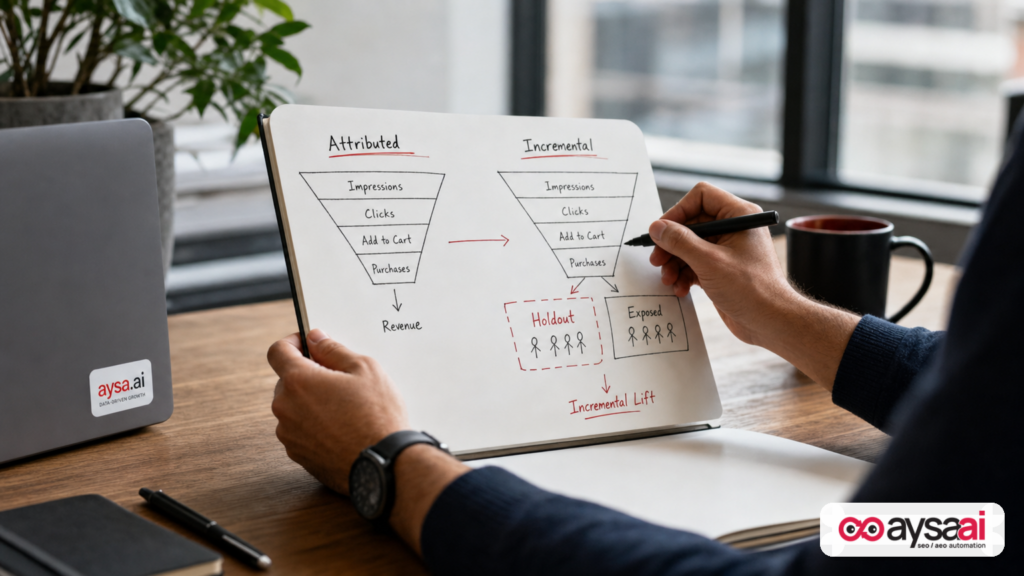
- Attribution is not incrementality. The fact that an ad was “last click” doesn’t mean it caused the sale.
- Branded Search is the #1 measurement trap. It often harvests demand created by SEO, PR, offline, social, or simply existing brand awareness.
- AI ad products optimize for efficiency first. They may reduce effort and smooth CPA, but you still have to test whether they increase incremental sales.
- Holdout tests (user-based or GEO-based) are the most practical path to causality. Borrow the OOH playbook.
- SMEs can do this. You don’t need a PhD—just a disciplined test plan, stable inputs, and a willingness to learn.
Key takeaways (read this if you only have 2 minutes)
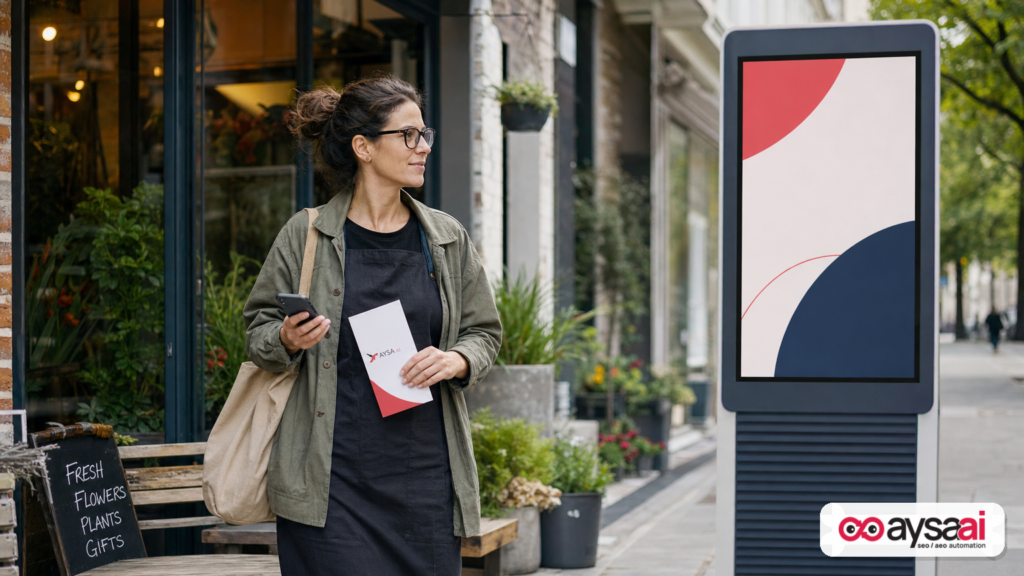
- Stop calling “ROAS” proof. Start asking: “What did we grow that wouldn’t have happened anyway?”
- Separate measurement into two lines: Efficiency (CPA, time saved, volume) vs Effectiveness (incremental lift, iROAS).
- Run at least one holdout test per quarter on the channels/campaigns that “always look best” (usually Brand Search, PMax, and remarketing).
- Track brand demand signals outside last-click (e.g., brand query volume, direct traffic trends, assisted conversions), but never let one platform be the only judge of its own value.
- Build a lightweight measurement cadence: test plan → launch → guardrails → learnings → budget change.
Table of contents
- What changed: search is still search, but journeys aren’t click-shaped anymore
- The real problem: attribution is not incrementality
- What out-of-home gets right (because it never had clicks)
- AI makes buying more efficient—effectiveness still needs proof
- Where PPC measurement goes wrong in the real world
- Three incrementality tests you can run in Google Ads (without becoming a scientist)
- Branded search: the campaign that needs a lie detector
- Performance Max and “AI Max”: what to test, what not to assume
- How to measure offline and “no-click” channels using search signals—carefully
- SME scenario: the local clinic that was “crushing it” on brand search—until we tested it
- Agency reset: what to change in reporting, incentives, and retainers
- What SMEs should monitor monthly (even if they outsource)
- Where AYSA fits: monitoring + approved execution so tests lead to action
- What to do next: a practical 30/60/90-day plan
- Sources and further reading
What changed: search is still search, but journeys aren’t click-shaped anymore
If you manage or fund Google Ads, you’ve felt the shift even if you can’t perfectly name it:
- Customers research in more places. Not just Google Search—also AI assistants, social platforms, marketplace search, and “dark” channels like group chats.
- More outcomes happen without a click. People see answers, compare options, call directly, or show up in-store.
- Ad platforms automate more decisions. Bidding, targeting, creative assembly, query matching, and budget allocation increasingly sit behind a black box.
The consequence is subtle but massive: your dashboards still show conversions, but it’s harder to know whether you caused them or merely collected the credit at the end of a longer journey.
Search Engine Journal framed this well by highlighting how OOH advertisers measure without clicks and how PPC teams can borrow holdout tests to evaluate branded Search and Performance Max before setting budgets. That’s the right direction because it shifts the question from “what got credit?” to “what created lift?” (source).
The real problem: attribution is not incrementality
Attribution answers: Which touchpoint gets credit?
Incrementality answers: What changed customer behavior versus what would have happened anyway?
Those are not the same question.
Here’s the uncomfortable truth: a campaign can have amazing attributed ROAS and still be mostly non-incremental. It’s not “fraud.” It’s how consumer intent works. People decide for reasons that may have started weeks earlier—word of mouth, an OOH ad, a podcast mention, a helpful SEO article, a competitor’s price increase, or simply recurring need. Then they search the brand name right before purchase. The last step gets the trophy.
And now AI increases the problem: the journey might include AI conversations you can’t track cleanly, making last-touch even more overconfident.
Why this matters to budget (CFO version)
When you fund channels using attributed ROAS:
- You tend to overfund bottom-funnel demand capture (brand search, remarketing, PMax that leans branded).
- You tend to underfund upper-funnel demand creation (content, PR, offline, partnerships, even non-brand search in some categories).
- You risk building a business that looks efficient in-platform but stops growing when brand demand slows.
Incrementality measurement is how you stop optimizing the spreadsheet and start optimizing the business.
What out-of-home gets right (because it never had clicks)
OOH (billboards, kiosks, screens) has historically lacked the neat “click → conversion” chain. That forced measurement discipline earlier. The SEJ piece describes the classic OOH approach: split audiences into exposed vs not exposed, then compare lift in actions like visits, site activity, or transactions. In other words: holdout testing as default, not as an advanced luxury.
This mindset is what PPC needs again, because search is drifting into similar conditions:
- More “answers” happen on the SERP or inside AI experiences.
- Cross-device identity is messy.
- Offline conversion paths are common (calls, visits, in-store purchases).
Billboards don’t confuse clicks with causality
OOH teams have to ask: “Did this campaign increase foot traffic in exposed areas compared to similar unexposed areas?” That’s the core question PPC teams should ask about brand search, PMax, and even retargeting.
The biggest PPC culture shift is admitting: the platform report is not the experiment. The platform report is a hypothesis generator.
AI makes buying more efficient—effectiveness still needs proof
One of the best lines in the SEJ source is the warning that “AI is about efficiency more than effectiveness” (paraphrased from the article’s discussion). That’s a useful mental model for Google Ads automation.
Efficiency improvements can be real and valuable:
- Faster campaign setup
- More automated bidding adjustments
- Asset generation and variation testing at scale
- Less time spent on manual Keyword sculpting
But “it took less time” or “CPA looks smoother” does not automatically mean the business grew more than it otherwise would have. If automation simply harvests more existing demand (especially branded demand), you might be paying for convenience, not growth.
This is why I recommend reporting automation outcomes on two separate lines:
- AI efficiency: time saved, cost per acquisition, operational simplicity
- AI effectiveness: incremental conversions, incremental revenue, iROAS from lift tests
When those diverge, you need a decision—not a celebration.
Where PPC measurement goes wrong in the real world
Most measurement failures aren’t due to incompetence. They come from incentives and defaults:
Default #1: last-click and platform attribution are treated as ground truth
Google Ads is both the seller and the scorekeeper. That doesn’t mean the data is useless, but it does mean you should validate major budget decisions with experiments where possible.
Default #2: branded search is rewarded for being last
Branded search often looks like the hero because it’s the final step. But it frequently represents demand created by:
- SEO content and local visibility
- OOH, TV, radio, events, PR
- Paid social or video
- Email and customer base
- Word of mouth
If you don’t measure incrementality, you’ll keep reallocating budget toward the channel that’s best at being last.
Default #3: remarketing is rarely tested for incrementality
Remarketing can be powerful, but it’s also notorious for taking credit for people who already intended to buy. Holdout tests are how you learn whether it’s truly pushing undecided buyers over the line.
Default #4: teams run “tests” without guardrails
It’s common to see tests that change multiple variables at once (bids, budgets, landing pages, creative, targeting), then claim a win. That’s not learning; that’s storytelling.
Three incrementality tests you can run in Google Ads (without becoming a scientist)
The SEJ source mentions three experiment paths in Google Ads worth paying attention to, including Conversion Lift studies and geo-based approaches. I’ll expand these into practical “how to run it” guidance, with SME constraints in mind.
Test 1: User-based holdout (Conversion Lift) for branded Search or PMax
If your account is eligible, user-based Conversion Lift is the cleanest option because it randomizes at the user level (in concept). The SEJ article notes Google Ads has support for Search and Performance Max in Conversion Lift and mentions eligibility thresholds and budget minimums (check your account for current requirements via Google’s documentation in-product; availability varies).
When to use:
- You have enough conversion volume
- You want to test incrementality of brand search or PMax
- You need a result you can defend to leadership
What to watch out for:
- Seasonality and promotions during the test window
- Changes in offline demand generation (PR hits, product launches)
- Too-short runtime (you need enough time for behavior to express)
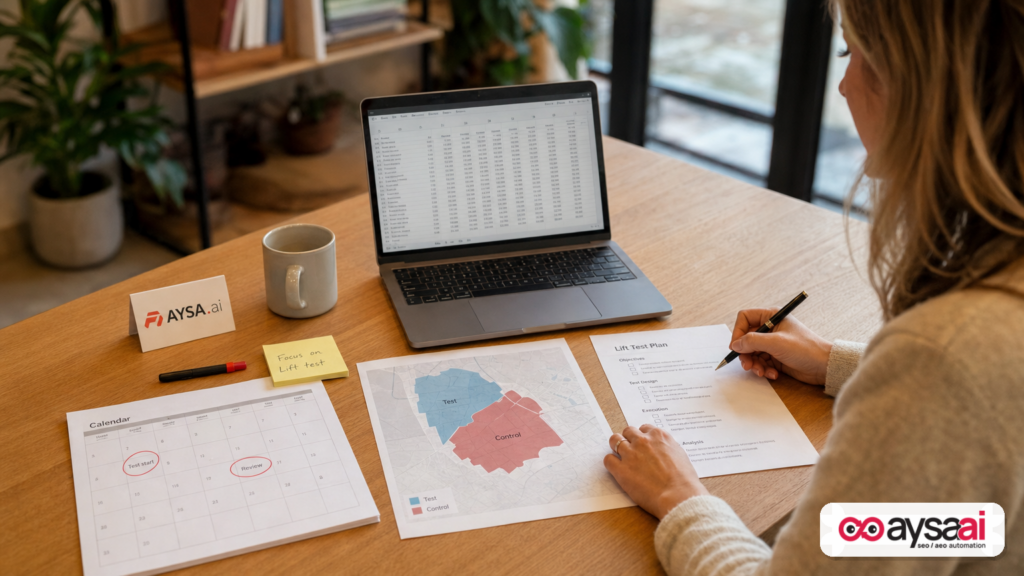
Test 2: Geo holdout (pause/limit in matched regions) when you don’t have special access
This is the OOH-style approach: choose similar geographies, hold out ads in some regions, keep others as control, then compare outcomes.
When to use:
- SMEs that don’t qualify for Conversion Lift
- Local/regional businesses where geo splits are practical
- Brands running offline media in specific DMAs/markets
Design rules (keep it simple):
- Pick matched regions: similar population and historical demand patterns
- Keep budgets and bidding stable in control markets
- Run the test long enough to dampen day-to-day noise (often multiple weeks; avoid holiday edges when possible)
- Define primary KPI before launching (e.g., total conversions: paid + organic brand)
What to measure:
- Total brand conversions (paid + organic) by geo
- Total revenue or qualified leads by geo
- Brand search impression volume trends by geo
- Non-brand demand shifts (if relevant)
Even if you don’t have perfect geo purity, this test often reveals what you need: whether brand search ads are truly additive or mostly substituting organic/direct conversions.
Test 3: Geo experiments + modeling (Meridian GeoX) for bigger multi-channel plans
The SEJ source mentions Meridian GeoX and notes it’s an open-source geo experiment library from Google, plus the possibility of feeding brand signals like branded query volume into marketing mix models. That’s directionally useful—especially for larger advertisers—but it comes with a caution: brand query volume is a Google-surface signal, and you shouldn’t let a single ecosystem be the only judge of its own incremental value.
When to use:
- You run meaningful spend across channels (search, video, offline)
- You need a planning-grade view of incrementality, not just campaign diagnostics
- You can support more rigorous experimentation and data pipelines
Practical caution for SMEs: modeling is not a replacement for simpler holdout tests. Start with the simplest experiment that can change your budget decision, then graduate to heavier methods.
Branded search: the campaign that needs a lie detector
If you only run one incrementality test this quarter, make it brand search.
Why? Because brand search sits at the intersection of:
- High intent
- High conversion rate
- High “looks amazing in a report” factor
- High risk of non-incrementality
What to test (and how to interpret it)
Test A: Do brand ads create incremental conversions, or just shift them from organic?
- Holdout a set of regions (or time blocks) where brand ads are paused/limited
- Compare total brand outcomes: paid brand conversions + organic brand conversions
Possible outcomes:
- No change in total conversions: paid brand is likely cannibalizing organic/direct (not necessarily “bad,” but not incremental)
- Small drop in total conversions: brand ads are partially incremental (often the real-world case)
- Meaningful drop: brand ads are strongly incremental (common in highly competitive SERPs or weak organic brand presence)
Guardrails so you don’t accidentally break the business
- Start with partial holdouts (some regions, not all)
- Avoid peak season unless your business can tolerate volatility
- Align internal stakeholders in advance (“This is a test; we expect a temporary shift”)
- Keep an eye on competitor brand conquesting—if it spikes, interpret results with that context
Incrementality testing isn’t about proving brand search is “bad.” It’s about finding the efficient coverage level and investing the freed budget where it creates new demand.
Performance Max and “AI Max”: what to test, what not to assume
Automation campaigns can be extremely useful—especially for lean teams. But they can also blend multiple intents and surfaces, which makes measurement tricky.
The common illusion: “PMax increased conversions, so it drove growth”
PMax can increase conversions by:
- Finding additional demand (incremental)
- Re-routing existing demand through a different path (not incremental)
- Taking credit for conversions that would have happened via another campaign or organic (not incremental)
Platform reporting alone rarely distinguishes these cleanly.
What to test for PMax
- Incremental conversions vs baseline: run user-based lift if eligible, or geo holdouts
- Brand vs non-brand mix: watch whether growth is actually branded demand capture
- New customer rate (if you can measure it reliably): use as a directional signal, not absolute truth
- Cross-channel displacement: check if shopping/search campaigns drop when PMax rises (substitution risk)
What not to assume
- Don’t assume lower CPA equals incremental growth.
- Don’t assume “more conversions” means “more net new customers.”
- Don’t assume automation is unbiased toward branded or easiest-to-convert audiences.
The job isn’t to “avoid AI.” The job is to put AI on trial the same way you would any other budget line item.
How to measure offline and “no-click” channels using search signals—carefully
The SEJ source highlights a practical move: if you run offline media (OOH, TV, radio) in specific markets, compare branded search metrics in exposed vs unexposed markets. This is smart because branded search is often the “wake” created by offline attention.
But we need to be precise about what this does and doesn’t prove.
Brand query volume is a signal, not a verdict
Branded queries can indicate rising awareness or consideration. They can also rise due to:
- Pricing promos
- Seasonality
- PR events
- Competitor news
- Distribution changes (new stores/locations)
So: use brand queries as an early indicator, then connect to outcomes via experiments (geo holdouts are often best here).
A simple “offline → search” measurement bridge for SMEs
If you’re a regional business doing offline campaigns in certain markets:
- Collect the flight dates and markets (DMAs/regions).
- Mark those markets as “exposed.” Choose comparable “unexposed” markets.
- Compare trends in:
- Brand search impressions
- Brand CPC (rising CPC can indicate competition for increased demand)
- Site visits by geo
- Lead/sales volume by geo
- Run a geo lift test where feasible to estimate incrementality.
This approach doesn’t require perfect tracking—just consistency and honesty about what you can and can’t conclude.
SME scenario: the local clinic that was “crushing it” on brand search—until we tested it
Let’s make this real with a scenario I see constantly across SMEs (clinics, home services, local franchises, boutique hotels).
Setup
A multi-location clinic runs:
- Branded search ads (exact match brand + “near me” variants)
- Some non-brand search (“urgent care near me”, “walk-in clinic”)
- Occasional offline sponsorships and community events
The owner looks at Google Ads and sees branded search with a near-perfect ROAS (or very low CPA). The instinct is to increase brand budget, because it’s “the most efficient.”
The problem
Many of those people were going to search the clinic’s name anyway. They might have:
- Seen the clinic on Google Maps days earlier
- Been referred by another doctor
- Heard about the clinic at an event
- Visited once before and came back
Brand ads show up at the final step and collect the credit.
The test (geo holdout, low drama)
You choose two matched sets of zip codes or counties:
- Control: brand ads continue as-is
- Holdout: brand ads are paused or heavily limited for a defined period
You track:
- Total appointments/leads by region
- Total brand conversions (paid + organic) by region
- Call volume if relevant
How to read the results
If the holdout region shows:
- Paid brand conversions drop but organic brand conversions rise, with total flat → brand ads were mostly cannibalizing
- Total conversions drop modestly → brand ads have partial incrementality (often where competition/conquesting exists)
- Total conversions drop meaningfully → brand ads are truly protecting and driving demand
The point is not to “win” the argument. The point is to set a defensible coverage level for brand ads, then fund the next most incremental lever—often local SEO improvements, non-brand search expansion, landing page conversion fixes, or content that answers high-intent questions.
And that’s where execution speed matters: tests create insight; businesses grow from implementing what the tests tell you.
Agency reset: what to change in reporting, incentives, and retainers
Agencies and consultants face a hard transition: clients still expect clean ROAS tables, but the real world is getting noisier.
Reporting change: show two truths at once
Build reporting that separates:
- Attributed performance: what the platform reports
- Incremental performance: what experiments suggest you truly caused
Clients can handle nuance if you present it clearly. CFOs actually prefer it—because it signals you’re not hiding behind vanity efficiency metrics.
Retainer change: sell experimentation as a deliverable, not an add-on
Most retainers pay for optimization work, but not for the scientific discipline needed to validate it. That has to change. A lightweight quarterly incrementality plan should be part of the scope:
- Which campaign gets tested
- What holdout method will be used
- What success metrics define the budget decision
- What risks exist and how you’ll mitigate them
Incentives change: stop rewarding “best ROAS” without context
If your internal incentives still reward the channel that captures existing demand most efficiently, you’ll optimize away growth. Agencies should be measured on incremental outcomes and learning velocity, not only CPA.
What SMEs should monitor monthly (even if they outsource)
You don’t need to become an analyst to be measurement-literate. You do need to watch the right indicators so you can ask better questions.
Monthly measurement checklist
- Brand demand trend: are branded searches/conversions rising, flat, or falling?
- Non-brand coverage: are you showing up for category needs, not just your name?
- Blended CAC/CPA: what’s the cost per acquisition across channels, not just in Google Ads?
- Lead quality / sales quality: are you buying real customers or cheap form fills?
- Creative fatigue: do ads look “stable” because demand is stable, while attention is decaying?
- Website conversion health: is your site improving or slowly leaking?
And at least once per quarter, ask: What did we test for incrementality? If the answer is “nothing,” you’re budgeting on assumptions.
Where AYSA fits: monitoring + approved execution so tests lead to action
Most businesses don’t fail at measurement because they can’t run a report. They fail because they can’t consistently act on what measurement reveals.
That’s the gap AYSA is designed to close: it’s an SEO/AEO/GEO execution system that monitors, prepares changes, asks for approval, and then executes accepted updates on your website—so the learning from your PPC and brand tests turns into compounding improvements.
Here are the most practical ways AYSA fits into the incrementality workflow:
1) Monitoring the foundations that make lift tests interpretable
If conversion tracking is messy, no experiment will save you. AYSA’s monitoring layer can help you keep a consistent baseline and flag SEO/website changes that may confound results. Start here: AYSA Monitoring.
2) Preparing and executing landing page improvements that increase true incrementality
When you discover that non-brand search is incremental but expensive, the next move is often improving landing pages so more of that incremental demand converts. AYSA helps you implement improvements safely via approval workflows. Explore: AI SEO Tools.
3) Building visibility for AI-assisted research (AEO/GEO), not just clicks
As AI search and assistants influence decisions upstream, businesses need structured content and entity clarity so they get found and chosen. AYSA focuses on AI search visibility outcomes: AI Search Visibility.
4) Helping defend budgets with a better blended growth story
The better you execute on SEO/AEO improvements, the less you rely on paid brand capture to “hit numbers.” AYSA supports that long-term balance—and that’s how you keep paid search honest.
5) Making the operational model predictable for SMEs
SMEs need simple pricing and execution predictability. If your team is small, you can’t afford projects that stall. See: AYSA Pricing.
For ongoing thinking and playbooks, our editorial library is here: AYSA Blog.
What to do next: a practical 30/60/90-day plan
Here’s a pragmatic plan for SMEs and agencies who want to stop guessing and start proving.
Next 30 days: set the baseline and pick one test
- Write down your two-line reporting template: efficiency vs effectiveness.
- Choose one campaign to test for incrementality (start with brand search).
- Define the primary KPI (e.g., total brand conversions paid+organic; total revenue; qualified leads).
- Freeze major variables for the test window (no big promos if you can avoid it; stable bids/budgets in control regions).
- Validate tracking hygiene (conversion actions, call tracking, offline imports if used).
Next 60 days: run the holdout and document learnings
- Launch a geo holdout (or Conversion Lift if eligible).
- Monitor guardrails weekly (you’re checking safety, not optimizing mid-test).
- At the end, summarize in one page:
- Hypothesis
- Design (who was held out, how long)
- Results (what changed, what didn’t)
- Decision (increase/decrease/maintain budget; next test)
Next 90 days: reallocate budget and improve the site so lift compounds
- If brand search is mostly cannibalization, set a leaner always-on coverage (or narrower targeting) and move budget to incremental areas (non-brand, creative testing, or demand creation).
- Improve your landing pages to convert incremental demand better (fewer leaks = less pressure on CPCs).
- Invest in AI search visibility so you’re present earlier in journeys, not just at the end. (This is exactly what we focus on at AYSA.)
- Schedule the next quarterly test (PMax incrementality or remarketing incrementality).
What can go wrong (and how to avoid it)
Failure #1: Changing too many things during the test
Fix: lock budgets, creative, and key settings in the control group. Treat the test like a controlled environment.
Failure #2: Choosing geographies that aren’t comparable
Fix: match on historical demand patterns, not just population size. If you can’t match well, reduce confidence and extend the test.
Failure #3: Calling a result “no lift” when the test was underpowered
Fix: be honest about sample sizes and runtime. If you don’t have volume, use longer windows or broader geos.
Failure #4: Treating brand signals as final ROI
Fix: brand query volume is an early indicator, not a P&L statement. Connect it to outcomes through experiments.
Failure #5: Learning something true but failing to execute
Fix: have an execution system. That’s where AYSA’s approved execution model matters: it turns insights into shipped changes without chaos.
What this means for 2027: measurement leadership becomes job security
The SEJ source ends on a point I strongly agree with: the PPC managers who keep budgets in 2027 will be the ones who can show incremental results instead of attributed ones. Search is losing the simplicity that made it feel like a spreadsheet machine. That’s not bad—it’s reality catching up with how humans decide.
If you’re an SME: you don’t need to win an attribution debate. You need to protect cash and invest where growth is real.
If you’re an agency: you can’t differentiate by knowing which bid strategy toggle is trendy. You differentiate by building a repeatable incrementality system clients can trust.
And if you’re building a modern search presence: you need SEO/AEO/GEO execution that compounds, because paid search will keep getting harder to “prove” with last-touch logic alone.
What to do next (action list)
- Pick one “best looking” campaign (usually Brand Search) and commit to an incrementality test this quarter.
- Create two-line reporting: AI efficiency vs AI effectiveness.
- If you can’t access Conversion Lift, design a geo holdout with matched regions and a clear KPI.
- Use offline media flight dates to interpret brand demand changes by market—but don’t stop there.
- Invest in the website improvements that increase conversion rate from incremental demand (this is where execution wins).
- Build AI search visibility so your brand shows up earlier in research journeys: AI Search Visibility.
- Set the next test on the calendar (PMax incrementality or remarketing holdout).
Sources and further reading
- Search Engine Journal: What A Billboard Network Knows About Measuring Search Ads That PPC Teams Forgot
- Search Engine Journal: Paid Media coverage (context and related analysis)
- Search Engine Journal: AI Search coverage (broader shift in discovery)
- Search Engine Journal: SEO coverage (how organic demand interacts with paid)
AYSA resources referenced in this article:
Note on sources: This editorial intentionally avoids adding new numeric claims that aren’t verifiable from the supplied research context. Where Google Ads feature availability or thresholds are mentioned, confirm inside your Google Ads account and official product documentation before making budget commitments.
Continue the AI search topic inside AYSA.
Use these pages to connect the article with AI SEO tools, AI visibility monitoring, AI Overviews and approved website execution.
Turn this topic into a website action plan.
Use these AYSA hubs to move from reading to technical fixes, AI visibility monitoring, research, glossary context and approval-first SEO execution.