
Google Search vs. ChatGPT Search Volume: The Metric That Matters (and the Action Plan for SMEs)
OpenAI says ChatGPT handles roughly one-fifth of Google’s “search-like” volume—depending on how you define a search. Here’s what changed, why the definition matters more than the headline ratio, and how SMEs should adapt their SEO/AEO/GEO execution for an AI-first discovery world.
Author: Marius Dosinescu (AYSA.ai)
OpenAI reportedly told an audience that ChatGPT handles roughly one-fifth of Google’s “search-like” volume—implying Google still sees about 5x more. That headline sounds simple. The reality is not.
The ratio depends on the most important detail in modern search strategy: what you mean by “a search”. Is it a user query? A web fetch? A referral click to a website? Or an “answer served” with zero Clicks?
For SMEs and agencies, this is not trivia. It changes how you forecast traffic, justify budgets, design content, measure ROI, and decide what to automate. In this editorial, I’ll unpack what changed, what the number does and doesn’t tell you, and how to build an execution system that makes you visible in both classic search and AI answer engines—without turning your website into a science project.
Concise summary

- The 5x headline is a metric problem, not just a market-share story. OpenAI’s definition counts each time ChatGPT sends a question to the web as one “search.” That is not the same thing as a Google query, and it’s definitely not the same thing as website referrals.
- Outside datasets show Google still drives vastly more site traffic. In the research context, Search Engine Journal cites Ahrefs’ analytics sample where Google accounts for a much larger share of tracked traffic than ChatGPT.
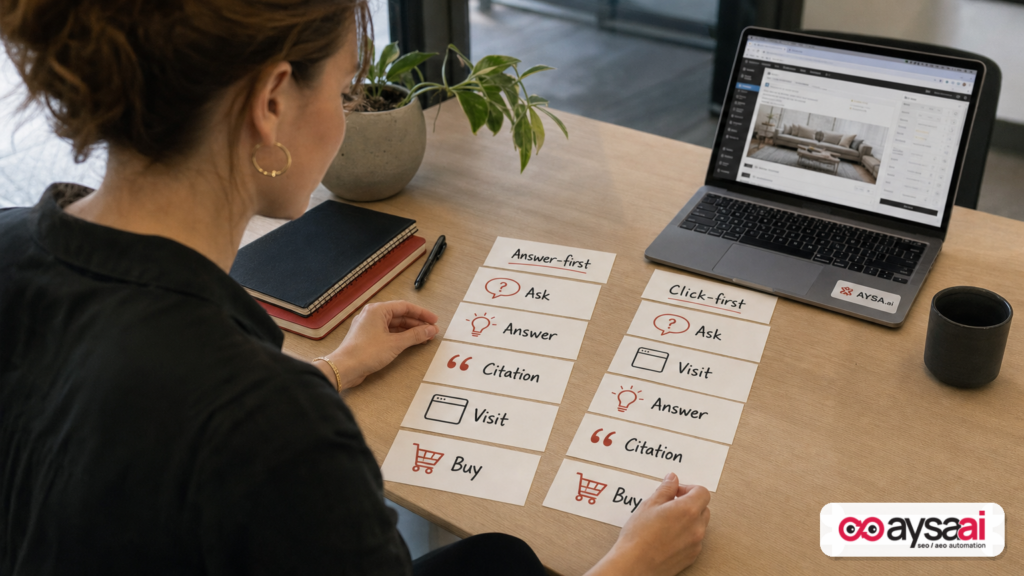
- Two funnels are forming: “answer-first” discovery (AI assistants) and “click-first” discovery (search results). You need content and measurement for both.
- The competitive question for SMEs is not ‘Google vs. ChatGPT’—it’s ‘visibility vs. value’. Being mentioned or cited by AI may not equal visits, but it can still influence revenue.
- Execution is now the bottleneck. Monitoring, preparing changes, getting approvals, and shipping improvements weekly is what wins. That’s where AYSA fits: monitor → propose → approve → deploy.
Table of contents
- What changed: the “5x” moment and why it landed
- The headline number is less important than the definition of “search”
- Why definitions change budgets, reporting, and strategy
- Two funnels are forming: “answer-first” vs. “click-first” discovery
- Queries aren’t referrals: the uncomfortable gap
- What can go wrong when businesses overreact to AI search headlines
- A practical measurement framework: volume, visibility, and value
- Content that wins in AI answers and Google: the new baseline
- Technical foundations that help AI systems trust your site
- The SME scenario: a local clinic trying to win in AI answers without losing Google
- Agency playbook: what to change in deliverables and reporting
- Where AYSA fits: approved execution for SEO/AEO/GEO
- What to do next (action list)
- Sources and further reading
What changed: the “5x” moment and why it landed
Search Engine Journal reported that OpenAI—through comments attributed to ChatGPT consumer product lead Adam Fry—suggested ChatGPT receives roughly one-fifth as many “search-like queries” as Google, counting a “search” as each time a user question sends ChatGPT to the web. That detail matters because it reveals how OpenAI is framing user intent: not every prompt is a “search,” only prompts requiring up-to-date web retrieval. You can read the reporting here: Search Engine Journal.
Two signals made this story resonate:
- The AI interface has become a default behavior. People aren’t just asking for writing help anymore; they’re asking “people, places, things,” plus finance and health questions—the classic territory of search engines.
- We’re finally hearing relative magnitude. Most AI-search debates drown in anecdotes. A ratio—however fuzzy—feels like a stake in the ground.
But if you’re running a business, the real question isn’t “Is ChatGPT big?” It clearly is. The question is: does this change how customers discover you, and what do you need to execute on your website to stay visible?
The headline number is less important than the definition of “search”
Here’s the heart of the issue: in 2026, the word “search” is overloaded.
In the SEJ report, OpenAI’s counting rule is specific: each time ChatGPT goes to the web to answer a user question, that counts as one search. That’s a legitimate operational definition—but it’s not the same thing as “a Google query.” It also doesn’t tell you whether the user clicked through to a website.
Meanwhile, third-party measurement tools often define “Search volume” in other ways—for example, the share of prompts that resemble traditional Search intent, or the number of referrers (traffic sent to websites). SEJ also referenced Ahrefs estimates and traffic share tracking from a subset of sites using Ahrefs’ analytics tooling, which showed a far larger share of traffic from Google than from ChatGPT.
So we have at least three different “search” realities:
- Query volume: how many times people ask something.
- Retrieval events: how often an AI system fetches web information to answer.
- Referral traffic: how many visits websites receive from that system.
If you mix these up, you’ll build the wrong strategy and argue about the wrong KPI inside your company.
Why definitions change budgets, reporting, and strategy
When leadership hears “ChatGPT is 20% of Google,” three budget conversations tend to follow:
- “Should we shift budget from SEO to AI Optimization?”
- “Is Google traffic going to collapse?”
- “Do we need to redesign our site content to be ‘AI-friendly’?”
The problem is that query volume is not the same thing as opportunity. A platform could have enormous question volume but low referral traffic. Or it could influence decisions without sending clicks (think: AI answers that shape brand preference, then the user navigates directly or converts elsewhere).
That’s why SEJ’s framing is correct and important: name the measure you cite. If your board deck says “AI Search is 20% of Google,” but your analytics report shows “AI referrals are 1% of organic,” you’re not contradicting yourself—you’re probably measuring two different things.
The practical takeaway: your strategy needs multiple metrics tied to multiple outcomes, not a single headline ratio.
Two funnels are forming: “answer-first” vs. “click-first” discovery
Traditional web search is mostly “click-first”:
- User searches.
- They evaluate snippets, titles, reviews, and ads.
- They click to websites.
- Websites convert.
AI assistants increasingly create “answer-first” journeys:
- User asks a question conversationally.
- The assistant synthesizes an answer.
- The user might never click—or might click a citation if they need deeper detail, booking, pricing, or proof.
This is where many teams get stuck: they assume “no click = no value.” That’s sometimes true, but not always. “Answer-first” can still:
- Introduce your brand (awareness).
- Shape the shortlist (consideration).
- Reduce friction (“Which option is best for X?”).
- Drive a later branded search or direct visit.
The point isn’t to abandon Google. The point is to recognize you’re optimizing for two different interfaces that interpret authority and usefulness in slightly different ways.
Queries aren’t referrals: the uncomfortable gap
SEJ’s reporting highlighted a critical mismatch: even if ChatGPT is large on “search-like” activity, referral traffic data (from outside measurement) shows Google still sending far more visits to websites.
Why does this gap exist?
- AI answers compress the journey. The system can answer many questions without a click.
- Users ask different questions. Many prompts are informational and don’t require visiting a vendor site.
- AI systems may cite fewer sources. Even when they pull from the web, they may not send proportional clicks.
- Interface design matters. If citations are de-emphasized, click-through declines. If citations are prominent, referrals increase.
For businesses, this means you need to plan for a world where:
- Some content exists primarily to earn citations and mentions, not immediate traffic.
- Other content exists to convert when a user does click.
If you only optimize for “traffic,” you may miss where the market is going. If you only optimize for “mentions,” you may starve your pipeline today.
What can go wrong when businesses overreact to AI search headlines
I’ve seen a familiar pattern whenever a new distribution channel emerges: people swing the pendulum too far, too fast. AI search headlines can trigger expensive mistakes. Here are the common ones SMEs and even agencies make.
1) Rewriting the site for AI while breaking what already works
Companies tear up page layouts, remove navigation, replace proven category pages with “AI-friendly essays,” or bury product/service pages under long-form content. Result: rankings drop, conversions drop, and the business blames “the algorithm.”
2) Chasing one-off “AI optimization hacks”
When a channel is new, the market floods with tactics that aren’t durable: keyword stuffing for bots, fake Q&A pages, schema spam, doorway pages, and other short-term tricks. They may work briefly, but they rarely survive platform changes—and they often degrade user trust.
3) Measuring the wrong thing, then “fixing” the wrong problem
If your KPI is “AI referral sessions,” you might ignore the reality that AI is influencing conversions without sending clicks. If your KPI is “mentions,” you might celebrate visibility that doesn’t move revenue.
4) Treating AI visibility as a branding project, not an execution discipline
AI visibility isn’t a campaign. It’s operational: technical hygiene, clear entities, updated pages, consistent policies, pricing, inventory, locations, reviews, and proof.
That brings me to the real moat for 2027-era search: execution velocity with governance. You need to ship improvements weekly—but safely.
A practical measurement framework: volume, visibility, and value
To operate in a world where “search” has multiple meanings, SMEs need a measurement stack that separates volume, visibility, and value.
Layer 1: Volume (demand signals)
This is where classic search volume and query trends still matter—because they reflect demand. Even if AI answers intercept some clicks, demand doesn’t disappear.
- Track category-level demand: “emergency plumber,” “best CRM for dentists,” “hotel near convention center.”
- Monitor branded search trend (your name + products/services).
Note: The provided research context does not include official Google query volume endpoints for public verification, so treat any absolute market-share claims cautiously unless they come from primary disclosures. SEJ notes that Google reports query growth as a rate rather than a count in some contexts.
Layer 2: Visibility (where you appear)
This is the AI-era addition. Visibility includes:
- Being cited/mentioned in AI answers for your category questions.
- Ranking presence in traditional SERPs for high-intent queries.
- Presence for entity-style queries (“best [service] in [city]”, “top [product] for [use case]”).
Visibility is not just “rankings.” It’s coverage of the questions customers actually ask—especially the messy ones they ask AI assistants (comparisons, suitability, safety, policies, edge cases).
Layer 3: Value (business outcomes)
This is where you connect visibility to money:
- Leads, bookings, purchases, calls.
- Assisted conversions from organic (including brand lift and direct).
- Conversion rate changes from “better informed” visitors.
If you’re an SME owner, here’s the simplest version:
- Volume tells you what people want.
- Visibility tells you if you show up where they decide.
- Value tells you if it paid off.
Content that wins in AI answers and Google: the new baseline
If AI assistants are pulling “people, places, things,” plus finance and health-type questions (as described in the SEJ reporting), then your site needs to become the best answer source in your niche—not just a landing page.
Here’s what I mean by “best answer source,” in practical SME terms.
1) Build pages around decisions, not just keywords
Instead of only “/services/roof-repair,” expand to decision-support content that matches real conversations:
- “How much does roof repair cost in [state]?”
- “When should you replace vs. repair?”
- “What does insurance cover?”
- “Timeline and what to expect.”
AI systems love content that resolves ambiguity. Google users love it too. This isn’t new, but it’s no longer optional.
2) Make your policies and specifics unmissable
AI users ask policy questions constantly:
- Returns, refunds, warranties.
- Shipping times and exceptions.
- Appointment prep, aftercare, insurance.
- Eligibility, restrictions, pricing ranges.
If your site hides these in PDFs, images, or vague copy, AI systems may not cite you—or worse, they may guess.
3) Add comparison and “fit” content that humans avoid writing
Many brands avoid comparison pages because they feel “salesy” or risky. But AI search behavior is inherently comparative. You need:
- “X vs. Y” comparisons (honest, nuanced).
- “Best for” pages (use-case driven).
- “Not a fit if…” disclaimers (builds trust, reduces refunds).
4) Keep content current (AI retrieval punishes stale pages)
SEJ’s report indicates OpenAI counts searches when ChatGPT goes to the web for up-to-date info. That implies freshness matters: updated pricing, new regulations, product availability, and revised guidance.
Operationally, “freshness” means you need a system to:
- Detect content that’s aging.
- Propose updates.
- Get approvals (legal/medical/brand).
- Publish safely and track outcomes.
This is exactly the type of workflow we designed AYSA around: monitoring plus approved execution, so updates don’t get stuck in tickets for months.
Technical foundations that help AI systems trust your site
Let’s keep this grounded: “AI optimization” is often just technical SEO and content clarity done properly. If your site is hard to crawl, inconsistent, or thin, you’ll lose in both Google and AI answers.
Key technical foundations to prioritize:
1) Crawlable, indexable content (no accidental lockouts)
If key pages are blocked, behind scripts, or loaded in ways that are unreliable, both search engines and AI retrieval can struggle.
2) Clear information architecture
AI systems need to identify “the page that defines the answer.” If you scatter details across dozens of short posts, the model may choose a competitor with a better canonical source page.
3) Structured clarity for entities
You don’t need schema spam. You do need consistency: business name, locations, services, product specs, pricing rules, availability. Think “data hygiene.”
4) Page experience that supports decision-making
Even if AI reduces some clicks, the clicks you do get are often high intent. When they land, they need proof: reviews, certifications, case studies, guarantees, photos, and clear CTAs.
At AYSA, we treat this as an execution problem as much as a strategy problem. Tools don’t fix sites—teams do. The job is to shorten the cycle from “issue detected” to “fix shipped.” If you want the overview of what we automate vs. what we require approval for, start here: AI SEO Tools.
The SME scenario: a local clinic trying to win in AI answers without losing Google
Let’s make this real with a scenario I see constantly.
Business: A two-location physical therapy clinic.
Goal: More booked evaluations for knee and back pain treatments.
Current situation: They rank okay for a few local queries, but their content is thin: a services page, a contact page, and a handful of blog posts from 2021.
What changes in an AI search world? Prospects ask ChatGPT questions like:
- “Is physical therapy worth it for knee pain or should I see an orthopedic doctor first?”
- “How many sessions does PT take for a meniscus tear?”
- “What should I expect in the first appointment?”
- “Can I do PT without a referral in [state]?”
If the clinic’s site doesn’t answer these clearly, AI assistants won’t cite it—and Google won’t reward it either because it’s missing topical depth and usefulness.
A practical plan that doesn’t break the business:
- Create one “Knee Pain Treatment” hub page with sections for symptoms, when to see a doctor, what PT does, typical timelines, insurance basics, and appointment prep.
- Add a transparent “What it costs” section with ranges and disclaimers, plus insurance guidance.
- Publish 6–10 supporting Q&A pages that link back to the hub and to booking CTAs.
- Update location pages with parking info, hours, service availability by location, and practitioner bios.
- Measure outcomes: bookings, calls, form submissions—plus branded searches over time.
Where AYSA fits operationally: AYSA can monitor for technical issues, content gaps, and on-page improvements, then prepare recommended changes for approval and execution—so the clinic owner doesn’t have to manage a messy stack of freelancers and plugins. Start with the AI visibility overview here: AI Search Visibility.
Agency playbook: what to change in deliverables and reporting
If you run an agency, the “Google is 5x ChatGPT” headline can push clients into reactive mode. Your job is to turn that anxiety into a plan with clear KPIs and governance.
1) Redefine “search performance” in proposals
Stop selling only “rankings and traffic.” Start selling a portfolio:
- Traditional SEO (traffic + conversions)
- AEO/GEO readiness (visibility in AI answers)
- Content operations (updates, comparisons, policies, hubs)
- Technical hygiene (crawl/index, internal linking, templates)
2) Add an “AI visibility audit” that’s actually operational
Most “AI audits” are screenshots and opinions. A useful audit outputs:
- A prioritized list of pages to build or improve.
- Specific edits needed to become citable (definitions, pricing, evidence, freshness).
- A change log with approvals.
This is where an execution system matters. If you want clients to renew, you must ship.
3) Change reporting: separate referrals from influence
Clients will ask, “How much traffic are we getting from ChatGPT?” Answer that—but also report:
- Brand lift signals (branded search trend, direct traffic patterns—interpreted carefully).
- Coverage of category questions (visibility tracking).
- Conversion rate changes on pages improved for clarity.
And be explicit: “This metric measures referrals, not mentions.” SEJ’s reporting reinforces why that honesty matters.
4) Productize execution governance
AI-era SEO is faster. Faster means riskier. Agencies need a workflow that prevents unapproved changes, especially for regulated industries and ecommerce pricing.
AYSA’s model—monitor, propose, approve, execute—fits this need. For agencies, the point isn’t “AI magic.” The point is operational control at scale. If you want to explore how we approach it, start here: Monitoring and browse recent thinking here: AYSA blog.
Where AYSA fits: approved execution for SEO/AEO/GEO
My perspective is simple: strategy is commoditized; execution is the differentiator.
Most SMEs don’t fail because they don’t know what to do. They fail because the work doesn’t ship:
- Content updates wait on approvals.
- Developers have bigger priorities.
- Agencies deliver audits, not outcomes.
- Tracking is inconsistent, so nobody trusts the results.
AYSA is designed as an execution system for the new search reality:
- Monitors your site and search visibility signals: AYSA Monitoring
- Prepares recommended changes (technical, content, internal linking, templates)
- Asks for approval before changes go live (governance built in)
- Executes accepted changes so improvements happen weekly, not quarterly
This matters even more as “search” fragments into multiple interfaces. Your website becomes your source of truth for both Google and AI systems. The businesses that win won’t be the ones who talk about AI the most. They’ll be the ones who keep their truth clean, current, and easy to retrieve.
If you’re evaluating where this fits financially, pricing is transparent here: AYSA Pricing.
What to do next (action list)
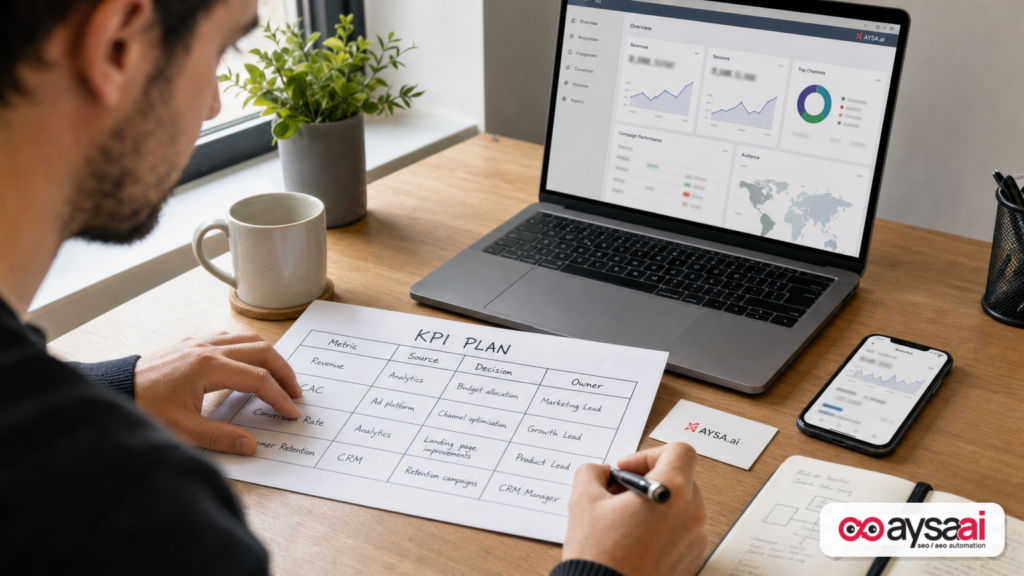
If you only take one thing from this editorial, take this: don’t bet on one metric. Build a system.
What to do next: a practical checklist
- Define “search” in your reporting. In every monthly report, label whether you mean queries, retrieval events, or referral sessions.
- Audit your “answer readiness.” Pick 20 real customer questions and see whether your site answers them clearly, with specifics, in one or two authoritative pages.
- Create 3 hub pages for your highest-value topics (services, categories, or problems) and link supporting Q&As to them.
- Fix the basics that block trust: outdated pricing, missing policies, thin location/service pages, unclear authorship, missing proof.
- Track value outcomes. Tie improvements to leads, bookings, purchases, not just sessions.
- Install an execution cadence. Weekly shipping beats quarterly overhauls. Use an approved workflow so changes are safe.
- Operationalize with AYSA if you need leverage: start by understanding our approach to AI search visibility (AI search visibility) and what we automate (AI SEO tools).
Sources and further reading
- Search Engine Journal: Google’s Search Volume Is About 5x ChatGPT’s, OpenAI Says (primary research input for this editorial)
- Search Engine Journal: AI Search coverage (context track)
- Search Engine Journal: Technical SEO coverage (context track)
- Search Engine Journal: SEO coverage (context track)
- AYSA: AI search visibility
- AYSA: Monitoring
- AYSA: AI SEO tools
- AYSA: Pricing
- AYSA Blog
Continue the AI search topic inside AYSA.
Use these pages to connect the article with AI SEO tools, AI visibility monitoring, AI Overviews and approved website execution.
Turn this topic into a website action plan.
Use these AYSA hubs to move from reading to technical fixes, AI visibility monitoring, research, glossary context and approval-first SEO execution.