
SEO Automation Software: What It Should Actually Do in 2026
SEO automation software should do more than produce reports. The useful version monitors, prioritizes, asks for approval and turns accepted work into website execution.
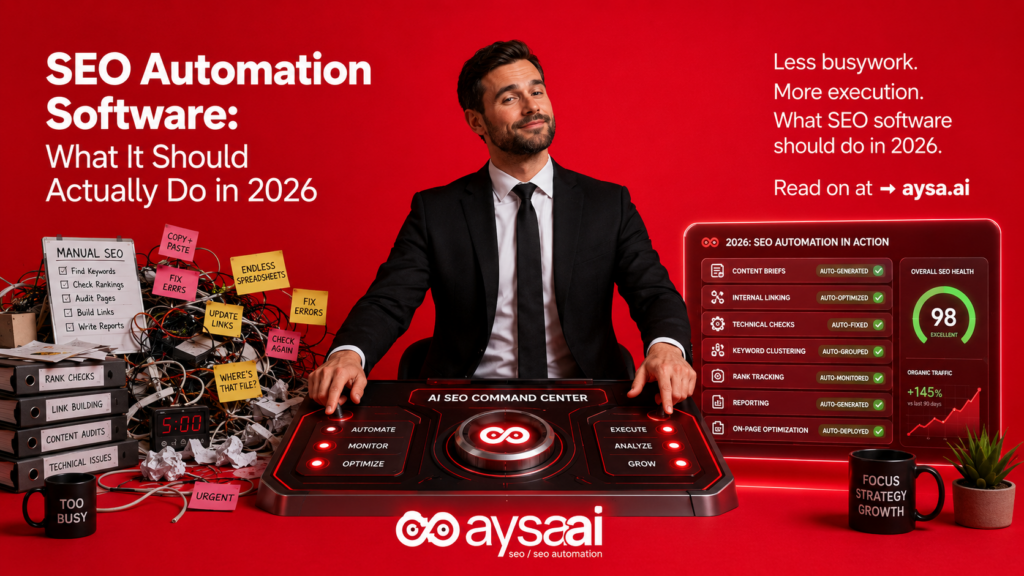
SEO Automation software should not simply generate more dashboards. The useful version turns Monitoring, research, technical signals, content opportunities and authority work into approval-ready actions that can actually be executed.
The phrase SEO automation software is broad enough to be confusing. Some tools automate Rank tracking. Some automate website audits. Some generate content briefs. Some produce reports. Some crawl pages. Some create internal link suggestions. Some write metadata. Some claim to be AI SEO platforms. But for a business owner, the real question is much simpler: does the software reduce the work required to grow organic visibility?
That question matters because many SEO tools are not bad tools. They are just incomplete workflows. They find issues, export data and generate recommendations, but the business still has to interpret the output, decide what matters, prepare the change, approve it, publish it and monitor the result.
Marius Dosinescu’s view, and AYSA’s product view, is that SEO automation becomes genuinely valuable only when it reduces the distance between insight and action. If the user still has to do all the operational work manually, the software has automated measurement, not SEO growth.
What SEO automation software really means
At a basic level, SEO automation software is software that automates repeatable parts of search engine optimization. That can include Crawling, monitoring, reporting, data extraction, Keyword grouping, content planning, technical checks, internal link discovery, Schema validation, metadata generation, rank tracking and alerting.
But those activities sit at different levels of maturity. A tool that automatically finds broken links is not doing the same job as a system that prepares a fix, asks for approval and applies the accepted change inside the website.
A useful way to think about SEO automation is to separate it into five layers:
- Measurement automation: collecting search, crawl, ranking, speed and visibility data.
- Detection automation: identifying issues, opportunities, patterns and changes.
- Recommendation automation: proposing what should be changed and why.
- Approval automation: organizing review, decision-making, acceptance and rejection.
- Execution automation: applying accepted changes and keeping Action History.
Most classic SEO tools are strongest in the first three layers. The most valuable new category is the fourth and fifth layers: approval and execution.
Automation is not the same as execution
A crawler can automatically find 404s. A rank tracker can automatically check positions. A content tool can automatically draft a title. A dashboard can automatically detect ranking movement. Those are useful automations, but they are not complete SEO execution.
Execution means the work moves forward. A redirect is prepared. A title is rewritten. A schema issue is explained. A content plan is built. An internal link is proposed. An authority opportunity is reviewed. The user can approve or reject the action. Accepted work is applied where integration allows it. The system remembers what happened.
This distinction is not semantic. It is the difference between knowing about SEO work and getting SEO work done.
Why this matters more in 2026
Search is no longer only a list of blue links. Google Search still matters enormously, but websites now also have to think about AI Overviews, answer engines, generative search, entity understanding, structured content, brand mentions, source citation and topical authority.
Google’s own documentation continues to emphasize crawlability, indexability, helpful content, page experience, structured data where appropriate and creating content for people. Its AI features documentation also points site owners back to the same fundamentals: make pages accessible to Google, use meaningful snippets and preview controls where needed, and make content useful and understandable.
That means modern SEO automation cannot be a thin layer of keyword stuffing or mass content generation. It has to help websites become clearer, better structured, more useful, technically healthier and easier to understand across classic search and AI-assisted discovery.
The minimum standard for modern SEO automation
In 2026, SEO automation software should cover at least eight layers.
1. Business and website context
The system should understand what the business does, who it serves, which products or services matter, what geography matters, what language and tone should be used, and which pages are important.
Without business context, automation becomes generic. A tool can suggest “optimize title tag” for every page, but it cannot know whether the page supports a high-margin service, a seasonal offer, a local query, a category strategy or an informational topic.
2. Research automation
The system should extract what people search for, compare competitor coverage, read what the website already ranks for, identify missing topics and organize keyword opportunities into useful clusters.
Good research automation should not only produce a keyword list. It should decide whether a keyword belongs to an existing page, a new page, a content hub, a FAQ, a glossary entry, a local landing page, a product category or a supporting article.
3. Technical SEO automation
Technical SEO automation should detect crawlability, indexability, redirects, canonical issues, sitemap and robots problems, schema opportunities, PageSpeed issues, internal linking weaknesses and template-level risks.
The key is separation. Some technical actions can be prepared for safe execution. Some require manual review. Some are warnings. Some are low priority. A serious system should not treat every detected issue as equally urgent.
4. On-page automation
On-page automation should prepare titles, meta descriptions, headings, content improvements, answer sections, FAQs, internal links and structured content based on the real page and the real search intent.
This is where low-quality automation often fails. It rewrites text without understanding the business, the page role or the user’s intent. Useful on-page automation should improve clarity and relevance, not produce generic SEO copy.
5. Content planning and content generation
Content automation should not mean publishing endless generic articles. It should build a topical map, identify missing pages, prepare briefs, draft content, connect articles to commercial pages and support topical authority.
For AEO and GEO, content also needs to answer questions directly, define entities clearly, use structured sections and make information easy to extract and cite. That does not guarantee inclusion in AI Overviews or answer engines, but it improves the website’s clarity and readiness.
6. Authority and off-page workflow
SEO is not only what happens on the website. Search engines also consider links, mentions, reputation, relevance and authority signals. Automation can help surface publisher opportunities, track links, monitor brand mentions and connect authority work to business goals.
But authority automation must be controlled. Any purchase, placement or link-building action should be transparent and approved before execution. Automation should make authority building safer and easier to manage, not turn it into a risky black box.
7. Monitoring and AI visibility
Modern SEO automation should monitor rankings, pages, topics, Search Console performance, technical changes, AI visibility signals, answer-engine mentions and competitor movement. It should not wait for a human to remember to check a dashboard.
The best monitoring is action-oriented. It does not only say “traffic dropped.” It explains what changed, what pages are affected, what likely matters and what should be reviewed next.
8. Approved website execution
This is the missing layer in most tools. The system should prepare the action, explain the reason, ask for approval and apply accepted changes where the website integration allows it.
Approved execution is different from blind autopilot. It means the user stays in control of important decisions while the system handles repetitive work, formatting, publishing steps, tracking and follow-up.
What SEO automation software should not do
Automation is powerful, but bad automation can create real SEO risk. A tool should not be trusted just because it uses the words “AI” or “automatic.”
It should not mass-publish without approval
SEO changes can affect revenue, compliance, brand voice, medical or financial wording, redirects, product categories and search appearance. Publishing at scale without approval can create indexation problems, duplicate content, brand damage or legal risk.
It should not generate generic content at scale
Google’s guidance has consistently pushed site owners toward useful, people-first content. Automation that creates pages only to capture keywords, without distinct value, can become a quality problem.
It should not hide the reason behind a recommendation
If the system says “change this title,” it should explain why: CTR opportunity, intent mismatch, duplicate title, missing primary topic, weak value proposition or SERP expectation.
It should not treat every issue as urgent
Some issues are critical. Some are template-level. Some are harmless. Some only matter on important pages. Automation should reduce noise, not amplify it.
It should not pretend to guarantee rankings
No responsible SEO automation software can guarantee rankings, AI Overview inclusion or answer-engine citation. It can improve technical health, content clarity, authority workflows and monitoring, but search systems remain external and dynamic.
Traditional SEO tools vs SEO automation software vs execution platforms
The market uses overlapping language, so it helps to separate categories.
| Category | Main value | Typical limitation |
|---|---|---|
| Traditional SEO tools | Research, rank tracking, audits, backlink data, competitive analysis and reports | The user still has to interpret and implement the work |
| SEO automation tools | Automated checks, alerts, recommendations, content briefs and recurring reports | Automation often stops before approval and publishing |
| AI writing tools | Drafting content, outlines, titles and summaries | They may lack website context, approval workflow and execution history |
| SEO execution platforms | Monitoring, preparation, approval, execution and follow-up | They require careful product design and platform integrations |
AYSA belongs closer to the execution-platform category. The point is not to replace every specialist tool in every professional SEO stack. The point is to make the work move for businesses that do not want to live in dashboards or depend entirely on manual handoffs.
What a useful SEO automation workflow looks like
A strong workflow is not complicated for the user. The complexity stays behind the system.
Step 1: Connect the website
The system needs website access, Search Console and analytics context where available, and basic business information. Without data and context, automation is mostly guessing.
Step 2: Build the SEO profile
The platform should learn the market, service area, audience, business objectives, tone of voice, competitors, priority pages and growth goals.
Step 3: Run research
The system should extract existing performance, discover keyword gaps, compare competitors, identify missing pages and organize topics into a coherent plan.
Step 4: Audit technical health
The system should check crawlability, indexability, redirects, sitemap, robots, internal linking, schema, PageSpeed and common technical issues.
Step 5: Prepare actions
Actions may include title updates, meta descriptions, content improvements, FAQ sections, internal links, schema recommendations, redirects, sitemap changes, new content briefs or authority opportunities.
Step 6: Ask for approval
The user should see what will change, why it matters and whether the action is safe to execute automatically or needs manual review.
Step 7: Execute accepted work
Once approved, the system should apply accepted changes where integration allows. If the action is not safe to automate, it should remain clearly marked for manual review.
Step 8: Monitor the result
The workflow should not end at publishing. It should monitor rankings, clicks, impressions, indexing, page performance, content decay and future opportunities.
Why approval-first automation is the right model
There are two bad extremes in SEO automation. The first is manual-only work: every recommendation becomes a spreadsheet, every change waits for someone, and progress is slow. The second is uncontrolled autopilot: the system publishes changes without enough business context or approval.
The better model is approval-first automation. The system does the heavy work: research, analysis, preparation, drafting, classification and execution mechanics. The user makes the important decisions: approve, reject, adjust, pause or request more context.
This model works especially well for business owners, ecommerce teams, bloggers and companies that do not want to become SEO specialists. They do not need to understand every crawl detail. They need clear recommendations and safe execution.
How AI changes SEO automation
AI makes SEO automation more powerful, but also more dangerous if used carelessly. AI can summarize Search Console patterns, cluster topics, draft page improvements, explain technical problems, generate schema ideas, prepare FAQs and identify content gaps. But AI can also hallucinate, overgeneralize or produce confident but wrong recommendations.
That is why AI SEO software should be connected to real website data and constrained by workflow. It should not operate as a disconnected chat window where the user has to paste screenshots, copy outputs and manually decide what is real.
In AYSA’s model, the AI learns from the business profile, website context, Google data, previous approvals and monitored outcomes. The goal is not to create 10,000 chat messages. The goal is to reduce the user’s work while increasing the quality of decisions.
SEO, AEO, GEO and AI visibility
Modern SEO automation should support classic SEO, answer engine optimization, generative engine optimization and AI visibility. These labels can sound trendy, but the practical work is concrete.
- SEO: technical health, rankings, content quality, internal links, authority and search performance.
- AEO: direct answers, FAQs, structured explanations and clear entity relationships.
- GEO: content that can be understood, summarized and cited by generative systems.
- AI visibility: monitoring how brands, topics and pages appear across AI-assisted discovery surfaces.
No platform should promise guaranteed AI Overview inclusion. But a good platform can help a website become easier to crawl, understand, quote, summarize and recommend.
How to evaluate SEO automation software
Before choosing a platform, ask practical questions.
- Does it connect to real website and search data?
- Does it understand business context?
- Does it prioritize actions instead of dumping issues?
- Does it separate safe automation from manual review?
- Does it require approval before important changes?
- Does it execute accepted work inside the website workflow?
- Does it keep action history?
- Does it monitor results after execution?
- Does it support SEO, AEO, GEO and AI visibility without fake guarantees?
- Does it reduce work for non-specialists?
If the answer is mostly “it gives you reports,” you are looking at a reporting tool. That may still be useful, but it is not the same as execution.
Where free tools still fit
SEO automation software should not ignore free tools. Google Search Console remains one of the most important sources of SEO evidence because it shows how Google Search sees and surfaces your pages. PageSpeed Insights, Lighthouse, Rich Results Test and URL Inspection are also useful diagnostic tools.
The issue is not whether free tools are useful. They are. The issue is whether the business can turn their signals into consistent action. A tool can show that a page has impressions and weak CTR. A workflow has to decide whether to rewrite the title, improve the content, add internal links, create a better page or leave it alone.
AYSA’s view
AYSA treats SEO automation as an execution layer. The goal is not to remove judgment. The goal is to remove repetitive work around research, preparation, prioritization and implementation while keeping the user in control of important decisions.
The agent learns the business, monitors the website, prepares SEO and AI visibility actions, asks for approval and executes accepted work inside the website workflow. That makes AYSA different from a dashboard, a crawler, a report generator or a disconnected AI chat.
For Marius Dosinescu, the product philosophy is practical: SEO should become accessible to people who are not SEO specialists. A business owner should be able to talk to an agent, understand the recommended actions, approve what makes sense and let the system handle the operational work.
Final takeaway
SEO automation software should do more than automate reports. It should help a business monitor, understand, prioritize, approve and execute the work that improves search visibility over time.
The future of SEO software is not a bigger dashboard. It is a calmer workflow: the system watches, prepares, explains and executes approved changes. Less manual SEO work. More organic growth.
FAQ
What is SEO automation software?
SEO automation software automates repeatable SEO tasks such as monitoring, crawling, auditing, reporting, keyword grouping, content planning, technical checks, internal link discovery and recommendation preparation.
Can SEO be fully automated?
Parts of SEO can be automated, but responsible SEO should not be blind autopilot. Important changes should use business context, approval and monitoring.
What is the difference between SEO automation and SEO execution?
Automation can detect or suggest work. Execution moves accepted work into the website workflow and tracks what happened afterward.
Is AI SEO automation safe?
It can be safe when it is connected to real data, constrained by approval workflows and transparent about what it changes. It becomes risky when it mass-publishes or makes unsupported claims.
Does SEO automation guarantee rankings?
No. No responsible platform can guarantee rankings, AI Overview inclusion or answer-engine citation. A good platform improves technical, content, structure, authority and monitoring signals.
Sources and further reading
- Google Search Central: SEO Starter Guide
- Google Search Console Help: About Search Console
- Google Search Central: Introduction to structured data markup
- Google Search Central: Page experience in Google Search results
- Google Search Central: AI features and your website
- Google Search Central: Spam policies for Google web search
Continue the AI search topic inside AYSA.
Use these pages to connect the article with AI SEO tools, AI visibility monitoring, AI Overviews and approved website execution.
Turn this topic into a website action plan.
Use these AYSA hubs to move from reading to technical fixes, AI visibility monitoring, research, glossary context and approval-first SEO execution.

