
TikTok SEO for 2026: How to Win Discovery Across Local, Search, and In‑App Commerce (Without Chasing Trends)
TikTok is no longer “just social.” With Local Feed, Places, AI summaries, creator reviews, and TikTok Shop, it’s becoming a discovery layer that influences what people search, trust, and buy. Here’s a practical TikTok SEO playbook for SMEs and agencies—and how AYSA helps you connect social discovery to measurable SEO outcomes with approved execution.
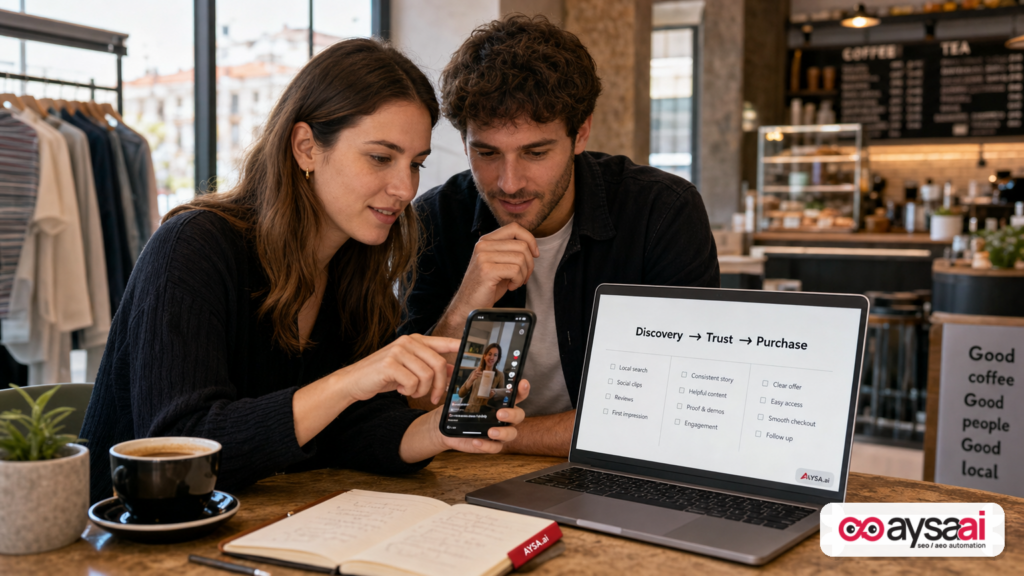
Search is not disappearing. It’s dispersing.
In 2026, a customer can discover you in a TikTok video, validate you in reviews, check your pricing on your site, and buy without ever touching the same “search engine” twice. TikTok is accelerating this shift with new discovery surfaces—especially for local businesses and commerce.
This editorial is a practical playbook for SMEs and agencies: what changed, why it matters, what to do, what to measure, and how to connect TikTok discovery back to durable SEO outcomes (brand demand, local actions, and revenue). I’m writing this from the perspective of Marius Dosinescu at AYSA.ai: execution matters more than opinions, and SEO now spans more than Google rankings.
Concise summary

TikTok increasingly behaves like a search-and-discovery layer. It can surface local places, summarize results with AI, route users into product shopping, and amplify creator reviews and comments as trust signals. Treating TikTok as “just social” risks missing early-funnel discovery that later shows up as Branded Search, Local intent, and conversion-ready traffic elsewhere.
Key takeaways
- TikTok SEO is now about understanding (spoken topics, on-screen text, visual cues, location context), not only hashtags and posting times.
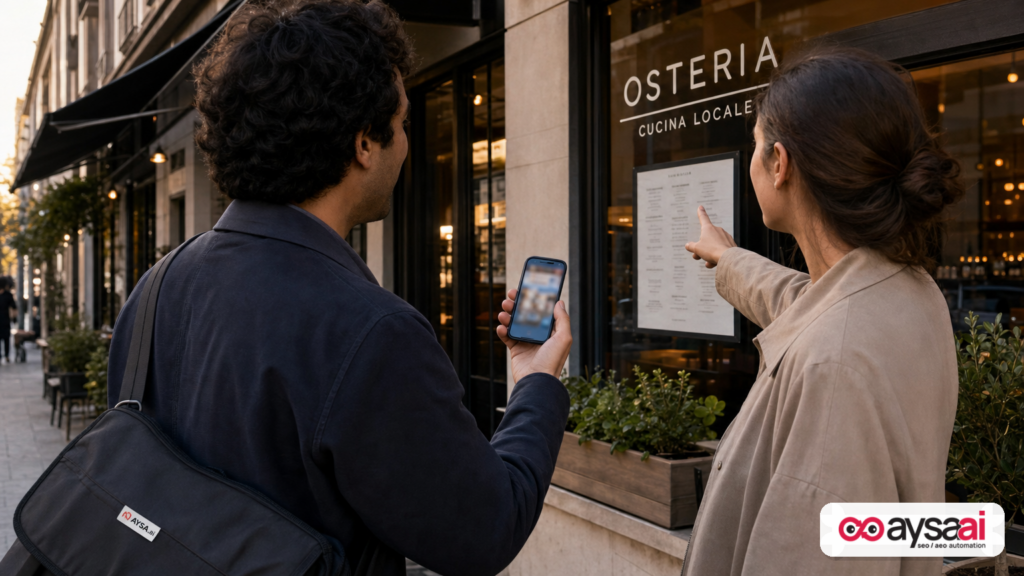
- Local discovery is a first-class surface via TikTok’s Local Feed and Places experience—meaning your storefront, signage, menu, and neighborhood context are optimization inputs.
- Trust is co-created through creator reviews, comments, and community Q&A—these are visibility assets you can plan for and reuse across your website and local presence.
- Commerce is closing inside the app through TikTok Shop, so product data quality (titles, attributes, visuals) matters like classic Ecommerce SEO.
- Measurement must shift to journeys: track Referral traffic, branded search trends, local actions, and landing-page engagement—then tighten the loop with site improvements.
- AYSA’s role: monitor discovery signals, propose site changes that capture demand, ask for approval, and execute accepted updates so TikTok-driven interest converts on your owned assets.
Table of contents
- The new discovery map: search is now a sequence, not a box
- What changed on TikTok (and why SEOs should care)
- TikTok SEO, redefined: from hashtags to understanding
- Local Feed, Places, and the fight for “near me” attention
- Creator reviews, comments, and why trust is now indexable
- AI inside TikTok: summaries, chat, and what it means for visibility
- TikTok Shop: ecommerce discovery that behaves like SEO
- Keyword research for TikTok: the practical workflow
- Content that “ranks”: production guidelines for non-creators
- Measurement that doesn’t lie: connecting TikTok to SEO outcomes
- What can go wrong (and how to reduce risk)
- Agency and in-house playbook: what to rethink in the operating model
- Where AYSA fits: approved execution across the discovery stack
- What to do next (action list)
- Sources and further reading
The new discovery map: search is now a sequence, not a box
For two decades, “SEO strategy” often meant one primary surface: Google’s results page. Build pages, earn links, improve technical health, and rise in rankings.
That model still matters. But the customer behavior model around it has changed. Discovery is now a sequence that can start and end in different places. A person might:
- See a 15-second TikTok about “best gluten-free bakery in Portland.”
- Open a review surface (maybe inside TikTok, maybe elsewhere) to sanity-check.
- Visit your website to confirm ingredients, hours, and parking.
- Search again—this time branded (“Your Bakery name”)—because trust has been established.
In that journey, TikTok doesn’t replace Google. It shapes what people search for, which businesses are considered, and what objections must be resolved before a visit or purchase.
Practical implication: your “SEO strategy” has to cover more than page-level ranking factors. It must cover discoverability signals across platforms and ensure your owned assets (site + local presence) capture the demand when it arrives.
Search Engine Land framed this clearly in its editorial on TikTok’s expanding discovery features, including local surfaces, AI summaries, reviews, and TikTok Shop. That piece is the research starting point for this article; read it here: Why TikTok deserves a place in your SEO strategy (Search Engine Land).
What changed on TikTok (and why SEOs should care)
TikTok has been “search-like” for years: people type queries, browse results, and refine their intent based on what they see. What’s different now is TikTok’s deliberate product investment into being a discovery and decision platform—especially for local and commerce.
Based on the Search Engine Land research summary and extracted context, TikTok has expanded multiple surfaces and systems that matter to businesses:
- Local Feed (a dedicated tab in the U.S. to surface nearby content)
- Places experiences, including reviews and summaries
- AI-assisted discovery (AI summaries / overview-style elements and chatbot-like search experiences)
- Visual and automated query prompts that connect videos to broader search topics
- TikTok Shop for product discovery and checkout inside the app
The net effect is that TikTok is pushing discovery closer to: where people build trust (creators, comments, short demos) and where people act (local visits, in-app purchases).
If you run an SME, this is not an abstract “platform trend.” It changes where your first impression happens—and what questions you must answer fast.
TikTok SEO, redefined: from hashtags to understanding
Most business owners still think TikTok optimization is:
- Stuff hashtags into a caption
- Use a trending sound
- Post at the “best time”
- Hope you hit the For You feed
Those tactics can help distribution, but they’re not a strategy—and they don’t reflect how TikTok increasingly understands content.
A modern, business-grade definition:
TikTok SEO is the practice of making your business, products, services, and locations easier to discover, interpret, trust, and choose across TikTok’s search, recommendations, local surfaces, and commerce experiences.
That means TikTok has to correctly interpret what your video is about. That interpretation comes from multiple inputs, including:
- Search query relevance: what you say and show needs to match real user intent
- Spoken clarity: plainly saying “gluten-free bakery in Portland” beats vague hype
- On-screen text: simple overlays that confirm topic + location + offer
- Captions and hashtags: still useful, but supporting—not leading
- Location context: tagging, neighborhood cues, storefront/signage
- Engagement signals: watch behavior and interaction patterns
- Comments and Q&A: often where the real objections surface
- Product signals: for commerce, the product data and visuals become “indexable” inputs
For SMEs, the simplest operational shift is this: make content that is unambiguous. If a stranger watched without audio, could they still tell what you do, where you are, and why you’re different?
Local Feed, Places, and the fight for “near me” attention
Local intent is incredibly valuable because it’s often conversion-ready: a person isn’t researching for fun—they’re deciding what to do next.
TikTok’s Local Feed (as covered in the Search Engine Land source) is a signal that the platform is investing in local discovery as a default behavior, not an edge case. It creates an additional organic surface where nearby businesses can appear without a user explicitly typing “near me.”
What this means for local businesses
If you operate a restaurant, clinic, hotel, salon, gym, or any service area that depends on local visits, your content needs to answer “before you go” questions:
- Where are you, exactly (neighborhood, landmarks, parking)?
- What does it look like inside?
- What’s the ordering/check-in process?
- What’s the price range?
- What should I get / what should I avoid?
These aren’t “content marketing” questions. They’re conversion friction questions.
A TikTok local optimization checklist (non-technical)
- Show signage (exterior) and a recognizable “arrival moment.”
- Say the city/neighborhood naturally in the first few seconds.
- Film a quick walkthrough: door → counter → seating → menu highlight.
- Tag location when appropriate.
- Create seasonal/event hooks: “best iced drinks in July,” “game-day specials,” “holiday gift bundles.”
- Use a pinned comment for hours, parking, and booking link.
Important: TikTok’s precise location options and visibility can vary by user setting and rollout. Treat local surfaces as opportunity, not guaranteed distribution.
Creator reviews, comments, and why trust is now indexable
Traditional SEO taught us that reviews matter. The shift is that reviews and commentary are no longer confined to a single review site or Google’s ecosystem. TikTok has become a place where:
- Creators publish “reviews” that feel like a friend’s recommendation.
- Comment sections become live Q&A threads.
- Users ask the questions they’re embarrassed to ask in public (prices, portion size, accessibility, wait times).
In the Search Engine Land source, there’s also discussion of TikTok incentivizing place reviews in certain contexts and pulling in reviews from other sources when TikTok reviews are sparse. The operational takeaway isn’t to game incentives—it’s to recognize that review ecosystems are converging, and your brand needs consistent truth across them.
Turn comments into business assets
Most businesses treat TikTok comments as “engagement.” That’s a miss. Comments contain:
- Objections (“Is it actually gluten-free or just ‘no wheat’?”)
- Context (“Is there parking if I’m coming from the east side?”)
- Use cases (“Is this okay for kids?”)
- Competitor comparisons (“How does it compare to X?”)
Your job is to capture these signals and feed them back into:
- Website FAQs
- Service pages
- Product pages
- Local landing pages
- Email/SMS scripts
- Front-desk/customer support playbooks
This is where TikTok becomes part of SEO strategy in a very literal sense: it reveals the language and concerns that should shape your on-site content. That’s content SEO—just sourced from a modern channel.
AI inside TikTok: summaries, chat, and what it means for visibility
The source highlights multiple AI-assisted discovery elements (availability may vary): chatbot-like exploration (e.g., “Tako”), AI overview-style summaries for search results, quick highlight summaries, and AI summaries inside Places.
You don’t need to be an AI researcher to take advantage of this. You need to understand one practical truth:
When platforms summarize content, they reward clarity.
If TikTok is generating summaries from sets of posts, then your content is competing not only for a view—but for inclusion in a machine-generated understanding of a place or topic.
How to make your content summarizable
- State the claim: “This is a same-day florist in Austin.”
- Show proof: same-day preparation, delivery labels, store hours.
- Quantify carefully (only if true): “We bake fresh every morning,” “online booking available.”
- Avoid vague superlatives: “best ever” is less useful than “nut-free options available.”
- Repeat the entity: business name + neighborhood + category (naturally).
Also note the broader industry direction: Google itself is experimenting heavily with AI-generated experiences in search and ads. Search Engine Land has covered these shifts, including AI-generated summaries in Search ads and the evolving “SEO stack.” If you’re trying to understand the bigger context, these are useful research leads:
- Google tests AI-generated summaries in Search ads (Search Engine Land)
- The new SEO stack: What replaces your old toolset (Search Engine Land)
- 6 SEO priorities to rethink for AI search (Search Engine Land)
Even if you never publish a TikTok, the meta-trend is the same: systems summarize the web; brands must be legible to those systems.
TikTok Shop: ecommerce discovery that behaves like SEO
TikTok Shop compresses the classic ecommerce funnel: awareness → consideration → purchase—into one environment. The source notes that TikTok Shop search relies heavily on matching a user’s query to product information (titles, categories, attributes, and context).
That’s familiar to any ecommerce SEO professional: if your product data is sloppy, you don’t rank—whether it’s Google Shopping, a marketplace search bar, or TikTok Shop.
Product data is the new metadata
If you sell products, treat TikTok Shop like an internal search engine with its own ranking logic. Your basics should be boring and perfect:
- Titles: include the primary descriptor people search (size, material, use case) without Keyword spam.
- Categories and attributes: fill them out completely and consistently.
- Visuals: demonstrate the product in use, show scale, show packaging, show variants.
- Comment mining: collect questions that should become product page copy and short videos.
Concrete SME scenario: a boutique skincare brand
Imagine a small skincare ecommerce brand with two hero products: a vitamin C serum and a barrier cream. They post creator-style demos on TikTok. People ask:
- “Is it fragrance-free?”
- “Can I use this with retinol?”
- “Is it safe for sensitive skin?”
- “How long does shipping take?”
Here’s the strategic move: don’t answer only in comments. Answer everywhere customers validate.
- Add a FAQ block on the product page.
- Create a comparison guide (“Vitamin C for sensitive skin: how to choose”).
- Create a short landing page for “fragrance-free vitamin C serum” if that’s the language you see repeatedly.
- Use Approved Execution to push these site updates fast, while the topic is hot.
This is how TikTok becomes an ecommerce SEO input: it reveals demand language and objections earlier than your own site search may.
Keyword research for TikTok: the practical workflow
If you treat TikTok like a discovery engine, your keyword research workflow can’t be Google-only. You need to learn the language people use inside TikTok.
A simple TikTok keyword research method (repeatable)
- Start with a seed query (your category + intent): “best brunch,” “things to do in [city],” “wedding florist,” “barrier cream,” “AC repair cost.”
- Search it on TikTok and record autocomplete suggestions and related prompts.
- Open top results and look for repeated phrases in on-screen text and voiceover.
- Read comments and group them into themes: price, quality, location, timing, alternatives, fear/risks.
- Add local modifiers (city, neighborhood, “near [landmark]”).
- Cross-check with your owned data: Google Search Console queries, your site search, and customer support logs.
Search Engine Land also mentions TikTok’s Creator Search Insights as a tool for identifying searched topics and content gaps. If it’s available for your account, use it as a directional guide—not as the only source of truth.
Content that “ranks”: production guidelines for non-creators
Most SMEs avoid TikTok because they assume they must become entertainers. That’s the wrong mental model.
For business growth, TikTok content should behave more like:
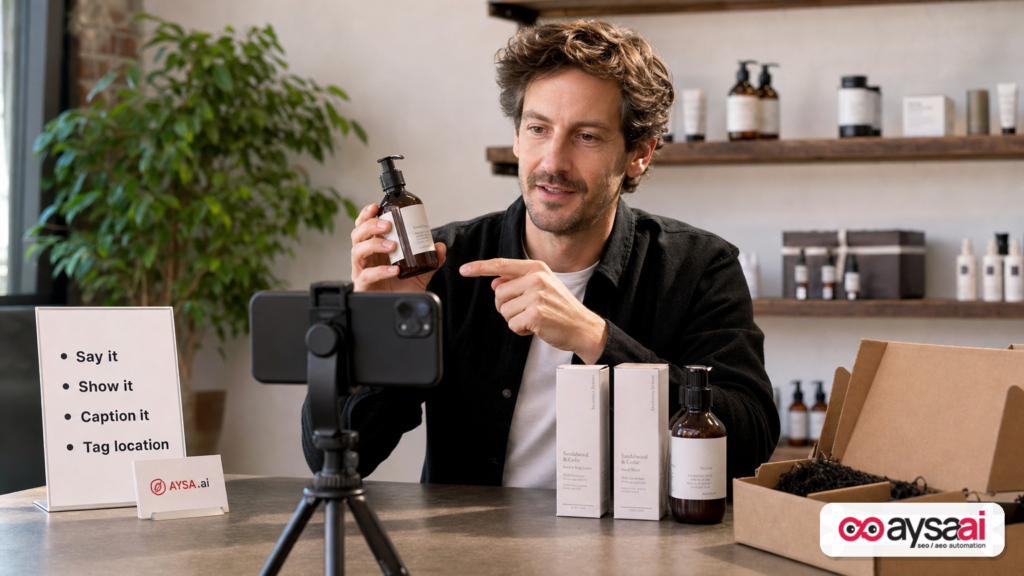
- a quick product demo
- a walkthrough
- a “before you go” explainer
- a myth-busting FAQ
- a real review response
Entertainment helps, but utility scales. Utility is also easier to systematize for teams.
The 10-second rule (what to include early)
- Who: “We’re a same-day florist…”
- Where: “…in downtown Austin…”
- What: “…here’s what $65 actually gets you.”
- Proof: show the stems, the wrap, the final bouquet, the pickup moment.
Keyword placement without being cringe
Use your core topic in:
- Spoken intro
- First on-screen text overlay
- Caption opening line
- Hashtags (a few relevant ones)
- Location tag (when appropriate)
- Pinned comment (to reinforce details)
- Profile bio and playlists (if you use them)
This is the TikTok version of on-page SEO: put the meaning where the system can easily interpret it.
Local business content templates (steal these)
Restaurants
- “What to order if you like spicy / vegetarian / gluten-free”
- “Parking + wait time + best time to come”
- “$20 vs $40 here—what changes”
Clinics (medical/healthcare note: avoid claims you can’t substantiate; follow compliance rules)
- “What happens at your first visit”
- “3 questions to ask before choosing a provider”
- “Insurance and billing basics”
Home services
- “Signs you need [service] now vs later”
- “What a quote includes (and common upsells to watch for)”
- “Before/after walkthrough”
Measurement that doesn’t lie: connecting TikTok to SEO outcomes
Attribution is the trap. If you demand perfect attribution, you will do nothing.
Instead, measure in layers:
Layer 1: direct impact
- TikTok referral traffic to your site (when links are used)
- Landing-page engagement (time, scroll, conversions)
- Offer-specific conversions (if you use dedicated landing pages)
Layer 2: demand creation (the real SEO win)
- Branded search trends (brand name + products + “near me” variants)
- Direct traffic changes over time (directional, not definitive)
- Local actions such as calls, direction requests, bookings (platform-dependent)
Layer 3: trust and objection reduction
- Repeated questions decreasing over time (a sign your content answers them)
- More high-intent comments (“Do you have availability Friday?”)
- Better conversion rates on the pages you updated based on TikTok objections
A practical measurement workflow
- Annotate the day a major TikTok post goes live (or a creator publishes).
- Watch branded queries in Google Search Console over the following days/weeks.
- Segment landing pages tied to TikTok intent (local page, product page, FAQ page).
- Use UTMs where you control links.
- Control for other events: PR, email, promotions, seasonality.
Search Engine Land’s broader coverage of AI search and visibility measurement can also be a useful context setter for teams trying to modernize reporting:
- How to measure prompt-level visibility in AI search (Search Engine Land)
- ChatGPT commands 92% of AI referral traffic. Here’s what 6.77 million sessions reveal. (Search Engine Land)
Even if you’re not doing prompt tracking today, the measurement theme is consistent: search influence is spreading, so measurement must include more surfaces than just “rank position.”
What can go wrong (and how to reduce risk)
Adding TikTok to your SEO strategy doesn’t mean blindly posting. There are real risks.
Risk 1: chasing virality and abandoning positioning
Viral reach that doesn’t attract your buyer wastes resources. Fix it by defining:
- your top 3 customer intents
- your top 10 objections
- your top 5 proof points (process, ingredients, sourcing, warranty, expertise)
Then make content that repeatedly answers those.
Risk 2: inconsistent information across platforms
If TikTok shows one set of hours, your site shows another, and your local profile shows a third, you lose trust. You don’t need perfection—but you need operational control. Assign an owner and a weekly check.
Risk 3: compliance and claims (especially healthcare and finance)
Be careful with medical, legal, or financial claims. If you can’t verify a claim, don’t say it. Focus on process, credentials, what to expect, and how you handle safety and quality.
Risk 4: platform dependence
TikTok can change distribution rules, features, or surfaces. The antidote is to use TikTok to create demand, but convert and retain customers through owned assets (your site, email list, booking system). That’s why connecting TikTok to SEO is strategic—not optional.
Agency and in-house playbook: what to rethink in the operating model
For agencies, TikTok as SEO input creates an uncomfortable truth: your scope boundaries are outdated.
If your SEO deliverables stop at “publish blog post + build links,” you are ignoring the channels shaping query demand and trust.
What to change
- From keyword lists to intent libraries: include TikTok phrasing, comment themes, and creator narratives.
- From page launches to feedback loops: comments and reviews become ongoing research.
- From “rankings report” to “visibility report”: include branded search movement, local actions, referral traffic, and engagement on updated pages.
- From slow execution to governed execution: you must ship improvements while attention is high.
Search Engine Land’s “new SEO stack” framing is a good prompt here: the stack is evolving, and teams need systems for monitoring and execution, not just research and recommendations (source).
Where AYSA fits: approved execution across the discovery stack
Most businesses don’t fail at strategy. They fail at execution speed and governance.
You can know that TikTok is influencing branded search and still do nothing because updating pages, fixing internal linking, publishing FAQs, or improving local landing pages requires time, coordination, and approvals.
AYSA is designed for this reality. We’re an execution system for modern SEO/AEO/GEO workflows: monitor, prepare recommended changes, ask for approval, then execute accepted updates on your website. That’s the only way to keep up when discovery shifts weekly.
What to monitor when TikTok becomes a discovery driver
- Branded search queries and impressions
- Local intent queries (brand + city, “near me” patterns)
- Referral landings from TikTok (and engagement quality)
- Pages that receive “validation” traffic after TikTok exposure (hours, pricing, booking, product details)
Start here: AYSA Monitoring.
What to execute (fast) to capture TikTok-driven intent
- FAQ expansions based on real comment objections
- Local landing page upgrades (parking, neighborhoods served, “what to expect”)
- Product page clarity (attributes, use cases, comparisons, shipping/returns)
- Internal linking that routes validation traffic to conversion pages
- Structured content (clear headings, scannability) so humans and systems can summarize accurately
To understand how we frame visibility across search and AI surfaces, see: AYSA AI Search Visibility and AYSA AI SEO Tools.
Why approved execution matters (especially for SMEs)
Most SMEs operate with limited time and real risk: wrong edits can break pages, pricing can become inconsistent, and compliance can be violated.
That’s why the workflow must be: propose → approve → execute. It keeps speed without sacrificing control. If you want to see how that fits your team, pricing and onboarding expectations are here: AYSA Pricing.
What to do next (action list)
Use this as a 30-day plan. Don’t overcomplicate it.
Week 1: baseline and positioning
- Write down your top 10 customer objections (price, access, ingredients, timing, trust).
- Baseline branded search queries in Google Search Console.
- Identify your top “validation” pages: contact, hours, booking, pricing, product pages.
Week 2: publish utility content
- Create 5–8 short videos answering top objections.
- Use the 10-second rule: who/where/what/proof.
- Pin a comment with the single next step (book, visit, shop).
Week 3: build the loop from TikTok → site
- Collect recurring questions from comments.
- Add/expand FAQs on the relevant site pages.
- Improve internal linking from validation pages to conversion pages.
Week 4: measure directional impact
- Annotate posts and compare branded search trends against baseline.
- Review TikTok referral landings and engagement quality.
- Decide what to double down on: local walkthroughs, product demos, or FAQ myth-busters.
If you want ongoing guidance and execution patterns, browse the AYSA editorial library: AYSA Blog.
Sources and further reading
- Search Engine Land: Why TikTok deserves a place in your SEO strategy
- Search Engine Land: The new SEO stack: What replaces your old toolset
- Search Engine Land: Google tests AI-generated summaries in Search ads
- Search Engine Land: 6 SEO priorities to rethink for AI search
- Search Engine Land: How to measure prompt-level visibility in AI search
- Search Engine Land: ChatGPT commands 92% of AI referral traffic. Here’s what 6.77 million sessions reveal.
Continue the AI search topic inside AYSA.
Use these pages to connect the article with AI SEO tools, AI visibility monitoring, AI Overviews and approved website execution.
Turn this topic into a website action plan.
Use these AYSA hubs to move from reading to technical fixes, AI visibility monitoring, research, glossary context and approval-first SEO execution.

