Your AI Sales Team Is Already Selling Your Brand: How to Train It (Without Losing the Plot)
AI assistants now influence—or directly make—buying decisions based on confidence signals, not just your content. Here’s how to build machine-readable trust across search, knowledge graphs, and third-party proof, plus an execution plan SMEs can actually run.

Search is still where demand starts—but it’s no longer where decisions finish.
AI assistants (and increasingly, AI agents) now act like a 24/7 sales team for every business: they explain categories, compare options, summarize your brand, suggest alternatives, and sometimes make the purchase decision on the buyer’s behalf. If you’re not actively training these systems, you’re letting them build their “understanding” of your company from whatever fragments they can find—often incomplete, inconsistent, or dominated by third parties.
This editorial builds on ideas discussed in Search Engine Land’s analysis of AI recommendations and confidence (Jason Barnard). I’m not here to repeat it—I’m here to translate it into what SMEs and teams can actually do, and to be blunt about the operational gap: you don’t win AI Search with opinions and documents. You win by shipping approved changes, steadily, to the assets AI systems rely on.
Concise summary
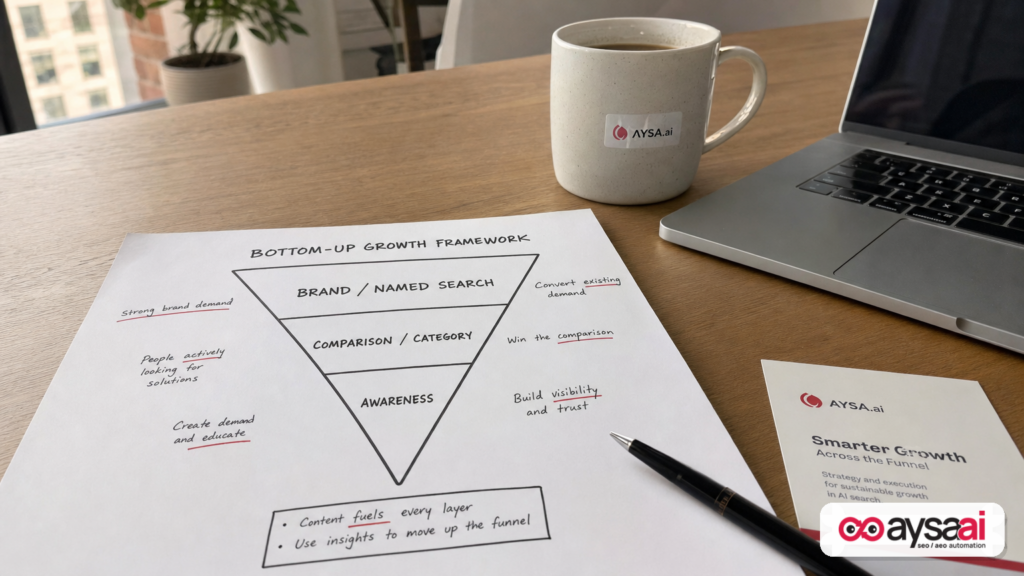
AI systems recommend the brand they’re most confident in—not necessarily the best one. Confidence comes from clarity (who you are), corroboration (independent proof), and consistency (same facts everywhere). Traditional SEO still matters, but it’s now the foundation for AEO/GEO: getting assistants to mention you, recommend you, and eventually transact with you. The practical play is to build from the bottom of the funnel up (brand → comparison → awareness), fix entity/knowledge signals, earn third-party proof, and maintain it with Monitoring and Approved Execution.
Key takeaways

- Your “AI salesforce” is already active: assistants answer questions in search, apps, and operating systems—often without a click.
- AI recommendations are confidence-driven: the system chooses what it can justify, corroborate, and explain reliably.
- SEO is not dead: it becomes the inner layer of a bigger stack—search + knowledge graphs + LLM reasoning + (increasingly) agents that act.
- The build order flips: build bottom-up from brand and high-intent comparisons first; awareness comes later.
- Third-party proof is not “nice to have”: it is the independent corroboration AI uses to stop hedging and start recommending.
- Execution is the bottleneck: monitoring, preparing changes, getting approval, and deploying clean updates is what compounds.
Table of contents

- What changed: from links to recommendations to actions
- The new buyer journey: the funnel didn’t change—your build order did
- Confidence is the currency: why AI recommends the brand it understands best
- The three layers that now sell your brand: search, assistive engines, agents
- Knowledge graphs and entities: how machines decide who you are
- Third-party proof: the fastest way to reduce AI “doubt”
- What can go wrong: misinformation, misattribution, and invisible losses
- An SME scenario: the local clinic that “lost” traffic but gained AI-driven patients
- What SMEs should monitor now (even if you don’t have an SEO team)
- What agencies should rethink: deliverables that don’t move the needle
- The practical action plan: train your AI salesforce in 90 days
- Where AYSA fits: monitoring + approved execution for AI search
- What to do next
- Sources and further reading
What changed: from links to recommendations to actions
For most of the last 20 years, marketing leaders could treat search as a traffic channel. You earned visibility, you earned clicks, and then your website did the selling.
That model is breaking in a specific way: buyers still use search behavior, but the search experience increasingly answers the question without sending a click. And when a click does happen, it may happen late—after an assistant has already summarized the category, shortlisted options, and framed what “good” looks like.
The difference between being found and being recommended is the difference between ranking for a query and being included in a decision. That’s what AI has changed: machines now sit inside the decision layer, not just the discovery layer.
Search Engine Land captured a crucial point: these systems don’t just echo content—they make choices based on confidence. The question for leaders becomes operational, not philosophical:
- Does the machine understand who we are and what we do?
- Can it verify that with independent sources?
- When it compares options, do we show up as a safe recommendation?
If the answer is “maybe,” you’re paying for uncertainty in ways your dashboards won’t show.
The new buyer journey: the funnel didn’t change—your build order did
The classic funnel is still real: awareness → consideration → decision. Humans still move through it that way.
But machines don’t learn you that way. They learn you in reverse:
- Decision/brand intent: “Is Brand X legit?” “What is Brand X?” “How much does Brand X cost?”
- Consideration/comparison: “Best payroll software for restaurants” or “Shopify vs WooCommerce for small catalog”
- Awareness: “How do I handle payroll?” “How do I choose an ecommerce platform?”
Traditional marketing advice often starts at awareness because it feels like “bigger reach.” But in AI-era discovery, reach without confidence is a tax, not an asset. Assistants can pull an awareness question into a self-contained answer, and if you’re not in the shortlist, you don’t get the click.
So the build direction flips: if you want to be recommended for category questions, you need machine confidence in your entity first. That means building:
- Your brand narrative (consistent facts + machine-readable identity)
- Your comparison narrative (when and why you’re the right choice)
- Your awareness narrative (education that reinforces the above)
This isn’t “branding vs performance.” It’s performance through brand clarity.
Confidence is the currency: why AI recommends the brand it understands best
In the old world, you could win a click with:
- a strong Title tag,
- a good snippet,
- and a high rank.
In the AI world, a recommendation is closer to a salesperson saying, “Buy this.” That carries more risk for the system. If it recommends the wrong thing and the user has a bad experience, the user loses trust in the assistant.
So the assistant behaves like a cautious salesperson. When it’s uncertain, it hedges (“claims to…”, “appears to…”, “reportedly…”) or it offers alternatives. That uncertainty is not random. It is typically caused by one of three gaps:
1) Clarity gap: the machine can’t confidently explain your identity
Common causes:
- Conflicting product or service names across your site and listings
- Multiple slogans that contradict each other
- Ambiguous positioning (“We do everything for everyone”)
- Thin About page, no leadership, no history, no concrete scope
2) Corroboration gap: the machine can’t validate your claims independently
This is where third-party signals matter: credible reviews, reputable directories, press mentions, citations, and consistent profiles. (More on this in the “Third-party proof” section.)
3) Consistency gap: the machine finds you—but sees different “versions” of you
Even good businesses fail here. They have:
- old pricing pages indexed,
- deprecated product pages,
- stale FAQ answers,
- inconsistent addresses/phone numbers,
- or multiple partner sites describing them differently.
Consistency is boring. Consistency is also what machines reward.
The three layers that now sell your brand: search, assistive engines, agents
The cleanest way to think about modern discovery is as layers that stack, not replace each other:
Layer 1: Search engines (crawl → index → rank)
This is still your foundation. If bots can’t crawl you, if pages aren’t indexable, if internal linking is broken, if canonicalization is messy, you’ve built a house on sand.
Layer 2: Assistive engines (LLMs that reason and summarize)
These systems may ground answers in web results, but the buyer experiences the answer, not your page. You’re optimizing for being included in a response, not just being ranked. That’s AEO/GEO in practice.
Layer 3: Agents (software that can act)
Agents change the economic relationship. It’s no longer: “we rank, we get a click, we persuade.” It becomes: “the agent evaluates options, then executes.”
The more agentic the buyer becomes, the more your business must be legible to machines—not just your marketing. Product data, policies, availability, support promises, and checkout flows become part of optimization.
I like Jason Barnard’s framing (from the Search Engine Land piece) because it forces a hard truth: when an agent can transact, your sales motion isn’t just messaging. It’s systems.
Knowledge graphs and entities: how machines decide who you are
To be recommended, you must first be understood. Machines understand the web through entities (people, companies, products, locations) and the relationships between them. This is why “entity-first” SEO has been rising for years, and why it matters more in AI search.
You don’t have to become a semantic web researcher to benefit from this. You just need to accept a simple operating principle:
Machines build an internal “resume” of your brand. If your resume is missing fields or contains contradictions, you will be treated as risky.
In practical terms, your “AI resume” is influenced by:
- Your website’s About, Contact, Policies, and product/service pages
- Structured data (where appropriate and correct)
- Consistent brand facts across the web (profiles, directories, partners)
- Third-party reviews and commentary
- How other credible entities mention and relate to you
When SEOs argue about whether “content is king,” this is what they miss: content is only useful if it becomes confirmed knowledge in machine systems.
If you want a broader framing of this shift toward “teaching AI who you are,” Search Engine Land also highlighted it in a related piece: Google’s LLM patent suggests a new goal for SEO: Teaching AI who you are. Patents aren’t product specs, but they’re often directional. The direction is clear: identity and corroboration matter.
Third-party proof: the fastest way to reduce AI “doubt”
Most SMB websites are inherently biased—they’re marketing assets. That doesn’t make them untrustworthy; it makes them incomplete for confidence-building. AI systems want independent corroboration.
In classic SEO, third-party proof often meant links. In AI search, third-party proof still includes links, but the concept is broader:
- Reputable mentions and reviews
- Strong listings with consistent facts
- Authoritative comparisons and roundups (when legitimate)
- Industry associations and certifications (when real)
- Partner ecosystem references
Here’s the uncomfortable part: if you don’t build this proof for your own brand, the market will build it for you—and it may not reflect your best narrative. Search Engine Land has also covered how AI answers can cite questionable listicles and still recommend competitors. The title tells the story: Google AI Overviews cite self-serving listicles, but recommend competitors 69% of the time. Whether that exact percentage holds across categories isn’t the point. The point is: AI can cite sources you didn’t choose, and the recommendation can still go elsewhere.
So your job becomes twofold:
- Increase the availability of credible corroboration (so the system can commit).
- Reduce the dominance of low-quality or misleading sources (so the system doesn’t learn the wrong story).
This is where digital PR, review strategy, and partner marketing stop being “brand campaigns” and start being AI confidence infrastructure.
What can go wrong: misinformation, misattribution, and invisible losses
If you feel like your brand is being discussed in rooms you can’t enter, you’re right. That’s the new default. Here are the most common failure modes I see when businesses start paying attention to AI recommendations.
1) The system confuses you with another entity
Names overlap. Acronyms overlap. Local businesses share names across states. SaaS companies share “cute” one-word brands.
If your entity signals are weak, assistants may merge or confuse identities. You’ll see wrong descriptions, wrong locations, wrong founders, or wrong product lines. Sometimes it’s subtle: it doesn’t say you’re the other company—it just borrows their positioning.
2) The system recommends you for problems you don’t solve
This can happen when your content strategy tries to “rank for everything.” You publish broad educational pieces, and the assistant associates your brand with the topic broadly, not your specific offering. You gain impressions and lose trust.
3) The doubt tax: hedged language and “have you considered…” alternatives
When someone searches your brand name and the assistant offers alternatives unprompted, that’s a signal of uncertainty. It might be caused by weak corroboration, inconsistent facts, or simply stronger competitor presence.
In classic search, you could often “own” your branded SERP. In AI answers, the assistant can inject competition because it’s optimizing for user satisfaction, not your brand protection.
4) The ghost tax: you lose the sale without ever seeing the click
With AI summaries, the user may never visit your site. You won’t see the session. You won’t see the attribution. You may only see the outcome later: fewer form fills, fewer calls, fewer “I heard about you from…” answers.
Search Engine Land has also pointed to research that suggests assistant recommendations can drive brand website visits in some cases: ChatGPT recommendations drive more brand website visits: Study. That’s plausible—recommendations can increase branded demand. But you can’t assume it will happen automatically. If the recommendation goes to your competitor, the lift goes to them.
5) The “AI slop” trap: scaling content that degrades trust
Some teams respond to AI search by publishing more pages faster. If quality drops, coherence drops, and you create internal contradictions, you may lower machine confidence rather than raise it.
Search Engine Land’s broader conversation on accountability for low-quality AI content is worth reading for mindset: What if you were held accountable for your AI slop?. The point isn’t moral panic. It’s operational: low-quality content can poison your entity signals.
An SME scenario: the local clinic that “lost” traffic but gained AI-driven patients
Let’s make this real with a scenario I’ve seen variations of across local services, clinics, and specialty practices.
The business: a multi-location physical therapy clinic in a mid-sized U.S. metro.
The complaint: “Our organic traffic is down. We must be losing.”
The reality: more prospects are getting their early-stage questions answered directly in assistants (symptoms, treatment types, what to expect), and they arrive later in the journey—or they don’t click at all and call directly after an AI recommendation.
What went wrong for them at first:
- The clinic had multiple service pages with overlapping names (manual therapy vs orthopedic therapy vs sports rehab) and inconsistent descriptions across locations.
- The About page was thin—no clinician credentials, no clear scope, no story.
- Third-party listings had old phone numbers and inconsistent addresses for two locations.
- Reviews existed, but the brand narrative wasn’t consistent in how patients described outcomes or specialties.
How that shows up in AI: the assistant hedges on specialties, recommends generic alternatives, and sometimes lists other clinics when asked about “best PT near me for runners.”
The fix (no magic tricks):
- Standardize service taxonomy across the website (same names, same definitions).
- Strengthen entity clarity: clinicians, credentials, service scope, locations.
- Clean up local citations and core business facts across the web.
- Publish a small number of high-integrity pages that map services to specific patient needs (not broad “we do everything” content).
What changed in outcomes: not “rankings only.” The clinic becomes easier for machines to describe confidently. That reduces hedging, increases inclusion in local recommendations, and makes late-stage branded search cleaner.
This is what I mean when I say SEO becomes business engineering: it touches operations (locations, phone numbers, scheduling), not just blog posts.
What SMEs should monitor now (even if you don’t have an SEO team)
Most SMEs don’t need a sprawling measurement program. They need a tight control panel that answers: “Are we being understood, recommended, and chosen?”
Here’s the monitoring stack I’d prioritize:
1) Brand understanding checks
- Ask assistants to describe your brand in one paragraph. Is it accurate?
- Ask “Is [Brand] reputable?” Do you see hedging?
- Ask “What is [Brand] best for?” Does it match your positioning?
You’re not looking for a single “right answer.” You’re looking for consistent, confident accuracy across time.
AYSA helps by continuously tracking AI-facing visibility signals and surfacing issues you can actually act on. Start here: AI Search Visibility and Monitoring.
2) Category inclusion checks
- For your money queries (“best [category] for [ICP]”), do you appear at all?
- When you do appear, are you framed correctly (pricing tier, use case, geography)?
- Which competitors are consistently mentioned?
This is the AI era’s version of “share of voice,” but it’s about recommendations, not rankings.
3) Entity consistency checks (your “facts” everywhere)
- Business name, address, phone (for local)
- Product/service names and definitions
- Leadership, founding year (if you publish it), location footprint
- Policies: returns, shipping, warranty, cancellations (for ecommerce/service)
Every contradiction is a confidence leak.
4) Website foundations (still non-negotiable)
- Indexing and crawlability (no accidental noindex, broken canonicals)
- Internal linking to your core “entity” pages (About, services/products)
- Performance basics (slow sites still lose)
This is why I keep saying: AI search did not delete SEO. It raised the stakes.
What agencies should rethink: deliverables that don’t move the needle
Agencies and consultants are facing an uncomfortable moment: many familiar deliverables look great in a deck and do nothing in an AI recommendation system.
Examples:
- Content calendars that expand topic coverage but create contradictions and thin pages
- Keyword reports that don’t map to entity clarity or comparison inclusion
- Link building measured only by quantity, not by corroborative quality
- Audits that never get implemented
The new differentiator is not “knowing what to do.” It’s a repeatable system for shipping improvements safely and consistently.
That’s where SEO teams need to adopt an execution mindset: monitor, propose, approve, deploy, validate. It’s also why “approved execution” matters: businesses want speed, but they also need control. No founder wants a tool rewriting their homepage without review.
AYSA was built to close that gap: it monitors, prepares changes, asks for approval, and executes accepted updates. If you’re an agency, that’s how you scale quality without scaling chaos. Explore the toolset here: AYSA AI SEO Tools and see how teams use it via our Blog.
The practical action plan: train your AI salesforce in 90 days
This is a pragmatic plan designed for SMEs and lean marketing teams. It’s not “publish 100 articles.” It’s “remove confidence leaks and earn machine trust.”
Days 1–15: Build your brand’s machine-readable core
- Define your entity facts: exact brand name, locations served, primary offer, ICP, differentiators, support promise.
- Fix your core pages:
- About: who you are, what you do, who you serve, why you exist
- Contact: consistent data and clear methods
- Service/product pages: unambiguous names and scope
- Policies: clear, current, consistent
- Eliminate contradictions: merge duplicates, redirect outdated pages, consolidate overlapping services.
If you need help operationalizing this, start with monitoring and guided execution: AYSA Monitoring.
Days 16–45: Strengthen corroboration (the proof layer)
- Clean up third-party profiles (where your customers actually look): consistent facts, correct categories, updated descriptions.
- Build review velocity ethically: ask every satisfied customer, not just the happiest ones; respond consistently.
- Create credible mentions: partnerships, associations, thought leadership—avoid pay-to-play junk that hurts trust.
This is also where local and ecommerce brands should ensure their core data is clean and current across platforms. If your price, availability, or policy differs by channel, you need a system to keep it synchronized.
Days 46–75: Win comparison queries (where decisions form)
Most businesses spend too much time writing broad awareness content and too little time earning their place in comparisons.
Do this instead:
- Create “choice” pages that help buyers decide: use-case fit, who you’re not for, alternatives, migration paths.
- Answer pricing and qualification questions directly. Ambiguity increases doubt.
- Align your language with real buyer prompts. Assistants expand and reinterpret queries; understanding that behavior matters. Search Engine Land also covered query expansion tactics that influence visibility: How to use Google query expansion to improve content visibility.
Done well, this content doesn’t just rank—it trains assistants on when to recommend you.
Days 76–90: Measure, tighten, and systematize execution
- Re-run brand and category checks: are answers more consistent and confident?
- Identify remaining “confidence leaks”: stale pages, conflicting claims, missing proof.
- Implement a monthly cadence: monitor → prepare updates → approve → execute.
This is where most teams fall apart. They do the first sprint, then move on. AI systems keep learning. Competitors keep publishing. Your data keeps changing. The only sustainable advantage is a system.
Where AYSA fits: monitoring + approved execution for AI search
AYSA’s role in this new environment is straightforward: help businesses become the brand machines confidently recommend—without turning website management into a full-time job.
Here’s the operational model:
- Monitor the signals that drive AI visibility and recommendation readiness.
- Prepare improvements as concrete, reviewable changes (not vague advice).
- Ask for approval so owners and teams keep control over messaging and risk.
- Execute accepted changes so progress compounds.
If you want to explore capabilities, start here:
- AI Search Visibility (see where you show up, where you don’t, and what to fix)
- AI SEO Tools (practical execution tooling)
- Monitoring (keep your signals clean over time)
- Pricing (choose a plan based on execution needs)
- Blog (implementation guides and playbooks)
Notice what’s missing: gimmicks. No “hack the LLM.” No pretending there’s one magic schema block that guarantees recommendations. The work is still the work—just pointed at a new decision layer.
What to do next
- Run a brand confidence audit: ask assistants 10 questions about your brand and write down inconsistencies and hedging.
- Fix entity basics on your website: About, Contact, services/products, policies—make them consistent and specific.
- Clean up third-party facts: ensure your key profiles reflect the same truth as your site.
- Build comparison readiness: publish a small number of high-intent pages that clarify fit and alternatives.
- Set a monitoring cadence: AI visibility is not a one-time project; it’s ongoing operations.
- Adopt approved execution: move from “recommendations” to “changes shipped.”
Sources and further reading
- Search Engine Land: Your AI salesforce is already selling your brand. The question is who trained it.
- Search Engine Land: Google’s LLM patent suggests a new goal for SEO: Teaching AI who you are
- Search Engine Land: Google AI Overviews cite self-serving listicles, but recommend competitors 69% of the time
- Search Engine Land: ChatGPT recommendations drive more brand website visits: Study
- Search Engine Land: How to use Google query expansion to improve content visibility
- Search Engine Land: What if you were held accountable for your AI slop?
Note on sourcing: The supplied research context primarily includes Search Engine Land links. Where you want deeper primary documentation (e.g., platform-specific details on AI Overviews or measurement), we recommend adding official documentation links in a future revision rather than guessing.
Continue the AI search topic inside AYSA.
Use these pages to connect the article with AI SEO tools, AI visibility monitoring, AI Overviews and approved website execution.
Turn this topic into a website action plan.
Use these AYSA hubs to move from reading to technical fixes, AI visibility monitoring, research, glossary context and approval-first SEO execution.