
Used vs. Cited in AI Search: The New Visibility Model Brands Must Measure (and How to Win It)
In AI search, your brand can be used to shape answers or cited as a visible source—and those are not the same thing. Here’s how to measure both, why classic SEO still matters, and how SMEs can build an AI visibility system they can actually operate.

Search is changing in a way that feels subtle until you look at your own analytics: fewer Clicks, more zero-click answers, and more customer journeys that start (and sometimes end) inside an AI summary.
The trap for most businesses is thinking the only thing that matters is whether an AI engine cites your site. Citations matter, but they are only half of the story. In AI Search, your brand can be present in two different ways:
- Used: the model consumes your brand’s information (or information about your brand) to shape the answer.
- Cited: the model visibly references you as a source (link, profile, phone link, etc.).
This “used vs. cited” distinction was clearly articulated in a recent Search Engine Land analysis of how brands appear in AI search, and it’s the most useful mental model I’ve seen for turning AI visibility into an operational strategy rather than vague fear.
Source: Search Engine Land – Used or cited: The two ways brands appear in AI search.
In this editorial, I’ll go deeper: what changed, why it matters to SMEs and agencies, how to measure both “used” and “cited,” and what to do next—especially if your Organic traffic is flattening while competitors seem to show up everywhere in AI answers.
Concise summary

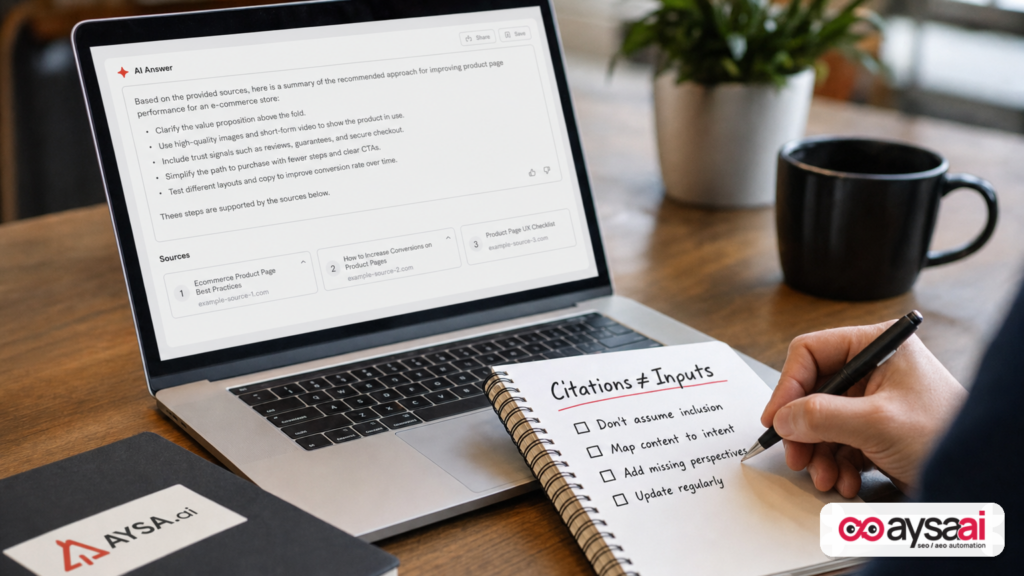
- “Used” is influence; “cited” is visibility. You can be influencing answers without getting credit (or traffic), and you can sometimes be cited without being the recommended choice.
- Citations are an incomplete KPI. AI engines may consult many sources and show only a few—so citation share is not the same as “share of inputs.”
- Traditional SEO still matters. Research cited by Search Engine Land suggests AI citations correlate with strong organic rankings (especially in Google’s AI experiences), so abandoning classic SEO is a mistake.
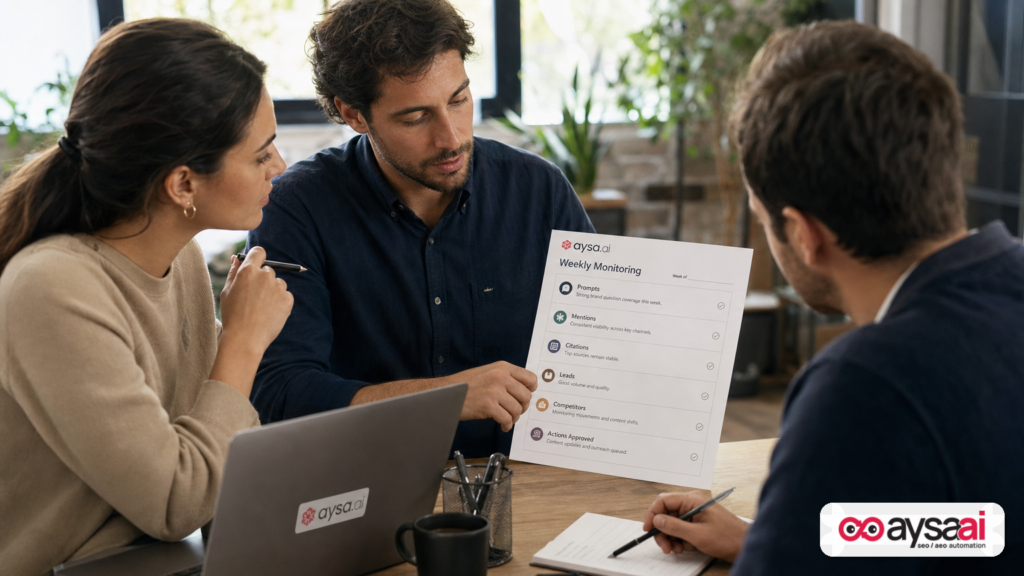
- Measurement is now a weekly discipline. You need prompt sets, competitor comparisons, and a way to turn findings into safe site changes.
- AYSA’s role: monitor AI visibility, prepare prioritized fixes, ask for approval, then execute accepted website changes—so you’re not stuck with “insights” that never become outcomes.
Table of contents
- What changed: the click economy is shrinking
- The new model: “Used” vs. “Cited” (and why it changes everything)
- Why citations alone are a misleading KPI
- Where AI engines get brand information (and what you can control)
- A practical measurement framework: what to track weekly
- Should you still care about traditional rankings?
- What content gets used and what content gets cited
- Your AI entity footprint: the operational checklist
- SME scenario: a local clinic that’s “used” but never “cited”
- What agencies must rethink (and how to productize AI visibility)
- Where AYSA fits: monitoring → recommendations → approved execution
- What to do next
- Sources and further reading
What changed: the click economy is shrinking
For the last 20 years, SEO was a fairly stable bargain:
- You publish useful pages.
- Google indexes them.
- You rank.
- You earn clicks.
That bargain is weakening. Search results pages have been getting more crowded for years—ads, local packs, shopping modules, featured snippets, and other SERP Features. Now AI summaries and AI-powered experiences are pulling even more intent into the results page itself.
Search Engine Land’s source article points to two data points that reflect this shift:
- A Pew Research finding that users click traditional links less often when AI summaries appear (the article references Pew’s reporting on link-click behavior around AI summaries).
- A Similarweb analysis suggesting that while AI Referral traffic can be smaller, it may convert differently than classic organic traffic (the article cites a conversion-rate comparison).
I’m intentionally not repeating the exact figures as a universal promise for your business. The reality varies by industry, device, and query type. But the directional truth is hard to ignore: more queries are being answered without a click, and more customer journeys are being influenced by AI-generated responses—even when no one visits your site.
That’s why measuring only “traffic from Google” is no longer enough. We have to measure representation and recommendation in AI outputs.
The new model: “Used” vs. “Cited” (and why it changes everything)
Here’s the key distinction, adapted from the Search Engine Land framing and expanded into something you can operate.
1) Your brand is “used”
“Used” means AI systems incorporate information about your brand—products, pricing ranges, policies, positioning, reputation signals, reviews, comparisons, and third-party commentary—when generating an answer.
Think of “used” as being part of the model’s working memory for a query. It’s influence.
What “used” can look like in the real world:
- Your brand is mentioned in a list of “best options” but with no link.
- Your return policy or shipping thresholds are summarized correctly (or incorrectly) by an AI assistant.
- Your clinic’s hours and services are described in an AI overview even if your website is never referenced.
Notice the risk: if you’re “used” but your information is outdated or inconsistent across the web, AI can confidently repeat the wrong thing. That’s not just an SEO problem—it’s a customer experience and revenue problem.
2) Your brand is “cited”
“Cited” means the AI system shows you as a source. That could be a link to a page, a profile, or a call link (especially in local or mobile experiences). Citation is visible credit.
Citations matter because they:
- Drive discovery (“Oh, I haven’t heard of that brand—let me click”).
- Create trust (“This answer is grounded in sources”).
- Can lead to direct actions (calls, visits, bookings) when the UI supports it.
But citations are not guaranteed, and they are not consistent across engines, prompts, devices, or user histories.
Why the distinction matters operationally
In classic SEO, ranking was the proxy for visibility. In AI search, you have two separate goals:
- Increase “usage” so the AI’s answer is aligned with your truth: your offer, your differentiators, your constraints, your inventory, your location rules.
- Increase “citation” so you receive credit and a path to action: clicks, calls, direction requests, signups.
If you chase citations only, you can still lose the narrative. If you chase “usage” only, you can win the narrative but lose the customer.
The winning strategy is to pursue both.
Why citations alone are a misleading KPI
Many marketing teams are building dashboards that track “how often are we cited in AI answers?” That’s better than doing nothing, but it can create false confidence (or false panic) because citations are a UI choice, not a full disclosure of inputs.
AI can answer without visibly citing you
AI engines frequently answer directly. Sometimes they include sources; sometimes they don’t. Even when they do, they may cite a handful of pages while consulting far more.
Search Engine Land’s source references an Ahrefs analysis suggesting a typical AI response may involve a similar count of cited and uncited URLs in the background, and that certain platforms can dominate the “uncited” inputs. The takeaway isn’t the exact averages—it’s this: AI answers can be constructed from a wider source set than what the user sees.
Citation share is not “share of market”
If you see your competitor cited more often than you, it might mean they have stronger content. Or it might mean:
- The AI engine trusts a particular platform that happens to feature them.
- Your site is blocked, slow, or hard to parse.
- Your pages are duplicative and add no unique value.
- Your Brand entity is fragmented (different names, addresses, old domains, inconsistent product naming).
So citation tracking must be paired with diagnosis: why are they cited and you aren’t?
The two failure modes you must separate
In practice, there are two common failure modes:
- You’re not used. The AI simply doesn’t consider you relevant or doesn’t reliably retrieve you.
- You’re used but not cited. You influence the answer but don’t get the credit, click, or action.
Those require different fixes. “Not used” is a distribution and authority problem. “Used but not cited” is often a crawlability, content uniqueness, or source-preference problem.
Where AI engines get brand information (and what you can control)
To win AI visibility, you need to stop thinking only in terms of “my website vs. the SERP” and start thinking in terms of an ecosystem of sources that models ingest and retrieve from.
1) Your owned assets (you control these)
- Your website: product pages, service pages, pricing, FAQs, policies, about pages, research pages.
- Your structured data: where appropriate, help machines interpret what a page is about (without relying on guesswork).
- Your brand channels: documentation, support center, press pages, partner pages.
Even in AI search, your site is still your highest-leverage asset—because it’s the one you can change quickly and safely.
2) Third-party assets (you influence these)
- Reviews and local listings
- Industry directories
- Comparison and affiliate content
- Forums and community posts
- Creator content and expert commentary
Search Engine Land’s article specifically calls out that certain platforms can show up disproportionately in AI systems’ uncited retrieval. You don’t have to like that, but you do have to account for it.
That doesn’t mean “spam Reddit” or chase every directory. It means: understand which sources each AI engine relies on for your category, then place your brand inside those sources in a legitimate, helpful way.
3) Technical controls (you can accidentally break these)
The Search Engine Land piece notes that within OpenAI there are separate user agents and separate levers for discovery vs. other usage patterns—highlighting an important reality: “AI access” is not one monolithic switch. If you (or your dev team) block bots or tighten rules without understanding the impact, you can reduce discovery and citation potential.
I’m not going to claim a universal “allow all AI bots” policy—that’s a business decision with privacy, legal, and infrastructure tradeoffs. But you should treat it like any other growth lever: decide intentionally, document the decision, and measure impact.
If you want a structured way to monitor and act on these changes without risky, unreviewed edits, that’s exactly what AYSA is built for: monitoring plus a controlled execution loop.
A practical measurement framework: what to track weekly
In AI search, measurement can get expensive and messy because it often involves prompt tracking and repeated sampling. But you don’t need perfection. You need a stable system that’s representative and repeatable.
Here’s a framework I recommend for SMEs and agencies—simple enough to run weekly, rigorous enough to guide decisions.
Step 1: Define a representative prompt set
Think in query clusters, not keywords. Your prompt set should include:
- Category discovery: “best [product/service] for [use case]”
- Comparison: “[Brand A] vs [Brand B] for [need]”
- Local intent: “best [service] near [city]”
- Problem/solution: “how to fix [pain]” + “who offers [solution]”
- Trust checks: “is [brand] legit” / “reviews of [brand]”
- Purchase/booking: “book [service]” / “buy [product] with [constraint]”
For each cluster, pick prompts that match how real customers talk. SMEs often underestimate how informal or situational customer language is.
AYSA can support this workflow as part of an AI visibility program by helping you track how your brand appears across a defined prompt set and how that changes over time. Start here: AI search visibility.
Step 2: Track two metrics separately: “Used” and “Cited”
At minimum, you want to capture:
- Mention rate (proxy for “used”): Is your brand mentioned? Is it described correctly? Is it recommended?
- Citation rate: Are you referenced as a source with a link/profile/phone action?
Also track sentiment/positioning qualitatively:
- Are you framed as premium or budget?
- Are you framed as “best for…” the segment you actually want?
- Does the model repeat outdated claims (old pricing, wrong address, discontinued features)?
Step 3: Record sources when available
When citations are provided, treat them like a competitive intelligence dataset:
- Which domains get cited repeatedly?
- Are they informational articles, product pages, reviews, directories, social profiles?
- Do they cite your competitors more than you? Why?
Then turn that into a priority list:
- Pages to update
- New pages to create (only if they add unique value)
- Third-party placements to pursue
- Entity/brand cleanup tasks (consistency, naming, NAP for local)
Step 4: Connect AI visibility to outcomes (without lying to yourself)
Clicks may drop even as demand grows. So you need a blended measurement view:
- Branded search lift (people search your brand after seeing it in AI)
- Direct traffic and returning visitors (not perfect, but directional)
- Lead quality (calls, booked consults, demo requests)
- Assisted conversions (where possible in analytics/CRM)
If you only measure last-click organic, you’ll underinvest in the channels that shape decisions earlier in the funnel.
Step 5: Create a weekly cadence (monitor → decide → execute)
AI visibility is not a one-time audit. Models change, UIs change, and competitors publish new content constantly.
A workable weekly cadence:
- Run your prompt set
- Review mentions/citations and sources
- Identify 3–5 actions with highest leverage
- Implement changes safely
- Repeat and compare trends
This is the missing link for most teams: turning monitoring into execution. AYSA was designed around exactly that loop: monitor, prepare, ask for approval, then execute accepted website changes. Learn more about how we structure it: AYSA AI SEO tools.
Should you still care about traditional rankings?
Yes. Not because the “#1 blue link” is the only prize, but because traditional SEO remains one of the strongest predictors of whether you’ll be cited in AI-driven Google experiences.
Search Engine Land points to Ahrefs research suggesting a relationship between pages cited in AI Overviews and strong organic rankings. The editorial implication is straightforward: if you want to be cited, you still need to be crawlable, indexable, and competitive in organic search.
In other words, classic SEO becomes the foundation layer for AI visibility:
- Technical health (crawlability, performance)
- Clear information architecture
- Content that demonstrates expertise and uniqueness
- Authority signals and reputation
The tactics aren’t dead. The scoreboard is changing.
Why traditional SEO still compounds in an AI world
Even as clicks decline for some queries, strong SEO still provides:
- Eligibility to be retrieved and cited
- Trust (the web has mechanisms for reputation; AI systems inherit those signals)
- Durability (your content can be used across engines and interfaces)
That’s why I advise businesses to stop framing this as “SEO vs AI.” It’s “SEO plus AI visibility operations.”
What content gets used and what content gets cited
AI engines don’t reward content just because it exists. They reward content that reduces uncertainty.
Search Engine Land’s source references Semrush research indicating that generic content that restates common knowledge tends not to earn citations. Again, the key takeaway isn’t the exact study design—it’s the principle: originality and specificity win.
Content that gets “used”
To be “used,” your content needs to be:
- Clear: explicit answers to real questions.
- Structured: scannable sections, descriptive headings, unambiguous language.
- Consistent: aligned with what the rest of the web says about you (or deliberately correcting it).
- Comprehensive within scope: not fluff, but complete enough that the model can pull facts confidently.
“Used” often correlates with: FAQs, policy pages, pricing explanations, service descriptions, comparisons, and troubleshooting content.
Content that gets “cited”
To be cited, you need content that stands out as a source worth pointing to. In practical SME terms, that’s usually:
- Original data: benchmarks, survey results, aggregated trends (even small, category-specific datasets).
- Unique expertise: strong author experience, clear “how we do it,” and verifiable credentials.
- Definitive assets: calculators, templates, checklists, detailed guides.
- First-party truth: pages that are the canonical reference for your products/services (specs, availability, warranties).
The old playbook of “publish 100 thin posts” is not only wasteful; it can dilute your perceived authority. A better approach is fewer, stronger, more defensible pages.
Practical content upgrades SMEs can execute in 30 days
- Rewrite 5 core pages (top products/services) for clarity: who it’s for, what it includes, what it costs (range), constraints.
- Add a comparison hub: honest “X vs Y” pages where you define when you’re the better fit.
- Publish a proof page: case studies, methodology, outcomes, process—without exaggeration.
- Create a canonical policy center: shipping, returns, cancellations, warranty, privacy, support response times.
These are also the kinds of updates AYSA can prepare and implement through an approved execution workflow. Start with monitoring to see what AI currently says about you: AYSA monitoring.
Your AI entity footprint: the operational checklist
AI search is not just “pages and keywords.” It’s entities and relationships: your brand, your products, your locations, your founders, your category, and the claims people repeat about you.
Search Engine Land’s broader context list includes a relevant lead: “How to audit your AI entity footprint.” Even if you don’t use that exact framework, the idea is essential: you need to understand where your brand exists and whether it’s consistent.
The entity footprint checklist (SME version)
- Brand name consistency: same spelling, same descriptors, same capitalization (this matters more than people think).
- Location consistency (local businesses): name, address, phone, hours.
- Product naming: avoid multiple names for the same offer unless you intentionally map them.
- Founder/expert profiles: clear bios, credentials, and consistent mentions across your site.
- Policy clarity: shipping, returns, refunds, cancellations—kept current everywhere.
- Review integrity: no fake, undisclosed, or incentivized reviews represented as organic. (Search Engine Land’s context list includes Google’s guidance warning against fake/undisclosed incentivized reviews in structured data—worth treating as a compliance baseline.)
This checklist is not glamorous, but it’s where “used but wrong” problems often begin.
SME scenario: a local clinic that’s “used” but never “cited”
Let’s make this real with a scenario I’ve seen variations of across local services: clinics, dentists, home services, and small hospitality brands.
The situation
A regional clinic offers a specialized service (say, dermatology or physical therapy). They’ve invested in SEO for years and still rank decently for some terms. But they notice:
- Fewer clicks from informational queries
- More “unattributed” phone calls (“I saw you listed somewhere…”)
- Competitors appearing in AI answer summaries with clickable actions
When they run prompts like:
- “best dermatology clinic near me”
- “who treats eczema in [city]”
- “how much is a skin consultation in [city]”
They discover:
- The AI summary describes services similar to theirs (so the model is using local-category information).
- Competitors are cited with direct call links or profile links.
- The clinic is occasionally mentioned, but rarely cited.
What’s really happening
This is often a compound issue:
- Entity mismatch: old addresses or old phone numbers still exist on third-party directories.
- Weak canonical pages: service pages are thin, generic, or unclear, so the engine prefers directory pages as a “source.”
- Not enough unique value: the clinic’s content doesn’t add specifics (pricing ranges, clinician credentials, treatment approach), so it’s not citation-worthy.
A fix plan that doesn’t require a giant budget
- Clarify 3–5 money pages: each service page gets clear eligibility, what happens in a visit, common questions, and next steps.
- Build a clinician expertise hub: bios, credentials, and “conditions treated” mapped cleanly.
- Standardize NAP: ensure listings are consistent and remove duplicates.
- Measure weekly prompts: monitor whether mentions become citations over time.
That’s the heart of AI visibility for SMEs: align the narrative, earn citation eligibility, and reduce ambiguity.
What agencies must rethink (and how to productize AI visibility)
If you run an agency or you’re an in-house marketer working with one, AI search changes what clients will value.
Rankings are no longer the only report clients will tolerate
Ranking reports are still useful, but they can feel disconnected from outcomes when clicks drop. Clients will ask:
- “Why did impressions rise but leads stay flat?”
- “Why are competitors in the AI summary?”
- “What does AI say about our pricing, quality, or credibility?”
Agencies need to add AI visibility reporting—and a method to turn it into actions.
Shift from project delivery to ongoing operations
AI visibility is a moving target. Agencies that win will offer:
- Prompt set design and maintenance
- Source analysis (which domains are shaping/citing answers)
- Content improvements focused on uniqueness and clarity
- Technical readiness and crawlability
- Entity footprint cleanup
- Ongoing monitoring and iteration
This is also where execution bottlenecks kill ROI: recommendations that sit in a doc for 60 days might as well not exist.
Approved execution becomes a differentiator
In my view, the next competitive edge is not “more insights.” It’s safer, faster implementation—without reckless auto-changes.
That’s the philosophy behind AYSA: we don’t just monitor. We prepare changes, request approval, and then implement what you accept. For businesses and agencies that need governance, that model is the difference between movement and stagnation. Explore how that works in practice: AI SEO Tools.
Where AYSA fits: monitoring → recommendations → approved execution
Most teams trying to adapt to AI search run into three problems:
- They can’t see what’s happening. AI answers vary, and manual checks are inconsistent.
- They can’t prioritize. There are too many possible fixes: content, technical, listings, PR, creators.
- They can’t execute. The backlog sits with developers, or changes happen without control.
AYSA is designed as an execution system for SEO/AEO/GEO, not a passive analytics tool.
1) Monitor AI visibility and search reality
Use monitoring to understand:
- Whether you’re mentioned (“used” proxy)
- Whether you’re cited
- Which sources are being cited
- Where competitors consistently show up
Start here: AI search visibility and monitoring.
2) Prepare a prioritized plan that’s actually implementable
AI visibility work often fails because plans are abstract (“make better content,” “build authority”). AYSA focuses on concrete, shippable items:
- Which pages to update first
- What sections to add/remove
- How to clarify entities (services, products, locations)
- Which internal links and supporting pages strengthen topical authority
If you want to see how AYSA approaches this in the broader editorial library, visit: AYSA Blog.
3) Ask for approval (governance)
Business owners and marketing leaders need control. AYSA’s model is: propose changes, explain impact and risk, request approval. Nothing goes live without acceptance.
4) Execute accepted website changes
This is where value compounds. The faster you can ship clarity, uniqueness, and technical readiness, the faster you can influence both “used” and “cited” outcomes.
For pricing and plan details, see: AYSA Pricing.
What to do next
If you want an action list you can start this week, use this.
In the next 7 days
- Write down 25 prompts customers would ask about your category (mix discovery, comparison, local, trust, and buying).
- Run them consistently across the AI experiences you care about, and record: mentions, citations, and sources (when shown).
- Identify the top 5 “truth gaps”: places where AI describes you incorrectly, vaguely, or unfavorably.
In the next 30 days
- Upgrade your 5 most important pages for clarity and specificity (not fluff).
- Create one unique asset that earns citations: a checklist, calculator, benchmark, or definitive guide.
- Fix entity consistency across your listings and your own site (name, location, phone, product naming).
- Set a weekly monitoring cadence and a monthly review of what sources are winning citations in your niche.
In the next 90 days
- Build a “comparison moat”: honest comparisons and “best for” positioning that matches real customer segments.
- Invest in authority: expert content, creator relationships, PR-worthy assets, and legitimate third-party coverage.
- Operationalize execution: implement continuously with governance, not sporadic projects.
If you want a system to run the monitoring and execution loop without living in spreadsheets, start with AYSA’s AI visibility stack: AI SEO Tools.
Sources and further reading
- Search Engine Land: Used or cited: The two ways brands appear in AI search
- Search Engine Land: Why creator content belongs in your AI search strategy
- Search Engine Land: How to audit your AI entity footprint
- Search Engine Land: Google guidance on fake/undisclosed incentivized reviews in structured data
- Search Engine Land: How SEO reduces blended customer acquisition costs
- Search Engine Land: 7 feedback loops for self-improving AI content workflows
- AYSA: AI search visibility
- AYSA: Monitoring
- AYSA: AI SEO tools
- AYSA: Pricing
- AYSA Blog
Continue the AI search topic inside AYSA.
Use these pages to connect the article with AI SEO tools, AI visibility monitoring, AI Overviews and approved website execution.
Turn this topic into a website action plan.
Use these AYSA hubs to move from reading to technical fixes, AI visibility monitoring, research, glossary context and approval-first SEO execution.

