
Traffic Is a Vanity Metric in AI Search: How “Hidden Gem” Publishers Build Real Authority (and What to Do About It)
In AI-driven search, brands win visibility through trusted, context-rich mentions—not just big-site links. Here’s how to rebuild your media list and content strategy around audience affinity, entity authority, and repeatable execution with AYSA.

Search used to reward the loudest brands. AI Search increasingly rewards the most believable brands.
That’s the uncomfortable truth behind a new pattern many SMEs are already feeling: you can do everything “right” in classic SEO—publish content, earn links, improve Core Web Vitals—and still watch Organic traffic flatten or decline while competitors show up in AI answers.
One of the clearest explanations comes from a recent Search Engine Land analysis of SparkToro-backed research on “hidden gem” publishers: smaller, niche outlets can outperform major media on audience affinity, even with dramatically less traffic. The strategic implication is bigger than Digital PR. It’s a blueprint for how brands should build authority in Generative search.
This editorial is my take—Marius Dosinescu, AYSA.ai—on what changed, why it matters, and how to execute a practical plan that improves your odds of being cited, recommended, and trusted in AI-driven discovery.
Concise summary
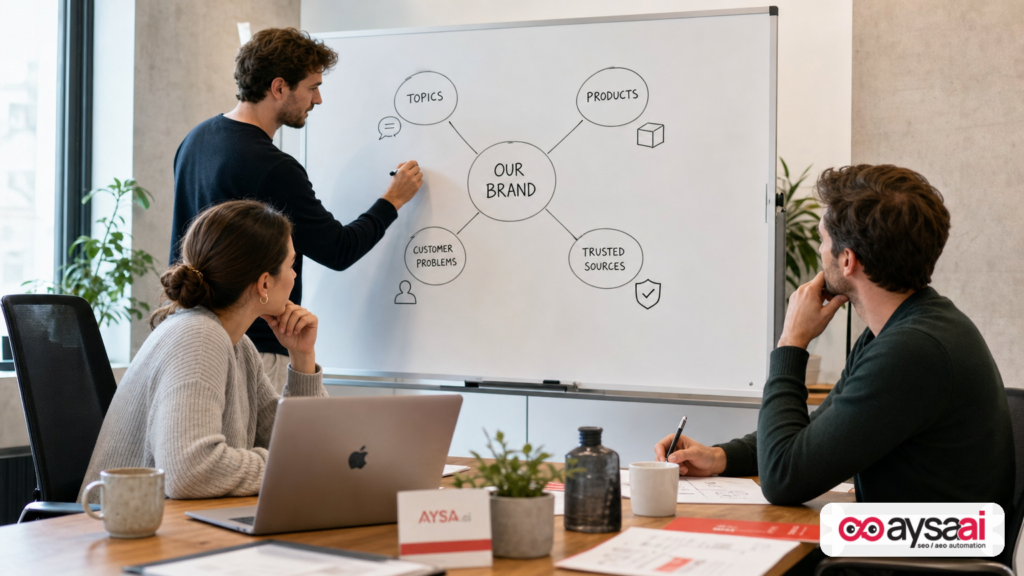
AI-driven search experiences (ChatGPT, Gemini, Perplexity, and Google’s AI surfaces) don’t “rank pages” the same way blue-link Google did for 15+ years. They synthesize answers using a web of third-party sources, mentions, and context. That shifts SEO strategy toward Entity Authority: repeated, consistent associations between your brand and specific topics across trusted sources.
Research covered by Search Engine Land argues that media lists still overweight traffic and domain authority—metrics that can miss niche publishers and communities that matter more to your real buyers. The winning approach is not “niche only” or “mainstream only,” but a balanced network strategy: mainstream for reach + niche for relevance + communities for repetition and engagement.
Key takeaways (for busy operators)

- Traffic is not the goal. In AI search, traffic is often a lagging indicator—and sometimes a misleading one.
- Authority is becoming contextual. A mention on a small, trusted niche site can reinforce your brand’s topical identity more than a broad, low-context mention on a major outlet.
- Community platforms matter. YouTube, Reddit, podcasts, newsletters, and practitioner communities can become “authority hubs” that AI systems draw from indirectly.
- Earned media and on-site execution must connect. Mentions don’t automatically translate into AI visibility; your website must reflect the same entities, topics, and relationships.
- Speed with guardrails wins. The brands that iterate quickly—without breaking their site—will compound visibility faster. This is where AYSA’s approved execution model fits.
Table of contents

- The problem: why “doing SEO” can still feel like losing
- The shift: from ranking pages to being recognized as an entity
- What the “hidden gem publishers” study gets right (and what most teams miss)
- Why traffic and domain authority are incomplete in AI search
- The new playbook: build a relevance network, not a link list
- Beyond publishers: YouTube, Reddit, podcasts, and communities as authority rails
- A concrete SME scenario: a local clinic that loses traffic but gains patients
- How to audit your brand’s AI entity footprint (without pretending it’s easy)
- How to build a GEO-ready media list (step-by-step)
- On-site moves that turn mentions into durable AI visibility
- What to measure now: KPIs that match AI discovery
- What agencies and in-house teams must change in 2026 workflows
- How AYSA fits: monitor → prepare → approve → execute
- What to do next
- Sources and further reading
The problem: why “doing SEO” can still feel like losing
SMEs are telling a similar story across industries—clinics, local services, ecommerce, SaaS:
- “We publish content every week. Traffic isn’t growing.”
- “We built links. Rankings moved… then flattened.”
- “Our brand shows up less in ‘AI answers’ than companies we’ve never heard of.”
Here’s what I think is actually happening: the surface area of search has expanded, and the rules of influence shifted. Blue links still matter, but they’re no longer the only decision layer.
When a customer asks an AI system, “What’s the best accounting software for contractors?” or “Which hotel near the airport is good for families?” the system is assembling an answer from patterns it sees across the web. That pattern-building rewards consistent third-party validation in the contexts that matter.
This is why the same business can experience:
- Less organic traffic (because users get answers without clicking), but
- More qualified leads (because when they do click, they’re already pre-sold).
If your reporting still treats traffic like the scoreboard, you’re going to make the wrong calls: cutting PR, cutting community efforts, or over-publishing content that adds no distinct expertise.
The shift: from ranking pages to being recognized as an entity
Classic SEO trained us to think in pages:
- Keyword → page
- Page → links
- Links → rankings
AI-era discovery pushes us to think in entities and relationships:
- Brand entity ↔ product category
- Brand entity ↔ use cases
- Brand entity ↔ customer types
- Brand entity ↔ peer brands/competitors
- Brand entity ↔ trusted sources that mention it in context
Search Engine Land’s coverage frames this through “entity authority” and “GEO” (generative engine optimization): visibility is shaped by repeated brand mentions across credible sources in your niche, not just your website’s optimization. That’s the right framing. The shift isn’t philosophical—it changes what you prioritize every week.
Two implications that matter for SMEs:
- You need fewer, better content assets (that are quotable and reference-worthy), not more content.
- You need distribution that creates trust signals in places your buyers actually pay attention to—even if those places don’t have huge traffic.
What the “hidden gem publishers” study gets right (and what most teams miss)
The Search Engine Land piece highlights a finding that should change how PR and SEO teams build media lists: “hidden gem” publishers can have higher audience affinity than major outlets, despite far lower traffic.
The exact figures come from the study discussed in the article (SparkToro-backed research, per the author’s disclosure). I’m not going to restate every number as a universal truth for every industry, but the direction matches what we see in practice:
- Big sites deliver reach.
- Niche sites deliver relevance.
- AI systems seem to reward relevance signals when forming recommendations.
What most teams miss is not that niche sites exist—it’s why they matter now:
- Niche publishers concentrate your buyer audience. That increases the chance your mention is seen, repeated, discussed, and referenced.
- Niche outlets supply cleaner topical context. A brand mention in a tightly themed publication is less ambiguous than a mention in a general-news outlet covering everything from politics to sports.
- Niche coverage creates “semantic reinforcement.” Multiple small, consistent mentions can build a stronger association than one large, fleeting mention.
In other words: a media list built only on traffic and domain authority is an old map for a new territory.
Why traffic and domain authority are incomplete in AI search
Traffic and authority metrics were never “bad.” They were just used as shortcuts for something harder to measure: influence.
In 2026, those shortcuts break more often because AI discovery changes the route between awareness and purchase:
- Users ask an AI assistant for options.
- The assistant summarizes and recommends.
- Clicks happen later—often only for shortlisting, validation, or price checks.
That means the sources that shape AI answers can matter even if they don’t drive lots of referral sessions to you directly.
Here’s the practical business interpretation:
- Traffic measures how many people arrived.
- Affinity (as used in the Search Engine Land coverage) measures how aligned a publication’s audience is with the people you want to influence.
- Entity authority describes whether the web consistently associates your brand with the right topics and credibility signals.
Traffic is still useful for forecasting reach. Domain authority can still be useful for link equity. But neither one tells you: “Does this placement increase the odds that an AI system will describe us correctly and include us in recommendations?”
The new playbook: build a relevance network, not a link list
Most outreach strategies still behave like this:
- Sort by DA/DR
- Pitch biggest sites
- Measure links + sessions
- Repeat
A relevance-network strategy behaves differently:
- Start with your buyer’s information diet. Where do they learn? Who do they trust? What communities do they participate in?
- Define the entity associations you want. Not “rank #1 for X,” but “be known for Y in the context of Z.”
- Place consistent, reference-worthy claims. Original research, clear frameworks, useful how-to guidance, expert commentary.
- Reinforce across formats. Article → podcast → YouTube → community thread → newsletter mention.
- Update your site so the story matches. AI and humans should find the same narrative when they land on your domain.
This is where GEO becomes less like “a new SEO trick” and more like classic brand building—except now it’s measurable, monitorable, and executable through modern tooling.
Beyond publishers: YouTube, Reddit, podcasts, and communities as authority rails
The Search Engine Land coverage notes that high-affinity authority isn’t limited to traditional publications. Platforms like YouTube and Reddit can dominate attention and influence, depending on the audience segment.
I’ll add a practical point: these platforms are not merely “promotion.” They’re primary sources of understanding for many buyers.
How that changes execution:
- YouTube: Founder interviews, product walkthroughs, teardown reviews, and practitioner case studies can create lasting citations people reference for years.
- Podcasts: Long-form conversation often carries more nuance than a short article—useful when your product/category is complex.
- Reddit and communities: Threads reveal real objections, alternatives, and language customers use. They also create a public “credibility trail” when handled ethically.
- Newsletters: In many industries, niche newsletters are more influential than mainstream publications because they’re curated and high-trust.
The mistake is bolting these on at the end. The right move is designing campaigns to travel across these formats from day one.
A concrete SME scenario: a local clinic that loses traffic but gains patients
Let’s make this real with a scenario that mirrors what we see across small and mid-sized businesses.
Business: a local physical therapy clinic in a mid-sized U.S. city.
Old approach:
- Publish weekly blog posts: “What is sciatica?” “Stretches for lower back pain.”
- Build a few directory links.
- Track organic sessions and keyword rankings.
What happens: traffic gradually declines as AI answers and local SERP features satisfy informational queries. The clinic panics and publishes more content. Nothing improves.
New approach (relevance network):
- Create one strong asset: “A simple decision guide for back pain: when to rest, when to see a PT, when to see a doctor.”
- Pitch it to niche local and professional outlets (fitness communities, local runner groups, workplace ergonomics newsletters).
- Do a guest segment on a local wellness podcast and one YouTube interview with a local strength coach.
- Publish a clinic page that matches the asset: clear services, outcomes, practitioner bios, and FAQs.
Expected result (without inventing stats): the clinic may not regain the same raw traffic volume, but it can improve the quality of discovery and increase bookings—because it’s now cited and discussed in the contexts where people make decisions.
The key is not “content” or “links.” It’s trusted context-rich mentions plus site alignment.
How to audit your brand’s AI entity footprint (without pretending it’s easy)
Most SMEs ask the wrong question: “Why am I not ranking?”
The AI-era question is: “What does the web think we are—and where is that belief coming from?”
A lightweight audit you can run quarterly:
1) List your desired associations
- Primary category (what you sell)
- Top 3 use cases (what problems you solve)
- Top 3 buyer types (who buys)
- 3 differentiators (why you)
2) Inventory third-party validation
- Trade publications
- Local media
- Podcasts and YouTube channels
- Communities (including forums where relevant)
You’re looking for consistent phrasing and repeated co-occurrences: your brand name plus category language plus use-case language.
3) Compare against competitors
Not just “who ranks,” but who gets mentioned in the contexts you want. If competitors are discussed in niche communities and you aren’t, that’s an entity-footprint gap.
4) Check your site for narrative mismatch
If your PR says “best for X,” but your site doesn’t clearly explain “X,” you’ve created friction for both users and AI systems.
AYSA’s monitoring and AI visibility tooling is designed to help here: you can track where you appear, what topics you’re associated with, and where gaps exist, then translate that into a controlled execution plan on your website.
How to build a GEO-ready media list (step-by-step)
The Search Engine Land coverage is blunt: many PR teams still build lists around outdated SEO metrics. So what replaces that?
A practical GEO-ready media list is balanced and scored. Here’s a process SMEs and agencies can actually run.
Step 1: Create three buckets (don’t skip this)
- Mainstream authority (reach and broad validation)
- Niche/trade authority (high relevance, high buyer density)
- Community authority (YouTube/podcasts/newsletters/forums where real discussion happens)
Step 2: Define your “entity relevance” criteria
For each target, answer:
- Does this outlet consistently cover our category and use cases?
- Will our mention appear next to the right adjacent entities (competitors, standards, problem terms)?
- Does the audience match our buyers or influencers?
- Is the outlet trusted enough that others reference it?
Step 3: Score targets (simple rubric)
- Affinity (1–5): how concentrated is the audience we want?
- Context (1–5): how well does the outlet frame topics in our niche?
- Propagation (1–5): does it get cited/syndicated/linked by others?
- SEO value (1–5): links and discoverability are still valuable
Now you can justify a placement that looks “small” on traffic but is strategically large in influence.
Step 4: Build campaigns that are inherently cite-worthy
PR pitches fail when the “asset” is thin. AI visibility compounds when the asset is referenced repeatedly.
What works for SMEs:
- Original mini-research (even small datasets, clearly explained)
- Clear frameworks (checklists, decision trees)
- Expert consensus roundups (with real practitioners)
- Transparent benchmarks (pricing, time-to-value, process steps)
On-site moves that turn mentions into durable AI visibility
Earned mentions can spark authority. But if your website doesn’t reinforce the same entities and topics, you leak value.
High-impact on-site moves (SME-friendly):
1) Clarify your category and use cases (above the fold)
If a human can’t tell what you do in 5 seconds, AI systems will struggle to describe you correctly too.
2) Build “proof pages” that match the narrative
- Case studies (specific problems, constraints, outcomes)
- Industry pages (why you’re credible for a vertical)
- Comparison pages (when appropriate and honest)
3) Strengthen internal linking around topics
Don’t just publish. Connect pages so your site presents a coherent topical map.
4) Use structured data carefully
Schema won’t magically get you into AI answers, but it can reduce ambiguity about who you are, what you offer, and how your content is structured.
Also, follow Google’s rules on structured data—especially reviews. Search Engine Land recently highlighted guidance on avoiding fake or undisclosed incentivized reviews in review snippet structured data. If your brand credibility matters, don’t risk it for a short-term SERP enhancement.
5) Close “entity gaps” on your site
Search Engine Land has a practical piece on using schema to identify and prioritize entity gaps; the concept matters even if you don’t implement everything at once: find what’s missing (services, people, locations, products, policies) and make it explicit.
AYSA’s role here is execution at speed with control: monitor changes, prepare updates, request approval, then implement accepted changes so you can iterate without chaos.
What to measure now: KPIs that match AI discovery
If you only report on sessions and rankings, you’ll optimize for the wrong outcomes. In AI-shaped discovery, you want a measurement stack that includes:
1) Mention quality and topical alignment
- Are you mentioned alongside the right topics and problems?
- Are you mentioned alongside the right peer brands (or instead of them)?
2) Branded demand signals
Branded search isn’t perfect, but it’s still one of the clearest indicators that the market is learning your name.
3) Conversion-rate stability and lead quality
Traffic may fluctuate. Lead quality and conversion rates tell you whether discovery is improving.
4) AI visibility checks (directional, not absolute)
AI systems change and personalization varies; treat AI visibility as a directional signal. Use it to identify gaps, not to claim precision.
AYSA is built to help businesses track and improve this over time through monitoring plus execution workflows:
What agencies and in-house teams must change in 2026 workflows
If you lead marketing, SEO, or PR, this is the operational shift: PR and SEO can’t be separate pipelines anymore.
Search Engine Land’s broader coverage this month reinforces that we’re in an “AI-first clarity” era. For example, they’ve published guidance on clarity for bloggers and how semantics/topical authority improve outcomes—ideas that apply beyond blogging.
- Search Engine Land: New SEO rules for bloggers (clarity in AI search)
- Search Engine Land: Semantics and topical authority (local SEO)
Three workflow changes I recommend:
1) Build campaigns as “content + distribution + site updates” packages
Don’t let PR ship without a matching landing page plan, internal linking plan, and structured content plan.
2) Replace monthly reporting with feedback loops
AI visibility is iterative. Treat it like product growth: test, measure, adjust. Search Engine Land has also discussed feedback loops for self-improving AI content workflows; that operational mindset is the right direction even if you customize the exact system.
3) Invest in execution capacity
Most teams know what they should do. The bottleneck is implementation: updating pages, fixing technical issues, adding content structure, improving internal linking, and keeping it all consistent.
That is precisely why we built AYSA as an execution system: it doesn’t just “tell you” what’s wrong—it helps you monitor, prepare changes, ask for approval, and execute the changes you accept.
If you want more on our thinking, our blog covers practical execution patterns and AI-era search strategy.
How AYSA fits: monitor → prepare → approve → execute
Most SEO tools stop at recommendations. That model is too slow for 2026.
What SMEs need is a controlled operating system for SEO/AEO/GEO:
- Monitor your site and your search/AI visibility signals
- Prepare specific changes (content, technical, internal linking, schema, page improvements)
- Ask for approval so humans keep control and brand risk is managed
- Execute accepted website changes quickly and consistently
That workflow matters because the “hidden gem publisher” insight only becomes business value if your brand story is reinforced everywhere—third-party sources and your owned properties.
If you’re evaluating whether this approach fits your team, start here:
What to do next
If you want a practical plan you can start this week, here it is.
- Rewrite your KPI dashboard. Add mention quality/topical alignment and lead quality metrics alongside traffic.
- Build a 30-target GEO media list. 10 mainstream, 10 niche, 10 community channels. Score them by affinity/context/propagation/SEO value.
- Create one cite-worthy asset. A decision guide, benchmark, or small research piece tailored to your buyers.
- Plan distribution across formats. Article + podcast + YouTube + newsletter + community discussion.
- Update your website narrative. Ensure category clarity, proof pages, internal linking, and structured content match the story you’re placing in the world.
- Set up monitoring and execution cadence. Use AYSA to track, prepare, approve, and execute changes consistently.
Sources and further reading
- Search Engine Land: Hidden gem publishers outperform major media on audience affinity: Study
- Search Engine Land: Schema for AI search: How to identify and prioritize entity gaps
- Search Engine Land: The new SEO rules for bloggers in 2026: Why clarity matters in AI search
- Search Engine Land: How semantics and topical authority improve local SEO
- Search Engine Land: Google says don’t include fake or undisclosed incentivized reviews in review snippet structured data
- Search Engine Land: 7 feedback loops for self-improving AI content workflows
- AYSA: AI Search Visibility
- AYSA: Monitoring
- AYSA: AI SEO Tools
- AYSA Blog
Note on evidence: This editorial relies on the research and interpretation discussed in Search Engine Land and related articles linked above. Where specific metrics or platform behaviors cannot be independently verified from the provided context, I’ve treated them as directional insights and focused on practical execution steps rather than absolute claims.
Continue the AI search topic inside AYSA.
Use these pages to connect the article with AI SEO tools, AI visibility monitoring, AI Overviews and approved website execution.
Turn this topic into a website action plan.
Use these AYSA hubs to move from reading to technical fixes, AI visibility monitoring, research, glossary context and approval-first SEO execution.

