
AI Agents Changed Your Website Audience: How CMOs & CIOs Can Stop Blocking Revenue (and Start Winning AI Search)
AI agents now visit your site on customers’ behalf, and many companies still treat them like junk bots. Here’s how CMOs and CIOs can align on access, measurement, and execution so brands get cited, chosen, and purchased in AI-driven search.

AI agents are no longer a futuristic idea. They are already visiting your website, extracting your product and service information, summarizing your brand, and—more and more—deciding what gets recommended to customers before a human ever sees your homepage.
And here’s the problem I’m seeing across the market: in many organizations, the CMO and the CIO are both talking about “AI agents” but solving two different problems. Marketing is thinking about AI-driven discovery, citations, and customer acquisition. IT is thinking about internal productivity, security, and automation. Same term. Different incentives. Different definitions. Real revenue consequences.
This editorial is a practical, business-first guide to aligning your leadership team around the reality of AI agents and AI answers (AEO/GEO), so you can stop treating external AI traffic like bot noise—and start treating it like the next wave of search demand.
Concise summary
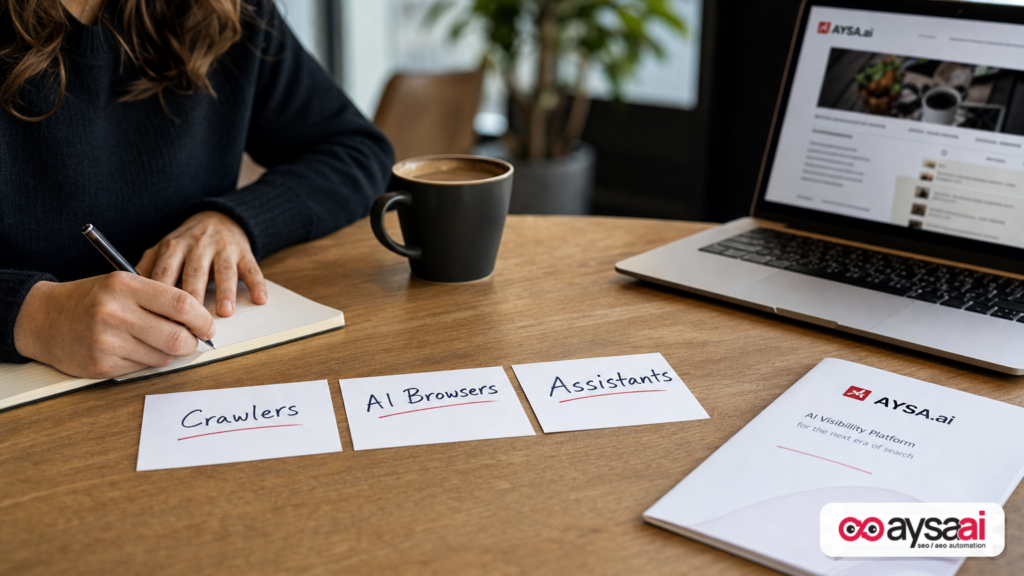
- Your website now serves humans and machines in parallel—including crawlers, AI browsers, and AI assistants acting on behalf of buyers.
- The biggest risk isn’t “AI strategy.” It’s misclassification. Many organizations still block or throttle AI agents using outdated “bot” rules designed for scrapers.
- Marketing can’t fix this alone. It requires shared ownership across marketing, IT/security, and the digital/web team.
- Winning in AI answers requires two things: (1) access and machine-readable pages, and (2) proof—measurement that connects AI visibility to business outcomes.
- AYSA’s role: monitor AI Search visibility, prepare improvements for approval, and execute accepted website changes—so “agent readiness” becomes an operational system, not a quarterly project.
Table of contents

- What Changed: Search Is Becoming Agent-Mediated
- The New Reality: Your Website Now Has Three Non-Human Audiences
- Why the CMO–CIO Disconnect Is Costing Brands Money
- AEO vs. GEO vs. SEO: Clear Definitions for Non-SEO Leaders
- What Can Go Wrong (In Plain English)
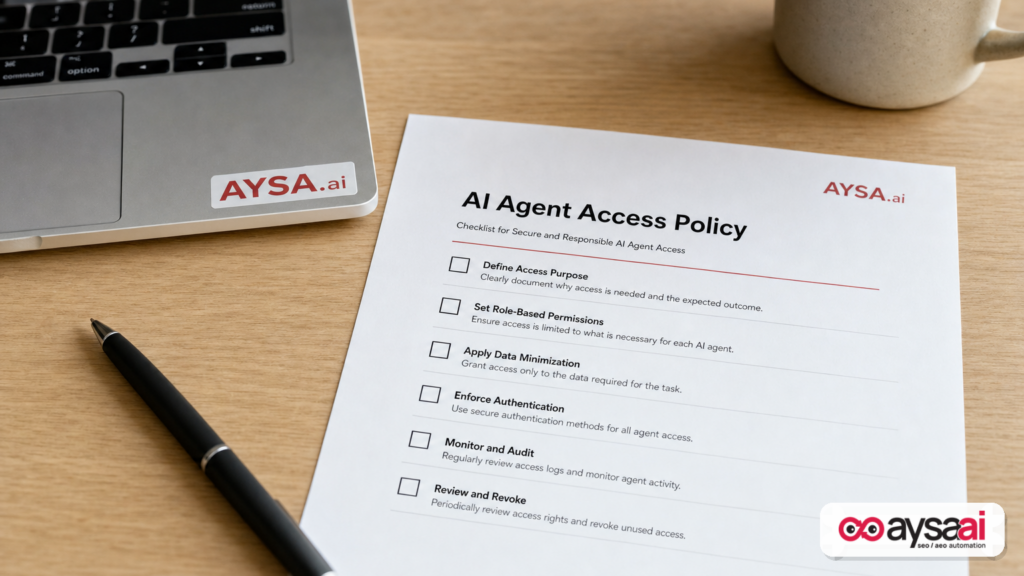
- Agent Access Policy: The Minimum Viable Governance Model
- Machine-Readable Pages: What AI Agents Need to Cite and Act
- Proof Over PowerPoints: How to Measure AI Visibility and Outcomes
- A Concrete SME Scenario: A Local Clinic and the “Invisible” Lost Patient
- What Agencies Must Rethink: From Rankings to Readiness to Revenue
- Where AYSA Fits: Monitoring, Preparation, Approvals, Execution
- What to Do Next: A 30-60-90 Day Plan
- Sources and Further Reading
What Changed: Search Is Becoming Agent-Mediated
For two decades, most web strategy assumed a simple funnel:
- A human searches.
- A search engine ranks results.
- A human Clicks.
- Your website persuades and converts.
That’s not disappearing—but it’s being wrapped in a new layer. Increasingly, the “searcher” is not a person using a browser. The searcher is an AI system retrieving and synthesizing information and then presenting an answer, a shortlist, or even a next action.
Search Engine Journal recently framed this as a leadership friction point: CMOs and CIOs hear “AI agents” and often talk past each other, with the gap showing up as lost visibility and lost revenue opportunities (source). That framing matters because it matches what many businesses are experiencing: new traffic patterns, new brand Impressions, and new decision-making surfaces that don’t map cleanly to old SEO playbooks or old IT security policies.
In practical terms, this shift means:
- AI systems summarize your brand (sometimes incorrectly) and that summary becomes the first impression.
- AI systems choose sources to cite, and citations become the new “ranking” signal customers trust.
- AI systems may browse your site automatically to compare products, check policies, or validate claims.
- AI systems may reduce clicks for basic informational queries—meaning fewer chances to “fix it on the landing page.”
So the website’s job expands. It’s still a conversion engine for humans. But it must also become a clean, reliable data source for machine readers.
The New Reality: Your Website Now Has Three Non-Human Audiences
If your leadership team leaves this article with one shared mental model, make it this: you now have three non-human audiences that behave differently and require different policies and optimizations. This model is discussed in the SEJ source and is the most useful “alignment shortcut” I’ve seen for CMO–CIO conversations.
1) AI crawlers and retrieval agents
These are automated visitors that fetch content to support AI answers, citations, or retrieval. They don’t behave like classic “search engine crawlers” that build an index slowly over time. Many retrieve pages in real time, on demand, because a user asked a question right now.
Business implication: if you block or heavily throttle these agents, you may not be “blocking bots.” You may be blocking the path that makes your brand discoverable in AI answers.
2) AI browsers
These behave like a customer’s proxy. They may open pages, compare options, extract pricing, evaluate policies (shipping/returns), and help complete tasks. This is where “machine readability” becomes urgent, because the AI browser isn’t persuaded by your design—it’s constrained by your structure and your data.
Business implication: if your product specs, availability, services, eligibility rules, or location hours are hard to parse, the agent may skip you and pick the competitor it can understand.
3) AI assistants (answer engines)
This is what most people think of: Chat-style systems that synthesize answers. They may cite sources (sometimes), or they may deliver “best effort” summaries that still shape perception.
Business implication: your brand narrative and factual accuracy become an operational responsibility, not just PR.
These three layers overlap, and the lines are blurring. But treating them as separate audiences is the fastest way to create ownership, set policies, and prevent accidental revenue loss.
Why the CMO–CIO Disconnect Is Costing Brands Money
Here’s the core friction point as I see it:
- The CMO’s world is demand: visibility, brand preference, pipeline, revenue. They hear “AI agents” and think: “Are we getting recommended? Are we being cited? Are we losing customers to competitors in AI answers?”
- The CIO’s world is risk and efficiency: internal copilots, workflow automation, governance, security posture, costs. They hear “AI agents” and think: “What licenses, what internal tooling, what data protection, what guardrails?”
Both are rational. But the failure mode is predictable: the company invests in internal agent productivity and simultaneously blocks or degrades external agent discovery—without realizing those are different conversations.
In older web eras, treating unknown user agents as suspicious “bot noise” was usually safe. Today it can be directly anti-growth. When AI agents sit between consumers and your website, access decisions become market decisions.
Why this becomes a revenue issue (not an SEO issue)
When a customer asks an AI system “best hotel near the convention center with parking,” or “what’s the best accounting software for contractors,” or “which clinic offers same-day allergy testing,” the AI’s short list may be their entire shopping journey. The buyer may never conduct a ten-blue-links comparison.
So if your site can’t be read, can’t be cited, or can’t be retrieved quickly in real time, you’re not merely “losing rankings.” You’re losing your chance to be considered at all.
The organizational trap: marketing owns it, but can’t fix it
The SEJ source references survey findings indicating unclear ownership and cross-functional stalling. I can’t independently verify the numbers from that proprietary dataset, but the pattern is consistent with what many teams report: marketing is told to “own AI visibility,” yet the levers—WAF rules, bot management, caching, Structured data, CMS releases—live with IT and engineering.
That’s why this isn’t a memo. It’s a system design challenge: shared governance, shared measurement, and a workflow that actually ships improvements.
AEO vs. GEO vs. SEO: Clear Definitions for Non-SEO Leaders
Leadership alignment fails when terminology is fuzzy. Here’s a clear translation layer.
SEO (Search Engine Optimization)
Classic goal: rank pages in traditional search results and earn clicks.
Still important. But no longer sufficient on its own, because discovery is increasingly mediated by AI answer experiences.
AEO (Answer Engine Optimization)
Goal: get your brand and content surfaced in AI-generated answers. This can include citations, direct mentions, and “best option” recommendations.
What it requires: clarity, structure, credibility, and retrievability.
GEO (Generative Engine Optimization)
Goal: influence how generative systems represent, summarize, and recommend your brand across different AI engines and experiences.
In practice, GEO overlaps heavily with AEO. The key distinction is that GEO emphasizes the broader generative ecosystem (summaries, comparisons, agents) rather than the narrower “answer box” concept.
A simple leadership-friendly framing
- SEO = “Can customers find our pages?”
- AEO = “Can customers find our answers?”
- GEO = “Can customers find our brand through AI systems even without clicking?”
What Can Go Wrong (In Plain English)
Most AI-agent failure modes aren’t dramatic. They’re mundane. That’s why they persist.
1) You block the wrong thing
Many organizations treat all AI-related user agents as equivalent. But “training crawl,” “retrieval for answers,” and “browsing for a user” are not the same behavior or the same business value.
If your policy blocks everything with “bot” in the name, you might protect content reuse but also eliminate your brand’s presence in AI discovery surfaces.
2) Your bot mitigation vendor is doing its job—against you
Bot management tools and WAF rules are designed to reduce risk and waste. If they’re not tuned to today’s environment, they may challenge, rate-limit, or block legitimate AI retrieval traffic.
This creates a hidden performance problem: marketing sees “we’re not cited,” IT sees “security is green,” and nobody realizes those are connected.
3) Your website is readable to humans but not to machines
Common examples:
- Key product specs are in images or collapsible UI without accessible markup.
- Pricing is only visible after interacting with scripts that agents can’t reliably run.
- Service areas and eligibility rules are implied, not explicit.
- Location hours, policies, or inventories are inconsistent across pages.
Humans can “figure it out.” Agents can’t—and they’ll choose the brand with explicit, structured information.
4) You can’t prove impact, so nothing gets funded
Executives don’t invest in what can’t be measured. If your reporting only shows rankings and clicks, it will miss the new layer: citations, mentions, and AI-driven referrals that don’t look like classic organic traffic.
5) AI summarizes you incorrectly, and it spreads
This is the brand risk many CMOs feel instinctively. The fix is rarely “complain at the model.” The fix is improving the inputs: clear, authoritative, updated content; consistent facts across your ecosystem; and pages that retrieval agents can access and interpret.
Agent Access Policy: The Minimum Viable Governance Model
Most organizations do not need a 40-page AI policy to start. They need a minimum viable governance model that answers three leadership questions:
- Who owns it? (named owner, documented)
- What is allowed? (per agent layer)
- How do we know it’s working? (measurement and review cadence)
Step 1: Assign shared ownership (not shared blame)
In practice, I recommend a small “AI discovery” working group with three seats:
- Marketing lead (AEO/GEO goals, competitive needs)
- IT/security lead (risk, controls, vendor coordination)
- Web/digital lead (CMS, performance, schema, releases)
It can be a 30-minute weekly standup. But it needs the authority to change rules and ship fixes.
Step 2: Write policy by layer
Use the three-layer model and document what you permit:
- Training crawlers: allow or disallow (business decision). If you restrict, document the rationale and the expected tradeoff.
- Search/retrieval crawlers: usually revenue-positive; treat as high-value discovery traffic.
- User-facing browsing agents: define allowed behaviors, rate limits, and checkout/form protections—without breaking legitimate comparison and research behavior.
Important: I’m not recommending “allow everything.” I’m recommending you stop defaulting to “block everything” because it looks like a bot.
Step 3: Align on guardrails
IT/security needs guardrails. Marketing needs outcomes. Agree on:
- Rate limits that protect infrastructure without denying retrieval.
- Allowed paths (e.g., content and product pages) vs. sensitive endpoints (e.g., account areas).
- Monitoring for abuse patterns.
- A documented exception process when marketing needs a change for visibility.
Step 4: Prefer “explicit allow” over “implicit maybe”
In many stacks, the difference between being cited and being ignored is not content quality—it’s whether the agent can fetch the page reliably without challenges, timeouts, or inconsistent responses.
Machine-Readable Pages: What AI Agents Need to Cite and Act
If governance is the “permission,” machine readability is the “product.” If you want AI systems to cite you, recommend you, or take actions on your behalf, your pages must be:
- Accessible (not locked behind scripts and UI tricks)
- Structured (clear headings, consistent entities)
- Fast and stable (retrieval agents often operate under strict time constraints)
- Unambiguous (pricing, policies, locations, specs)
- Trustworthy (clear sources, ownership, and update cadence)
Technical SEO becomes “agent UX”
Historically, technical SEO was about search engines. Now it’s about machines that act like shoppers. That means technical fundamentals are no longer “best practice.” They’re conversion prerequisites—just earlier in the funnel.
What to prioritize first (especially for SMEs)
Most small and mid-sized businesses don’t have the resources to rebuild their entire site. Good news: you don’t need to. Start with the pages that drive money.
- Top product or service pages
- Category pages
- Location pages (if local/multi-location)
- Pricing, plans, or menu pages
- Shipping/returns, policies, or insurance/eligibility pages
- Comparison pages (“X vs Y”, “best for…”) where you can earn citations
Structured data: not magic, but leverage
Structured data (schema markup) helps machines interpret what a page is about. It’s not a guarantee of citations or visibility, but it reduces ambiguity—which is the enemy of AI retrieval and summarization.
If you’re new to schema, think of it as adding labels to the shelves in your store so a fast-moving assistant can find the right products without asking a clerk.
Content clarity beats content volume
Many teams respond to AI change by producing more content. That’s often the wrong first move. The better first move is making your existing content clearer:
- Add plain-language definitions.
- Publish explicit policies.
- Use consistent naming for products, locations, and services.
- Update old pages so AI systems don’t learn stale facts.
Proof Over PowerPoints: How to Measure AI Visibility and Outcomes
Teams get stuck because they can’t prove impact. Leadership won’t fund what looks speculative. So the measurement layer is not optional—it’s the bridge between marketing urgency and IT prioritization.
What to measure (leader-friendly)
You want a weekly view that answers:
- Visibility: Are we mentioned/cited in AI answers for our money keywords?
- Coverage: Which products/services/locations are missing or misrepresented?
- Traffic: Are we receiving referrals from AI experiences (when available) and how do they behave?
- Conversion: Are those sessions converting (leads, purchases, bookings)?
- Operational health: Are agents able to fetch our key pages reliably (status codes, response times, blocks)?
Don’t wait for “perfect attribution”
AI-mediated journeys will challenge classic attribution models. Some answers don’t send clicks. Some do. Some influence later branded search. You can still measure progress with a pragmatic approach:
- Track prompts/queries that matter (your category + your differentiators).
- Track citation/mention share against competitors for those prompts.
- Track AI-referred sessions when identifiable.
- Track leading indicators: branded search lift, direct traffic lift, assisted conversions.
This is similar to how teams learned to measure social influence and dark social: you won’t see everything, but you can see enough to make better decisions.
Use Google tools where appropriate (with realistic expectations)
Google Search Console remains the cleanest source for many organic search insights, even as SERP experiences evolve. It won’t directly tell you “you were cited by an AI answer engine,” but it can show changes in impressions, clicks, and query mix over time. If your AI visibility efforts are working, you often see downstream signals.
For those managing traditional Google performance and visibility, Google’s documentation remains a foundational reference point for how crawling, indexing, and performance fundamentals work (How Search Works).
A Concrete SME Scenario: A Local Clinic and the “Invisible” Lost Patient
Let’s make this real with a scenario that mirrors what many SMEs face.
The business
A local allergy clinic with two locations. They compete with a hospital network and a few urgent care centers. Their differentiators are speed (same-week appointments), specific testing options, and transparent pricing for self-pay patients.
The new customer journey
A parent asks an AI assistant: “Where can I get allergy testing for my child this week near me? What does it cost?”
The AI responds with a short list. The hospital is mentioned. A big urgent care chain is mentioned. The clinic is not.
Why the clinic isn’t included (common causes)
- The clinic’s pricing is only mentioned in a PDF.
- The appointment availability claim (“same-week”) is buried in a slider component.
- The location pages have inconsistent hours and no clear service list.
- The site’s bot protection challenges unknown user agents, causing intermittent access failures.
How this becomes a CMO–CIO problem even in an SME
In a small business, the “CIO” might be a fractional IT provider or a security-minded operations lead. The “CMO” might be the owner plus a marketing manager. The conflict still happens: marketing wants visibility; IT wants safety and cost control; the website is the battlefield.
The fix (in business language)
- Publish a plain-language “Allergy Testing” service page with explicit pricing ranges, what’s included, and appointment expectations.
- Make location pages explicit: services offered, hours, insurance/self-pay, and a simple FAQ.
- Ensure key pages are accessible without agent-breaking challenges (with sensible rate limits).
- Monitor AI answers for key prompts and adjust content where the model is uncertain or incorrect.
This isn’t about “gaming AI.” It’s about being the most legible, verifiable option when a machine is asked to help someone make a high-intent decision.
What Agencies Must Rethink: From Rankings to Readiness to Revenue
Agencies and consultants are facing a hard truth: clients don’t care what we call it—AEO, GEO, AI SEO. They care if revenue shows up.
The old deliverables are losing persuasive power
Rank tracking, traffic reports, and content calendars are not enough when the discovery surface is an AI answer that may not generate a click. Agencies need to evolve deliverables toward:
- Prompt-level visibility (where are we cited/mentioned vs competitors?)
- Entity-level clarity (how consistently does the web represent this brand’s facts?)
- Technical access readiness (can agents fetch key pages reliably?)
- Conversion readiness (when AI-referred users arrive, do pages answer their intent quickly?)
Agencies must build an IT collaboration muscle
In enterprise settings, the agency may not touch bot policies or WAF rules. But they can still bring:
- A clear request format for IT/security
- Evidence that access restrictions correlate with lost visibility
- A prioritized list of pages where machine readability matters most
This is where many agency relationships either deepen (strategic partner) or shrink (content vendor).
For agencies serving SMEs: the opportunity is operational
SMEs don’t have time for long strategy decks. They need an execution engine that keeps their site current and legible. That’s also where tools and platforms that combine monitoring with approved execution can create an advantage: fewer meetings, faster fixes, more compounding improvements.
Where AYSA Fits: Monitoring, Preparation, Approvals, Execution
The hardest part of this shift isn’t understanding it. It’s operationalizing it.
That’s the gap AYSA is built to close: turning AI search visibility from an idea into a repeatable execution system.
1) Monitor what AI search is doing to your business
You can’t manage what you don’t monitor. AYSA is designed to help teams keep a pulse on visibility and site readiness over time—so “AI readiness” isn’t a quarterly scramble.
Explore monitoring capabilities here: AYSA Monitoring
2) Prepare changes that actually improve AI discovery
Most businesses don’t need 50 new blog posts. They need:
- clearer service/product pages,
- better internal linking,
- structured data where appropriate,
- updated facts and policies,
- and fewer technical blockers.
AYSA’s purpose is to identify and prepare those improvements, tied to outcomes, not vanity metrics.
3) Ask for approval (because businesses need control)
In the real world, the reason websites don’t improve is not ignorance. It’s risk, approvals, and bandwidth. AYSA’s model emphasizes approved execution: you review suggested changes, approve what you want, and keep control.
4) Execute accepted website changes (the compounding advantage)
Execution speed is the new moat. When the AI ecosystem changes month-to-month, teams that can ship weekly improvements win. Teams that debate for a quarter fall behind.
If you want to see how AYSA approaches AI-driven visibility as a system, start here:
A practical way to position AYSA inside the CMO–CIO conversation
AYSA isn’t “another AI tool.” It’s an execution system that helps marketing and IT align because it produces:
- shared visibility (what’s happening),
- shared backlog (what to change),
- controlled approvals (who signs off),
- and shipped updates (what actually changed).
That’s the operational bridge most organizations are missing.
What to Do Next: A 30-60-90 Day Plan
If you’re a founder, CMO, marketing lead, or agency owner reading this, you don’t need to “boil the ocean.” You need momentum with governance and proof.
Days 1–30: Alignment and triage
- Define the three agent layers in your org’s language (crawlers, AI browsers, assistants).
- Name an owner and two co-owners (marketing + IT/security + web).
- Inventory your money pages: top services/products/locations and the policy pages that influence decisions.
- Check for obvious access problems: bot blocks, WAF challenges, inconsistent status codes.
- Establish a baseline: what AI answers say about you today for 20–50 priority prompts.
Days 31–60: Fix the highest-impact readability gaps
- Rewrite key pages for clarity (explicit specs, policies, eligibility, pricing ranges).
- Implement basic structured data where it matches page intent.
- Improve internal linking so agents can traverse important topics quickly.
- Reduce fragility: ensure key content is visible without relying on heavy scripts.
- Document the agent policy and review it with IT/security.
Days 61–90: Build the proof loop
- Stand up a weekly “AI visibility” report: prompts, citations/mentions, traffic signals, conversion signals.
- Compare against competitors for the same prompts—this is what unlocks budget.
- Create an execution cadence: ship improvements weekly or biweekly.
- Expand from pages to entities: unify brand facts across site, location pages, and key offsite profiles.
What to do next (action list)
- Schedule a 45-minute CMO–CIO (or marketing–IT) working session with one goal: define ownership + policy + measurement.
- Pick 25 “money prompts” (high-intent questions customers ask) and evaluate how AI systems answer today.
- Audit your top 10 pages for machine readability: explicit answers, structured data, accessible content, fast retrieval.
- Stop treating all bots the same: separate training vs retrieval vs browsing behaviors in your policy discussion.
- Operationalize execution: choose a system (like AYSA) that monitors, prepares, requests approval, and executes improvements—so you can keep up with rapid ecosystem change.
Sources and Further Reading
- Search Engine Journal: The CMO And CIO Friction Point: Navigating The AI Agent And AEO Ecosystem
- Google: How Search Works
- AYSA: AI Search Visibility
- AYSA: AI SEO Tools
- AYSA: Monitoring
- AYSA: Pricing
- AYSA: Blog
Continue the AI search topic inside AYSA.
Use these pages to connect the article with AI SEO tools, AI visibility monitoring, AI Overviews and approved website execution.
Turn this topic into a website action plan.
Use these AYSA hubs to move from reading to technical fixes, AI visibility monitoring, research, glossary context and approval-first SEO execution.

