
Building a Growth Marketing Team in 2026: Spend Less on “Doers,” More on Decisions (and Automate the Rest)
In 2026, the cheapest part of marketing is execution—and the most expensive part is bad judgment. Here’s how to design a lean growth team, a modern tool stack, and an AI-ready SEO/AEO/GEO execution system (with approvals) that keeps SMEs and startups from compounding the wrong bets.

Growth marketing team building used to be a headcount problem. In 2026, it’s a decision-quality problem.
AI has compressed a lot of the “doing” work—drafting, iterating, testing, reporting. But it hasn’t compressed the hardest parts: choosing the right channel bets, building a measurement model that isn’t lying to you, separating signal from noise, and knowing what not to do this quarter.
This editorial is my practical playbook for building a growth marketing team on a startup/SME budget—without falling into the two classic traps: hiring specialists too early and buying tools without a strategy. I’ll also show where an approved-execution system like AYSA’s AI Search Visibility model fits: monitor what matters, prepare changes, ask for approval, and only then execute.
Concise summary
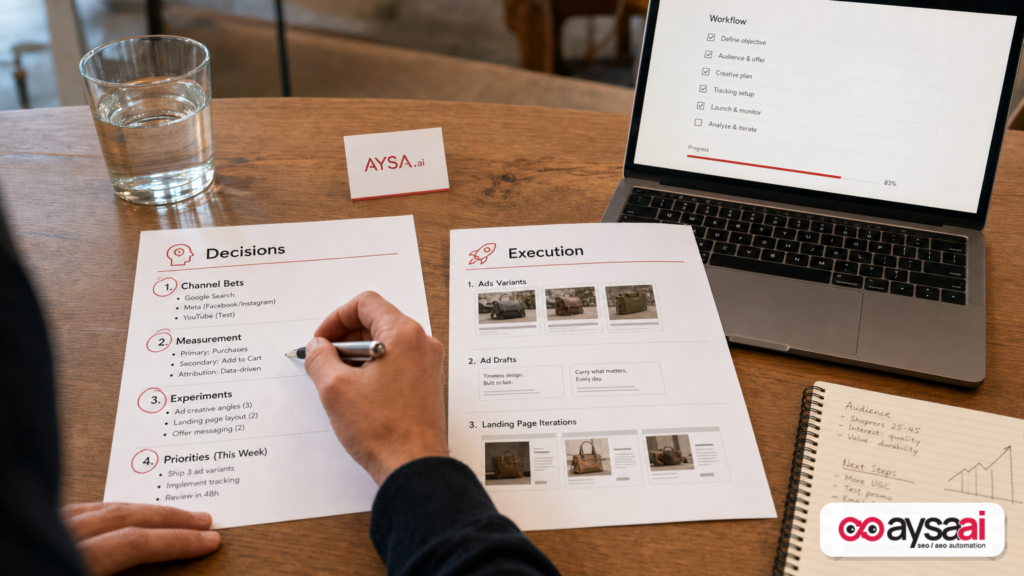
- Execution is cheaper than ever. Strategy, measurement, and prioritization are the scarce resources.
- Hire order matters more than role names. Start with a strategic lead (fractional or full-time), then a T-shaped IC, then specialists once you know your real growth engine.
- AI Search changed SEO. Ranking is no longer the only objective; being citable in AI answers (AEO/GEO) is now part of the job.
- Tool stacks don’t create clarity. They amplify whoever is holding the brief—good or bad.
- Lean teams win with governed automation. Systems that propose and execute changes (with approvals) can replace a lot of coordination overhead.
Table of contents

- What Changed: Execution Got Cheap, Wrong Decisions Got Expensive
- The Search Shift: From “Rankings” to AI Answers (AEO + GEO)
- The 2026 Build Order: A Practical Team Model for $15K–$60K/Month
- Phase 1 (0–6 months): The Minimum Viable Growth Team
- Phase 2 (6–12 months): Add a T-Shaped IC and Tighten the Loop
- Phase 3 (12+ months): Specialists, But Only After the Engine Is Known
- A Lean Tool Stack That Increases Capacity Without Inflating Headcount
- Measurement That Doesn’t Lie: A 2026 Analytics Checklist
- Concrete SME Scenario: Local Clinic vs. Ecommerce vs. B2B SaaS
- What Burns the Runway: 7 Mistakes I See Repeated
- The Execution Engine: How AYSA Makes Lean Teams Possible (Without Losing Control)
- What Agencies Should Rethink: Deliverables → Decisions → Execution
- A 90-Day Action Plan You Can Run on a Real Budget
- What to do next
- Sources and further reading
What Changed: Execution Got Cheap, Wrong Decisions Got Expensive

When founders ask, “Who should I hire first in marketing?” they’re usually importing an org chart from a different era: a generalist growth marketer who can do everything, then a paid specialist, then content, then analytics, plus design “when we can afford it.”
That logic made more sense when shipping marketing output was inherently expensive. If you needed five landing pages, you needed a person (or an agency) to build five landing pages. If you needed 30 ad variants, you needed a person to write 30 ad variants. If you needed a weekly performance report, you needed a person to compile a weekly performance report.
In 2026, a lot of that has changed—not because humans disappeared, but because the labor mix changed. A smaller team with strong judgment can now produce the same volume of execution work a larger team produced a few years ago.
But there’s a catch: if you make the wrong strategic call, you can now scale the wrong thing faster than ever. You don’t just waste a week—you compound the mistake across dozens of assets, campaigns, and pages.
“Doers” are easier to buy than “deciders”
Marketing execution is increasingly commoditized: copy drafts, creative variations, on-page improvements, basic reports. You can get those from contractors, modern platforms, and AI-assisted workflows.
Decision-making is not commoditized. And it’s the part that keeps your CAC from exploding, keeps your Attribution from getting gamed, and keeps your team from chasing shiny tactics that don’t match your business model.
Why this matters for SMEs (not just venture-backed startups)
If you run an ecommerce brand, a clinic, a home services business, or a small SaaS company, you probably don’t have the luxury of burning $50K–$100K/month to “learn.” Your learning rate has to be efficient, and your marketing team has to be structured to learn the truth quickly.
That is the heart of modern growth: fast, honest learning.
The Search Shift: From “Rankings” to AI Answers (AEO + GEO)
There’s a second shift that changes hiring and budgets: how customers discover information.
Search isn’t only “ten blue links” anymore. In many contexts, people see summaries, AI answers, and recommendation-style results—especially for informational and comparison queries. Even when users end up clicking, the path to the click is different: they’re influenced by what the system chooses to cite, summarize, or recommend.
So the modern SEO problem is not only “How do we rank?” It’s also:
- How do we become a source that AI systems want to cite? (AEO: Answer Engine Optimization)
- How do we monitor and improve our visibility inside AI answer engines? (often discussed as GEO: Generative Engine Optimization)
- How do we keep our brand/entity/location data consistent so systems don’t confidently repeat the wrong thing?
What “AI-ready” content actually means (in plain English)
If you’re an SME owner, you don’t need jargon. Here’s the practical translation:
- Clarity beats cleverness. Pages that clearly define services, pricing ranges (when possible), policies, and locations are easier to reuse in summaries.
- Structure beats volume. One well-structured service page with FAQs, clear headings, and consistent terminology can outperform ten thin blog posts.
- Consistency beats novelty. If your site says one thing and your listings/schemas say another, you create ambiguity—and ambiguity reduces citation confidence.
This is where a system like AYSA’s AI SEO tools approach becomes relevant: visibility is not “set and forget.” It’s Monitoring + controlled iteration.
SEO + AEO + GEO changes the staffing equation
In the older model, “SEO” was a specialist lane you hired later. In 2026, AI search behavior pushes SEO fundamentals earlier because:
- Your website is the source of truth for your brand/entity information.
- Your on-page structure influences how systems extract answers.
- Your technical hygiene (indexing, canonicals, internal linking) affects whether your best pages even get considered.
That doesn’t mean you need a big SEO team on day one. It means your early strategic lead must understand enough to protect your future optionality. You can’t “fix it later” if later means you’ve already scaled a messy site architecture or inconsistent brand data.
The 2026 Build Order: A Practical Team Model for $15K–$60K/Month
This section is inspired by the “build order” thinking discussed in Search Engine Journal’s piece, How To Build A Growth Marketing Team On A Startup Budget. I agree with the core idea: modern teams should be built around senior judgment first, with execution augmented by tools and flexible operators.
Where I’ll extend it is for the real-world SME environment: smaller teams, less clean data, more operational constraints, and a bigger need for governed automation (because you can’t afford mistakes).
A simple principle: hire for the bottleneck you can’t automate
In 2026, the first bottleneck is usually not “We need more content” or “We need more ad variations.” It’s “We don’t know what to do next, and we can’t trust our numbers.”
So the early team needs to answer three questions reliably:
- What are we betting on? (channels, segments, offers)
- How will we measure success without fooling ourselves?
- How will we ship improvements continuously without breaking the site or the brand?
Phase 1 (0–6 months): The Minimum Viable Growth Team
Most startups and many SMEs can’t (and shouldn’t) hire a four-person in-house team right away. The Phase 1 model is a small senior core with high-leverage contractors and a governed tool stack.
Role 1: Strategic growth lead (fractional or full-time)
This person is not “the one who does everything.” They are the one who:
- Picks the two most plausible channels to focus on first.
- Chooses the right offer framing and landing page structure.
- Designs a measurement model the business can trust.
- Defines the experiment cadence and kill criteria.
- Protects focus by saying no to distractions.
Founder reality check: if you don’t have this person, you’re the strategic lead by default. That’s not inherently bad, but it is risky if you don’t have time and you don’t have a strong measurement mindset.
Role 2–4: small retainer contractors (operators)
You generally want flexible execution coverage early. A common trio that works across many business types:
- Paid operator (part-time): account structure, creative iteration, landing page alignment, weekly checks.
- Designer (part-time): fast iterations, conversion-focused layouts, ad creatives, simple brand system.
- Technical SEO / website hygiene (light retainer): indexing hygiene, template issues, internal linking, basic schema guidance.
Important: none of these contractors should be choosing strategy independently. Their output should be shaped by one brief.
The missing “role” most teams ignore: governed execution
If you’re lean, your biggest enemy is not effort—it’s coordination. You can have great ideas but fail to ship them because nobody owns the backlog, approvals, and publishing.
This is where monitoring and approved execution matter. You need a repeatable way to:
- Spot problems early (technical issues, content decay, page conflicts).
- Propose fixes as concrete changes.
- Get a human sign-off.
- Ship changes safely.
Phase 2 (6–12 months): Add a T-Shaped IC and Tighten the Loop
Once you’ve found traction—meaning you have a channel that produces leads/sales predictably enough to learn from—it’s time for your first full-time individual contributor.
Why a T-shaped hire usually beats a specialist at this stage
A specialist is amazing when the playbook is known. But at 6–12 months, most companies are still discovering their playbook. You might be “winning” with paid search this month and discover that onboarding/lifecycle is the real constraint next month. Or you might learn that your best customers come from one niche where SEO content converts, but your site structure can’t support the necessary pages.
A T-shaped growth marketer can extend the strategic lead across multiple functions:
- Write and iterate landing pages with basic CRO thinking.
- Run simple paid campaigns and coordinate creative testing.
- Build lifecycle flows (welcome, post-purchase, reactivation).
- Work with analytics at a practical level (not perfect, but competent).
What to keep outsourcing—and what to bring in-house
By Phase 2, you should start reducing “miscellaneous” retainers. Keep only what directly increases learning speed or execution quality.
- Often keep: design support, light technical SEO oversight, specialized engineering help for tracking.
- Often cut: generic content retainers without strategy, agencies selling “SEO packages,” disconnected reporting services.
The Phase 2 operating rhythm (simple and effective)
- Weekly: one growth meeting (decisions), one execution review (shipping).
- Biweekly: experiment planning + experiment readout.
- Monthly: channel economics review and backlog reset.
Lean teams win with cadence, not chaos.
Phase 3 (12+ months): Specialists, But Only After the Engine Is Known
Specialist hires become rational once you can answer, with evidence, “This is our growth engine.”
Examples of “engine known” signals
- You can forecast pipeline or revenue from a channel with acceptable error.
- Your conversion rate is stable enough to interpret tests.
- Your creative iteration process is repeatable (not random).
- Your best pages and offers are clear—and you know why they work.
How to choose the specialist
Pick the specialist who removes the constraint in the engine you’ve proven:
- Paid is the engine: hire a performance lead with scaling and creative-testing discipline.
- Search/content is the engine: hire a content/SEO lead who can build a durable information architecture and editorial system.
- Lifecycle is the engine: hire retention/lifecycle with segmentation and experimentation skills.
Then do the uncomfortable but necessary thing: cancel retainers that duplicate the new specialist’s responsibilities. Otherwise you accumulate “zombie spend.”
A Lean Tool Stack That Increases Capacity Without Inflating Headcount
I’m not going to pretend I can validate pricing or performance claims for every tool mentioned in the broader ecosystem without browsing. But I can give you a framework: buy tools that reduce manual work after you have a clear brief, and avoid tools that promise “strategy in a box.”
Five tool categories worth budgeting for
-
Measurement & analytics
- At minimum: Google Analytics (GA4) for baseline site measurement. (Primary reference: Google Analytics 4 Help)
- Optional: product analytics platforms for events, funnels, retention if you have a product motion.
-
Search visibility & technical hygiene
- Google Search Console for indexing, coverage, and search queries. (Primary reference: Google Search Console Help)
- A systemized way to monitor and implement fixes (this is where AYSA fits; more below).
-
Content production support (with human review)
- LLMs can accelerate outlines and first drafts, but SMEs should treat them as “assistants,” not publishers.
- Keep a human editor accountable for accuracy and brand voice.
-
Experimentation workflow
- Even if you don’t use a formal platform, you need a system: hypothesis → test → readout → decision.
- A/B testing should be governed; avoid over-testing tiny changes with no power.
-
Lifecycle / CRM
- Email and messaging are “owned channels.” They become more valuable as paid becomes more competitive.
- Make sure your data model supports segmentation and quality measurement.
A warning about tool stacks
Tools are multipliers. If your plan is fuzzy, tools multiply fuzziness. If your plan is clear, tools multiply throughput.
So the correct purchase order is:
- Brief (what we’re doing and why)
- Measurement (how we’ll know it worked)
- Tools (how we’ll do it faster)
Measurement That Doesn’t Lie: A 2026 Analytics Checklist
Most early-stage marketing mistakes aren’t “bad ads.” They’re bad measurement.
When measurement is broken, teams argue opinions. When measurement is honest, teams argue tradeoffs.
Baseline measurement questions every SME should answer
- What counts as a conversion? Not vanity events—real leads, bookings, purchases, qualified demos.
- Where is conversion data stored? If it’s only in spreadsheets, you will lose truth over time.
- Can we connect spend to outcomes? Not perfectly, but enough to make decisions.
- Do we have a single weekly performance view? One page, consistent definitions.
Attribution: keep it simple early
Most SMEs don’t need a complex multi-touch model in the first year. They need consistency and a few guardrails:
- Use GA4 and platform reporting, but treat both as directional.
- Track at least one “hard” outcome (revenue, booked appointment, SQL) outside ad platforms.
- Run periodic reality checks (call tracking, CRM checks, cohort views).
Search measurement that matters in the AI era
If your only SEO KPI is “rankings,” you’re behind. In an AI-influenced search environment, add these practical checks:
- Indexability: are your key pages indexed and canonicalized correctly?
- Snippet readiness: do your pages answer questions clearly with structured sections?
- Entity clarity: do you clearly define who you are, what you do, where you do it, and how to contact you?
- Content decay: are your best pages staying accurate and updated?
Concrete SME Scenario: Local Clinic vs. Ecommerce vs. B2B SaaS
“Growth marketing team” sounds like a startup concept, but the structure applies to normal businesses too. The difference is which channels are plausible and what “conversion” means.
Scenario A: A 3-location dental clinic group
Goal: more booked appointments for high-margin services.
Common trap: spending heavily on ads while location pages are thin, inconsistent, and hard for both Google and AI systems to interpret. The clinic “wins” clicks but loses bookings.
Lean team approach:
- Strategic lead defines which services and locations are priority and what a qualified booking looks like.
- Paid operator runs geo-targeted campaigns with landing pages aligned to each service.
- Technical SEO hygiene ensures each location has a clear, structured page and consistent NAP details.
Where AYSA fits: ongoing monitoring of technical issues, page changes, and structured improvements—then preparing fixes and executing only after approval. See AYSA Monitoring.
Scenario B: A $2M/year ecommerce brand (home goods)
Goal: improve profitable growth without over-relying on paid social.
Common trap: hiring a paid specialist first because it’s the fastest lever, while the real constraints are merchandising pages, product content quality, and category architecture that limits organic discovery.
Lean team approach:
- Strategic lead chooses the wedge: high-intent search categories + lifecycle retention.
- T-shaped IC iterates landing pages, builds email flows, coordinates product page improvements.
- Specialist SEO/content hire only after you know which categories convert and why.
Where AYSA fits: continuous, approved improvements across product/category pages and internal linking patterns, driven by monitoring and prioritized recommendations. Start at AYSA AI SEO Tools.
Scenario C: A seed-stage B2B SaaS company
Goal: qualified demos and pipeline, not just traffic.
Common trap: “content factory” blogging that never maps to buyer intent or sales objections. Traffic grows, pipeline does not.
Lean team approach:
- Strategic lead maps the ICP, pain points, and the two best channels (often one inbound + one outbound/partner).
- T-shaped IC builds conversion assets: comparison pages, integration pages, demo flows, retargeting, lifecycle.
- Later specialist: content/SEO lead focused on information architecture + authority building.
Where AYSA fits: turning “we should improve the site” into a governed, trackable execution stream that doesn’t depend on engineering availability every week. Learn more at AI Search Visibility.
What Burns the Runway: 7 Mistakes I See Repeated
Search Engine Journal highlighted several runway-burning mistakes in the source article. I’ll expand that list into a practical set of “don’t do this” rules that apply to both startups and SMEs.
1) Hiring a specialist before you know what to scale
A paid specialist will scale paid. An SEO specialist will scale content. A lifecycle specialist will scale email. None of them can choose your growth engine for you.
If you haven’t identified the engine, the specialist may optimize the wrong thing beautifully.
2) Treating tools as strategy
Tools don’t create positioning. Tools don’t fix weak offers. Tools don’t invent differentiation. They only help you produce and iterate faster.
3) Confusing “activity” with “learning”
Shipping 50 ad variants is not learning if you didn’t control the variables. Publishing 20 blog posts is not learning if you didn’t define the conversion path.
4) Building content that can’t be cited
In the AI era, vague content is a liability. If your “ultimate guide” never answers the pricing question, the eligibility question, the comparison question, and the “what should I do next” question, it won’t win citations or conversions.
5) Neglecting technical fundamentals because “Google will figure it out”
Google is good, but it’s not magic. Broken internal links, duplicate pages, messy canonicals, and thin templates reduce the odds your best pages are used in results.
6) Letting the site become a junk drawer
Many SMEs accumulate pages like clutter: old service pages, outdated promos, duplicate location pages, blog tags generating thin archives. This creates internal competition and confuses both users and systems.
7) No approval gates for changes
The more you automate, the more you need governance. It’s too easy to ship changes that conflict with legal, brand, medical/financial guidelines, or operational reality.
The Execution Engine: How AYSA Makes Lean Teams Possible (Without Losing Control)
Here’s my POV: the “team” you’re building in 2026 isn’t only people. It’s people + an execution system.
AYSA is designed to be that execution system for SEO/AEO/GEO work:
- Monitors your site and visibility signals (so you don’t find out about problems three months later).
- Prepares recommended website changes in a structured way.
- Asks for approval (so humans stay accountable for brand and compliance).
- Executes accepted changes (so improvements actually ship, consistently).
Why “approved execution” matters for SMEs
SMEs typically have one of two constraints:
- No time: the owner is the operator and marketer.
- No pipeline: the agency or freelancer sends recommendations, but nothing gets implemented.
Approved execution addresses both. You keep control, but you reduce the friction between “we should fix this” and “it’s live.”
Where AYSA plugs into your lean team
- Strategic lead: uses AYSA insights to prioritize what matters and avoid random walks.
- T-shaped IC: uses AYSA to maintain a steady shipping cadence without constant dev tickets.
- Agency: uses AYSA to productize monitoring and implementation while keeping clients in the approval loop.
If you want the product overview, start with AI SEO Tools and then review pricing based on your footprint and needs.
A practical governance model (recommended)
- Auto-approve: low-risk technical fixes (after you define rules): internal linking suggestions, minor on-page structure improvements, missing metadata cleanup.
- Always approve: anything that changes claims, pricing, medical/legal language, brand promises, or redirects/canonicals.
- Monthly audit: review what was shipped and what changed in performance.
What Agencies Should Rethink: Deliverables → Decisions → Execution
Agencies used to sell deliverables: “20 blog posts/month,” “link building package,” “PPC management.” In 2026, that’s increasingly misaligned with what clients need.
Clients don’t need more output. They need:
- Better bets (which channels and pages will create demand and conversions?)
- Faster learning (what worked and why?)
- Reliable shipping (how do improvements get implemented?)
How AYSA helps agencies defend margins
If you’re an agency, your margin gets destroyed by manual ops: audits, repetitive fixes, chasing approvals, and the “we’ll send recommendations” loop that never closes.
AYSA’s model—monitor, prepare, approve, execute—turns the messy middle into a system. That lets your humans focus on the only part that stays expensive: judgment and client-specific strategy.
If you want more tactical guidance, check the AYSA blog for playbooks and updates.
A 90-Day Action Plan You Can Run on a Real Budget
Most growth advice fails because it ignores time. Here’s a 90-day plan you can run with a small team.
Days 1–14: Establish the brief and the measurement
- Pick one primary conversion (purchase, booked appointment, qualified demo).
- Set up/validate GA4 and Search Console basics. (GA4, GSC)
- Write a one-page growth brief: ICP, offer, two channels, constraints, weekly KPI view.
- Define “stop doing” list for the quarter.
Days 15–45: Fix the site fundamentals that block AI and human discovery
- Ensure key pages are indexable and not competing with duplicates.
- Improve page structure: headings, FAQs, clear service/location language.
- Create/repair the “money pages” that map to real intent (services, categories, comparisons).
- Implement a monitoring + approved execution workflow so fixes don’t stall.
This is exactly the kind of ongoing work that benefits from a system like AYSA Monitoring.
Days 46–75: Run a tight experiment loop in 1–2 channels
- Launch controlled creative/landing page tests (not 20 random tweaks).
- Review results weekly with kill/keep decisions.
- Build one lifecycle flow (welcome or lead follow-up) to protect conversion efficiency.
Days 76–90: Decide what to scale, and what to cut
- Choose one channel to scale modestly and one to keep as “learning spend.”
- Document the playbook: what worked, what didn’t, and why.
- Decide Phase 2 hiring: T-shaped IC or keep contractors longer.
What to do next
- Write your one-page growth brief (two channels, one primary conversion, one weekly KPI view).
- Validate GA4 + Search Console and agree on definitions (no arguing about what a “lead” means).
- Inventory your money pages: the pages that should be cited, clicked, and convert.
- Set up monitoring so issues surface automatically instead of by surprise.
- Adopt an approval-based execution workflow so changes ship safely and consistently.
- Hire in the right order: strategic lead → T-shaped IC → specialist after the engine is proven.
Sources and further reading
- Search Engine Journal (source inspiration): How To Build A Growth Marketing Team On A Startup Budget
- Google Analytics 4 documentation: GA4 Help
- Google Search Console documentation: Search Console Help
- AYSA overview: AI SEO Tools
- AYSA AI visibility context: AI Search Visibility
- AYSA monitoring: Monitoring
- AYSA pricing: Pricing
- More AYSA editorials: Blog
Note on tooling claims: The source article mentions specific platforms and pricing ranges. Because I’m not browsing those vendor pages from within this workflow, I’ve focused on decision frameworks and primary measurement references (Google documentation) rather than repeating precise tool pricing/performance claims.
Continue the AI search topic inside AYSA.
Use these pages to connect the article with AI SEO tools, AI visibility monitoring, AI Overviews and approved website execution.
Turn this topic into a website action plan.
Use these AYSA hubs to move from reading to technical fixes, AI visibility monitoring, research, glossary context and approval-first SEO execution.

