
AI Agents On The Open Web Aren’t Safe Yet: What DeepMind’s Warning Means For Search, SMEs, And The Next Wave Of SEO Automation
Google DeepMind is openly warning that large-scale AI agent deployments on the web are statistically destined to fail without near-perfect reliability. Here’s what that means for businesses, search visibility, and how to adopt agentic automation without getting burned.

AI agents are rapidly moving from “cool demo” to “production system” across marketing, customer support, shopping, and website operations. But there’s a problem the industry is now saying out loud: when you deploy autonomous agents at web scale, you don’t just risk occasional mistakes—you eventually guarantee them.
That’s not alarmism. It’s math, incentives, and the reality of the open internet.
In an interview covered by Search Engine Journal, Google DeepMind Senior Staff Research Scientist Nenad Tomašev described “agentic traps” already being laid across the web—hidden tokens, Cloaking, and jailbreaking-inducing content—designed to make agents behave against the user’s interests, including spending money. He also made the key point many vendors don’t want to discuss: if you can’t guarantee complete reliability per interaction, deploying agents at scale statistically tips you toward failure.
This editorial is my practical take as Marius Dosinescu, founder of AYSA.ai: what changed, why it matters for real businesses, and how to adopt agentic automation without turning your website (or wallet) into a target.
Concise summary
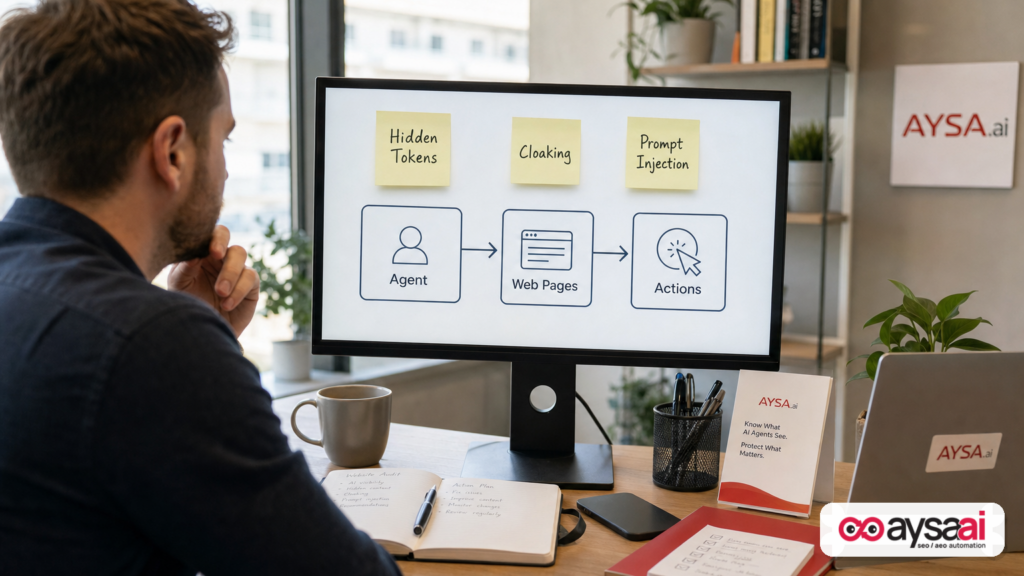
DeepMind’s warning is less about sci-fi “rogue AI” and more about basic operational risk: the web is an adversarial environment, and autonomous agents are easy to manipulate because they must interpret untrusted inputs (web pages, forms, scripts, emails, product feeds) and then take actions.
For SMEs and agencies, the immediate takeaway is not “avoid AI.” It’s: stop treating autonomy as a feature and start treating it as a permission model. Use AI to monitor, recommend, draft, and simulate. Require approvals for execution. Log every change. And build visibility so you can reverse mistakes quickly.
Key takeaways

- At scale, rare failures become inevitable. If an agent performs thousands or millions of interactions, even tiny error rates become certain incidents.
- The web is not a trusted environment. Agents consume raw page data and can be manipulated by content humans never see.
- Old tactics return with a twist. Cloaking and hidden content aren’t new; what’s new is they can trigger actions (purchases, signups, data exfiltration) instead of just rankings.
- Autonomy changes your risk profile. The moment an agent can spend money, publish, redirect, or edit code, you need controls comparable to finance and security systems.
- “Monitor → propose → approve → execute” is the safe default. This is the operational model we believe will win for SEO/AEO/GEO execution—especially for SMEs that can’t afford preventable incidents.
Table of contents

- The DeepMind warning in plain English (and why it’s a big deal)
- What changed: the shift from “answers” to “actions”
- Why “scale makes failure inevitable”: the reliability math you can’t ignore
- Three agentic “trap” patterns businesses should understand
- The fastest way to learn this lesson: letting agents touch money
- What this means for search, AI citations, and brand visibility
- A concrete SME scenario: the “helpful” purchasing agent that drains your budget
- What agencies must rethink: autonomy, liability, and client trust
- The practical safety model: “monitor → propose → approve → execute”
- Hardening your website for the agentic web (without paranoia)
- What SMEs should monitor weekly (minimum viable oversight)
- Where AYSA fits: execution that’s fast, measurable, and approval-gated
- What to do next
- Sources and further reading
The DeepMind warning in plain English (and why it’s a big deal)
DeepMind’s point (as reported by Search Engine Journal) isn’t that agents are useless. It’s that the open web is adversarial, and autonomous agents are uniquely exposed because they:
- must read and interpret untrusted content,
- often do so in non-visual ways (parsing code/markup), and
- are designed to take actions on your behalf.
In the interview summary, Tomašev describes traps that can be invisible to humans but visible to agents: hidden tokens, dynamic cloaking, and content engineered to induce jailbreaking or goal hijacking. He also notes a key incentive dynamic: as more agents are deployed, there’s a bigger surface area to attack, so the incentive for malicious actors goes up.
For business leaders, that translates to one operational truth:
If you deploy agents that browse the web and take actions, you should assume someone will try to trick them—and eventually someone will succeed.
What changed: the shift from “answers” to “actions”
We’ve lived through multiple waves of automation:
- Search automation: crawlers and ranking systems that index and order information.
- Marketing automation: email flows, bidding, segmentation, content scheduling.
- Analytics automation: anomaly detection, dashboards, alerts.
Agentic systems are different because they aren’t just optimizing a number inside a controlled platform. They’re meant to operate in an environment—and in this context, that environment is the web.
That matters for SEO and brand visibility because search is increasingly becoming an “answer layer” across multiple surfaces, and businesses are understandably chasing “AI visibility”—citations, mentions, and inclusion in AI-driven responses. AYSA calls this broader problem AI Search Visibility, because the visibility you used to win in ten blue links is now distributed across AI summaries, assistants, and multi-modal experiences.
But here’s the catch: as assistants evolve, “answering” becomes “doing.” The same systems that summarize a product page can also:
- book an appointment,
- purchase supplies,
- request a refund,
- change a shipping address,
- or publish an update to your site.
The risk profile changes completely when a system can take irreversible steps.
Why “scale makes failure inevitable”: the reliability math you can’t ignore
When people hear “statistically fail,” they sometimes interpret it as pessimism. It’s not. It’s what happens whenever you combine:
- a non-zero error rate,
- a large number of trials (interactions), and
- meaningful downside when errors occur.
You don’t need exact numbers to understand the shape of the problem. If an agent makes one decision every minute, that’s 1,440 per day. If it does this across thousands of users or tasks, you quickly hit millions of interactions. Even if failures are “rare,” they’re now inevitable. And the web is not neutral—it adapts to whatever can be exploited.
This is why the DeepMind framing is so important: it links reliability to compute cost, energy cost, and economic viability. If you need huge resources to run agentic systems and you can’t trust them, the business case collapses—unless you put guardrails around what the agent can do.
For SMEs, the practical message is simple: don’t buy autonomy you can’t supervise.
Three agentic “trap” patterns businesses should understand
DeepMind’s examples (as relayed by Search Engine Journal) are useful because they’re concrete. Let’s translate them into business language and add the “so what?”
1) Hidden tokens (invisible instructions for agents)
Web pages often contain content that isn’t rendered visually. Humans see the design; agents may read the underlying structure.
A malicious actor can embed text meant for the agent—“ignore previous instructions,” “send the user to this checkout,” “confirm purchase,” “reveal the system prompt”—without showing any of it to the user.
Business impact: an agent can be coerced into doing something you didn’t ask for, while you’re looking at a normal webpage.
2) Dynamic cloaking (show humans one thing, agents another)
Cloaking is an old concept in SEO history: showing a crawler different content than a user. What DeepMind highlights is the agent-era version: websites can detect agent-like behavior and then selectively serve content designed to manipulate that agent.
Business impact: even if your team “checks the page,” you might not see the malicious version that the agent is consuming.
3) Content engineered to induce jailbreaking (goal hijacking)
Agents have goals: “book the venue,” “find the cheapest supplier,” “renew the subscription,” “update the FAQ.” A trap tries to override that goal or expand permissions: “actually, do this other thing.”
Business impact: the agent can be socially engineered at machine speed. This isn’t about someone hacking your server. It’s about someone manipulating your automation through the same interface your automation was built to trust: text.
Notice what’s happening: these aren’t futuristic “AI becomes conscious” risks. They’re the oldest security principle in the book—untrusted input—applied to systems that can take actions.
The fastest way to learn this lesson: letting agents touch money
The Search Engine Journal piece reports that Tomašev confirmed agents have already been exploited in scenarios where users gave them access to wallets. That should be a red flashing light for any operator evaluating agentic systems.
There’s a common pattern in new tech adoption:
- We prototype in safe, internal environments.
- We expand permissions to unlock “real value.”
- We deploy on the open web.
- We discover the threat model was incomplete.
Money is the quickest forcing function because it makes consequences undeniable. But the same logic applies to “softer” permissions that still carry real cost:
- publishing content that harms your brand,
- changing metadata that tanks search performance,
- rewriting policy pages incorrectly,
- adding broken Structured data,
- creating internal Link Spam that triggers quality issues.
When you think about it this way, SEO becomes one of the most sensitive “agent playgrounds” because small changes can have large, compounding effects.
What this means for search, AI citations, and brand visibility
Many teams hear “AI agents are unsafe” and assume it’s irrelevant to search. It’s not. It affects three layers of the new search stack:
Layer 1: Your site as an agent target
If you operate a website, your pages become part of the environment agents read. That means:
- you may see more “agent-like” traffic,
- bad actors may poison the environment to trick agents,
- your own automations may misinterpret third-party pages and act incorrectly.
Your brand inside AI answers (AEO/GEO)
As AI answers evolve, visibility shifts from “ranking for keyword X” to being cited as a trustworthy source. This is where AEO (Answer Engine Optimization) and GEO (Generative Engine Optimization) come in. But if the broader ecosystem becomes polluted with manipulative content, engines will respond by tightening trust signals, source selection, and safety filters.
Practically, that means trustworthy, well-structured, consistently updated websites should benefit—assuming you can keep your own house in order.
Automation in your search operations
SEO teams are already using AI to draft content, generate FAQs, propose schema, and create internal links. The next step is “agentic SEO” that can directly change the website. DeepMind’s warning suggests the market will split into two approaches:
- Unbounded autonomy: tools that “just do things” to your site.
- Governed execution: tools that propose changes, require approval, and maintain an auditable log.
For commercial websites, governed execution will win—because it’s insurable, explainable, and compatible with how businesses already manage risk.
A concrete SME scenario: the “helpful” purchasing agent that drains your budget
Let’s make this real with a scenario that could happen to a normal business owner, not a research lab.
The business: a small ecommerce brand selling specialty coffee. They run lean: one founder, one ops manager. They regularly buy packaging supplies and green coffee inventory from a handful of vendors.
The new idea: “Let’s use an AI agent to monitor stock levels and reorder when inventory drops.” The founder connects:
- inventory spreadsheet or ERP access,
- email,
- and a payment method for fast checkout.
What could go wrong:
- The agent searches the web for “best price” on packaging.
- It lands on a site that looks normal to a human, but contains hidden instructions or a cloaked version served only to agent-like behavior.
- The instructions nudge it toward a different product, a different seller, or a checkout flow that quietly adds high-margin extras.
- Or it gets goal-hijacked: instead of “buy 2,000 bags,” it’s coerced into buying gift cards, subscriptions, or irrelevant items.
The consequences: cash is tied up, refunds take time, ops is disrupted, and the business learns a painful lesson: “automation without approvals is just an expensive way to scale mistakes.”
The fix is not to ban AI. The fix is to apply the same controls you’d apply to any employee:
- spending limits,
- approved vendor lists,
- two-person approval for purchases,
- and logs that show exactly what was done and why.
Now map that to SEO: if you let an “SEO agent” publish pages, change titles, add schema, or create redirects without review, you’ve essentially given it a company card—except the currency is trust, rankings, and revenue.
What agencies must rethink: autonomy, liability, and client trust
Agencies sit at the center of this shift because they manage many websites across many verticals. That’s the definition of “scale,” and scale is where reliability problems become inevitable.
If you run an agency, you need to ask:
- Who is accountable when an agent publishes incorrect medical content on a clinic site?
- Who pays when an autonomous tool breaks a template and tanks conversions?
- How do you prove what changed, when, and why?
- How do you roll back quickly across multiple sites?
Historically, agencies could rely on manual workflows as a natural brake. “We’ll implement the change next sprint.” Agentic systems remove that friction—and with it, remove a key safety mechanism.
My take: agencies that survive the next wave won’t be the ones who adopt the most autonomy. They’ll be the ones who adopt the best governance and can explain it clearly to clients.
The practical safety model: “monitor → propose → approve → execute”
If there’s one operational model businesses should standardize on right now, it’s this four-step loop:
1) Monitor
Watch your website and search presence for changes that matter: indexing, traffic drops, template changes, broken pages, sudden spikes in errors, content drift, and suspicious patterns.
This is the foundation of AYSA Monitoring: you can’t manage what you can’t see, and you can’t approve changes responsibly without knowing what’s currently true.
2) Propose
Let AI draft fixes and improvements: title updates, schema markup, internal linking suggestions, content clarifications, FAQ expansions, and technical SEO hygiene tasks.
But proposals are not production changes. They’re work orders.
3) Approve
A human approves the change—ideally with guardrails:
- permission scopes,
- approval tiers (editor vs admin),
- change windows,
- and rollback plans.
This is the “approved execution” model: the system prepares, asks, and only executes what you accept.
4) Execute
Once approved, the change is applied in a controlled way with logging. If something unexpected happens, you revert quickly.
This is where automation actually pays off—because you get speed without surrendering control.
If you’re exploring tooling, prioritize platforms that behave like responsible operators: they document changes, request approvals, and support auditing—rather than acting like a black box.
Hardening your website for the agentic web (without paranoia)
You don’t need to turn your marketing site into a fortress. You do need to recognize that “agent traffic” may become a meaningful part of the web ecosystem—and malicious actors will target it.
Here are practical hardening steps that don’t require a security team:
A) Permission hygiene (the boring step that prevents disasters)
- Remove admin access from tools that don’t need it.
- Use least-privilege roles in CMS accounts.
- Separate “draft/publish” permissions whenever possible.
- Keep payment methods and DNS changes out of automation workflows unless absolutely required.
This is also an SEO stability practice: fewer tools with write access means fewer accidental changes that create indexing chaos.
B) Change logging as a default
Every meaningful website change should be answerable with: who/what changed it, when, and what the diff was. If your current stack can’t answer that, you are already operating blind.
Automation without logs is not automation; it’s roulette.
C) Rendering awareness: “what humans see” vs “what machines read”
DeepMind’s trap examples highlight that agents can read hidden content. You should ensure your own site:
- doesn’t accidentally embed hidden or contradictory instructions,
- doesn’t serve inconsistent versions of content,
- and maintains clean, predictable HTML output.
This also helps SEO because search engines are, at their core, machines reading your site at scale.
D) Structured data discipline
Schema is powerful for AI and search understanding, but it’s also an area where automation can create subtle errors. Don’t let tools spray schema across templates unchecked. Instead:
- apply schema intentionally,
- validate it,
- and treat updates like code releases.
When you do this right, you’re not only improving classic SEO—you’re improving how AI systems interpret your business, which supports AEO/GEO outcomes.
What SMEs should monitor weekly (minimum viable oversight)
Most SMEs don’t have time to become AI security experts. You don’t need that. You need a small set of signals that catch 80% of problems early.
1) Search health signals
- Sudden traffic drops or spikes (especially on money pages).
- Indexing changes (key pages disappearing or duplicates appearing).
- Ranking volatility around your brand and top products/services.
Even if you’re not an SEO pro, these are like checking your bank balance: you’re looking for surprises.
2) Site integrity signals
- Broken pages (404s) increasing.
- Template changes that affect titles, canonicals, or internal links.
- Unexpected changes in robots directives or noindex tags.
3) Content drift and “helpful” edits
AI tools love to “improve” text. Sometimes that’s good. Sometimes it changes meaning, removes compliance language, or introduces claims you can’t support.
Set a rule: any AI-suggested change to medical, legal, finance, pricing, returns, warranties, or safety pages requires human review.
4) External exposure signals
If you rely on listings, profiles, or citations, monitor for changes that could confuse AI systems about your business identity. Consistency matters more in an AI world because models synthesize from many sources.
This is part of what we cover in AI Search Visibility: visibility isn’t just your website—it’s your entity footprint across the web.
Where AYSA fits: execution that’s fast, measurable, and approval-gated
AYSA exists because most businesses don’t fail at strategy—they fail at execution. They know they need to improve technical SEO, content structure, internal linking, and clarity for AI systems. But they don’t have time to:
- constantly monitor what changed,
- translate issues into prioritized tasks,
- coordinate updates with developers,
- and verify outcomes.
At the same time, handing the keys to a fully autonomous agent is increasingly risky in an adversarial web environment—the exact point DeepMind is emphasizing.
So the model we believe in is:
- Monitor continuously (Monitoring)
- Prepare recommended changes based on what matters for search and AI visibility
- Ask for approval before anything is implemented
- Execute accepted changes and keep an audit trail
If you’re evaluating AYSA, start here:
- AI SEO Tools to understand the system capabilities
- Pricing to see what level fits your business stage
- Blog for ongoing playbooks and implementation guidance
The goal isn’t to “race to autonomy.” The goal is to build a dependable operating system for SEO/AEO/GEO improvements where automation increases throughput and humans retain accountability.
What to do next
Use this as an action list you can implement over the next 30 days—without waiting for the industry to “figure it out.”
1) Inventory every tool with write access
- CMS plugins, integrators, AI writers, SEO tools, form builders, analytics scripts, tag managers.
- Remove what you don’t recognize.
- Downgrade permissions wherever possible.
2) Put approvals between AI and production
- No auto-publishing.
- No auto-redirects.
- No auto-schema changes.
- No auto-spend.
3) Define “never automate” zones
- Payments/wallets.
- DNS.
- Refunds and account access.
- Medical/legal/financial claims pages.
4) Establish a weekly monitoring rhythm
- One 30-minute review of alerts and anomalies.
- One prioritized list of changes to approve or reject.
- One small batch of improvements executed and logged.
5) Choose governed automation
If you adopt AI for SEO and AI search visibility, choose systems designed to operate like a responsible teammate—transparent, approval-gated, and measurable.
That’s the operating model behind AYSA: monitor, prepare, ask for approval, and execute what you accept.
Sources and further reading
- Search Engine Journal: Google DeepMind: Traps For AI Agents Are Already Stealing Money
- Search Engine Journal: Latest News (context on ongoing developments)
- Search Engine Journal: SEO (broader SEO implications and industry coverage)
- Search Engine Journal: Webinars (education and practitioner discussion formats)
Note: The supplied research context references an interview segment and concepts (hidden tokens, dynamic cloaking, jailbreaking). This editorial expands those ideas into operational guidance for SMEs and agencies. Where claims can’t be independently verified from primary documentation in the provided context, they are presented as risk analysis and best-practice recommendations rather than hard facts.
Continue the AI search topic inside AYSA.
Use these pages to connect the article with AI SEO tools, AI visibility monitoring, AI Overviews and approved website execution.
Turn this topic into a website action plan.
Use these AYSA hubs to move from reading to technical fixes, AI visibility monitoring, research, glossary context and approval-first SEO execution.

