
The Grounding Wars: How AI Search Gets Manipulated (And What Honest Businesses Should Do About It)
AI assistants are becoming the first stop for research and vendor selection—and that creates a new manipulation economy. Here’s the practical line between grounding, shaping, and poisoning, plus a defensible visibility plan for SMEs and agencies.

AI Search didn’t just change how people discover brands. It changed how people decide.
When an assistant returns a shortlist—“these are the top options, here’s the trade-off, here’s the winner”—that answer can skip weeks of reading, comparison, and internal debate. That’s a productivity miracle. It’s also an irresistible target.
We’re entering what I call the Grounding Wars: a period where brands compete to become the sources AI systems trust, cite, and recommend—and where some players will try to win by manipulating the recommendation process itself.
This editorial is informed by (but does not copy) a strong warning published at Search Engine Journal about “AI recommendation poisoning” and the emerging black-hat playbook around AI visibility. Read the original perspective here: Search Engine Journal: The Grounding Wars Are Coming.
Concise summary

- AI visibility is becoming AI influence. When assistants recommend vendors and products, the incentive to manipulate those recommendations grows fast.
- The new spectrum is grounding → shaping → poisoning. Grounding is inspectable evidence; shaping is visible-but-slanted positioning; poisoning is hidden, persistent influence that users didn’t consent to.
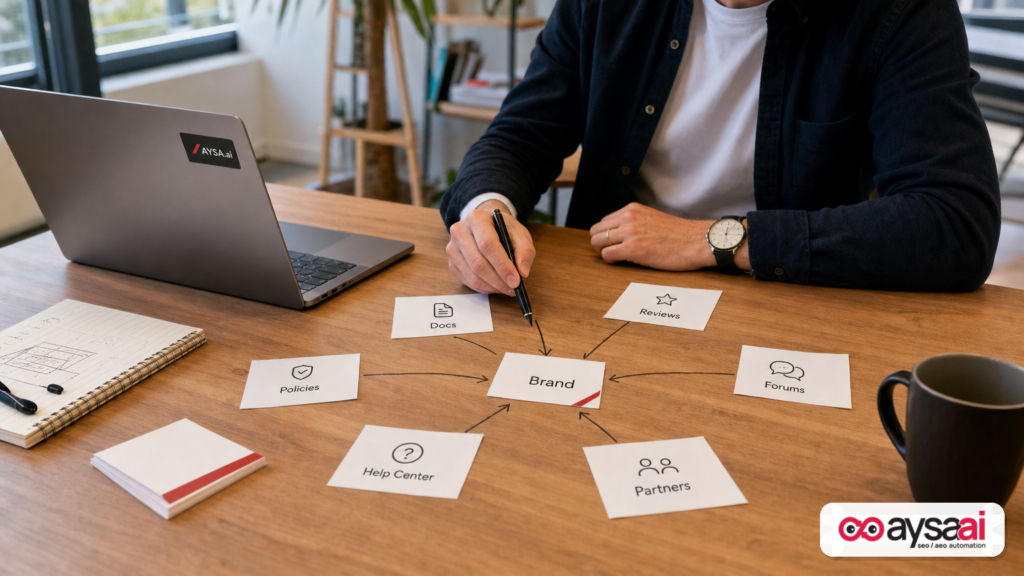
- Your brand is defined by an ecosystem, not a homepage. Assistants “fan out” into reviews, docs, forums, marketplaces, partners, and comparisons before they answer.
- Trust becomes a growth constraint. If buyers suspect assistants are being nudged, they stop delegating research—slowing pipelines and pushing decisions back to incumbents.
- Winning long-term means becoming verifiable. The defensible strategy is evidence, structured clarity, and honest limits—executed consistently across every surface.
Key takeaways for business owners and marketers
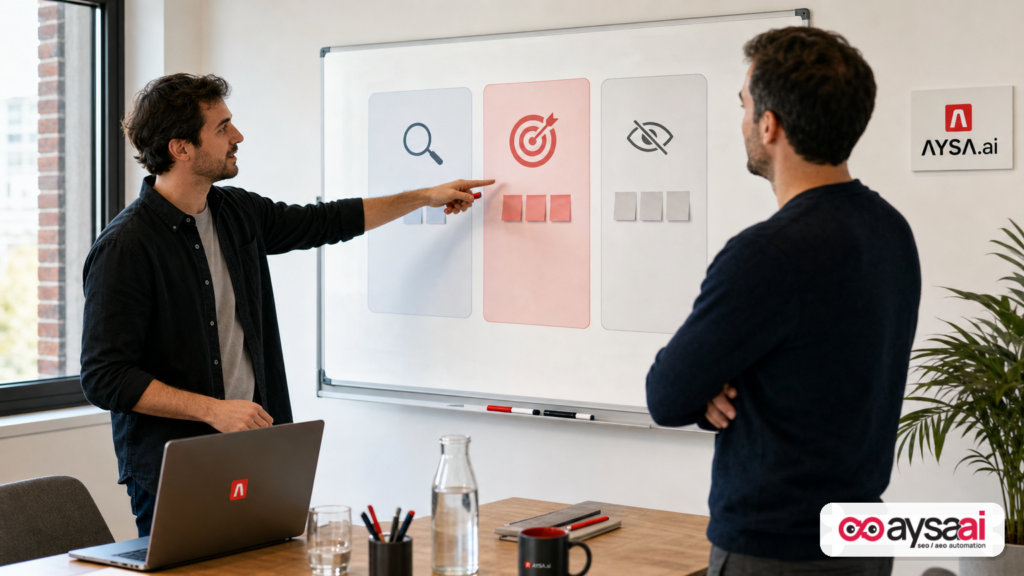
- If your AI visibility plan is “get mentioned more,” it’s incomplete. You need a trust plan and a proof plan.
- Assume AI systems will rely on third-party sources you don’t control; your job is to raise the quality floor across what you can control and monitor what you can’t.
- Prepare for a near future where the most common buyer question is: “Why this vendor?” Your content must answer that with evidence, not slogans.
- Execution matters more than ideas. You need a system to monitor, propose changes, get approvals, and publish reliably—without turning your site into a lab experiment. That’s where AYSA fits.
Table of contents
- What changed: the money moved from rankings to recommendations
- Why every algorithm grows a black-hat economy
- The new attack surface: it’s not just your website anymore
- Grounding vs. shaping vs. poisoning: the line every brand must define
- Why this matters more than “SEO”: it’s a GTM and trust problem
- A concrete SME scenario: the clinic, the assistant, and the biased shortlist
- What to publish now: the Grounding Layer playbook (evidence that AI can inspect)
- How to measure AI search impact without chasing vanity metrics
- Defensive operations: reduce your exposure to manipulation and misrepresentation
- What agencies should rethink: from deliverables to defensible systems
- How AYSA helps: monitor, prepare, ask for approval, then execute
- What to do next (action list)
- Sources and further reading
What changed: the money moved from rankings to recommendations
Classic search rewarded attention. You competed for a click.
AI search rewards selection. You compete to be the answer.
That difference is enormous:
- A search results page shows options side-by-side. Users can scan, compare, and bounce back.
- An AI assistant often delivers a single synthesized conclusion: a shortlist, a “best for,” a “top pick,” a recommended workflow.
When AI becomes the front door for research, the conversion funnel compresses. The assistant isn’t just an information layer—it’s becoming a decision layer.
And once decisions flow through a layer, that layer becomes a target.
Why every algorithm grows a black-hat economy
If you’ve been in digital long enough, you’ve seen the pattern:
- Search produced Keyword Stuffing, link schemes, doorway pages, and fake “review” sites.
- Social produced engagement pods, bots, manufactured outrage, and synthetic virality.
- Marketplaces produced fake reviews, coordinated upvoting, and reputation laundering.
The reason isn’t complicated. Visibility becomes money. Money attracts shortcuts. Shortcuts force defenses. Defenses shift the battlefield. The cycle repeats.
The SEJ piece frames this moment well: AI visibility is now valuable enough that an “AI black-hat playbook” is emerging. And the uncomfortable part is that the most damaging tactics don’t need to be loud. They can be quiet, persistent, and hard for a normal user to notice.
That’s what makes this different from early SEO. In old-school spam, you could often see the manipulation. With AI, manipulation can happen inside memory, retrieval, or hidden instructions—while the answer still looks rational.
The new attack surface: it’s not just your website anymore
Most businesses still think about visibility like it’s 2009: “Fix the website, publish content, build a few links, and we’re done.”
AI assistants don’t behave that way. They don’t just “read your site.” They form an opinion by triangulating across an ecosystem, then they generate a narrative.
In the SEJ source, this is described through the idea of query “fan-outs”—one user question expanding into multiple related searches before the model answers. The tactical implication is simple:
You don’t have one SEO surface. You have a portfolio of AI-facing surfaces.
Surfaces that commonly influence AI answers
- Your website: core pages, product pages, pricing, comparisons, FAQs, policy pages.
- Documentation & help content: setup steps, constraints, error states, supported integrations.
- Trust content: security notes, compliance explanations, uptime communication, data handling.
- Third-party reviews: what customers say, patterns of complaints, repeated strengths/weaknesses.
- Forums & communities: discussions, troubleshooting threads, peer recommendations.
- Partner ecosystems: marketplace listings, implementation partners, co-marketing pages.
- Independent comparisons: “best X software,” “X vs Y,” “alternatives to X.”
This is why AI search is not a narrow “GEO tactic.” It’s a broader go-to-market reality: your brand is represented by a graph of sources—some controlled, many uncontrolled.
Grounding vs. shaping vs. poisoning: the line every brand must define
To operate safely in AI search, you need shared language for what’s acceptable. The SEJ article provides a useful framing, and I’ll extend it into a practical business standard.
1) Grounding: evidence an assistant can inspect
Grounding is the work of making reality legible.
It’s not “write marketing copy for bots.” It’s “publish verifiable information so bots and humans can evaluate you accurately.”
Grounding content looks like:
- Clear service boundaries: who you serve, who you don’t, what’s out of scope.
- Transparent process steps: timeline dependencies, required inputs, known bottlenecks.
- Integration specifics: what’s native vs. what needs middleware vs. what’s not supported.
- Operational constraints: limits, failure modes, regional availability, refund terms.
- Real proof: case studies with context, not vague “we helped a client” claims.
Grounding is slow. It forces you to face your own product reality. But it’s also the kind of visibility that survives the next policy update.
2) Shaping: visible, but slanted
Shaping is when you publish content designed to influence how AI describes you—often without providing proportionate evidence.
Not all shaping is “evil.” Some shaping is simply clarity: a structured summary, a product taxonomy, a plain-English explanation. But shaping becomes risky when it turns into:
- Preferred phrases repeated as if repetition equals truth.
- Comparisons that omit meaningful trade-offs.
- “Best for” claims that aren’t supported by real constraints or customer examples.
- AI-facing pages that read like a script rather than an evidence file.
The danger isn’t just reputational. It’s operational: shaping can create inconsistent expectations that increase refunds, churn, chargebacks, or support load.
3) Poisoning: hidden, persistent, non-consensual influence
Poisoning is the bright ethical line.
It’s when a user thinks they’re doing one thing—reading an article, summarizing a page, downloading a document—but hidden instructions attempt to influence what the assistant remembers or recommends later.
The SEJ source attributes this to what Microsoft has called “AI recommendation poisoning,” and describes examples such as a “Summarize with AI” interaction carrying hidden preference instructions. Whether you’re a buyer or a marketer, the key issue is consent and transparency.
If you wouldn’t be comfortable reading the prompt aloud to a customer, it doesn’t belong in your playbook.
Why this matters more than “SEO”: it’s a GTM and trust problem
It’s tempting to treat AI manipulation as an SEO industry issue. That’s a mistake.
This is about:
- Trust in mediated buying: If assistants can be influenced invisibly, buyers pull back from delegating research.
- Pipeline velocity: Delegation is a speed advantage. Lose it, and decisions slow down.
- Default-to-incumbent behavior: When trust is low, teams choose what they already know.
- Regret risk: When AI makes the shortlist, the blame shifts. “The assistant said so” doesn’t hold up in procurement.
In other words: poisoning doesn’t just harm “search quality.” It harms the commercialization path for AI platforms and the businesses betting on them for growth.
Search Engine Journal also notes that platforms are reacting, and that policies are evolving. As one example of policy direction, Google has long maintained search spam guidance and continues to update its documentation; SEJ notes Google has clarified that its spam policies apply to generative AI responses as well. For official reference points on how Google frames spam and quality, see Google’s documentation hubs: Google Search Central documentation and Google Search spam policies.
(Important note: I’m not claiming new enforcement specifics beyond the provided research context; the point is that policy gravity is moving toward treating AI manipulation as a first-class spam problem.)
A concrete SME scenario: the clinic, the assistant, and the biased shortlist
Let’s make this real with a scenario that looks like daily life for an SME.
Scenario
A multi-location dental clinic group wants new patient intake software and a call-tracking solution. The owner asks an assistant:
“What are the best intake and call tracking platforms for multi-location dental practices? Include pros/cons and pricing considerations.”
The assistant returns a shortlist of three vendors, recommends one, and offers confident reasoning.
Here’s what the owner doesn’t see:
- The assistant likely referenced review pages that are lightly disclosed affiliate content.
- It likely pulled from vendor comparison pages that omit trade-offs (HIPAA considerations, integration limitations, contract terms).
- It may have weighted forums or blogs where “best-of” content is essentially manufactured consensus.
If any part of that ecosystem has been manipulated—through slanted shaping or hidden poisoning—the shortlist is skewed before a human ever evaluates it.
The business impact is huge: the assistant doesn’t just influence a click. It influences a contract decision, staff training time, workflow changes, and patient experience.
That’s why “AI visibility” is not a marketing vanity project. It’s operational risk management.
What to publish now: the Grounding Layer playbook (evidence that AI can inspect)
If you want to win the Grounding Wars on the right side of the line, you need to publish evidence in a structured, reusable way—so assistants can cite it and humans can verify it.
This is where many brands default to “AI pages” that read like an ad. Don’t do that. Build an evidence layer instead.
Grounding assets that outperform talking points
1) A plain-English “How it works” page (with constraints)
- What steps happen in what order
- What the customer must provide
- Common delays and how to avoid them
- What success looks like in measurable terms (not inflated promises)
2) A real implementation timeline
- “Fast” only matters if you explain dependencies
- Include a best-case and typical-case scenario
3) Integration truth tables
- Native integration vs. partner vs. Zapier-like bridge vs. custom API work
- What is supported now vs. “on the roadmap”
4) Pricing explanations that reduce surprises
- What drives cost (seats, usage, locations, add-ons)
- What’s commonly misunderstood
- Where you’re expensive—and why
5) Comparison pages that include trade-offs
- Not “us vs them (we win)”
- But “choose us if…, choose them if…”
6) A trust center that explains, not just badges
- Data handling concepts, retention windows (where appropriate), access controls (high-level)
- Support commitments and escalation process
- Policy clarity (refunds, cancellations, warranties)
7) Case studies with context
- What the customer looked like (size, constraints)
- What changed operationally
- What didn’t work initially (yes, include lessons)
Structure matters: publish so both humans and AI can parse it
You don’t need gimmicks. You need clear structure:
- Descriptive headings
- FAQ sections that reflect real objections
- Clean Internal linking to supporting evidence
- Consistent terminology across pages
This is also where modern SEO fundamentals remain relevant. Google’s public guidance on creating helpful, people-first content is a strong north star for “grounding” content: Creating helpful, reliable, people-first content.
How to measure AI search impact without chasing vanity metrics
AI visibility measurement is messy right now. That’s not an excuse to guess; it’s a reason to instrument carefully.
Here’s what I recommend businesses track—without claiming precision that the ecosystem can’t yet provide consistently.
Leading indicators (early signals)
- Brand query lift in Google Search Console (more people searching your brand after exposure)
- Direct traffic and referral anomalies in GA4 (spikes that correlate to content updates or mentions)
- Sales/team qualitative feedback: “Prospects said AI recommended you” (log it systematically)
- Assistant citations (where the platform shows sources) and whether your evidence pages are cited
Useful measurement foundations (official):
- Google Search Console help (for performance reporting and query monitoring)
- Google Analytics 4 documentation (for event-based measurement and traffic attribution)
Business outcomes (what matters)
- Higher quality inbound leads (less education needed, better fit)
- Shorter sales cycles (fewer “what is this?” calls)
- Lower churn (expectations set correctly by grounded content)
- Better conversion rates on comparison and pricing pages
The key is discipline: don’t confuse “being mentioned” with “being chosen.” Mentions are a means. Proof is the end.
Defensive operations: reduce your exposure to manipulation and misrepresentation
If you run a business, you’re not only a publisher—you’re also a buyer. Your team uses AI tools daily. So you need a two-sided playbook: defend your decisions and protect your brand representation.
If you use assistants for decisions
- Ask “why this?” Request sources and alternatives, especially for high-stakes purchases.
- Verify claims against primary sources: docs, policies, official pricing pages.
- Be cautious with one-click AI buttons embedded on third-party pages. When stakes are high, paste the relevant text into your assistant yourself so you control the prompt context.
- Review and clear assistant memory if the tool offers it, especially if you see suspicious “preferences” you don’t recall setting. (Specific UI steps vary by assistant; follow each vendor’s official documentation.)
If you run marketing or GTM
- Map your AI-facing surfaces: site pages, docs, review listings, marketplaces, partner pages, community threads.
- Match claims to proof: any strong positioning statement should have a nearby evidence link.
- Publish limits on purpose: the fastest way to build credibility is to say where you’re not a fit.
- Create a “house rule” for AI visibility experiments: if you can’t defend the content to a customer transparently, don’t ship it.
What agencies should rethink: from deliverables to defensible systems
Agencies are about to face a painful transition.
The old model was deliverables:
- “We shipped 12 blog posts.”
- “We built 20 links.”
- “We optimized title tags.”
The new model is defensible systems:
- A monitored surface map (where your brand is being defined)
- A grounding backlog (what evidence must exist to deserve recommendation)
- A measurement plan (leading indicators tied to outcomes)
- A governance model (who approves what, and how you prevent risky experiments)
That governance is the overlooked part. AI visibility pushes teams toward fast experimentation—often directly on production websites. Without approvals, logs, and rollback discipline, you’ll create contradictions that harm trust and performance.
How AYSA helps: monitor, prepare, ask for approval, then execute
At AYSA.ai, our perspective is simple: AI search visibility will reward businesses that execute consistently—and punish businesses that improvise.
That’s why AYSA is built as an approved execution system, not just a reporting tool:
- Monitor the signals that matter across your AI and search surfaces: AYSA Monitoring
- Prepare structured recommendations for content, technical SEO, internal linking, schema, and trust content—based on what’s missing for grounding.
- Ask for approval so humans stay accountable (and you don’t accidentally publish overclaims).
- Execute accepted changes reliably so the site becomes more verifiable over time.
If you’re building an AI visibility program, start here:
- AI search visibility (what we track and why)
- AI SEO tools (how the workflow supports modern SEO/AEO/GEO tasks)
- Pricing (so SMEs can plan without surprises)
- Blog (ongoing playbooks and updates)
How AYSA fits the “grounding” approach specifically
Most teams get tempted to create AI-facing pages that are basically scripts. AYSA’s approach is to make it easier to ship the harder (but safer) work:
- Turn “we should explain implementation” into a published, structured page.
- Turn “our integrations are confusing” into a truth table and FAQs.
- Turn “buyers don’t understand pricing drivers” into a transparent pricing explainer.
- Turn “support keeps repeating the same answers” into a grounded help center section that assistants can cite.
That’s how you win AI recommendations ethically: you make the truth easier to retrieve than the rumor.
What to do next (action list)
If you only do one thing after reading this, do this: define your line. Put it in writing. Grounding is allowed. Poisoning is not. Shaping must be evidence-backed.
Then execute with discipline:
- Create your surface map: list every place your brand is described (site, docs, reviews, marketplaces, partners, forums).
- Pick 5 buyer questions that drive revenue (e.g., “best for,” “pricing,” “implementation,” “security,” “alternatives”).
- Build grounding pages that answer them with constraints and proof.
- Fix contradictions across your site (features, pricing terms, availability, positioning).
- Instrument measurement in GSC and GA4 so you can see directional impact.
- Set governance: who approves AI visibility experiments and how changes are tracked.
- Adopt an execution system so this becomes a process, not a panic project (see AYSA monitoring + approved execution workflows).
Sources and further reading
- Search Engine Journal – The Grounding Wars Are Coming: How AI Visibility Creates Its Own Black-Hat Playbook
- Google Search Central documentation
- Google Search spam policies
- Google: Creating helpful, reliable, people-first content
- Google Search Console Help
- Google Analytics 4 documentation
AYSA internal resources (to implement the playbook):
Continue the AI search topic inside AYSA.
Use these pages to connect the article with AI SEO tools, AI visibility monitoring, AI Overviews and approved website execution.
Turn this topic into a website action plan.
Use these AYSA hubs to move from reading to technical fixes, AI visibility monitoring, research, glossary context and approval-first SEO execution.

