
AI Citation Strategy: How to Get Your Brand Cited in AI Search
AI citations are becoming a new visibility layer. This deep guide explains how brands can become easier for ChatGPT, Google AI Mode, AI Overviews, Perplexity and other answer engines to retrieve, trust and cite.
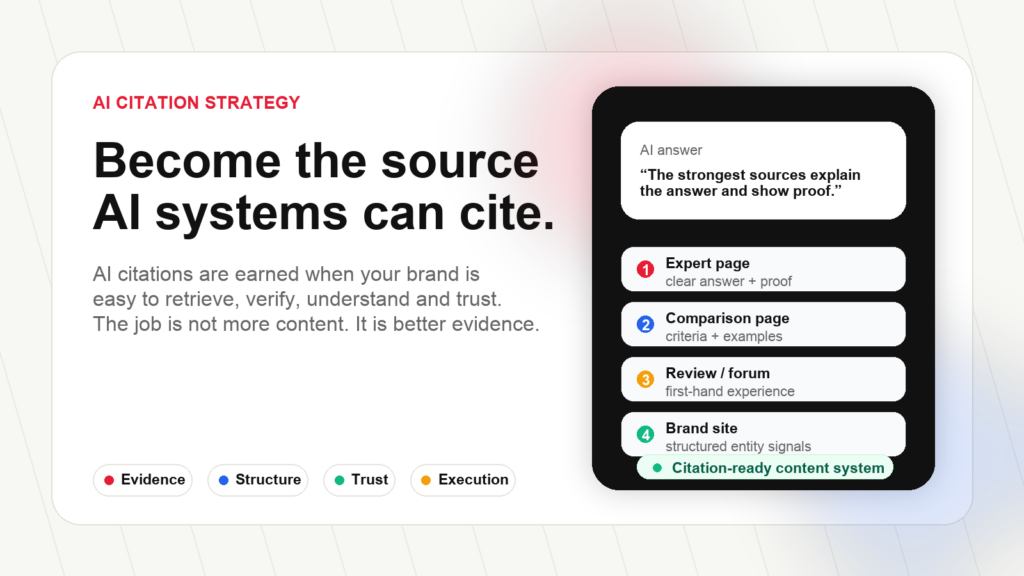
Executive summary: Search Engine Journal announced a webinar about proven strategies to get brands cited inside AI answers. That is a good signal: AI citations are no longer a side conversation for technical SEOs. They are becoming a practical visibility layer for business owners, marketers, publishers, ecommerce teams and agencies.
This article goes deeper than a webinar announcement. It explains what an AI citation is, why citations are different from classic rankings, what current research suggests about how AI systems choose sources, what brands can realistically influence, and how a company can move from “we want AI visibility” to a repeatable operating system for evidence, structure, trust, Monitoring and Approved Execution.
The short version: brands do not earn AI citations by adding a few buzzwords to a page. They earn them by becoming easier to retrieve, easier to verify, easier to summarize, easier to trust and easier to connect with the exact problem a user is asking about.
What is an AI citation?
An AI citation is a reference, link, source card, URL, Brand mention or supporting source used by an AI Answer engine when it generates a response. The exact interface changes by platform. Google AI Overviews and AI Mode may surface links inside or near generated explanations. Perplexity often shows source citations beside the answer. ChatGPT Search and browsing experiences may cite source pages. Claude, Gemini, Copilot and other assistants can use web results or connected sources depending on the product mode and user context.
The common point is simple: the AI system is not only returning a list of blue links. It is selecting, synthesizing and presenting information. That makes citation visibility different from classic ranking visibility. A page may rank, but not be cited. A source may be cited, but not receive many Clicks. A brand may be mentioned without a link. A third-party page may become the cited source for your brand because it explains the category better than your own website.
That last point is uncomfortable but important. In classic SEO, many companies treated their own website as the center of the universe. In AI search, your own website remains important, but answer engines also use the wider web to understand what is credible, repeated, recent, useful and easy to synthesize. Review platforms, forums, YouTube videos, expert articles, publisher pages, local business profiles, documentation, comparison pages and community discussions can all shape how a brand is represented.
So AI citation strategy is not the same as “rank number one.” It is closer to a visibility and evidence strategy. The goal is to make the brand and its expertise retrievable across the places AI systems actually use when answering questions.
Why AI citations matter even when clicks are lower
The old SEO model was easier to explain: rank, get impressions, get clicks, convert. AI answers complicate that funnel. If an AI answer gives the user enough information directly, the click may not happen at the same rate. But the brand can still influence the decision. A user may see a company cited, mentioned or recommended in the answer and later search the brand directly. A buyer may ask an AI assistant to compare options and treat cited sources as a trust filter. A parent may ask for pediatric clinics in Bucharest and compare review signals, location details, booking options, parking, insurance and website clarity without clicking every result.
That means citations can act like a new type of impression. They are not identical to impressions in Search Console because they are often not reported with the same granularity. They are not guaranteed to create traffic. But they can affect brand memory, trust, shortlist inclusion and downstream demand.
Google has repeatedly explained that AI search experiences are designed to help users explore the web and discover relevant sites. In its AI Mode and AI Overviews communications, Google describes techniques such as query fan-out, where a complex question can be broken into related sub-queries and connected to multiple web sources. The practical implication for marketers is clear: a brand may need to be present across several subtopics, not only one exact keyword.
For example, “best pediatric clinic for a toddler with recurring fever, private, good reviews, easy parking and online booking” is not one keyword. It contains medical intent, local intent, trust intent, logistics intent, review intent, booking intent and comparison intent. A website that only has a generic “Pediatrics” page is less useful than a website that explains services, age ranges, urgent vs non-urgent care, booking, parking, doctors, reviews, location, prices, process and what parents should compare.
This is where AI citations become connected to real business content quality. If your page is the most useful explanation for a specific user, at a specific stage, in a specific market, it has a better chance of being retrieved, summarized or cited. If your content is generic, thin or written only for keywords, it gives AI systems less to work with.
How AI systems may choose sources: what we know and what we should not overclaim
No serious marketer should claim to know the exact citation formula for every AI answer engine. These systems differ by product, query, location, language, personalization, available indexes, freshness, retrieval method and interface. But current public documentation and industry studies point to several patterns that are worth understanding.
First, classic search still matters. Several observational studies in 2026 suggest that pages with stronger traditional search visibility are often more likely to appear in AI citation sets, although the relationship is not perfect. This makes sense. If a page is crawlable, indexable, trusted, useful and already visible for relevant queries, it is more likely to be available to retrieval systems. But AI citations are not simply a mirror of the top ten organic results. Research on AI Overviews and multi-platform citation behavior has found that cited domains can differ from classic rankings, and that different AI products cite different source types.
Second, source type matters. Depending on the query, answer engines may prefer official documentation, how-to guides, review platforms, forums, videos, structured business listings, product pages, publisher articles or comparison pages. A B2B software query may cite review and comparison sources. A local services query may lean on business profiles, directories, review signals and local content. A technical implementation query may prefer official documentation, developer docs and expert tutorials.
Third, content format matters. AI systems need pages that can be parsed, chunked and summarized. A page with clear headings, concise definitions, examples, tables, step-by-step logic, FAQs, visible facts, authorship, dates and internal links is generally easier to use than a page with thin copy, hidden content, oversized JavaScript, vague marketing claims and no proof.
Fourth, off-site corroboration matters. AI systems are designed to answer with confidence. If your own website says you are the best, that is a claim. If your website explains what you do, your customers review you, third-party sites mention you, publishers describe you, and your brand appears consistently across credible locations, that becomes corroboration. In AI search, consistency across the web is not optional decoration. It is part of entity clarity.
Fifth, freshness and specificity matter. AI systems answering current questions need current sources. A page last updated years ago may still be useful for evergreen definitions, but fast-moving topics such as Google AI Mode, AI Overviews, schema visibility, product feeds, platform policies, medical pricing, ecommerce delivery, SaaS pricing or local availability need current evidence.
Sixth, not every citation is worth chasing. Some AI answers cite weak pages, forum discussions, outdated posts or pages that only partially support the final answer. The goal is not to manipulate every AI engine into citing every page. The goal is to become the strongest available source for the questions your business should deserve to answer.
Rank for a keyword
- Optimize one page for one query.
- Measure impressions, clicks and position.
- Focus mainly on the website.
- Use backlinks and content to improve organic rankings.
Become useful evidence
- Cover the problem, context and comparison criteria.
- Measure citations, mentions, source inclusion and assisted demand.
- Strengthen the website and the off-site evidence graph.
- Make the brand easier to retrieve, verify and recommend.
What makes content citation-worthy?
Citation-worthy content starts with a harder question than “what keyword do we target?” The better question is: what would make this page the most useful source for a specific user, at a specific stage of the journey, in a specific market?
A page about “what are backlinks” should not only define backlinks. It should explain why links matter, what makes a link useful, what makes a link risky, how anchor text works, what a referring domain is, why relevance matters, what Google says about link spam, what a business owner should avoid, and how authority building can be done safely. A page about “technical SEO audit” should not only list checks. It should explain crawlability, indexability, canonical tags, redirects, schema, sitemap health, Core Web Vitals, prioritization and what happens after issues are found.
A page about a local medical clinic should not look like a generic directory entry. It should help a patient or parent compare services, understand when urgent care is needed, see real locations, read about doctors, check booking options, evaluate trust signals and decide what to do next. That is the difference between content that exists and content that can actually help an AI system answer a real-world question.
In practical terms, citation-worthy content usually has several traits:
- Clear definitions: the page explains the topic in plain language before going deep.
- Specific examples: the content shows how the concept applies to real situations.
- Visible proof: claims are supported by sources, data, screenshots, customer examples or documented experience.
- Entity clarity: the page makes it clear who the brand is, what it does, where it operates and what it is known for.
- Comparison usefulness: the page helps users evaluate options, not just read a sales pitch.
- Technical accessibility: the content is crawlable, indexable, fast and structured.
- Freshness: important pages are updated when the market, product, policies or data change.
- Actionability: the page tells the user what to do next, not only what something means.
For AI citations, thin definitions are rarely enough. In many categories, the cited source is the page that best compresses expertise into a usable answer. That means the page must be detailed enough to support the answer, but structured enough for a machine and a human to quickly understand it.
Off-site proof: why your brand website is not enough
Brands often ask: “Can we just improve our own website and get cited?” Sometimes, yes. For navigational queries, product facts, documentation, pricing, locations and official statements, the brand website can be the strongest source. But for comparison, recommendation, trust, reputation and category questions, AI systems may look beyond your site.
That is not surprising. Humans do the same thing. If a user asks, “Which local SEO software should I use?” they do not only want vendor copy. They want reviews, comparison criteria, third-party analysis, examples, pricing clarity, limitations and proof. If a user asks, “Which florist delivers fast in Bucharest?” they want availability, reviews, coverage, photos, delivery rules and local trust signals. If a user asks, “Which clinic is good for pediatric consultations?” they want medical credibility, location, reviews, doctor information and booking confidence.
Off-site proof can include:
- review platforms and customer feedback;
- Google Business Profile information for local businesses;
- publisher mentions and expert articles;
- industry directories and marketplace listings;
- credible forum discussions and social content;
- case studies and customer stories;
- YouTube videos and explainers;
- podcasts, interviews and public appearances;
- partner pages and integrations;
- authority-building placements that are relevant and clearly approved.
This is where authority building becomes more than old-school link building. The objective is not to buy random links and hope rankings improve. The objective is to create a credible evidence graph around the brand. Search engines and AI systems should be able to see what the brand does, where it is mentioned, which problems it solves, which market it serves and why it deserves to be considered.
For AYSA, this is one reason Adverlink matters inside the wider ecosystem. Authority building is still part of search visibility, but it must be controlled. A business should see the publisher opportunity, understand the context and cost, approve the action and track delivery. That is very different from messy outreach, blind link buying or spreadsheets full of unverified placements.
Technical readiness: AI cannot cite what it cannot reliably access
AI citation strategy has a technical foundation. If a page is blocked, slow, hidden behind JavaScript, noindexed, duplicated, canonicalized incorrectly or buried in a crawl trap, it is harder to retrieve. If a site has chaotic internal links, broken pages, thin tag archives, duplicate metadata, missing schema or poor mobile performance, the problem is not only classic SEO. It is also AI retrieval readiness.
Google’s own AI optimization guidance points back to search fundamentals: make pages accessible to Google, allow crawling of important content, use descriptive page titles, provide useful content, use structured data when it matches visible content and avoid spammy tactics. That may sound boring, but boring fundamentals are exactly what many websites still fail to execute.
For SMEs, the technical layer often breaks in predictable ways:
- too many WordPress plugins;
- heavy builders and bloated themes;
- slow mobile pages;
- images that are too large;
- wrong canonical tags;
- old redirects and 404 errors;
- thin category and tag pages;
- inconsistent business information;
- schema markup that does not match the visible page;
- important content hidden in tabs, scripts or images.
These are not glamorous problems, but they decide whether the website is a reliable source. AI systems do not need your site to be flashy. They need it to be understandable, accessible and trustworthy.
How to measure AI citation visibility
Measuring AI citations is still messy. Search Console does not yet give every brand a complete “AI citation report” across all platforms. Different tools track different engines, prompts and geographies. AI answers can vary between users, sessions and time. Some systems cite URLs. Some mention brands without links. Some use sources that are visible to the user, while others use retrieval internally without surfacing every source.
That does not mean measurement is impossible. It means marketers need a layered model instead of pretending there is one perfect KPI.
A practical measurement system can include:
- Prompt set tracking: monitor important buyer, comparison, local, problem and category prompts.
- Citation rate: how often your website or third-party pages about your brand are cited.
- Brand mention rate: how often your brand is recommended or named, even without a link.
- Source type analysis: which sources are cited: your site, reviews, forums, publishers, videos, directories, documentation.
- Competitor citation share: which competitors appear for the same prompts.
- Source gap analysis: which cited pages exist for competitors but not for your brand.
- Downstream demand: branded search, direct visits, assisted conversions and higher-intent organic traffic.
- Content action history: what changes were made and when.
The key is to connect measurement to execution. A dashboard that says “you were not cited” is not enough. The useful system should ask why. Is the page missing? Is the content too generic? Are there no third-party mentions? Is the business profile incomplete? Is schema missing? Is the page not crawlable? Are competitors present in review sources where you are absent? Is the content old? Are you answering the wrong stage of the journey?
AI citation work becomes valuable when it produces actions: create this page, improve this explanation, add this evidence, fix this technical issue, build this authority signal, update this business profile, answer this comparison, add this FAQ, improve this internal link, monitor this prompt.
AYSA point of view: citations require execution, not just advice
In our opinion, the biggest gap in AI citation strategy is not knowledge. It is execution. Many companies will read about AI citations, create a spreadsheet of target prompts, publish a few generic articles and then stop. That will not be enough.
AI citation visibility requires continuous work across content, technical SEO, authority, local data, monitoring and updates. A business owner should not need to become a GEO specialist to benefit from that. The system should do the heavy lifting: monitor opportunities, identify gaps, prepare improvements, ask for approval and execute accepted changes inside the website workflow.
This is exactly where AYSA fits. AYSA is built around approved SEO execution. It learns the business, connects website and Google data, monitors SEO, AEO and AI visibility opportunities, prepares work and lets the user approve important actions before execution. That matters because AI citation readiness is not one article. It is a process.
For example, AYSA can help identify:
- pages that receive impressions but do not answer the query well;
- topics where the business lacks enough coverage to build authority;
- weak internal links between related pages;
- service pages that lack clear pricing, location, process or proof information;
- FAQ opportunities for answer readiness;
- schema opportunities that match visible content;
- technical issues that reduce crawlability or indexability;
- authority-building opportunities that need review and approval;
- AI visibility gaps where the brand is not easy to identify, cite or recommend.
The important part is what happens next. AYSA does not only show the issue. It prepares the work, explains why it matters, asks for approval and can execute accepted changes inside the website workflow. That is the difference between an AI citation report and an AI citation operating system.
A practical AI citation playbook for SMEs
If you run a small or mid-sized business, do not start with the phrase “how do I rank in ChatGPT?” Start with a more useful question: “What would make my business the most trustworthy answer for the questions my future customers actually ask?”
Here is a practical sequence.
1. Map the questions that matter
List the questions buyers ask before they choose. Include classic SEO keywords, but go beyond them. Add comparison prompts, location prompts, price prompts, risk prompts, “best option for” prompts, “what should I compare” prompts and “is it worth it” prompts.
2. Identify the source types AI systems may use
For each question, ask what a human would trust. Official documentation? A local business profile? A comparison guide? Reviews? A forum discussion? A video? A publisher article? A technical tutorial? A case study? Build evidence across the source types that matter for your category.
3. Make your own pages citation-ready
Your pages should answer the question clearly, show proof, include current details, explain trade-offs and use semantic structure. Avoid pages that are only keyword wrappers. AI systems need facts and context, not generic marketing paragraphs.
4. Strengthen entity consistency
Your brand name, service names, location, founder information, contact details, pricing language, product descriptions and social profiles should be consistent across the web. Inconsistent entity data makes it harder for AI systems to understand and trust the brand.
5. Build authority carefully
Look for relevant publisher opportunities, interviews, customer stories, partner mentions and industry pages. Avoid spammy placements and fake authority. Good authority building should make the web more useful, not noisier.
6. Monitor citations and gaps
Track priority prompts across AI search surfaces. Record whether your brand is mentioned, whether your site is cited, which competitors appear, which sources are used and what gaps repeat over time.
7. Execute improvements continuously
AI citation readiness is not a one-time optimization. As products, search interfaces, competitors and customer questions change, your website and evidence graph must change too.
The businesses that win will not be the ones that publish the most AI-generated pages. They will be the ones that create the clearest, most useful, most trustworthy and most consistently maintained evidence for the problems they deserve to answer.
What AI citation readiness looks like in real business categories
The idea becomes much clearer when we move away from abstract SEO language and look at real business situations. AI citation strategy is not one universal checklist applied blindly. It changes with the decision a user is trying to make.
Local medical clinics
A private clinic that wants to appear in AI-assisted answers should not rely only on a “Services” page and a few generic medical descriptions. A parent searching for a pediatric clinic may care about appointment speed, doctor empathy, parking, online booking, opening hours, insurance, emergency boundaries, age range, reviews and location. A strong website page should answer those questions directly, while the wider evidence graph should include a complete Google Business Profile, consistent contact details, visible doctors, review signals and third-party mentions where appropriate.
Ecommerce stores
An ecommerce store that wants AI visibility should not create hundreds of near-identical category pages. It should help the buyer choose. For example, a flower shop should not only list roses. It should explain which flowers fit which occasion, how delivery works, what freshness guarantees exist, how same-day delivery is handled, what happens if the recipient is not available, and how to choose between premium and budget options. This gives AI systems useful comparison criteria, not just product inventory.
Hotels and HoReCa
Hotels, restaurants and event venues need to think beyond “best hotel” keywords. AI systems may answer questions about parking, family rooms, business travel, airport transfer, meeting rooms, breakfast, cancellation rules, pet policies, local attractions and event capacity. A citation-ready hospitality page should be structured around the questions guests ask before booking, not only around poetic brand copy.
Car rental, parking and airport services
For airport parking or car rental, AI answers may compare price clarity, shuttle frequency, booking flow, distance from the terminal, insurance, deposits, cancellation terms, reviews and support availability. The strongest source is often the one that reduces uncertainty. A page that clearly explains the process, fees, pickup, return, safety, reviews and common mistakes is more useful than a page that only says “cheap airport parking.”
Agencies and B2B services
For B2B services, AI citation readiness often depends on comparison content, case studies, public proof, expert perspective and precise positioning. A generic “we are a full-service agency” page is weak evidence. A page that explains who the agency is best for, what it does not do, how pricing works, what the onboarding process looks like and how results are measured is more likely to help an answer engine make a useful recommendation.
The common pattern is this: citation-worthy content reduces uncertainty. It helps users compare. It explains trade-offs. It shows proof. It answers the next question before the user has to ask it.
What not to do: the new citation spam trap
Every time search changes, marketers look for shortcuts. AI citations will be no different. Some brands will try to manufacture mentions, flood the web with low-quality pages, create fake comparison articles, build synthetic reviews, publish unsupported “best” lists, stuff pages with answer-engine buzzwords or mass-produce AI-generated pages around every possible prompt.
That approach is risky for two reasons. First, Google’s spam policies apply to manipulative content and scaled abuse regardless of whether the content was produced by humans or AI. Second, answer engines are increasingly designed to evaluate source quality, corroboration, freshness and usefulness. If a brand creates a noisy footprint without real value, it may create short-term visibility but long-term trust problems.
A better approach is slower, but stronger. Build pages that deserve to be cited. Publish original examples. Show real constraints. Explain how decisions are made. Add expert review where needed. Keep business data accurate. Improve technical accessibility. Earn relevant mentions. Monitor where competitors are cited and ask why. Then execute improvements.
AI citation strategy should not become another version of link spam. It should become a better content and authority discipline: useful pages, real evidence, controlled authority building and continuous improvement.
Sources and further reading
- Search Engine Journal: Inside AI Citation webinar announcement
- Google Search Central: AI optimization guide
- Google: How AI Mode and AI Overviews help users explore the web
- Search Engine Journal: 68 million AI crawler visits and AI search visibility
- Research: Measuring Google AI Overviews, source quality and publisher impact
- Research: Citation selection and citation absorption framework for GEO
- Research: AI answer engine citation behavior and GEO factors
Turn AI citation gaps into approved website execution.
AYSA monitors SEO, AEO and AI visibility opportunities, prepares the work, asks for approval and executes accepted changes inside your website workflow.
Continue the AI search topic inside AYSA.
Use these pages to connect the article with AI SEO tools, AI visibility monitoring, AI Overviews and approved website execution.
Turn this topic into a website action plan.
Use these AYSA hubs to move from reading to technical fixes, AI visibility monitoring, research, glossary context and approval-first SEO execution.

