
AI Search in 2026: The New Rules of Visibility (and the Playbook SMEs Can Actually Execute)
AI search isn’t one channel anymore—it’s a stack of engines with different source preferences, different ad dynamics, and different optimization levers. Here’s what changed, why your visibility can swing wildly by model, and a practical, execution-first plan SMEs and agencies can run with.

AI Search didn’t “change SEO.” It changed where answers come from, how those answers get assembled, and how brands get chosen (or ignored) when a customer asks a question.
In 2026, you can do everything “right” in traditional SEO and still lose visibility because a different engine—or the same engine in an AI-first interface—uses different sources, different retrieval logic, and increasingly, different paid placements.
This editorial is my practical, operator-focused playbook for SMEs and agencies who want to stop guessing and start building repeatable visibility across AI engines. The research inputs and prompts for this article are based on the shifts described by Search Engine Land (and the industry talks it covered). I’ll cite that source directly and connect it to an Execution Plan you can run with today.
Primary reference: Search Engine Land — “7 AI search shifts you can’t afford to ignore”.
Concise summary (read this first)

- AI search is multi-engine. ChatGPT and Claude can cite dramatically different sources for the same question, which means “AI visibility” must be measured per engine, not as one bucket.
- Audience matters. Consumer usage and enterprise usage may concentrate in different tools; optimization should follow the audience that drives your revenue.
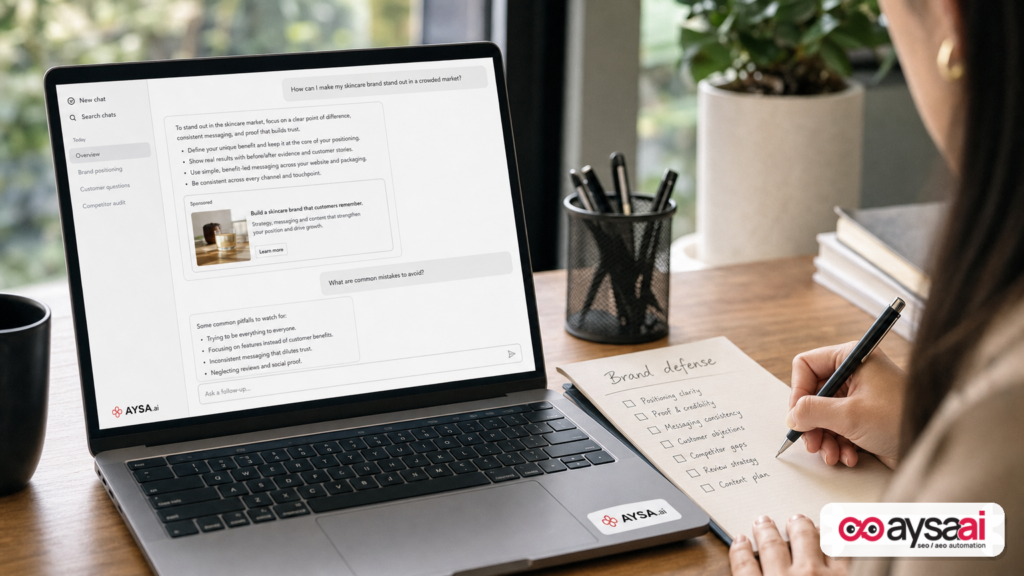
- Paid and organic are converging. Ads inside AI chat experiences mean brand defense and organic presence become one strategy.
- Some engines are more “optimizable” than others. When an AI relies heavily on a specific web index, classic ranking work can translate into citations—if the model actually triggers a web search for your prompt type.
- The constraint is execution. The winners will be teams that can monitor, decide, and ship changes continuously—safely—rather than teams that only produce strategy decks.
Table of contents
- The biggest change: “AI search” is not one engine
- Why different AI engines cite different sources (and why you should care)
- Prioritize engines by audience, not hype
- Paid and organic are merging inside AI answers (and you can’t treat them separately)
- Retrieval vs. memory: when “SEO work” can influence the answer
- Query fan-out: stable vs. volatile engines and what to do about it
- What to measure now: the new visibility KPIs
- Content that survives AI summaries: formats, proof, and eligibility
- Authority still matters—just in more places than your website
- A concrete SME scenario: the dental clinic that “ranked #1” and still lost leads
- What agencies should rethink: deliverables to systems
- Where AYSA fits: monitoring + approved execution for AEO/GEO
- What to do next: a 30-day plan you can execute
- Sources and further reading
The biggest change: “AI search” is not one engine

Most businesses are still asking the wrong question: “How do I rank in AI?”
The right question is: Which AI engine(s) shape my customers’ decisions—and what does visibility mean in each one?
Search used to be one primary interface (ten blue links). Today it’s a stack:
- Google with AI-first experiences (AI Overviews and AI Mode) that can answer the question without a click.
- Chat-based assistants that can cite sources, recommend vendors, and optionally route traffic to sites.
- Business tooling and agents that never “visit Google” but still decide what’s credible enough to recommend or buy.
If you’re a founder, you don’t have time for a philosophical debate about “the future of search.” You need a plan for how you get chosen when a buyer asks, “What’s the best X for Y?” or “Compare A vs B.” That is now an AI-mediated moment.
This is also why measurement is the new battleground. If you only measure Clicks from Google, you’re watching the wrong scoreboard.
Why different AI engines cite different sources (and why you should care)
One of the most important signals from the Search Engine Land analysis is simple: different models cite different sources for the same query. That means you can be “winning” in one engine and invisible in another.
Even if you never run ads and you never change your site, your market can shift under you because:
- Engine preferences differ. Some engines lean into community content; others prefer more traditional editorial formats.
- Index relationships differ. Some models track closely with classic search results; others diverge.
- Retrieval behavior differs. Some engines frequently browse the web; others often answer from internal memory.
For an SME, this matters because your “visibility budget” is finite. If you spread effort evenly without a model-by-model plan, you will:
- produce content that is ineligible to be retrieved,
- invest in prompts that don’t trigger web search,
- optimize for engines your buyers don’t actually use.
At AYSA, we treat AI visibility as a portfolio: track it by engine, by topic cluster, and by business outcome. This is why our product pages focus on AI search visibility rather than a single “Rank tracking” view of the world.
Prioritize engines by audience, not hype
There’s a common trap: picking your AI search strategy based on what’s loudest on social media.
Instead, start with your customer path:
- B2C (local and ecommerce): discovery still heavily flows through Google surfaces, social, and consumer assistants. AI summaries can reduce clicks, but also can elevate brands that become “the recommendation.”
- B2B (SaaS, services, industrial): evaluation is more research-heavy, with comparison prompts, procurement workflows, and internal “ask an assistant” behavior that doesn’t show up as web traffic.
Search Engine Land highlights the idea that enterprise/API usage may be a separate reality from consumer web traffic, which is a crucial business point: your buyer might be “in an AI tool” without generating a visible referral session.
So how do you sequence work?
A practical sequencing framework
- Start with the engine that influences your highest-margin deals. Not the engine you personally use.
- Map your top 20 “money questions.” These are prompts that signal buying intent (comparisons, best-of, pricing, implementation, alternatives).
- Check visibility per engine. If you’re strong in one and absent in another, that’s not “fine”—it’s a risk profile you need to consciously accept or address.
That’s the difference between AI search as a curiosity and AI search as a revenue channel.
Paid and organic are merging inside AI answers (and you can’t treat them separately)
Historically, businesses separated SEO and ads like two different sports. AI interfaces are collapsing that separation.
Search Engine Land’s coverage points to a world where ads can appear inside the chat experience, where matching can be topic-based, and where competitors can effectively “buy defense” on your Brand Mentions. That changes two fundamentals:
- You can’t evaluate organic visibility without also checking paid placements in the same interface.
- Your “brand query” strategy expands. It’s no longer only about Google brand terms; it includes conversational prompts where your brand is mentioned.
For SMEs, here’s what I’d internalize:
Three risks when ads move into AI answers
- Brand interception: A buyer asks about you, the AI mentions you, and an ad for a competitor is what gets the click.
- Higher effective CPCs: Scarce inventory tends to be expensive. Even if prices normalize later, early periods can be volatile.
- Creative becomes targeting: If matching is more semantic/topic-based, your ad text can influence where you show up—meaning ad copy must be engineered, not just “clever.”
If you want more background on how AI is blending paid and organic visibility, Search Engine Land also linked to: How AI is merging paid and organic visibility.
The SME takeaway: even if you don’t run ads today, you should still monitor whether competitors are effectively purchasing visibility on “you-shaped” prompts.
Retrieval vs. memory: when “SEO work” can influence the answer
Here’s a hard truth that most SEO advice avoids: you can’t optimize what the model doesn’t retrieve.
AI answers can come from two places:
- Memory/weights: the model’s internal training (not directly editable by you).
- Retrieval/browsing: the model performs web searches, selects sources, and cites them.
Why does this matter? Because a lot of “AI SEO” effort is wasted on prompt categories where an engine mostly answers from memory. If your plan is “write a definition article and hope it gets cited,” you might be optimizing something that never enters the retrieval set.
Search Engine Land’s referenced talk suggested that some prompt types (recency, rankings, location, comparisons) are more likely to trigger web searches in certain engines. The practical instruction is:
- Test your prompt categories. Don’t assume “it browses.”
- Invest where retrieval happens. Retrieval is where your content can be selected and cited.
Operationally, this is what we do in an execution system: we don’t just recommend content; we first classify prompts into “retrieval-likely” vs “memory-likely,” then prioritize what can actually move.
A note on index dependencies
Search Engine Land also describes how certain AI web-search behaviors may be closely tied to a specific underlying search index. When an AI assistant relies strongly on a known index, you get a rare advantage: a more checkable, measurable roadmap (rank here → more likely cited there).
Whether that remains stable long-term is uncertain, so treat it like a window of opportunity, not a permanent law of physics.
Query fan-out: stable vs. volatile engines and what to do about it
“Query fan-out” is one of the most useful mental models for modern AI search. The user asks one question; the system silently expands it into many related sub-queries to gather information before answering.
Why you should care as a business owner:
- Your customer’s question isn’t the only query that matters.
- You might be eligible to appear because you match a sub-question better than the main question.
- Format can determine eligibility (a comparison page vs a PDF vs a forum thread).
Search Engine Land’s piece describes an important strategic split:
- In more stable fan-out environments: you can engineer content to match recurring sub-queries.
- In more volatile environments: you need broader surface area—more “tickets”—across formats and platforms.
What “stable” means in practice
If an engine tends to generate similar sub-queries for the same prompt, you can build a targeted content plan:
- Year-stamped pages for “best in 2026” style prompts (updated annually).
- Comparison hubs (A vs B vs C) that answer evaluation questions clearly.
- Location/industry variants where appropriate (without thin duplication).
What “volatile” means in practice
If the fan-out changes often, you win by being present in more of the places the model tends to trust:
- High-quality community participation (where it’s relevant and credible).
- Earned media and third-party reviews.
- Multiple content formats (FAQ, comparison, case studies, glossaries, buyer guides).
Notice what I didn’t say: “Publish 100 AI-generated articles.” Volume doesn’t equal eligibility, and it can create brand risk if the content is not accurate or differentiated.
What to measure now: the new visibility KPIs
SMEs love simple metrics. “Rankings went up.” “Traffic went up.” “Leads went up.”
AI search requires a few additional measures, because you might lose clicks but gain influence (or vice versa). Here’s a practical KPI set you can adopt without building a research lab.
AI search KPIs that map to business outcomes
- AI presence rate (by engine): For your top prompt list, how often does your brand appear at all?
- Citation share (by topic): When sources are cited, what percentage include your site or your key assets?
- Recommendation rate: How often does the engine recommend your product/service explicitly vs just citing you?
- Competitor interception rate: How often do competitors appear when your brand is mentioned?
- Outcome correlation: Track whether changes in AI presence correlate with leads, demo requests, calls, or cart starts—even if click data is incomplete.
On the tooling side, the market is starting to ship more AI-search reporting. For example, Search Engine Land referenced: Bing Webmaster Tools updates AI reporting with Intents, Topics, Citation Share and Compare. Even if you’re not a heavy Bing user, the direction matters: platforms are acknowledging that “AI performance” needs its own reporting layer.
In AYSA, this is why we emphasize continuous monitoring—not just quarterly audits. AI interfaces can change quickly; if you measure slowly, you’ll react late.
Don’t overfit to one metric
One warning: don’t build a fragile strategy around a single number like “citations.” Different engines cite differently, and some answers won’t cite at all. Use a basket of metrics and trend them over time.
Content that survives AI summaries: formats, proof, and eligibility
AI-first search increases the penalty for vague content. If your content doesn’t add unique, verifiable value, it won’t be selected—or it will be summarized in a way that removes what little differentiation you had.
To compete, your content must do at least one of these things:
- Provide evidence (original data, clear methodology, primary documentation).
- Provide specificity (pricing ranges, constraints, step-by-step, checklists, decision criteria).
- Provide comparisons (tradeoffs, who it’s for, who it’s not for).
- Provide credibility (author expertise, editorial standards, references).
Formats that tend to map to AI fan-out and evaluation prompts
- Comparison pages: “X vs Y” and “X alternatives” (done honestly, not as smear pages).
- Best-of pages with real criteria: If you publish these, disclose how you evaluate and keep them updated.
- Implementation guides: “How to choose,” “How to implement,” “Common mistakes.”
- Industry-specific landing pages: If you truly have differentiated offerings for niches.
- Objection-handling FAQs: Build pages that answer sales calls at scale.
Search Engine Land also linked to a related discussion worth reading: What replaces the ultimate guide in AI search. The core idea is that the old “ultimate guide” play may be less dominant when AI can synthesize. The content that wins is content that provides something the model can’t easily fabricate: proof, specificity, constraints, and real-world experience.
A quick note on distribution surfaces like Discover
Not all visibility is “search results.” Surfaces like Google Discover can still drive massive attention, and headline formats matter. Search Engine Land points to data here: Headline formats and Google Discover: What 3.4 million articles reveal. If you’re a publisher or a content-heavy brand, treat Discover and AI summaries as parallel systems competing to answer before the click.
Authority still matters—just in more places than your website
Classic SEO taught: build links, build authority, publish helpful content, and Google will reward you.
In AI search, authority is still a core concept, but it expresses itself across a wider footprint:
- Your website (structured content, clear entity signals, strong pages that answer evaluation prompts).
- Third-party editorial (reputable sites that mention and review you).
- Communities (where appropriate—some engines surface community content more than others).
- Market consensus (if multiple independent sources converge on the same claims about you, AI systems are more likely to reflect that).
In other words: AI doesn’t kill reputation. It amplifies it. And if your reputation is fragmented or unclear, AI will fill the gaps with whatever sources are easiest to retrieve.
The listicle problem (and what to do about it)
One of the more uncomfortable realities in AI-assisted discovery is how “best” lists and affiliate-style content can shape recommendations. Search Engine Land also referenced research about citation behavior in AI Overviews: Google AI Overviews cite self-serving listicles, but recommend competitors 69% of the time. Regardless of the exact percentage in any one test set, the strategic insight is clear: the page that gets cited isn’t always the brand that gets recommended.
So what should you do?
- Don’t rely on “being mentioned” as your goal. Track whether you’re recommended and in what context.
- Build assets that make you the safe recommendation. Clear positioning, transparent pricing ranges (when feasible), credible reviews, detailed feature comparisons, and case studies with specifics.
- Monitor third-party pages about you. If inaccurate listicles dominate, you need a PR/content response—not just on-site SEO.
A concrete SME scenario: the dental clinic that “ranked #1” and still lost leads
Let’s make this real with a scenario I see constantly (and not just in healthcare):
The business: a dental clinic in a mid-sized U.S. city. They invest in SEO for “dentist near me,” “teeth whitening,” “emergency dentist,” and they rank well. Calls are steady.
Then something changes: more prospects start asking questions like “Is whitening safe for sensitive teeth?” or “Invisalign vs braces cost and timeline.” They do this inside AI experiences, and they read AI summaries in search results.
What the clinic sees: Rankings are stable, but leads soften. The team blames seasonality. They cut marketing.
What’s actually happening:
- The AI summary answers the question and doesn’t send the click.
- The AI cites an “orthodontics cost guide” from a national publisher and a forum thread.
- A competitor clinic is named as an option because their site has a comparison page and stronger third-party reviews.
This is the modern failure mode: you’re visible in the old interface and invisible in the new interface.
How you fix this without doubling your marketing budget
- Identify your top patient decision prompts (cost, pain, recovery, insurance, comparison).
- Create (or upgrade) pages that answer those prompts with specifics: ranges, timelines, disclaimers, who qualifies, and next steps.
- Strengthen off-site evidence: reviews, local citations, community trust signals, and reputable mentions.
- Monitor AI visibility monthly for those prompts and adjust based on what’s cited and recommended.
This is exactly the type of work that needs a system to execute—not just advice. It’s why AYSA focuses on “monitor → prepare → ask approval → execute accepted changes.” You can learn more about the approach in our AI SEO tools overview and ongoing research on the AYSA blog.
What agencies should rethink: deliverables to systems
If you run an agency, AI search is both a threat and an opportunity.
It’s a threat because:
- clients will question SEO value if clicks drop due to AI answers,
- reporting becomes harder,
- content volume strategies get commoditized.
It’s an opportunity because most businesses can’t operationalize this alone. They need a partner who can build a system—not just write content.
What a modern “system deliverable” looks like
- Prompt portfolio: a tracked list of money prompts, grouped by intent and engine.
- Eligibility map: what content formats are required to be retrieved for each group.
- Ship cadence: weekly or bi-weekly site changes, not monthly decks.
- Defense monitoring: visibility plus competitor interception in AI answers.
- Governance: approvals, QA, and rollback plans to avoid breaking conversion flows.
Search Engine Land also referenced the rise of the “marketing engineer” role as a real market signal. Whether you call it that or not, the capability is clear: teams need someone who can connect data, automation, and channel outcomes.
In smaller organizations, that capability often comes from tooling and process. That’s where platforms like AYSA can act as the execution layer.
Where AYSA fits: monitoring + approved execution for AEO/GEO
Here’s my direct perspective as Marius Dosinescu building AYSA.ai: the market doesn’t have an “ideas” problem. It has an execution bottleneck.
Most teams can list what they should do:
- update old pages,
- improve comparisons,
- add structured content,
- fix technical issues,
- monitor AI visibility.
What they can’t do consistently is ship those changes safely, quickly, and repeatedly—especially when the website is owned by another team, built on fragile templates, or constrained by compliance.
AYSA is designed as an approved execution system:
- Monitor what’s happening (rankings, pages, visibility signals, and the prompts that matter). See: Monitoring.
- Prepare specific recommended changes (content improvements, on-page fixes, internal linking, structured enhancements).
- Ask for approval so humans stay in control and brand/compliance risk is managed.
- Execute accepted changes so the work actually ships.
If you’re exploring how to budget for this kind of system, you can see options here: AYSA pricing. If you’re starting from scratch, begin with the core: AI search visibility and a monitoring baseline.
Where AYSA helps most in AI search work
- Speed: shipping improvements faster than competitors who only plan.
- Consistency: staying on a cadence while engines and interfaces change.
- Safety: approvals reduce the risk of AI-driven edits harming conversion pages.
- Focus: executing against the prompt portfolio that drives revenue.
What to do next: a 30-day plan you can execute
If you only do one thing after reading this, do this: stop treating AI search like a single monolith. Make it measurable, pick your engines, and ship changes.
Week 1: Build your “money prompt” list
- List your top products/services and the 5 biggest buying questions for each.
- Include: “best,” “top,” “vs,” “alternatives,” “pricing,” “near me,” and “for [industry].”
- Keep it to 20–40 prompts to start so it’s manageable.
Week 2: Baseline visibility and identify gaps
- Check whether you appear, whether you’re cited, and whether you’re recommended.
- Record what sources are used when you’re absent.
- Identify “interception” moments where competitors appear on your brand mentions.
Week 3: Create a prioritized fix list
- Fast wins: upgrade existing pages to answer evaluation prompts (add clear sections, criteria, FAQs, proof).
- New pages: build comparison and alternatives pages where you’re missing.
- Authority wins: identify one or two third-party placements you can realistically pursue (industry directories, reputable reviews, partnerships).
Week 4: Ship, measure, and set cadence
- Implement changes (not just drafts).
- Re-check visibility against your prompt list.
- Set a weekly/bi-weekly cadence for improvements and monitoring.
What can go wrong (and how to avoid it)
- Thin content at scale: Publishing generic AI-written pages can weaken trust and create inaccuracies. Use AI to assist, not to replace expertise.
- Optimizing for the wrong prompts: If your target prompts don’t trigger retrieval, you might not see movement. Test and adjust.
- Breaking conversion pages: Aggressive SEO edits can reduce conversions. Use approvals and QA.
- Measuring only clicks: AI influence can rise while clicks fall. Track leads and brand demand alongside visibility.
What to do next (action list)
- Create your prompt portfolio (20–40 prompts tied to revenue).
- Track visibility by engine (presence, citations, recommendations, interception).
- Prioritize prompt categories that drive retrieval (recency, comparisons, rankings, location—depending on your business).
- Upgrade content for evaluation (criteria, proof, constraints, comparisons).
- Expand authority beyond your site (reputable mentions, reviews, community where relevant).
- Ship changes on a cadence using a system with governance.
- Use AYSA to operationalize monitoring and approved execution: Monitoring, AI search visibility, and AI SEO tools.
Sources and further reading
- Search Engine Land: 7 AI search shifts you can’t afford to ignore (primary source for this editorial’s research direction)
- Search Engine Land: How AI is merging paid and organic visibility
- Search Engine Land: Bing Webmaster Tools updates AI reporting with Intents, Topics, Citation Share and Compare
- Search Engine Land: Google AI Overviews cite self-serving listicles, but recommend competitors 69% of the time
- Search Engine Land: OpenAI opens ChatGPT Ads Manager beta to UK advertisers
- Search Engine Land: What replaces the ultimate guide in AI search
- Search Engine Land: Headline formats and Google Discover: What 3.4 million articles reveal
- Search Engine Land: New Adobe tool shows where brands win and lose in AI search
AYSA internal reading:
Note: Some claims in industry presentations referenced by the source (e.g., model-specific citation percentages, exact ad inventory behavior, or model retrieval rates) can shift quickly and may depend on testing methodology. Where I couldn’t independently verify with primary documentation inside the provided research context, I treated them as directional insights and focused the guidance on what is consistently actionable: measure per engine, prioritize by audience and prompt type, and build a system to ship improvements.
Continue the AI search topic inside AYSA.
Use these pages to connect the article with AI SEO tools, AI visibility monitoring, AI Overviews and approved website execution.
Turn this topic into a website action plan.
Use these AYSA hubs to move from reading to technical fixes, AI visibility monitoring, research, glossary context and approval-first SEO execution.

