AI Search Turned SEO Into an Engineering Problem: How to Win Citations, Measure Volatility, and Execute Faster
AI search isn’t replacing SEO—it’s forcing it to become measurable, multi-platform, and execution-driven. Here’s how to monitor citations across ChatGPT/Perplexity/Claude/Google, build closed-loop workflows, and use approved automation to ship fixes safely.

AI Search didn’t “kill SEO.” It changed the unit of competition.
For most businesses, classic SEO meant: publish a page, get it indexed, earn some links, climb rankings, and collect Clicks. In 2026, that still matters—but it’s no longer enough. When customers ask ChatGPT, Perplexity, Claude, or Google’s AI experiences for a recommendation, those systems often answer without sending a click. And when they do cite sources, they frequently cite pages you don’t own.
That’s the strategic shift highlighted in a Search Engine Journal webinar recap featuring Writesonic’s CEO Samanyou Garg: AI search turned SEO into an engineering problem—one you solve with Monitoring, controlled tests, and closed-loop execution rather than “publish and pray.”
This editorial is my take—practical, opinionated, and built for operators who need results without gambling their brand on ungoverned automation. I’ll explain what changed, why it matters for SMEs and agencies, and how AYSA fits as an Approved Execution system that monitors, prepares changes, asks for approval, and executes what you accept.
Concise summary
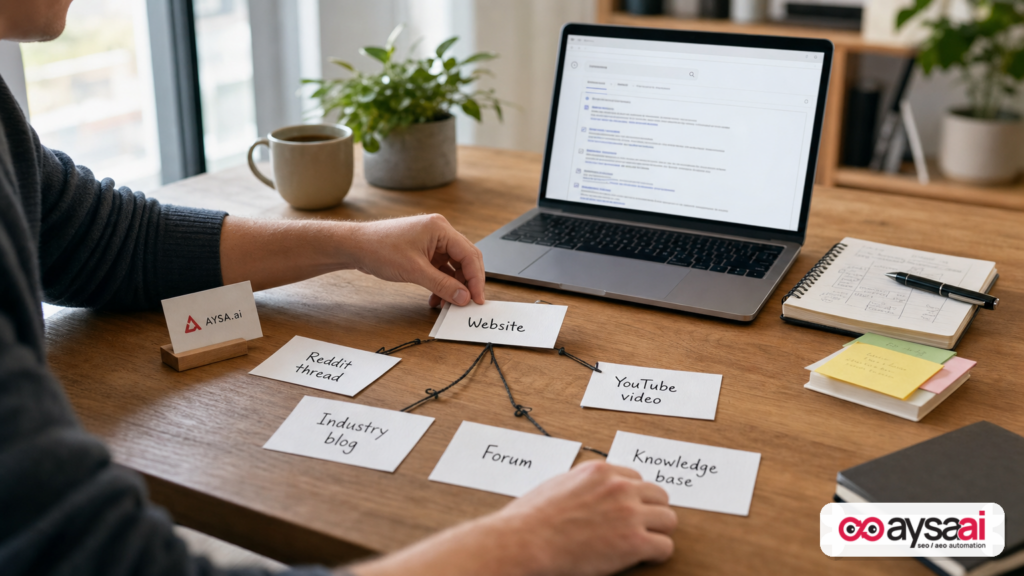
- AI search visibility is increasingly off-site: citations and “sources” often come from forums, videos, and third-party articles—not your domain.
- AI citations are volatile: model updates and probabilistic outputs rotate sources; you need continuous verification.
- SEO becomes closed-loop: ship changes, verify impact, and iterate—like engineering, not publishing.
- Automation must be approval-based: let AI do diagnosis and drafting; keep humans in control of what goes live.
- Winning now is multi-surface: on-page + off-page + entity/brand consistency + measurement.
Table of contents

- What changed: from “ranking pages” to “earning citations everywhere”
- Why “SEO is an engineering problem” is the right mental model
- The off-site reality: most citations point to pages you don’t own
- The volatility problem: citations rotate, models update, competitors replace you
- Measurement: proving what moved (without pretending attribution is perfect)
- Closed-loop SEO for AI search: ship, verify, iterate (without breaking your site)
- What an SEO/AEO agent actually is (and isn’t): identity, knowledge, skills, tools
- On-page vs off-page in AI search: what to prioritize first
- A concrete SME scenario: a multi-location clinic that keeps getting AI answers wrong
- What agencies should rethink: deliverables, reporting, and execution speed
- What can go wrong: governance, hallucinations, brand risk, and “automation debt”
- A practical 30–60–90 day action plan
- Where AYSA fits: monitoring + approved execution for SEO/AEO/GEO
- What to do next
- Sources and further reading
What changed: from “ranking pages” to “earning citations everywhere”
Traditional SEO had a straightforward target: the Google results page. You earned rankings; rankings earned clicks; clicks earned revenue.
AI search changes the geometry of the problem. The customer’s query can be answered inside an assistant interface. When sources are shown, the assistant chooses them—often from:
- community discussion (forums, Q&A threads)
- video transcripts and explainers
- industry publications and “best of” lists
- docs, templates, or tool roundups
In the Search Engine Journal recap, Writesonic’s research found that the overwhelming majority of AI citations pointed to third-party sources—an important directional signal even if the exact mix will vary by model, category, and prompt. Read the recap here: Search Engine Journal: SEO Study—5 Lessons From Running AI Agents Across Every Search.
My takeaway: your website is still your home base, but it’s not the only surface that matters. If AI assistants cite “the best answer,” your job becomes making sure your brand is present in the places those systems repeatedly trust.
Why “SEO is an engineering problem” is the right mental model
I agree with the framing that modern SEO (and AEO/GEO—Answer Engine Optimization and Generative Engine Optimization) is increasingly engineering-like. Not because it’s only technical—but because it’s iterative, measurable, and system-dependent.
Engineering problems have a recognizable pattern:
- You define the desired behavior (visibility, citations, qualified traffic, leads).
- You instrument the system (monitoring, logging, diagnostics).
- You ship changes (small, controlled, reversible).
- You verify impact (tests, comparisons, validation).
- You repeat based on evidence.
That’s a better model than editorial calendars and one-time audits—because AI search introduces more volatility and more “unknown unknowns.” The output can change even when you didn’t change anything. So the only sustainable advantage is a loop that detects change and responds quickly.
AYSA’s philosophy is built around that reality: monitor continuously, propose changes, require approval, execute safely, then re-check. You can explore that workflow approach here: AYSA Monitoring.
The off-site reality: most citations point to pages you don’t own
Here’s the uncomfortable truth for many SMEs: you can write the “perfect” page and still not get cited by AI assistants if the broader web doesn’t reinforce your expertise.
In the SEJ recap, Writesonic emphasized that citations are frequently pulled from third-party sources (community sites, media, video, etc.). Even if you disagree with the exact percentage for your niche, the operational implication remains:
- You need off-site coverage as an input to AI answers, not just backlinks as an input to PageRank.
- You need to know where competitors are being cited so you can earn inclusion in the same ecosystems.
- You need a repeatable process to identify, prioritize, and outreach—without spam.
This is where “link building” evolves into authority building and citation engineering. It’s not about spraying guest posts. It’s about being referenced where AI systems reliably find helpful, current explanations.
Practical examples of off-site assets that can earn citations:
- A well-received how-to video that gets embedded and discussed.
- A forum answer from a credentialed staff member that becomes the canonical reference.
- An industry publication mention that clarifies a confusing concept.
- A useful template or checklist that other sites reference.
Notice what’s missing: “a generic press release.” AI systems tend to reward content that appears genuinely helpful to humans, not just optimized for crawlers.
The volatility problem: citations rotate, models update, competitors replace you
One of the most important points in the SEJ recap: citation behavior is volatile. AI models update. Retrieval sources change. Even when nothing changes, the model’s probabilistic output can.
So if your team says, “We got cited last month—great, we’re done,” you’re already behind.
What volatility means operationally:
- You need recurring checks for your most valuable prompts.
- You need to track which sources are cited (and when those sources change).
- You need a plan for refresh and diversification: if one citation drops, you have other surfaces carrying weight.
In classic SEO, volatility was largely “rankings moved.” In AI search, volatility can look like:
- Your brand name disappears from a recommended list even though your page still ranks.
- A competitor becomes the cited source because their explanation is newer, clearer, or hosted on a frequently cited platform.
- An assistant starts citing a community thread that contradicts your updated policy or pricing.
That last point is especially dangerous: AI answers can amplify outdated off-site statements faster than your next content sprint.
Measurement: proving what moved (without pretending attribution is perfect)
AI search measurement is messy. Anyone who tells you it’s clean today is selling you something.
The SEJ recap mentions a pragmatic approach: self-attribution (“Where did you hear about us?”) plus verification via sales conversations. That’s realistic. It’s not perfect, but it is directionally useful.
How I recommend SMEs think about measurement right now:
1) Separate “visibility” metrics from “business” metrics
- Visibility signals: whether your brand/site is cited for target prompts, how often, and on what surfaces.
- Business outcomes: leads, calls, purchases, booked appointments, demos.
If you only track outcomes, you won’t know what to fix. If you only track visibility, you may optimize vanity.
2) Use GA4, but don’t expect GA4 to “solve” AI attribution
GA4 is valuable for trend monitoring, landing page performance, and conversion tracking—but AI assistants can reduce clicks and obscure referrers.
If your business relies on inbound leads, add a low-friction self-attribution field to your forms and keep the options current (e.g., “AI assistant,” “Google,” “YouTube,” “Referral,” “Friend”). Then train sales/support to confirm the story in conversation. You’re not looking for a courtroom-grade audit; you’re looking for a reliable compass.
As you build your stack, keep your tracking disciplined. Don’t create a 40-option dropdown that nobody uses accurately.
3) Treat prompts like “keywords,” but track them like test cases
In AI search, it’s often more useful to define prompt clusters that map to real buying situations:
- “Best [service] near me” equivalents
- “[problem] causes and fixes”
- “Compare [tool A] vs [tool B]”
- “What should I choose for [use case]?”
For each cluster, document:
- the prompt variant
- the desired outcome (brand mentioned, source cited, local pack presence, etc.)
- the current result snapshot (date-stamped)
- the next experiment to run
This is where “SEO as engineering” becomes real: you are managing test cases and regressions, not just writing posts.
Closed-loop SEO for AI search: ship, verify, iterate (without breaking your site)
The closed-loop approach described in the SEJ recap resonates because it fixes the biggest operational failure I see in growing businesses:
Most teams either don’t measure… or they measure and don’t act.
A closed-loop system forces action by design. The loop looks like this:
- Monitor: capture what AI assistants and Google surfaces are saying/citing.
- Diagnose: identify gaps (missing entities, weak explanations, inconsistent facts, competitor citations).
- Prioritize: pick changes by impact potential (not by whoever shouts loudest).
- Propose: draft specific fixes (on-page updates, schema, internal links, new sections, PR/outreach targets).
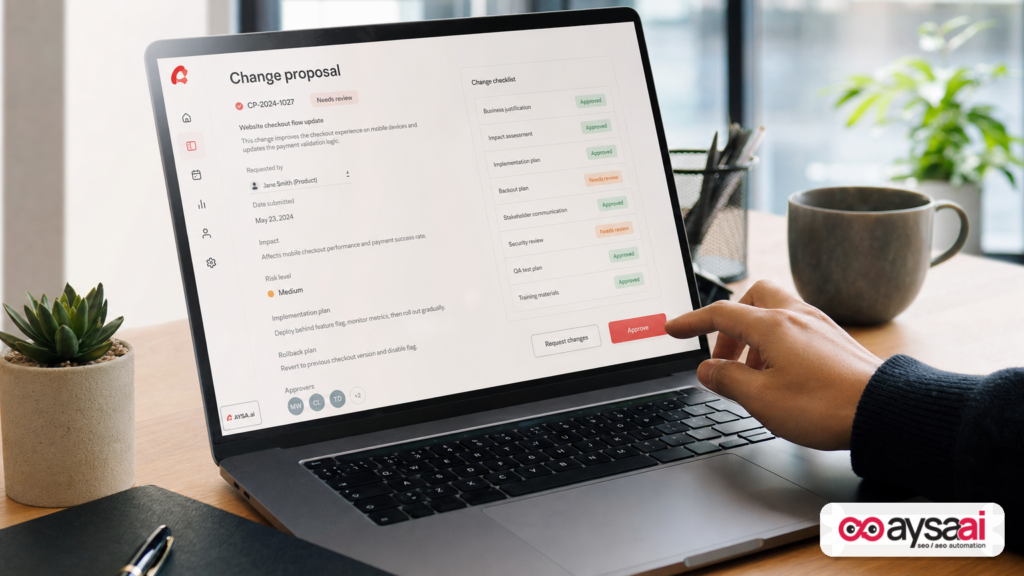
- Approve: a human signs off (brand, legal, medical, pricing, risk).
- Ship: publish safely, with rollback possible.
- Verify: confirm indexing, confirm visibility shift, and log results.
AYSA is designed to support that workflow in an SME-friendly way: it doesn’t just produce ideas; it helps you operationalize them with monitoring and approved execution. Start here: AYSA AI Search Visibility and AYSA AI SEO Tools.
What an SEO/AEO agent actually is (and isn’t): identity, knowledge, skills, tools
The SEJ recap outlines an agent framework with four layers: identity, knowledge, skills, and tools. That structure is helpful because it prevents a common mistake: confusing a chat model with a business-ready system.
Here’s how I interpret those layers in practical terms for a business:
Identity: who the agent “is” and what it’s responsible for
An agent needs a clear role definition, such as:
- “Technical SEO QA assistant for WordPress pages”
- “Local listing consistency auditor for multi-location brands”
- “Citation gap researcher for AI search prompts”
Without identity, the agent becomes a generalist chatbot—fine for brainstorming, unreliable for execution.
Knowledge: what it’s allowed to use
This includes approved brand facts, product/service definitions, pricing policies, disclaimers, and editorial standards. The SEJ recap mentions building “expert files” (structured second-brain documents). The key word is structured. Agents don’t need 10,000 words of prose; they need clear rules, examples, and constraints.
For SMEs, “knowledge” should also include your business’s non-negotiables:
- regulated language (health, finance, legal)
- refund policies and guarantees
- geo/service-area boundaries
- brand voice do’s and don’ts
Skills: what tasks it can perform consistently
Examples of reliable skills:
- generate an internal linking plan based on existing URLs
- draft FAQ sections based on real customer questions
- identify missing sections vs competitors’ cited sources
- create change proposals for title tags, headings, and schema
Examples of skills you should be careful with:
- auto-publishing medical claims
- rewriting legal pages without counsel review
- mass-creating location pages without verification
Tools: what systems it can read/write
This is where safety matters. If an agent can write directly to your CMS, your business needs a permission model. AYSA’s positioning is that AI should prepare changes and route them for approval—then execute what you accept. This reduces the risk of “automation gone wild.” See pricing and packaging options here: AYSA Pricing.
On-page vs off-page in AI search: what to prioritize first
In the SEJ recap, Samanyou Garg suggested a tilt toward off-page early, then rebalance as your own pages start earning citations. I largely agree—with a caveat.
The caveat: some businesses are failing at the basics so badly that off-page work won’t stick. If your site has inconsistent service definitions, thin pages, missing author credibility, or broken indexing, you’re trying to build authority on a shaky foundation.
So I recommend a staged approach:
Stage 1: Fix “citation eligibility” on-site
- Make the page the assistant wants to cite: clear definitions, steps, comparisons, and updated dates where appropriate.
- Ensure crawl/indexing basics are correct.
- Strengthen entity clarity (who you are, what you do, where you operate).
Even if AI citations are mostly off-site, your site should remain the canonical source for brand facts and product truth.
Stage 2: Build off-site references that AI systems trust
- Earn coverage on reputable industry sites.
- Contribute genuinely useful answers where your customers already ask questions.
- Create assets (videos, templates, explainers) that others reference.
Stage 3: Re-test, then double down where you’re actually cited
Once your own pages start earning citations, it’s often efficient to invest more in on-page expansion and freshness—because you’re compounding a working surface.
A concrete SME scenario: a multi-location clinic that keeps getting AI answers wrong
Let’s make this real with a scenario I see constantly across local businesses.
Business: a multi-location physical therapy clinic (8 locations across one metro area).
Problem: AI assistants answer “Does [clinic] offer dry needling?” with an outdated “no,” cite an old forum discussion, and recommend a competitor. Meanwhile, Google Maps visibility is fine. The clinic assumes “SEO is handled.” Leads start dropping because customers trust the AI summary.
What’s actually happening:
- The clinic updated services on the website, but not consistently across all location pages.
- A third-party directory and an old blog post still list an outdated service menu.
- A competitor has a strong YouTube explainer that’s frequently referenced.
Closed-loop fix:
- Monitor target prompts (“dry needling near me,” “does X offer dry needling,” “best PT for runners”).
- Identify citation sources: which pages are being cited and why.
- Repair your canonical facts: update every location page with a consistent services block, clinician credentials, and FAQs.
- Create one definitive service page that explains dry needling, candidly addresses contraindications, and links out to locations that offer it.
- Off-site correction: request updates on key directories; publish a clinician-led explainer video; participate in local sports/running community resources.
- Verify after shipping: indexing, prompt reruns, and call tracking/self-attribution.
This is exactly the type of workflow that benefits from approved execution: you want automation to catch inconsistencies and prepare drafts, but you need a human to approve medical language and service claims.
What agencies should rethink: deliverables, reporting, and execution speed
Agencies are under pressure because AI search changes what clients perceive as value.
Historically, agencies sold:
- keyword research
- content briefs
- monthly blog posts
- rank tracking
But if AI answers reduce clicks and citations rotate, clients will ask questions like:
- “Are we being mentioned and cited in AI answers?”
- “Why did we disappear this month?”
- “What did you change based on the data?”
Agencies that thrive will shift toward:
- multi-surface monitoring (not just Google rankings)
- execution velocity (how fast you can ship improvements safely)
- authority engineering (digital PR + community + creator + partnerships)
- test-driven reporting (what we tested, what moved, what we’re doing next)
AYSA can support agencies by standardizing the operational loop: monitor, propose, approve, execute, verify—so teams spend less time on spreadsheets and more time on strategy. If you want more practical implementation notes, we publish ongoing guidance here: AYSA Blog.
What can go wrong: governance, hallucinations, brand risk, and “automation debt”
I’m bullish on AI-assisted SEO execution, but I’m not naïve about the failure modes.
Risk 1: Ungoverned publishing creates brand and legal exposure
If an agent auto-publishes changes, it can introduce:
- incorrect pricing
- overpromising claims (“guaranteed results”)
- medical or financial misinformation
- contradictions between pages
That’s why approved execution matters. Automation should accelerate preparation and QA—humans should control the final ship.
Risk 2: “AI content volume” becomes the new thin content problem
Many teams respond to AI search by producing more pages. That’s often backwards. If citations and trust are the bottlenecks, more pages can dilute quality and create maintenance overhead.
Instead, invest in:
- fewer, stronger canonical explanations
- better internal linking and consolidation
- freshness and clarity upgrades
Risk 3: Automation debt (lots of changes, no verification)
When teams ship changes faster than they can verify outcomes, they accumulate “automation debt”—a backlog of unknown impact. Closed-loop systems are the antidote: every change is logged and checked.
Risk 4: Optimizing for one model or one surface
The SEJ recap emphasizes not putting all your eggs in one basket. I agree. Your visibility should not depend on one assistant, one platform, or one community site. Diversification is risk management.
A practical 30–60–90 day action plan
If you’re a founder, marketing lead, or agency owner, you don’t need more theory—you need a plan that survives real constraints.
Days 1–30: Instrumentation and baselines
- Pick 20–50 prompt clusters tied to revenue (not “interesting” queries).
- Record baselines: where you’re mentioned/cited today (date-stamped).
- Audit your canonical facts: services, locations, pricing policies, return/refund, product specs—ensure consistency.
- Set up lead self-attribution (“Where did you hear about us?”) and train sales/support to confirm.
Start with monitoring so you’re not guessing. This is foundational: AYSA Monitoring
Days 31–60: Close the biggest gaps
- On-site fixes: rewrite or expand the top 10 pages most likely to be cited (comparison pages, “best for,” FAQs, definitions, location pages).
- Schema and structure: make pages easy to parse with clear headings, summaries, and FAQs where appropriate.
- Off-site targets: identify the top third-party pages cited where you are absent; build a prioritized outreach list.
- Publish one citation-worthy asset: a definitive guide, calculator, checklist, or clinician/engineer-led explainer video.
Days 61–90: Build the loop and scale safely
- Move to continuous verification: schedule re-checks for your most valuable prompt clusters.
- Adopt approved execution: automation drafts + human approval + tracked shipping + verification.
- Formalize governance: who can approve what (pricing, regulated claims, legal policies, brand voice).
- Scale what’s working: if a certain content format or off-site surface earns citations, replicate it.
This is where AYSA becomes an execution multiplier: AI search visibility plus AI SEO tools with an approval gate.
Where AYSA fits: monitoring + approved execution for SEO/AEO/GEO
Most AI SEO tools stop at suggestions. That’s where the work actually begins.
AYSA is built for operators who need an end-to-end system:
- Monitor search and AI visibility signals over time
- Prepare concrete website improvements (not vague advice)
- Route for approval so humans control risk
- Execute accepted changes reliably and consistently
That model is increasingly necessary because AI search rewards teams that can respond quickly to shifts—without sacrificing quality or compliance. Learn more about the toolset: AI SEO Tools, visibility tracking: AI Search Visibility, and ongoing monitoring: AYSA Monitoring.
For teams evaluating cost and rollout scope: AYSA Pricing.
What to do next
- Choose 20 prompts that map to revenue (not vanity).
- Document today’s reality: who is cited, where, and for what.
- Fix your canonical facts (services, locations, policies) across your site.
- Upgrade 10 pages for “citation-readiness”: clarity, structure, FAQs, comparisons.
- Build an off-site plan based on what AI assistants already cite in your category.
- Adopt closed-loop execution: monitor → propose → approve → ship → verify.
Sources and further reading
- Search Engine Journal — SEO Study: 5 Lessons From Running AI Agents Across Every Search
- Search Engine Journal — SEO coverage (category)
- Search Engine Journal — Local SEO coverage (category)
- Search Engine Journal — Link Building coverage (category)
- Search Engine Journal — Google Algorithm Updates history (reference hub)
Note: The SEJ recap references Writesonic’s internal research (e.g., citation mix and citation lifespan). Those underlying datasets are not included in the provided source context, so I treated them as directional insights and focused this editorial on operational implications rather than reproducing unverified figures.
Continue the AI search topic inside AYSA.
Use these pages to connect the article with AI SEO tools, AI visibility monitoring, AI Overviews and approved website execution.
Turn this topic into a website action plan.
Use these AYSA hubs to move from reading to technical fixes, AI visibility monitoring, research, glossary context and approval-first SEO execution.