AI Search Is Turning Your “Best Tools” Page Into a Competitor Recommendation Engine (Here’s How to Fix It)
In AI Overviews and chatbot search, being cited is not the same as being recommended. If your content strategy relies on self-promoting listicles, you may be training AI systems to recommend your competitors. Here’s the practical playbook to measure the citation vs. recommendation gap, rebuild your content architecture, and scale independent mentions that AI actually trusts—plus how AYSA.ai helps you monitor and execute the fixes with approval-based automation.

AI Search didn’t just change how people find answers. It changed who gets credit for them.
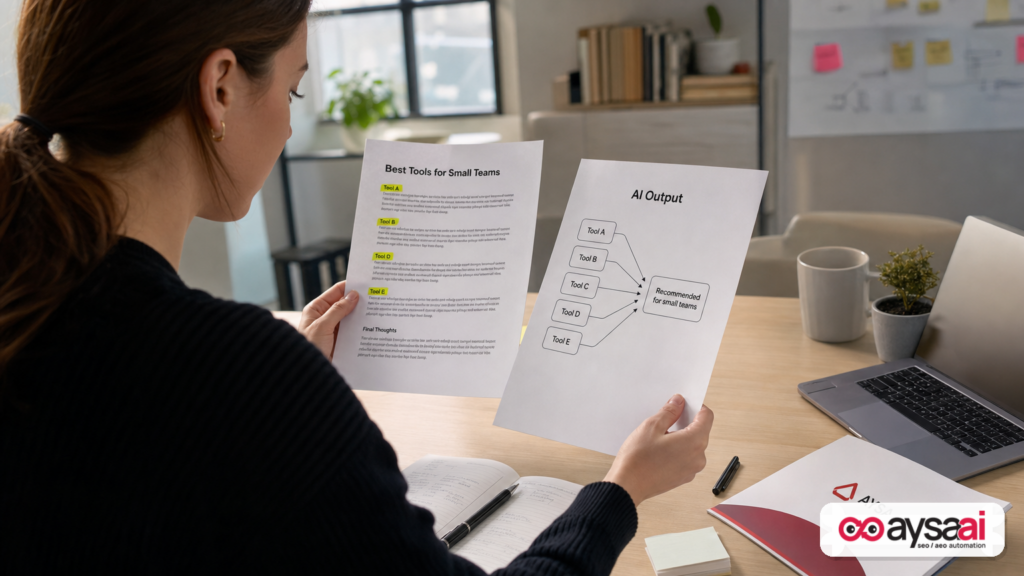
In the old web, you could publish a “Best [category] tools” page, rank it, and harvest buyer intent. In AI Overviews and chatbot-style search, that same page can become a weapon against you: the model may cite your listicle as a source, then recommend the competitor products you listed—because your page conveniently supplied the candidate set.
This isn’t a theoretical edge case. It’s a structural shift in how modern search products summarize, attribute, and recommend. If you’re a founder, marketer, or agency lead relying on comparison content as a growth lever, you need a new mental model and a new measurement framework.
This editorial is my practical playbook for navigating that shift: what changed, why the old strategy backfires, what to measure (and what not to celebrate), and how to rebuild an AI-era visibility strategy that earns recommendations, not just citations. I’ll also explain where AYSA.ai fits as an execution system—Monitoring what AI says, preparing fixes, requesting approval, and implementing changes without turning your site into a perpetual dev-ticket backlog.
Concise summary
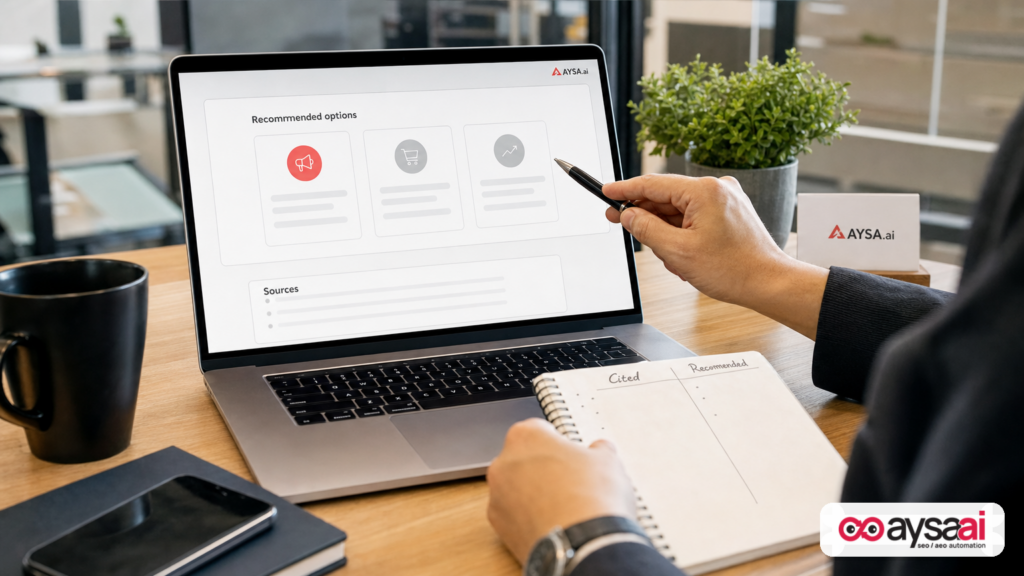
- Citations and recommendations are different outcomes. A citation can show your URL; a recommendation drives the click and the purchase.
- Self-promotional listicles can backfire. AI systems may use your page as evidence while recommending a competitor you mentioned.
- AI recommendations rely heavily on third-party signals. Independent reviews, comparisons, and creator coverage often carry more recommendation weight than your own claims.
- You need a new audit: track “citation share” vs. “recommendation share,” repeat queries, and test across engines.
- The fix is not just on-page SEO. You need off-site authority and credible, independent mentions—paired with content architecture that doesn’t hand competitors the narrative.
Key takeaways (the executive version)
- Stop treating AI visibility like classic rankings. Your brand can “appear” and still lose the buyer.
- Make your content strategy recommendation-safe. Don’t publish pages that function as a curated shortlist of competitors unless you have a clear reason and mitigation plan.
- Measure what matters: recommendation frequency and brand inclusion in AI answers—not just citations or Impressions.
- Invest in independent coverage you don’t control. AI systems lean on broad web consensus signals.
- Build an operational system. AI outputs change; your strategy needs monitoring, testing, and fast execution with guardrails.
Table of contents

- What changed: from “ranking pages” to “recommending brands”
- The new problem: your content gets cited, your competitor gets recommended
- Why self-promotional listicles backfire in AI search
- Citations vs. recommendations: the metric split most teams miss
- The measurement framework: track citation share vs. recommendation share
- Cross-engine reality: Google AI Overviews vs. chatbots
- What to build instead: content that increases recommendation eligibility
- Independent mentions: how to earn them without harming trust
- A practical SME scenario: the “best scheduling software” trap
- What agencies should rethink (and what to put in contracts)
- Where AYSA.ai fits: monitoring + approved execution for AEO/GEO
- The 90-day action plan (with realistic capacity)
- What to do next
- Sources and further reading
What changed: from “ranking pages” to “recommending brands”
For most of SEO history, the economic unit was the page. You made a page rank, you got the click. If you were clever, you could rank a comparison page for high-intent queries (“best CRM,” “best project management tool,” “Shopify alternatives”) and insert yourself at the top.
AI-first search experiences change the unit of value. The economic unit becomes the answer and the recommendation set inside that answer. The engine might still show sources, but it also synthesizes and selects options, especially for transactional queries.
That selection step is where many brands lose. And it’s where a decade of content playbooks—especially self-ranked listicles—starts to produce unintended consequences.
The Search Engine Journal piece that sparked this conversation (sponsored by FirstPromoter) frames the issue sharply: listicles can be quoted as sources while competitors get named as the recommended tools, effectively using your content against you. Read it as a starting point here: Search Engine Journal: AI Search—Is Your Content Strategy Accidentally Recommending Your Competitors?.
My take: this is not a “quirk” that will go away. It’s consistent with how summarization systems work. When you publish a page that enumerates alternatives, you supply the model with candidates and language it can reuse. Whether it picks you depends on what the wider web appears to agree on, not what you claim about yourself.
The new problem: your content gets cited, your competitor gets recommended
Here’s the painful version of the new funnel:
- A buyer asks: “Best invoicing software for small business?”
- Your site has a “Best invoicing software” listicle that ranks well (or is otherwise accessible to the model).
- The AI answer references your page as a source because it contains structured comparisons.
- The AI answer then recommends two to four products—and chooses competitors you listed.
- You got “visibility.” Your competitor got the click, the demo, or the checkout.
In classic SEO, a citation-like appearance (a blue link) was the invitation to compete for the click. In AI search, the recommendation is often the click destination by default—especially when the AI interface reduces the need to visit many sites.
So if your KPI dashboard celebrates “we appeared in AI Overviews,” you can be celebrating the wrong thing.
Why self-promotional listicles backfire in AI search
Self-ranked listicles worked because humans tolerated the format. Everyone knew the vendor would place itself first, but the list still helped the reader discover options. Search engines, meanwhile, rewarded pages that matched the query intent and earned links over time.
In AI search, listicles introduce three compounding problems:
1) You supply the candidate set
A model generating an answer needs options to choose from. Your “best tools” page is a ready-made option list—often more comprehensive than what a single review site provides. You’re essentially giving the system an ingredient list.
If you mention ten competitors, you increased the odds that the AI will choose from those ten. Unless your brand is the strongest entity in that set (based on independent signals), you’re at risk.
2) Your claims are treated as less trustworthy than independent consensus
Even without asserting how AI systems weigh content, we can make a practical observation: when the content is self-interested, it’s rational for any recommendation system to be cautious. A vendor’s site can describe features accurately, but it’s still marketing. AI answers that behave “helpfully” tend to echo what appears to be third-party validation: reviews, user discussions, reputable editorial, and broad mentions.
This aligns with what the SEJ article highlights: recommendations tend to follow broader web coverage rather than the vendor’s own on-page positioning.
3) You dilute your own brand narrative
Listicles often flatten differentiation. In trying to rank for “best X,” brands end up writing content that makes everyone sound similar—“easy to use,” “powerful automations,” “great integrations.” AI models are excellent at summarizing sameness.
When differentiation collapses, the model defaults to brand familiarity and widely repeated claims from third-party sources. That’s rarely the underdog.
The hidden risk: listicles are sticky, but AI answers are volatile
Your listicle might live for years, accumulating links and ranking signals. AI answers can shift daily, session to session, or by user context. If the AI layer starts using your page as a stable source while changing the recommendation set frequently, you may be continuously feeding the system while receiving inconsistent value.
That’s why operational monitoring matters (we’ll get there).
Citations vs. recommendations: the metric split most teams miss
You need to separate two outcomes that many teams currently lump together under “AI visibility”:
- Cited: Your page/domain is referenced as a source used to construct the answer.
- Recommended: Your brand/product is presented as the option the user should pick (or one of the shortlist options).
Those are not the same business event. A citation is an Attribution signal. A recommendation is a conversion signal.
Why this distinction matters operationally:
- Citations can often be influenced by formatting, clarity, structured explanations, and coverage breadth.
- Recommendations are more sensitive to entity-level trust signals: independent mentions, reviews, comparative discussions, and perceived authority.
The SEJ source frames this in practical terms: brands can “win the citation” and still “lose the recommendation.” That’s the new failure mode you must plan around.
The measurement framework: track “citation share” vs. “recommendation share”
Most organizations are not measuring this correctly because their tooling is built around rankings, impressions, and clicks. AI search requires a slightly different approach—closer to testing and QA than to classic Rank tracking.
Below is a framework you can run with spreadsheets and disciplined repetition. It’s inspired by the measurement steps described in the source article, but expanded into an operational playbook you can actually run as a business.
Step 0: Decide what you’re trying to win
Pick one of these as your primary goal per query cluster:
- Recommendation win (brand included in shortlist)
- Click win (brand cited and user clicks through)
- Consideration win (brand named as an alternative, “often compared with,” or “good for” scenario)
For high-intent “best” queries, recommendation wins are usually the priority.
Step 1: Build your query list (buyers first, not keyword tools first)
Start with the questions your customers actually ask when they’re close to choosing. Examples:
- “best [category] software for small business”
- “[category] tool for [specific use case]”
- “[your brand] vs [competitor]”
- “[competitor] alternatives”
- “is [your brand] worth it”
Keep the list manageable: 25–100 queries per product line or per location/service cluster.
Step 2: Record citations and recommendations separately
Create a sheet with:
- Query
- Engine (Google AI Overviews, ChatGPT, Perplexity, etc.)
- Date/time
- Run number
- Cited sources (domains + specific URLs if possible)
- Recommended brands/products (as listed in the answer)
- Notes: language used (“best for,” “recommended,” “popular choice,” etc.)
Why the separation matters: you can improve citations and still make no progress on recommendations. If you don’t separate them, you’ll ship the wrong fixes.
Step 3: Repeat each query (AI answers vary)
Run each query multiple times over multiple sessions. AI outputs can shift based on subtle factors. Repetition helps you estimate stability.
Operationally, you’re looking for:
- How often you’re recommended (frequency)
- Which competitors dominate recommendations (pattern)
- Which sources show up repeatedly (inputs)
Step 4: Score your share of voice—based on recommendations
Create two scores:
- Citation share: percentage of runs where your domain is cited
- Recommendation share: percentage of runs where your brand is recommended
If your citation share is high but recommendation share is low, you have the exact problem discussed in the SEJ piece—and your strategy should shift toward independent trust signals and entity strength.
Step 5: Extend the audit beyond Google
The source article suggests extending checks to engines like ChatGPT and Perplexity. That’s smart because “AI search” isn’t one surface; it’s a family of surfaces with different retrieval and summarization behaviors.
At minimum, run your top query set across:
- Google (including AI Overviews where present)
- One chatbot experience your audience uses
- One “answer engine” style product if relevant
Then compare which publishers and communities are consistently used as sources. The SEJ source points to the role of major third-party and user-driven sites (e.g., forums and large publishers) in what gets surfaced. Whether that remains constant or not, your job is to map your category’s inputs, not assume.
Step 6: Create a control group (so you can attribute change)
Pick a set of 10–20 queries you will not actively optimize for during the test period. Track them anyway. This helps you separate “your work moved the needle” from “the system changed.”
It’s basic experimentation discipline—and it’s the difference between a strategy and a story you tell yourself.
Cross-engine reality: Google AI Overviews vs. chatbots
It’s tempting to treat “AI search” as one thing. It isn’t.
Even within Google, there are multiple surfaces: classic blue links, featured snippets, local packs, shopping modules, and AI Overviews. In chatbots, you have conversational answers that may or may not provide citations in the same way.
That’s why I advise businesses to:
- Measure per surface. Don’t average your results into a single “AI visibility” score.
- Expect different source ecosystems. One engine may cite publishers; another may cite community posts more heavily.
- Plan for volatility. AI interfaces are iterating rapidly. Your monitoring needs to be continuous, not quarterly.
From an execution perspective, this is where systems matter. You can’t “set and forget” AI optimization the way some teams treated SEO content production in the past.
What to build instead: content that increases recommendation eligibility
The fix is not “never write comparisons again.” The fix is writing with a different purpose: to strengthen your entity, clarify your best-fit scenarios, and reduce the chance that your own content becomes the competitor’s recommendation fuel.
Here are content assets that tend to be safer and more effective in AI-era discovery—especially for SMEs that need ROI discipline.
1) Build category and use-case pages that speak in outcomes, not lists
Instead of “Best [category] tools,” build “How to solve [problem]” pages:
- “How to reduce no-shows for clinics”
- “How to reconcile invoices for multi-location services”
- “How to migrate from spreadsheets to inventory tracking”
These pages can still include comparisons, but the center of gravity is your method, your framework, your checklist—things competitors can’t copy without being obviously derivative.
2) Create “best for” pages (and be honest)
AI answers often include “best for” qualifiers. Help the system understand where you’re the best fit:
- Best for solo operators
- Best for regulated industries
- Best for multi-location scheduling
- Best for high-SKU ecommerce
Be careful: if you claim to be best for everything, you’ll be believed for nothing. Specificity wins.
3) If you publish comparisons, design them to protect you
Comparisons are inevitable because buyers search for them. But you can structure them defensively:
- Write fewer, deeper comparisons (top 2–3 competitors you truly face) instead of long lists of 20.
- Make the evaluation criteria explicit (price model, onboarding time, integrations, compliance, support), so the “why” is captured.
- Use scenario-based conclusions (“Choose X if… Choose us if…”) rather than “We’re #1.”
- Avoid gratuitous competitor name-dropping in unrelated pages.
This reduces the risk that your content becomes a neutral directory that AI can mine for competitor options.
4) Build proof assets that third parties can reference
AI models love compressible facts: clear definitions, process steps, and verifiable statements. Even if we can’t claim exactly how each engine weighs it, we know that clear, referenceable material is more likely to be reused.
Create assets like:
- Public documentation pages
- Integration directories
- Implementation checklists
- “How pricing works” explainers
- Transparent limitations and “not a fit if…” sections
These support citations and trust-building without turning into competitor recommendation fuel.
Independent mentions: how to earn them without harming trust
The SEJ source argues that AI recommendations often come from coverage you don’t publish—third-party reviews, comparisons, walkthroughs, and creator content. Whether you agree with the affiliate-program angle or prefer other channels, the strategic core is correct: independent mentions are a key ingredient in AI-era brand selection.
The tricky part is doing this without turning your web footprint into low-quality noise (which can backfire).
The independent coverage types that matter
- Hands-on reviews by credible operators or creators
- Side-by-side comparisons written for a specific audience
- Walkthroughs and tutorials that demonstrate real usage
- Community discussion where users share outcomes and caveats
Notice what’s not on that list: spun content, fake review farms, and thin “Top 10” pages created solely to collect affiliate clicks. If you flood the web with low-trust signals, you risk polluting the very pool AI systems draw from.
How to earn independent coverage (without making it weird)
Practical, ethical approaches:
- Creator enablement: provide a sandbox account, demo data, and a technical contact so creators can genuinely test.
- Editorial briefs that protect independence: give criteria, not conclusions. Invite critique.
- Customer story amplification: help customers publish on their own channels (LinkedIn posts, YouTube, blogs) without scripting their voice.
- Partner ecosystems: integrations and agencies often write about tools they implement—support them with co-marketing resources.
The SEJ source specifically discusses affiliate programs as a scalable structure to keep this coverage compounding. That may be part of your mix. Just remember: the goal is not “affiliate volume.” The goal is credible coverage that stands up to scrutiny.
Quality control: the non-negotiable guardrails
If you pursue incentivized coverage in any form (affiliate, sponsorship, revenue share), enforce guardrails:
- Vet partners for real audience and real content quality.
- Reject coupon-only partners if your goal is editorial depth.
- Monitor for fraud and self-referrals (the SEJ article flags this operational risk explicitly).
- Prioritize transparency (clear disclosures where applicable).
Operationally, you need a system, not a one-off campaign.
A practical SME scenario: the “best appointment scheduling software” trap
Let’s make this concrete with a realistic small-business scenario.
Scenario: A five-location physical therapy clinic group wants more new patient bookings. They publish a blog post: “Best appointment scheduling software for clinics (2026).” They put their own scheduling product (or their preferred partner) at #1 and list 12 alternatives. The page starts to show up in search, and the marketing team sees their domain cited in AI answers.
But leads don’t rise. Why?
Because the AI answer uses the clinic’s list as a source and then recommends two widely known scheduling platforms that have:
- more independent reviews,
- more creator walkthroughs on YouTube,
- more forum threads with real usage stories,
- and broader general brand recognition.
The clinic’s page helped the AI produce a better answer while pushing demand to other brands.
What the clinic should do instead:
- Publish “Reduce no-shows” and “Increase rebook rates” guides tied to their workflow.
- Create a “best for multi-location clinics” page with honest constraints and operational detail.
- Commission or enable independent practitioners (not the vendor) to publish real walkthroughs of how scheduling impacts no-show rates and staff time.
- Track whether AI answers now include the clinic’s chosen tool in the recommended set for queries like “best scheduling software for physical therapy clinic.”
This is the core lesson: in AI search, you don’t win by being “present.” You win by being selected for a scenario.
What agencies should rethink (and what to put in contracts)
If you run an agency, this AI shift changes your deliverables and your risk profile.
1) Stop selling “AI visibility” without defining the win condition
Define whether you’re optimizing for:
- citations,
- recommendations,
- clicks,
- or downstream conversions.
Then align reporting accordingly.
2) Build a new reporting layer: recommendation share
Clients will ask: “Are we showing up in AI?” The real answer should be: “Are we being recommended for the money queries?”
Recommendation share becomes a defensible KPI—especially when paired with query repetition and cross-engine testing.
3) Treat content as a liability as well as an asset
In the past, more content often meant more surface area to rank. Now, some content types can actively harm you by:
- feeding competitor recommendations,
- creating ambiguous positioning,
- or making your site a citation-only source.
You need content governance: what you publish, what you update, and what you deprecate.
4) Execution speed matters again
AI outputs can shift quickly. Agencies that rely on monthly or quarterly cycles will fall behind. You need:
- monitoring,
- issue detection,
- change preparation,
- approval workflows,
- and reliable implementation.
This is exactly why “strategy-only” SEO is getting squeezed. Execution is the moat.
Where AYSA.ai fits: monitoring + approved execution for AEO/GEO
At AYSA.ai, we think about AI search optimization as an operations problem, not a one-time content sprint.
Here’s where AYSA fits naturally in the workflow described above:
- Monitor: track your AI search visibility and surface changes over time so you’re not relying on anecdotes. See: AYSA Monitoring.
- Diagnose: identify which pages are being used as sources and where your brand is missing from recommendation sets. Start here: AI Search Visibility.
- Prepare fixes: generate structured, review-ready recommendations—content edits, internal linking updates, schema opportunities, and clarity improvements—based on what’s happening in the market.
- Ask for approval: nothing “auto-publishes” blindly. AYSA prepares changes and requests your explicit approval.
- Execute accepted changes: once approved, AYSA implements changes on-site so insights don’t die in a backlog. Explore capabilities: AI SEO Tools.
This is the difference between “we know what to do” and “it shipped.” AI search is moving too fast for the gap between those to be months.
If you’re evaluating whether your team needs this kind of system, you can review options and packaging at AYSA Pricing or explore more implementation thinking on the AYSA Blog.
What AYSA does not do (and why that’s important)
AYSA is not a magic “get recommended” button. No credible system can promise that—because recommendations depend on the broader web and real market behavior.
What AYSA can do is make you operationally excellent at the parts you can control:
- clarity of positioning,
- content architecture,
- technical hygiene,
- entity-consistent messaging,
- and fast, governed execution.
Then you pair that with an off-site strategy to earn credible independent mentions.
The 90-day action plan (with realistic capacity)
If you’re an SME or a lean marketing team, you need a plan that respects capacity. Here’s a 90-day program you can actually run.
Days 1–14: Run the audit and identify “recommendation leakage”
- Build a 50-query list of high-intent questions.
- Run 3 repetitions per query in Google AI Overviews where available; track citations vs. recommendations.
- Repeat for at least one chatbot product your audience uses.
- Identify where your own pages are cited but competitors are recommended.
Outcome: a prioritized leakage list (“these queries cite us but recommend others”).
Days 15–45: Fix on-site architecture that makes you easy to exclude
- Rewrite or restructure self-promotional listicles that function as competitor directories.
- Create “best for” scenario pages with honest, specific positioning.
- Strengthen product/use-case pages with clear criteria and outcomes.
- Improve internal linking so your best-fit pages are discoverable and coherent.
Operational note: this is where AYSA can prepare and execute approved updates so you don’t stall in implementation.
Days 46–90: Build an independent mention engine (small, repeatable, ethical)
- Pick 10 creators/partners who can produce hands-on walkthroughs or comparisons.
- Give them what they need to do real evaluation (access, data, support).
- Build a cadence: 2–4 pieces/month, not a one-off burst.
- Monitor brand inclusion in recommendation sets for your top queries every two weeks.
Outcome: you start changing the “what the web says about you,” which is the long-term lever for recommendations.
What to do next
- Inventory your listicles and alternatives pages. Identify which ones contain long competitor lists.
- Run a 50-query citation vs. recommendation audit and repeat each query multiple times.
- Pick 10 queries to win and define “win” as recommendation inclusion, not citation presence.
- Deprecate or redesign risky pages that feed competitor recommendations without a clear business case.
- Launch an independent mention program focused on credible reviews and walkthroughs (not coupon spam).
- Set up monitoring so you can detect shifts and act quickly. Start with AYSA AI Search Visibility and AYSA Monitoring.
- Operationalize execution with an approval workflow so changes ship safely and consistently. Explore: AYSA AI SEO Tools.
Sources and further reading
- Search Engine Journal — AI Search: Is Your Content Strategy Accidentally Recommending Your Competitors? (primary source for the prompt; used as research input)
- Search Engine Journal — SEO section (contextual reference)
- Search Engine Journal — Local SEO section (contextual reference)
- Search Engine Journal — Link Building section (contextual reference)
- Search Engine Journal — SEO News (contextual reference)
Note: The SEJ source references research attributed to Lily Ray. The underlying publication and dataset are not included in the provided research context for this assignment, so I’ve avoided restating specific numeric findings as independently verified facts here. If you want to cite those numbers in your final WordPress version, add the original research link directly and verify the methodology.
Continue the AI search topic inside AYSA.
Use these pages to connect the article with AI SEO tools, AI visibility monitoring, AI Overviews and approved website execution.
Turn this topic into a website action plan.
Use these AYSA hubs to move from reading to technical fixes, AI visibility monitoring, research, glossary context and approval-first SEO execution.