
You Can’t See How AI Ranks You—So Build What It Can Read (And Verify)
AI Overviews and LLM answers don’t come with a clear ranking report. The only durable advantage is making your site machine-readable: renderable HTML, extractable structure, and verifiable facts across your brand footprint. Here’s a practical, SME-friendly playbook—and how AYSA turns it into approved execution.

AI Search has a credibility problem for business owners: you can do everything “right,” publish great content, and still watch an AI answer recommend a competitor—without a clear explanation. No ranking report. No simple dashboard. No “here’s why you lost.”
That missing visibility is triggering a predictable reaction: waiting for transparency. If regulators force Google (and others) to reveal more about how AI-driven answers are assembled and ranked, surely we’ll finally know what to do, right?
Here’s my view as Marius Dosinescu, building at AYSA.ai: transparency will be welcome, but it won’t be the breakthrough most teams are hoping for. The durable advantage isn’t “knowing the scoring rubric.” It’s building a site that machines can consistently read, extract, and verify—even when you can’t see the box.
This editorial is a practical playbook for SMEs and lean marketing teams. It’s not a theory piece. It’s about what you can change on your site this quarter to earn more AI citations, reduce misrepresentation, and increase the odds that you become the recommended answer—not just a blue link.
Primary research lead: Search Engine Journal’s discussion of AI ranking opacity and the “build what machines can read” imperative, plus the UK Competition and Markets Authority (CMA) action pushing for transparency in Google’s ranking systems: Search Engine Journal.
Concise summary

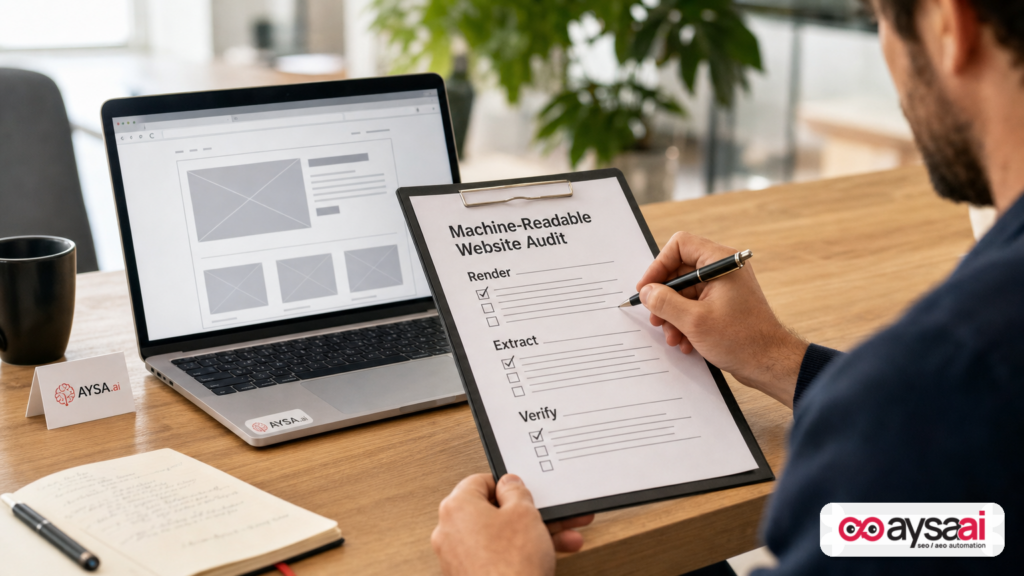
AI Overviews and LLM-based answers reward a different kind of SEO maturity: not hacks, not hidden signals—just content and Site architecture a machine can reliably fetch, parse, and corroborate. The most practical framework is a three-part audit:
- Render: The important content must exist in server-delivered HTML (not only client-side JavaScript).
- Extract: Answers must be structured so they can be lifted cleanly (headings, definitions, lists, tables, scoped FAQs).
- Verify: Your core facts must be consistent and provable across your own site (and supported by reputable external references where appropriate).
AYSA fits because AI Search Optimization is increasingly an execution problem: monitor changes, generate fixes, route for approval, and ship safe edits continuously. See: AI search visibility, monitoring, and AI SEO tools.
Key takeaways (for busy operators)
- Don’t wait for transparency. Even if ranking criteria become more visible, the work remains: make your site legible to machines.
- AI answer systems are picky about extraction. If the best answer is buried in narrative, you may not get cited—no matter how knowledgeable you are.
- Consistency beats cleverness. Conflicting location details, mismatched product specs, or vague claims are AI-search poison.
- Server-rendered content is a competitive edge. If important content doesn’t show up without JavaScript, many AI fetchers won’t see it reliably.
- Execution velocity matters. AI Search Behavior changes quickly; weekly Monitoring and approved changes beat quarterly “big SEO projects.”
Table of contents

- What changed: ranking opacity meets AI-first interfaces
- The new reality: AI answers are the interface, not the “10 blue links”
- Transparency is coming (maybe). Why it won’t save you
- The “machine-readable” audit: render, extract, verify
- 1) Render: if it’s not in HTML, it often doesn’t exist
- 2) Extract: write like a system that needs clean passages
- 3) Verify: make your claims provable (and your facts consistent)
- Content architecture for AI: fewer “posts,” more answer inventory
- What can go wrong: competitor leakage, misquotes, and brand drift
- SME scenario: a multi-location clinic that “disappears” in AI answers
- How to measure progress without hallucinating your own metrics
- What agencies should rethink: from deliverables to systems
- Where AYSA fits: monitoring + approved execution (not “set it and forget it”)
- What to do next: a 30/60/90-day execution plan
- Sources and further reading
What changed: ranking opacity meets AI-first interfaces
For years, SEO teams lived with a familiar kind of ambiguity. Google’s ranking systems were complex and constantly evolving, but at least the playing field was legible: you could see the search results page, you could compare pages side-by-side, and you could test changes with some confidence about what moved.
AI answers break that comfort.
Now, an increasing share of search journeys begin with a synthesized answer, not a list of candidates. When you’re cited, you may get a link and a moment of authority. When you’re not cited, users may never reach your site—even if you still “rank” somewhere in the classic results.
At the same time, the mechanisms behind AI answers are not transparent. The systems can pull from multiple sources, rewrite, compress, and blend. Even when they cite sources, the Attribution may be incomplete or inconsistent. And unlike classic ranking, there’s not always an obvious “position” to optimize for.
That’s why the premise in the Search Engine Journal piece matters: you can’t see how AI ranks you, so build what it can read (SEJ).
The biggest mindset shift is this: you’re no longer optimizing for a page of results. You’re optimizing for a system that must confidently extract and restate your facts.
The new reality: AI answers are the interface, not the “10 blue links”
In traditional SEO, the question was often: “How do I get the click?”
In AI search, the question becomes: “How do I become the answer?”
That single change has compounding effects:
- Compression pressure: AI answers compress your category into a few bullets. If your differentiator isn’t stated cleanly, it won’t survive compression.
- Attribution pressure: AI answers may cite a handful of sources. If you’re not among them, your brand is absent from the buyer’s first impression.
- Verification pressure: Systems prefer facts that can be corroborated. Vague superlatives (“best,” “leading”) don’t help, and can backfire if the answer compares options.
- Structure pressure: A system needs chunks: definitions, lists, steps, tables, and unambiguous statements.
This isn’t a call to write robotic content. It’s a call to stop hiding the most important business facts in formats machines struggle to extract.
Transparency is coming (maybe). Why it won’t save you
Regulators are starting to demand more accountability in how dominant search platforms rank and present information. The Search Engine Journal article highlights a UK regulatory action that pushes Google toward more transparency and objective criteria, including within AI-driven results (SEJ).
Even without quoting legal specifics beyond what’s in the provided research context, the direction is clear: governments want visibility, recourse, and fairness when a platform controls discovery for most businesses.
But here’s the business reality: transparency doesn’t automatically create advantage. It mostly removes myths.
In every era of SEO, once you remove myths, what remains is execution discipline:
- Can systems fetch your content reliably?
- Can they parse it into usable passages?
- Can they trust the facts enough to repeat them?
Those are upstream of any scoring rubric. And they’re largely under your control.
So yes—if regulators force more disclosure, that’s good for the ecosystem. But don’t make it your strategy. Make legibility your strategy.
The “machine-readable” audit: render, extract, verify
If you only take one framework from this editorial, take this one. It’s simple enough for a founder to understand, and specific enough for an SEO or developer to execute.
Render
Question: Does your meaningful content exist in the HTML that loads from the server?
If the page relies on client-side JavaScript to assemble the real content, many AI fetchers and some crawlers won’t see it consistently. That can lead to incomplete understanding, misclassification, or no citation at all.
Extract
Question: Can the system lift a self-contained answer from the page without reading the entire narrative?
If your answer is distributed across paragraphs, buried under UI tabs, or mixed with marketing fluff, the system may either skip you or restate you incorrectly.
Verify
Question: Are your defining facts consistent and corroboratable across your site and broader footprint?
If your own pages contradict each other—pricing, service area, product specs, address, policies—you’re teaching machines that your brand is unreliable.
This “render/extract/verify” triad mirrors the core argument from the SEJ source: what a machine can read, parse, and trust is what matters now (SEJ).
1) Render: if it’s not in HTML, it often doesn’t exist
Most SMEs don’t intentionally hide content from machines. It happens accidentally—through modern web stacks, heavy JavaScript frameworks, and “design-first” site builders that assemble content client-side.
Why this matters for AI search: Many systems that fetch web pages to answer questions operate more like simplified crawlers than like full browsers. If they don’t execute JavaScript (or don’t execute it reliably), they may receive a shell of a page.
Practical test (anyone can do this):
- Open your most important page (homepage, category page, top service page).
- Disable JavaScript in your browser (or use a text-mode/HTML viewer tool) and refresh.
- If your core content disappears—headings, product/service descriptions, pricing, FAQs—you have a machine-readability problem.
Common SME failure patterns:
- Service details only visible inside interactive accordions/tabs rendered by JS.
- Location pages that load address/hours via a script from a third-party widget.
- Product specs that only appear after selecting a variant, without server-rendered defaults.
- “Helpful” popups and overlays that obscure the core text, confusing extraction.
What to do (without starting a rebuild):
- Prioritize server-rendered HTML for your “answer pages”: the pages most likely to be cited.
- Move key facts above interactive layers. Use progressive enhancement: the content should be present even if JS fails.
- Ensure canonical pages have full copy and critical data in the initial HTML response.
If you’re on WordPress, this is often more achievable than you think—because the platform defaults to server-rendered content unless you’ve layered on heavy client-side components.
AYSA’s role here is operational: ongoing monitoring and alerts when critical pages change rendering behavior (e.g., a plugin update that moves content behind JS). See AYSA monitoring.
2) Extract: write like a system that needs clean passages
“Great content” for humans often looks like this:
- A long intro story
- Beautiful brand language
- Benefits sprinkled across sections
- The actual answer buried halfway down
That can convert well when a user is already on your page. But AI answers operate under a different constraint: they need to extract and restate quickly.
Your job is to reduce extraction friction.
What “extractable” content looks like
- Clear headings that match real questions. Use H2/H3 like “How long does X take?” or “What’s included in Y?”
- Definitions near the top. One or two sentences: “X is…”
- Lists and tables. Systems can lift bullet lists and tables more reliably than dense prose.
- Scoped FAQs. Not 60 generic questions—5 to 12 high-intent questions with concise answers.
- Step-by-step procedures. Especially for services, setup, returns, installations, and timelines.
What to avoid (because it produces bad AI answers)
- Competitive name-dropping as filler. If you list competitors without context, you may help the AI recommend them.
- Unbounded claims. “Best,” “#1,” “industry-leading” with no evidence invites skepticism or omission.
- Ambiguous language. “Usually,” “often,” “may include” without specifics can get compressed into something inaccurate.
Notice what we’re doing here: we’re not chasing a trick. We’re aligning with how machines work: extraction favors structure.
AYSA can support this by preparing restructuring suggestions and routing them for approval before changes go live—especially helpful if you’re coordinating marketing, legal, and product stakeholders. Explore AYSA AI SEO tools.
3) Verify: make your claims provable (and your facts consistent)
If AI search has a “new ranking factor,” it’s not magic. It’s confidence.
Confidence comes from consistency and corroboration.
Consistency: Your own site should not disagree with itself. If your homepage says “24/7 support,” your support page says “Mon–Fri,” and your footer says “9–5,” you’ve created a fact conflict. Machines don’t resolve conflicts like humans do; they hedge, omit, or choose randomly.
Corroboration: Some facts are inherently verifiable (address, phone, product dimensions). Others require proof (certifications, awards, research claims). If your business depends on trust—health, finance, safety, compliance—your site needs a higher standard of evidence and sourcing.
A practical “verifiability inventory” (start here)
Make a one-page list of the facts you want AI systems to repeat accurately:
- Business name, primary category, and who you serve
- Primary products/services (plain language)
- Service area / locations
- Hours, policies, pricing ranges (where feasible)
- Unique differentiators (what you do differently, not just “better”)
- Credentials, standards, compliance, or warranties (with proof pages)
Then ensure those facts are:
- Present on the site in crawlable HTML
- Repeated consistently on relevant pages (not only the homepage)
- Supported by details (bios, documentation, policy pages, citations to official standards where relevant)
Important note: This editorial avoids asserting specific studies or numeric impacts that aren’t included in the provided research context. If you want to lean on external datasets (e.g., controlled tests on schema or AI citations), bring the primary study links into your internal research pack before publishing those claims.
Content architecture for AI: fewer “posts,” more answer inventory
A lot of SMEs have a “blog strategy” that looks like this:
- Publish 2–4 articles per month
- Pick keywords with volume
- Hope rankings follow
AI search changes the value of that approach. Not because content doesn’t matter—it matters more than ever—but because fragmented content is harder to extract and trust.
What works better now
- Topic hubs with strong internal linking. One authoritative page that defines the topic, plus supporting pages answering sub-questions.
- Decision pages. “Which option is best for X?” “Cost vs. value” pages that help comparisons (and prevent competitor leakage).
- Proof pages. Case studies, methodology, QA, sourcing, and policies that reduce the need for the system to “take your word for it.”
- Entity clarity. Your brand, locations, products, and key people should have dedicated pages with consistent facts.
Think in “answer units”
Every page should contain one or more “answer units”—tight blocks of content that can be lifted verbatim:
- A two-sentence definition
- A list of included features
- A short eligibility checklist
- A table of tiers or options
- A step-by-step process
This doesn’t reduce creativity. It increases clarity—especially for non-branded discovery, where AI systems try to summarize the category quickly.
If you need a starting point for operationalizing this, AYSA’s workflow is designed to turn “we should restructure content” into shipped changes with approvals: monitor pages, propose improvements, and execute accepted edits. Start at AI search visibility or browse resources on the AYSA blog.
What can go wrong: competitor leakage, misquotes, and brand drift
AI search creates new brand risks that classic SEO didn’t emphasize as much.
1) Accidental competitor recommendations
If your content compares you to competitors poorly—especially if it lists competitor names with positive descriptors—you may be feeding the answer engine. Systems aren’t “loyal.” They’re trying to be helpful. If your page gives them a neat list of alternatives, they might use it.
2) Misquoted policies and pricing
If your policies are unclear, spread across PDFs, or inconsistent between pages, AI answers can compress them into something wrong. That’s not just a traffic problem—it’s a customer support and legal problem.
3) Location and service-area inaccuracies
Multi-location and service-area businesses are especially exposed. If one page says you serve a city and another implies you don’t, the system may hedge or omit your brand for that query.
4) “Brand drift” over time
As teams update sites, launch campaigns, and change product positioning, the site’s facts can drift. AI systems don’t know what changed; they only see the mess.
This is why monitoring matters as much as optimization. A machine-readable site is not a one-time project; it’s a maintenance discipline. That’s the core of AYSA monitoring.
SME scenario: a multi-location clinic that “disappears” in AI answers
Let’s make this real with a scenario I see constantly across SMEs—clinics, home services, dental groups, and multi-location retail.
Business: A regional clinic group with 8 locations.
Problem: When users ask AI-driven search experiences “Which clinic offers X treatment near me?” the AI answer lists competitors, even though the clinic ranks decently in traditional local search.
What’s usually happening (in plain English)
- The location pages are thin, inconsistent, or loaded via a widget.
- Services are described globally, but not tied to each location in a crawlable way.
- Doctor bios and credentials exist, but are hard to extract or scattered across PDFs.
- Hours, insurance accepted, and booking options vary by location but aren’t stated plainly.
The machine-readable fix (without replatforming)
Render: Ensure each location page contains server-rendered HTML for address, phone, hours, booking CTA, and core services.
Extract: Add a tight “Services at this location” block, plus 6–10 FAQs that match real patient questions (eligibility, duration, pricing ranges if appropriate, what to bring, etc.).
Verify: Make sure the same location facts appear consistently in the header/footer, location directory, and each location page. Ensure clinician credentials and licensing statements have a stable, crawlable page.
Outcome you’re aiming for: When a system composes an answer, it finds clean passages that state (a) this location offers the treatment, (b) who provides it, (c) what the process looks like, and (d) how to book—without guessing.
AYSA’s execution model fits this exact scenario because it requires lots of coordinated changes across many similar pages—high risk for human error. With AYSA, you can monitor all locations, prepare standardized improvements, request approvals, and execute changes consistently.
How to measure progress without hallucinating your own metrics
AI search creates measurement confusion because the traditional KPI—organic sessions—may not reflect influence. You can be cited in an AI answer and still see fewer clicks (because the answer satisfies the query). That doesn’t always mean you’re losing.
At the same time, you should not invent “AI visibility scores” without grounding them in observable behavior.
Use a balanced measurement stack
1) Your normal analytics (GA4): Track organic traffic trends, brand vs. non-brand segments, and landing pages that matter. If you don’t have GA4 set up cleanly, fix that first. (GA4 is referenced in the source context as part of AI testing methodology promotions; however, this editorial does not claim any specific GA4 technique beyond standard usage.)
2) Search Console: Monitor impressions/clicks for key query clusters and pages. Watch for shifts where impressions hold but clicks drop—this can indicate more “answer-first” behavior.
3) AI citation and mention monitoring: This is newer and less standardized. The goal is simple: track whether your brand and key pages are being used as sources in relevant AI answers. If you can’t reliably measure it with your current tools, treat it as qualitative sampling—consistent prompts, tracked outputs, documented citations.
What not to do
- Don’t attribute every movement to “AI Overviews.” Seasonality and site changes still matter.
- Don’t chase single-prompt wins. AI answers vary by phrasing, location, and context.
- Don’t optimize only for citations if your business needs conversions. Build answer pages that convert when clicked.
If you want AYSA’s perspective on building an operational measurement layer for AI search, start with AI search visibility and then connect monitoring to execution at Monitoring.
What agencies should rethink: from deliverables to systems
Agencies are under pressure because clients want certainty. “Tell me how to rank in AI Overviews.” But AI search isn’t a checklist deliverable—it’s a systems problem.
What breaks in the old model
- Quarterly audits. Too slow. AI interfaces and SERP layouts change faster than quarterly.
- One-off content briefs. If the site’s structure and facts are inconsistent, more content just adds more contradictions.
- PDF recommendations. Advice that doesn’t get implemented doesn’t exist.
What wins now
- Continuous monitoring. Detect drift in content, templates, and key facts.
- Approved execution workflows. Propose fixes, route approvals, implement safely, and track changes.
- Standardization. Especially for multi-location and ecommerce: templates that keep facts consistent.
This is exactly the “system builder” mentality implied by the SEJ framing: the work doesn’t change just because transparency improves; you still need a machine-legible site and an operational practice to maintain it (SEJ).
Where AYSA fits: monitoring + approved execution (not “set it and forget it”)
Most SEO tools tell you what’s wrong. The gap is turning that into shipped improvements—without breaking pages, without endless stakeholder loops, and without guessing which changes matter.
AYSA is built to close that gap with a simple operating model:
- Monitor the site and its search/AI visibility signals (Monitoring).
- Prepare recommended changes (technical + content structure) in a reviewable format.
- Ask for approval so teams keep control—especially important for regulated industries, pricing, and policy changes.
- Execute accepted changes on the website, continuously (see AI SEO tools).
This matters for AI search because the “render/extract/verify” work is not a one-time project. It’s an ongoing discipline. Pages change, templates change, product catalogs evolve, and facts drift. The winners won’t be the brands with the most SEO opinions. They’ll be the brands with the tightest execution loop.
If you’re evaluating whether AYSA is right for your team size and change frequency, start with pricing and then explore implementation patterns on the blog.
What to do next: a 30/60/90-day execution plan
Here’s a practical plan you can actually run—without waiting for regulatory timelines or platform announcements.
First 30 days: establish machine readability basics
- Pick 10 “AI answer target” pages. Typically: top services, top product categories, top location pages, and your about/trust pages.
- Rendering check: Validate that core content is present in server HTML (not dependent on JS).
- Extraction check: Add clear H2/H3 question headings and concise answer blocks.
- Facts check: Create your verifiability inventory and identify contradictions across pages.
- Set monitoring: Track changes and drift (start with AYSA monitoring).
Days 31–60: restructure content for AI-friendly extraction
- Build hub pages for your top 3 categories or services.
- Standardize templates (especially locations and product pages): consistent blocks for key facts.
- Add proof sections where trust matters: methodology, credentials, policy clarity.
- Reduce competitor leakage by rewriting comparison content to focus on decision criteria (not competitor brand lists).
Days 61–90: operationalize and scale
- Roll the pattern out to the next 50–200 pages depending on your site size.
- Create a change approval cadence (weekly or biweekly) so improvements ship consistently.
- Measure intelligently: track Search Console trends, GA4 outcomes, and a consistent AI answer sampling routine.
- Document your standards: one internal doc that defines how your site states facts (names, services, pricing language, location formatting).
AYSA can support this plan end-to-end: monitor, propose, route approval, and execute changes. Start with AI search visibility and AI SEO tools.
Sources and further reading
- Search Engine Journal (research lead): You Can’t See How AI Ranks You, So Build What It Can Read
- Search Engine Journal (context hub): SEO section
- Search Engine Journal (context hub): SEO News
- Search Engine Journal (context hub): Google Algorithm Updates (history)
- Search Engine Journal (context hub): Local SEO
- Search Engine Journal (context hub): On-Page SEO
Note on primary sources: The provided research context references UK regulatory action and other legal decisions, but does not include direct links to the CMA order or court rulings. If you want to cite those primary documents in this article, add the official URLs to the research pack before publication so we can link directly and accurately.
What to do next
- Audit your top 10 pages using the Render → Extract → Verify checklist.
- Fix any page where critical info disappears without JavaScript.
- Rewrite one key page into “answer units” (definition, bullets, steps, FAQs).
- Inventory your core business facts and remove contradictions across the site.
- Set up continuous monitoring and a weekly approval-and-ship cadence.
If you want AYSA to help operationalize this—monitor changes, propose fixes, and execute approved updates—start here:
Continue the AI search topic inside AYSA.
Use these pages to connect the article with AI SEO tools, AI visibility monitoring, AI Overviews and approved website execution.
Turn this topic into a website action plan.
Use these AYSA hubs to move from reading to technical fixes, AI visibility monitoring, research, glossary context and approval-first SEO execution.

