AI Search Visibility in 2026: The 10 Brand Signals That Get You Cited (and the Execution Plan to Fix What’s Missing)
AI search doesn’t “rank” brands the way blue links did. It retrieves, summarizes, and recommends—only when it trusts it can access, understand, and corroborate your brand. Here are the 10 signals winning brands share, what breaks most often for SMEs, and a practical, execution-first plan you can run with AYSA.

AI Search is forcing a hard reset on how brands earn visibility. It’s no longer just “ranking pages.” Increasingly, AI systems retrieve chunks of information, decide what’s trustworthy, and then recommend (or ignore) brands inside answers. That shift rewards a different kind of discipline: not hacks, not volume, but clarity, consistency, and verifiability.
This editorial is my execution-focused breakdown of the 10 characteristics AI-search-winning brands share, inspired by Aleyda Solis’ research and checklist (source). I’m adding what most SMEs and agencies actually struggle with: prioritization, operational workflows, and shipping changes without breaking the site.
Concise summary: If AI systems can’t access your content, isolate your key facts, connect them to a recognizable entity, and corroborate them across reputable sources, you won’t get cited—or you’ll be misrepresented. The good news: most of what works is built on durable SEO fundamentals, executed with more rigor.
Key takeaways
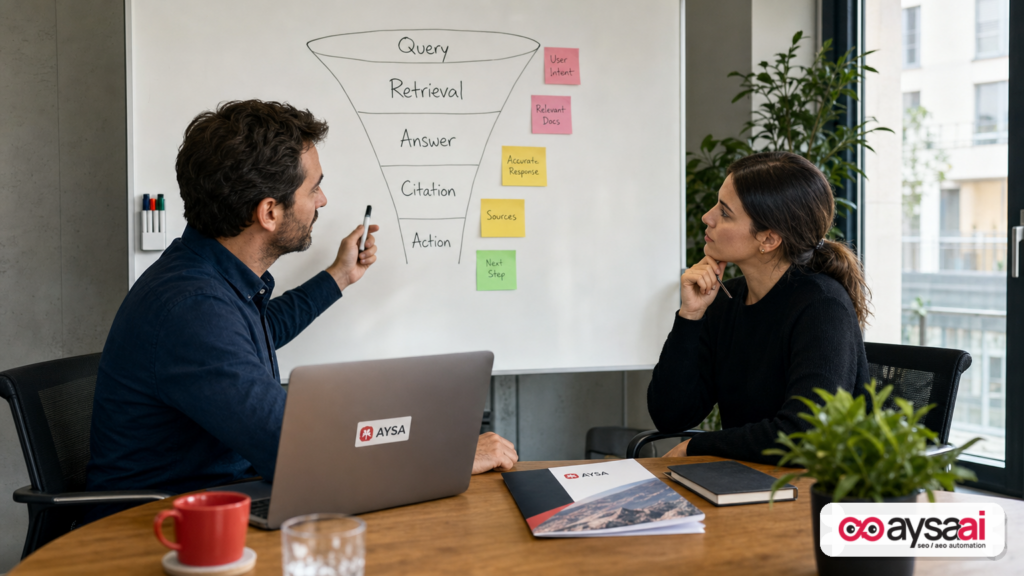
- AI visibility is retrieval + trust: accessible, extractable, consistent information that other sources confirm.
- Entity Clarity beats Keyword cleverness: if your brand isn’t recognizable and corroborated, AI answers will “choose” substitutes.
- SMEs lose on execution, not strategy: broken rendering, stale pages, inconsistent positioning, and weak Structured data are fixable.
- Ecommerce has an extra gate: product data must be machine-readable and synchronized across pages, schema, and feeds.
- Systems win: Monitoring + Approved Execution (prepare changes, ask for approval, deploy safely) is what sustains AI visibility over time.
Table of contents
- What changed: from ranking pages to being retrieved and recommended
- Why it matters for SMEs, ecommerce teams, and agencies
- The 10 brand signals AI systems reward (and how to operationalize each)
- A concrete SME scenario: the ecommerce brand that ‘disappeared’ from AI recommendations
- What can go wrong (and why AI makes the consequences worse)
- What to monitor weekly (the minimum viable AI visibility dashboard)
- The execution gap: why most AI search “strategies” fail
- A 30–60–90 day action plan
- Where AYSA fits: monitoring + prepared changes + approvals + execution
- What to do next
- Sources and further reading
What changed: from ranking pages to being retrieved and recommended

Traditional SEO trained us to think in “pages” and “rankings.” AI search experiences increasingly operate in “chunks,” “answers,” and “recommendations.” That subtle change has big implications:
- Retrieval-first: Your content has to be retrievable by crawlers and AI systems. If it’s blocked, hidden behind scripts, or inconsistent, it won’t be part of the candidate set.
- Answer assembly: Systems may pull multiple sources, synthesize them, and cite a few. You’re not competing for position 1—you’re competing to be one of the trusted inputs.
- Entity-centric understanding: AI systems prefer stable entities (brands, products, authors) with corroborated facts across the web.
- Reduced tolerance for ambiguity: If your pricing, policies, product names, or positioning vary across pages and profiles, it’s harder for a system to confidently recommend you.
In other words: AI doesn’t “reward” you for being clever. It rewards you for being machine-legible and verifiable.
Why it matters for SMEs, ecommerce teams, and agencies
When you’re a big brand, you can survive inconsistency. You have enough mentions, reviews, press, and branded demand to keep showing up. SMEs don’t get that luxury.
For SMEs, the risk is asymmetric:
- If you’re not retrieved: you’re invisible, even if you have the best offer.
- If you’re retrieved incorrectly: AI may summarize you with the wrong category, wrong service area, or outdated feature list—hurting conversions without you realizing.
- If competitors are more “machine-ready”: they become the default recommendation, even if they’re not objectively better.
Agencies face a parallel problem: clients still want “rankings,” but the deliverable is shifting toward entity, content structure, corroboration, and ongoing maintenance. That’s less glamorous—but more defensible.
And for ecommerce, there’s an additional layer: AI-assisted discovery and comparison is only possible when product data is complete, current, and consistent across page copy, structured data, and feeds.
The 10 brand signals AI systems reward (and how to operationalize each)
Aleyda Solis summarized 10 characteristics that show up in brands that consistently surface across AI search platforms (The 10 Key Characteristics of AI Search Winning Brands). I agree with the list—and I’d add one framing: these are not “nice to have.” They’re risk controls. Each characteristic reduces a specific type of AI failure:
- Failure to access you
- Failure to understand you
- Failure to trust you
- Failure to recommend you
1) Accessible
What it means: AI and search systems can crawl, render, retrieve, and parse your content.
Why it matters more now: In AI retrieval workflows, content that isn’t accessible simply doesn’t exist. This goes beyond “is the page live?” to questions like:
- Is the core content visible in the HTML, not only after client-side JavaScript?
- Are internal links crawlable (real anchor links) or hidden behind scripts?
- Is robots.txt or a CDN rule blocking important bots?
- Are product details exposed via structured data and/or feeds?
Operational checks:
- Use Google Search Console to spot indexing, crawling, and rendering issues.
- Compare raw HTML vs rendered output with crawlers (Screaming Frog/Sitebulb/JetOctopus are common options mentioned in the source).
- Review robots.txt, CDN bot rules, and server logs to confirm access patterns.
AYSA execution angle: Accessibility fixes are often straightforward but tedious (template changes, rendering adjustments, internal linking). This is exactly where an approved execution workflow matters: identify issues via monitoring, prepare the changes, get approval, and deploy safely. Start with AYSA Monitoring and align it to your crawl/index coverage.
2) Useful
What it means: Your content actually helps someone make a decision or solve a problem, with enough depth to be reference-worthy.
AI systems tend to cite content that provides:
- Direct answers and clear structure
- Evidence, examples, first-hand experience
- Complete coverage of a topic cluster (not isolated pages)
SME reality check: Most businesses have “marketing content” that says a lot but proves little. AI is less impressed by adjectives and more impressed by specifics: constraints, tradeoffs, comparisons, steps, policies, and definitions.
What to build:
- Decision-stage pages (pricing explanation, “who it’s for,” alternatives, implementation details)
- Problem-solving pages (symptoms → diagnosis → options; use cases → steps)
- Proof pages (methodology, process, standards, references, original research when possible)
AYSA execution angle: Use AI Search Visibility as your operating goal, then use AYSA to propose page improvements and internal linking changes, and ship what you approve. Your advantage isn’t “writing more.” It’s writing what AI can reuse and users can trust.
3) Recognizable
What it means: Your brand is a distinct entity that systems can identify and disambiguate.
This is where many SMEs quietly fail: the brand name varies, the “about” copy differs across platforms, leadership bios are missing, and the organization schema is incomplete. The result: AI answers may confuse you with similarly named businesses or describe you inaccurately.
How to strengthen recognizability:
- Use consistent naming (business name, product names, service names).
- Publish a clear About page with stable descriptions.
- Implement Organization schema and connect profiles with
sameAsreferences.
Reputable reference: Start with Google’s structured data documentation and testing tools (official guidance: Structured data in Google Search and Rich Results Test).
AYSA execution angle: Entity cleanup is a mix of content and technical: schema, About/Contact clarity, author pages, and consistency across templates. AYSA can prepare those changes and route them for approval before deployment.
4) Extractable
What it means: Your key information is easy for systems to isolate and reuse.
This is the hidden skill of AI visibility: your best insight may exist, but if it’s buried in a 2,000-word wall of text, it won’t get used. Extractability is how you write and structure for retrieval:
- Put the answer first (summary at the top).
- Use descriptive headings that match real questions.
- Keep one idea per paragraph.
- Use definitions, steps, comparisons, and FAQ blocks where appropriate.
Practical example: Instead of “We offer flexible shipping,” write a section titled “Shipping times and cutoff hours” and state the actual rules. Even if the user doesn’t read your whole page, AI can retrieve that chunk.
AYSA execution angle: Extractability is often a rewrite, not a replatform. AYSA can propose content restructuring (headings, summaries, FAQ blocks, internal links), then execute the approved changes consistently across templates and pages.
5) Consistent
What it means: Your brand facts and positioning match across your site and external profiles.
AI systems build confidence through repeated aligned signals. Inconsistency creates uncertainty, and uncertainty reduces recommendations.
Common inconsistency traps:
- Different service names on the homepage vs pricing vs blog.
- Old category labels on LinkedIn or directories.
- Schema fields that don’t match visible content (e.g., wrong address, outdated descriptions).
- Multiple “versions” of your value proposition across landing pages.
What to do: Create a one-page “source of truth” doc for naming, positioning, categories, and descriptions. Then propagate it.
AYSA execution angle: Consistency is ongoing work. With monitoring, you can detect drift (stale pages, mismatched metadata, broken schema) and then deploy consistent updates through an approval workflow.
6) Corroborated
What it means: Other reputable sources validate what you say about yourself.
This is where “entity authority” becomes real. AI systems are hesitant to amplify claims that exist only on your own website. Corroboration comes from:
- Relevant industry publications mentioning your brand or experts
- Professional associations and directories
- Quality reviews and third-party profiles
- Original research that others cite
Important constraint: You can’t force AI systems to cite you. But you can increase the probability by increasing the number of reputable, consistent confirmations of your expertise.
AYSA execution angle: AYSA won’t magically create PR, but it can ensure your site is ready to benefit from it: proper author bios, citations, linkable assets, and clean entity schema—so when you earn mentions, the system can connect the dots.
7) Credible
What it means: Your own site demonstrates expertise and trust with identifiable authors, sourcing, and evidence.
Credibility is not a badge you add. It’s a set of signals you repeatedly publish:
- Named authors with real bios
- Editorial standards and review processes (especially for sensitive topics)
- Citations to reputable references where claims matter
- First-hand analysis (tests, benchmarks, teardown explanations)
Official reference point: Google’s guidance on creating helpful, people-first content is a solid baseline (Creating helpful, reliable, people-first content).
AYSA execution angle: Credibility improvements often require systematic template updates (author boxes, editorial notes), plus content edits. AYSA can propose those updates across your site, then implement only what you approve.
8) Differentiated
What it means: AI systems can describe why your brand is distinct—without resorting to generic category clichés.
If your positioning sounds like everyone else’s (“best quality,” “great service,” “innovative”), AI has no reason to select you as a distinct recommendation. Differentiation that’s easier for AI to represent includes:
- A named framework or method
- A specialized niche (specific industry, use case, geography)
- A transparent process (steps, standards, guarantees)
- Proprietary research or data
Plain-language test: Can a customer explain your difference in one sentence without using vague words?
AYSA execution angle: Once you define differentiation, it has to be repeated consistently across core pages—homepage, category pages, service pages, About, and key FAQs. AYSA helps operationalize that repetition without turning it into spam.
9) Fresh
What it means: Your most important information stays current, and you signal updates clearly.
Freshness matters most when topics change: product features, pricing, policies, regulations, best practices. AI systems that consider recency will prefer up-to-date sources for time-sensitive queries.
Freshness isn’t “posting more.” It’s maintaining your core assets:
- Update key pages on a schedule
- Refresh statistics, screenshots, examples
- Consolidate obsolete pages instead of letting them rot
- Use accurate publish and “last updated” dates when appropriate
AYSA execution angle: Freshness requires a maintenance engine. AYSA monitoring can detect pages that drift out of date (broken links, outdated snippets, missing schema, changes in internal linking), and then prepare updates for approval.
10) Transactable (ecommerce)
What it means: Your product information supports AI-assisted discovery, comparison, and commerce flows.
If you sell products online, you’re not just publishing content—you’re publishing structured truth: price, availability, variants, shipping, returns, and merchant policies. If these are inconsistent across feeds and pages, AI systems can’t safely recommend you.
What “good” looks like:
- Valid Product structured data on product pages
- Consistent price/availability between page copy, schema, and feeds
- Clear shipping and returns information
- Fast updates when inventory or pricing changes
Official reference: Start with Google’s product structured data documentation (Product structured data). If you use Merchant Center, keep feeds synchronized and validated (official entry: Google Merchant Center).
AYSA execution angle: Ecommerce teams don’t lose because they lack ideas; they lose because feeds and templates drift. AYSA can monitor for mismatches and propose fixes—then implement approved updates safely, without breaking checkout or templates.
A concrete SME scenario: the ecommerce brand that ‘disappeared’ from AI recommendations
Imagine a 15-person ecommerce brand selling specialty home coffee gear. They used to do well in organic search with detailed category pages and product guides. Then, customers started saying: “I asked an AI assistant what grinder to buy, and it recommended other stores.”
No penalty. No sudden traffic cliff. Just a slow loss of mindshare inside AI-driven recommendations.
Here’s what usually causes that “disappearance”:
- Accessibility issue: key product details are injected via JavaScript and not reliably present in rendered HTML for bots.
- Extractability issue: buying guides are long essays without scannable comparisons; the “answer” is hidden.
- Consistency issue: shipping/returns differ between PDPs, footer policies, and FAQ pages.
- Transactable issue: schema says “in stock,” the page says “backorder,” and feeds are a day behind.
- Corroboration gap: few independent mentions in relevant coffee communities or publications; competitors are referenced more often.
The fix isn’t a single trick. It’s a sequence:
- Make key pages reliably crawlable and renderable.
- Restructure guides into extractable sections (top summary, tables, FAQs).
- Standardize shipping/returns truth and propagate everywhere.
- Validate Product schema and fix feed/page mismatches.
- Publish one genuinely cite-worthy asset (e.g., a testing methodology for grinders) and pitch it to relevant outlets.
This is the work that wins in AI search: turning your site into a dependable source of truth.
What can go wrong (and why AI makes the consequences worse)
AI search introduces failure modes that traditional SEO didn’t amplify as much:
- Misrepresentation: AI summarizes your offer incorrectly (wrong pricing model, wrong service area, wrong category). If you don’t monitor it, you may never notice.
- Entity confusion: Similar brand names or inconsistent naming causes conflation.
- Stale citations: Old pages get reused because they’re structured well—even if they’re outdated.
- Winner-takes-most citations: In many AI interfaces, only a few sources are cited. Being “top 10” is no longer a comfortable place to be.
- Operational drift: A redesign, CMS plugin, or script change can silently break accessibility or structured data.
That’s why AI visibility is less a campaign and more an operating system.
What to monitor weekly (the minimum viable AI visibility dashboard)
If you’re an SME, you don’t need a complex observability stack. You need a short list of leading indicators that warn you when AI systems may stop trusting you.
Weekly monitoring checklist:
- Indexing and crawl health: coverage changes, spikes in errors, render problems (via Google Search Console).
- Structured data validity: new errors/warnings in key schemas (Organization, Product where relevant).
- Critical page changes: unintended template changes that remove headings, summaries, internal links, or policy sections.
- Top commercial pages freshness: pricing, shipping/returns, service descriptions updated when reality changes.
- Brand representation checks: periodic prompting on major AI platforms to see how your brand is described (note: results vary; treat as a qualitative audit, not a KPI).
This is exactly why we built AYSA Monitoring: you can’t improve what you don’t continuously observe, and AI search raises the cost of silent breakage.
The execution gap: why most AI search “strategies” fail
Most AI search advice is strategy-heavy and execution-light. But SMEs don’t fail because they didn’t read a list of best practices. They fail because implementation stalls:
- Changes require developer time
- Marketing and product disagree on copy and positioning
- Schema updates are scary (“Will it break something?”)
- No one owns the “last 10%” (internal linking, headings, template consistency)
AI visibility work is also cross-functional by nature. It touches:
- Engineering (rendering, performance, crawlability)
- Content (usefulness, extractability, freshness)
- Brand (recognizability, consistency, differentiation)
- PR/partnerships (corroboration)
If you don’t have a system that translates audits into approved changes that actually ship, you’ll stay stuck in the “we should” stage.
A 30–60–90 day action plan
This plan is designed for SMEs and lean teams. It prioritizes the “price of admission” first, then builds authority and differentiation.
Days 1–30: Fix access, entity clarity, and extractability
- Accessibility audit: confirm key pages render as crawlable HTML; remove accidental blocks; fix internal linking discoverability.
- Structured data baseline: implement/validate Organization schema; for ecommerce, validate Product schema on top SKUs first.
- Extractability upgrades: add concise summaries to top pages; rewrite headings to match questions; break long sections into standalone chunks.
- Consistency doc: create a “source of truth” for naming and positioning; update core pages to match.
AYSA workflow: Use AYSA to monitor the site, generate recommended fixes, and deploy approved updates. Start here: AYSA AI SEO Tools.
Days 31–60: Build usefulness, credibility, and freshness routines
- Topic system: organize content into clusters around what you want to be known for (not random blog posts).
- Credibility signals: author bios, editorial review notes, citations where claims matter, clear company info.
- Freshness schedule: identify 10–30 “money pages” and set update cadence; add accurate updated dates where appropriate.
- Internal linking: connect cluster pages and decision-stage pages so systems see a coherent body of knowledge.
AYSA workflow: Use AI Search Visibility as the north star and push ongoing improvements through the approval pipeline—so maintenance doesn’t get postponed indefinitely.
Days 61–90: Differentiate and earn corroboration
- Name your method: publish a framework, process, or standard that is uniquely yours (and repeat it across key pages).
- Create one linkable, cite-worthy asset: original research, a benchmark, a dataset, a teardown guide, or a transparent methodology.
- Corroboration push: partner, contribute, and pitch—aiming for mentions that connect your brand with your core topics.
- For ecommerce: reduce feed/schema/page mismatches and tighten update frequency for price/stock changes.
AYSA workflow: Corroboration is earned externally, but it pays off only if your internal entity signals are clean. Use AYSA to keep your site consistent while external mentions accumulate.
Where AYSA fits: monitoring + prepared changes + approvals + execution
Here’s my blunt view: the future belongs to businesses that can execute small improvements continuously. AI search is too dynamic for “quarterly SEO projects” that never ship.
AYSA is built as an execution system for SEO/AEO/GEO work:
- Monitors your site for issues and opportunities (Monitoring).
- Prepares specific changes (technical, content, internal links, structured data improvements).
- Asks for approval so you stay in control.
- Executes accepted changes so work doesn’t die in a backlog.
That model matters because the 10 characteristics aren’t a one-time checklist. They’re a maintenance posture. Every redesign, new product line, and content push can either strengthen or erode your AI visibility.
If you want to explore what that looks like operationally, start with:
- AI Search Visibility (the outcome)
- AI SEO Tools (the execution toolkit)
- Monitoring (the safety net)
- Pricing (how teams adopt it)
- Blog (ongoing playbooks)
What to do next
- Pick 10 pages that matter most (top revenue pages + top informational entry points).
- Audit the 10 signals against those pages: accessibility, usefulness, recognizability, extractability, consistency, corroboration, credibility, differentiation, freshness, and (if ecommerce) transactability.
- Fix “price of admission” issues first: crawl/render, schema validity, inconsistent facts, and extractability.
- Create one differentiating asset you can own for years (framework, benchmark, methodology).
- Set a maintenance cadence (monthly updates for core pages, weekly monitoring checks).
- Operationalize execution so improvements ship: use AYSA to monitor, prepare changes, route approvals, and deploy accepted updates.
Sources and further reading
- Aleyda Solis: The 10 Key Characteristics of AI Search Winning Brands [With an Assessment Checklist]
- Checklist referenced in the source: AI Search Winning Brands Assessment Checklist (Google Sheet)
- Google Search Console: Search Console
- Google: Structured data in Google Search
- Google: Rich Results Test
- Google: Product structured data
- Google Merchant Center: Merchant Center
- Google: Creating helpful, reliable, people-first content
Note: AI search platforms and features change frequently. Where platform-specific capabilities (like direct commerce integrations) aren’t clearly documented in the supplied research context, treat them as emerging directions rather than guaranteed channels. Focus on the durable fundamentals above—the same ones AI systems keep rewarding.
Continue the AI search topic inside AYSA.
Use these pages to connect the article with AI SEO tools, AI visibility monitoring, AI Overviews and approved website execution.
Turn this topic into a website action plan.
Use these AYSA hubs to move from reading to technical fixes, AI visibility monitoring, research, glossary context and approval-first SEO execution.