
AI As a Tool vs AI As a System: The New SEO Gap (And How SMEs Can Close It Without Burning the House Down)
Most businesses are using AI like a faster intern. A small minority is rebuilding workflows so AI can reliably execute, measure, and improve outcomes. That gap is now showing up in search visibility, content performance, and operational efficiency—and it’s widening. Here’s how to move from prompts to systems, with a practical plan for SMEs and agencies.
By Marius Dosinescu (AYSA.ai)
AI is no longer a novelty in marketing. It’s table stakes. But there’s a brutal truth most teams haven’t internalized: using AI often is not the same thing as using AI well. And using AI well is not the same thing as building a system where AI consistently improves outcomes—search visibility, conversion, revenue—without creating brand, legal, or operational risk.
New research highlighted by Search Engine Journal points to a widening maturity gap: most organizations still use AI as a tool, while a small minority have embedded AI into systems—integrated workflows, governance, and measurement—that change how work gets done end to end. That difference is already showing up in who wins in AI-shaped search experiences, where answers are synthesized, citations are selective, and “ranking” is only part of the story.
This editorial is a practical guide for small and midsize businesses (SMEs), in-house marketers, and agencies that want to move from “we tried AI” to “AI is part of how we operate”—without turning their website into an experiment that breaks.
Concise summary
- The next SEO moat isn’t prompt engineering. It’s building an execution system: monitor → propose → approve → implement → measure.
- AI Search changes the ROI model. Visibility can rise while Clicks fall; citations, Brand Mentions, and “answer inclusion” become new battlegrounds.
- The 12% advantage isn’t magic. It comes from integration, governance, and real metrics—not self-reported “time saved.”
- SMEs can compete. You don’t need autonomous agents running your business—you need repeatable workflows on the few pages and data sources that actually drive demand.
- AYSA fits as the safe middle layer. It monitors, prepares changes, asks for approval, and executes accepted updates—so you get system benefits without uncontrolled automation.
Key takeaways (print this for your next team meeting)
- Tool use scales output; systems scale outcomes. Output is content volume, drafts, ideas. Outcomes are qualified traffic, leads, bookings, sales, retention.
- AI in SEO is shifting from creation to orchestration. The winners will have cleaner data, tighter page templates, faster fixes, and better feedback loops.
- Governance is not a legal formality—it’s a growth lever. Clear rules reduce rework, brand risk, and “silent damage” to conversion.
- Measurement must evolve. If you can’t tie AI work to quality and workflow metrics (and then to business impact), you’re stuck in the early stage.
- Approved Execution beats autopilot. For most brands, the right automation model is: propose changes automatically, approve intentionally, execute reliably.
Table of contents
- The system-building gap: what the 88% are missing
- Why this matters for SEO, AEO, and “AI search visibility”
- What changed in search: from rankings to answers to actions
- The new competitive advantage: integration, governance, measurement
- Where teams get stuck (and why “more AI” makes it worse)
- Smarter automation, not more automation: what to systematize first
- A concrete SME scenario: from “we tried AI” to “AI runs the checklist”
- What agencies must rethink: deliverables, pricing, and accountability
- Measurement that matters: quality + workflow + business impact
- Governance without bureaucracy: practical guardrails for SMEs
- Where AYSA fits: approved execution for AI-era SEO
- The 30–60–90 day action plan
- What to do next
- Sources and further reading
The System-Building Gap: What the 88% Are Missing
Search Engine Journal covered a global study discussed by Greg Jarboe showing that most organizations are still using AI as an individual productivity tool, while only a small minority have built AI into systems that reshape workflows and business processes. Read the source here: Search Engine Journal – 88% Of Companies Use AI As A Tool, Only 12% Built A System.
That framing—AI as a tool vs AI as a system—is the clearest way I’ve found to explain why so many “AI initiatives” feel productive but don’t move the business.
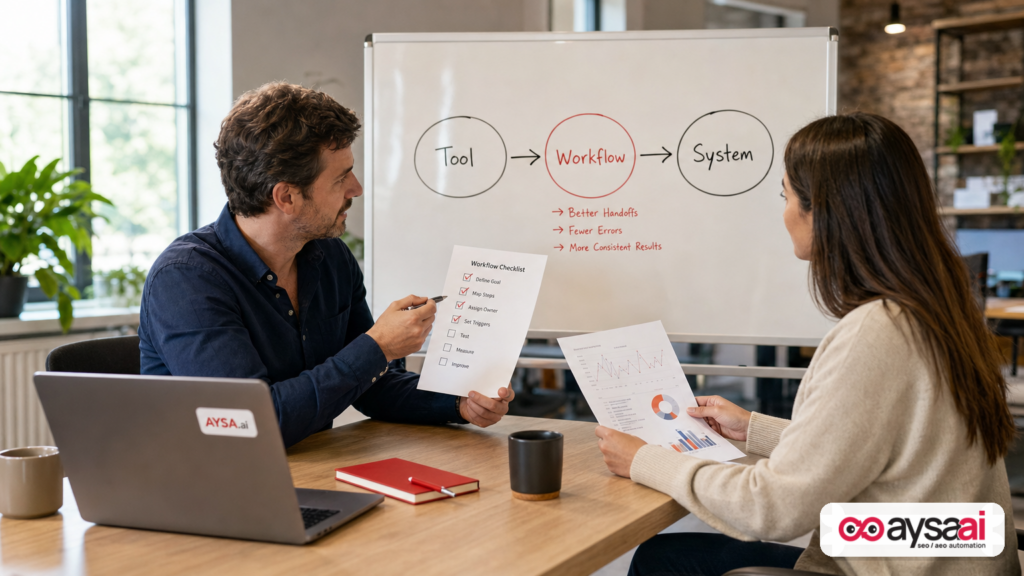
Tool vs system in plain English
- AI as a tool means: someone opens a chat box, asks for help, copies output, pastes it into a doc/CMS, and hopes it performs.
- AI as a system means: AI is embedded into the workflow with rules, data inputs, approvals, integrations, QA, and measurement—so improvements happen repeatedly, not randomly.
Most companies are doing the first. The minority are doing the second. And that’s why the gap is widening: systems compound. Tools don’t.
What compounds (and what doesn’t)
Tool usage compounds activity: more drafts, more posts, more variants. But without a system, volume creates three predictable outcomes:
- Quality variance: some outputs are decent; others quietly damage trust.
- Operational drag: more editing, more rework, more alignment meetings.
- Measurement fog: you can’t prove which changes improved performance.
System usage compounds learning. Each cycle improves inputs, templates, Internal linking, schema, page structure, topical coverage, location data accuracy, product attributes, and performance reporting. Over time, that makes a site easier for both humans and machines to understand—and easier for your team to maintain.
Why This Matters for SEO, AEO, and “AI Search Visibility”
If you run a business, you might not care about maturity models. You care about outcomes:
- “Are we showing up when customers search?”
- “Are we being mentioned in AI answers?”
- “Are we getting leads, bookings, and sales?”
AI is changing the environment in which those outcomes happen. In the classic model, you optimized pages to rank, earned clicks, and converted visitors. In the new model, customers may get a synthesized answer first. They might click less. They might compare fewer vendors. They might be influenced by citations or brand mentions you never tracked.
That doesn’t mean SEO is dead. It means SEO is becoming more operational—and more system-driven. The brands that win won’t just write content. They’ll maintain clean, structured, continuously updated knowledge about their products, services, locations, policies, and expertise.
At AYSA, we talk about AI search visibility because it captures the shift: you’re optimizing not only for rankings, but for being understood, trusted, and retrieved by AI systems that generate answers.
A quick translation: SEO vs AEO vs GEO
- SEO (Search Engine Optimization): improving visibility in traditional search results.
- AEO (Answer Engine Optimization): improving inclusion and representation in AI-generated answers.
- GEO (Generative Engine Optimization): a broader term often used for optimizing across generative AI discovery experiences.
You don’t need to obsess over acronyms. You need to build a system that keeps your website and business facts accurate, structured, and compelling—at scale.
What Changed in Search: From Rankings to Answers to Actions
For two decades, SEO taught businesses a mental model that worked: “Rank higher, get more clicks.” That model is now incomplete.
AI-driven search experiences are pushing three shifts:
Shift 1: From ten blue links to fewer decisions
When an AI system summarizes options, users may not browse as broadly. That can reduce click-through for some queries, even when visibility is “high.” If your performance reports only track classic organic traffic, you may under-measure your real brand presence—or overestimate it.
Shift 2: From “page authority” to “knowledge reliability”
In AI answers, it’s not just whether a page is relevant. It’s whether the underlying information is consistent, well-structured, and corroborated across sources. That’s why governance and data hygiene are becoming SEO issues, not just content issues.
Shift 3: From publishing to maintaining
Historically, teams treated publishing like the finish line: launch the page and move on. In AI search, maintenance becomes the moat. AI models and retrieval systems will surface whatever is most consistent and easiest to trust. If your FAQs are outdated, your policies unclear, your location data inconsistent, or your product specs missing, AI will fill gaps with other sources—or competitors.
This is exactly why “AI as a system” matters. Search is no longer just a marketing channel. It’s an operational mirror.
The New Competitive Advantage: Integration, Governance, Measurement
The study described in the SEJ article emphasizes that advanced adopters separate themselves with three behaviors: integration, governance, and measurement. You don’t need to memorize the percentages to understand the principle. You just need to recognize that these are the ingredients of any system that scales.
1) Integration: stop copy-pasting your way to “AI transformation”
If your process is “ask ChatGPT → paste into Google Doc → paste into CMS,” you’re not building a system. You’re outsourcing drafting. The weakness isn’t AI. The weakness is the lack of operational wiring:
- No structured inputs (briefs, templates, brand rules).
- No connection to performance data (what actually worked).
- No linkage to inventory, pricing, policies, or location facts.
- No audit trail of changes (what changed, when, and why).
Systems connect the dots. In SEO, those dots include your CMS, your analytics, your product data, your location data, and your QA checks.
2) Governance: the difference between speed and recklessness
Governance sounds like something only enterprises need. That’s a misconception. SMEs often have more to lose per mistake: fewer reviews, less brand equity, tighter margins, and smaller teams. One wrong claim on a medical clinic page, one outdated return policy, one incorrect shipping promise—these aren’t “content issues.” They are trust issues and revenue issues.
Governance doesn’t mean a 40-page policy. It means:
- Who can approve changes?
- What categories require stricter review (health, finance, legal, pricing)?
- What sources of truth must be referenced?
- What gets logged and measured?
3) Measurement: move beyond “we saved time”
Time savings are real—but they’re also a trap. If the only ROI you can articulate is “we produce content faster,” you’re in a fragile position. Faster content that doesn’t rank, convert, or get cited is just faster waste.
Systems measure:
- Quality: error rate, factual consistency, reduction in revisions, compliance checks passed.
- Workflow: cycle time from idea → published → updated, throughput, backlog reduction.
- Business impact: leads, bookings, revenue, assisted conversions, reduced churn, fewer support tickets.
If you’re serious about “AI search visibility,” measurement is not optional. It’s the steering wheel.
Where Teams Get Stuck (And Why “More AI” Makes It Worse)
I see the same failure pattern across SMEs and agencies:
Failure mode 1: Confusing activity with progress
AI increases activity. That feels like progress. But SEO rewards compounded clarity—clean information architecture, clear page intent, consistent internal linking, structured data, and reliable updates.
When activity increases without a system, you get “content sprawl”: too many pages targeting similar queries, inconsistent positioning, and internal cannibalization. In AI answers, that sprawl can make your brand easier to misrepresent.
Failure mode 2: Treating AI like a writing machine, not an operating model
Most teams start with content generation because it’s visible and easy. But the biggest AI advantage in SEO isn’t writing—it’s operational follow-through:
- Finding broken or outdated pages.
- Identifying missing schema and metadata.
- Improving internal links and topical hubs.
- Keeping product and location data accurate.
- Detecting sudden ranking/visibility shifts and responding quickly.
This is where systems win: they make the boring work repeatable.
Failure mode 3: No approval model
Unapproved automation is how brands get burned. Fully manual workflows don’t scale. The practical middle ground is approved execution: AI prepares changes; humans approve; the system executes and logs what happened.
That model is the backbone of how we think about AYSA: monitor what’s happening, prepare the right fixes, ask for approval, then execute reliably.
You can explore the broader concept here: AYSA AI SEO tools.
Smarter Automation, Not More Automation: What to Systematize First
Most businesses ask the wrong first question: “How do we use AI more?”
The right question is: “Which recurring workflow, if systematized, would reduce risk and increase performance every month?”
Start with high-frequency, high-leverage, low-drama workflows. Here are strong candidates for SMEs:
1) Website hygiene that AI search punishes when it’s sloppy
- Duplicate or thin pages that confuse intent.
- Outdated FAQs, policies, shipping details, pricing language.
- Missing or inconsistent structured data (where appropriate).
- Broken internal links, orphan pages, messy navigation.
This is where a monitoring-first approach matters. If you don’t detect issues early, your “AI content engine” just produces more surface area to maintain.
See how we think about this at a system level: AYSA Monitoring.
2) Updating your highest-value pages on a schedule
Pick 10–50 pages that drive most of your leads or revenue (category pages, service pages, location pages, top blog posts). Build a system to:
- Monitor performance signals and visibility changes.
- Propose improvements (clarity, structure, internal links, FAQs, schema, media).
- Approve and ship changes with an audit trail.
- Measure impact after 2–4 weeks.
That’s a system. And SMEs can absolutely do it.
3) Creating “citation-ready” content assets
AI answer systems tend to cite content that is structured, specific, and unambiguous. “Citation-ready” content typically includes:
- Clear definitions and comparisons.
- Step-by-step processes.
- Original expertise (real operational details, not generic tips).
- Tables, FAQs, and consistent terminology.
This is not about pumping out 200 posts. It’s about building a small library of high-utility pages that are easy to retrieve and summarize accurately.
4) Internal linking as a governed system (not a one-off task)
Internal linking is one of the most under-systematized SEO levers. Everyone knows it matters. Few teams maintain it. A system approach:
- Defines hub pages and spokes.
- Enforces consistent anchor patterns.
- Updates links when new pages are published.
- Checks for orphaned pages monthly.
When AI-generated answers rely on understanding your site’s topical structure, internal linking is not “basic SEO.” It’s your site’s semantic wiring.
A Concrete SME Scenario: From “We Tried AI” to “AI Runs the Checklist”
Let’s make this real with a scenario that mirrors what I see constantly.
Scenario: a mid-size ecommerce brand in a competitive category
Imagine a specialty ecommerce store doing $2–10M/year. They sell products with technical specs (materials, sizing, compatibility). Their team is lean:
- Owner + ops manager
- One marketer who also runs email and social
- A freelance writer or agency
They “adopt AI” by generating product descriptions, blog posts, and ad variations. Output goes up. But results plateau because the real bottlenecks are operational:
- Top category pages are inconsistent and outdated.
- FAQs don’t match actual support questions.
- Specs differ between product pages and documentation.
- Internal links are random and rarely updated.
- No one can confidently say which changes improved rankings or conversion.
The system fix (not the “write more” fix)
Instead of publishing 50 new blog posts, they implement a monthly execution loop:
- Monitor the top 50 revenue pages for visibility and quality issues.
- Prepare specific improvements: clarify spec tables, add compatibility FAQs, improve headings, add internal links, add schema where appropriate.
- Approve changes: the owner approves anything policy/pricing-related; the marketer approves content and structure.
- Execute updates reliably with an audit trail.
- Measure with two lenses: (a) search visibility and (b) conversion/support impact.
Within a few cycles, three things happen:
- Content becomes consistent, which makes it easier for AI systems to represent accurately.
- The site becomes easier for humans to navigate and trust.
- The team stops arguing about “AI productivity” and starts managing business outcomes.
This is what “AI as a system” looks like at the SME level. No science fiction required.
What Agencies Must Rethink: Deliverables, Pricing, and Accountability
Agencies are in a tough spot. AI can reduce the time required to produce deliverables—audits, outlines, drafts, even code snippets. That pressures pricing if the value proposition is “hours worked.”
The agencies that survive and grow will reposition around systems and outcomes:
Agency shift 1: From projects to managed execution loops
A “content sprint” is less valuable than an ongoing system that maintains the pages that matter. Agencies can package:
- Monthly monitoring + prioritized fixes
- Approved execution workflows
- Measurement and reporting that ties to business KPIs
Agency shift 2: From deliverables to decision support
AI can generate 20 page titles. The hard part is deciding which one aligns with positioning, conversion, and compliance. Agencies can become the decision layer: what to ship, what not to ship, what to test, what to measure.
Agency shift 3: From “SEO work” to “search operations”
In AI-shaped search, SEO touches:
- Content operations (briefs, templates, approvals)
- Web operations (publishing, QA, performance)
- Analytics operations (measurement, attribution, forecasting)
That’s an operations problem. And operations is where systems win.
If you’re an agency leader, it’s worth following the evolving conversation on AI’s impact in SEO and marketing operations via reputable industry publications like Search Engine Journal’s broader coverage: SEJ – SEO and SEJ – News.
Measurement That Matters: Quality + Workflow + Business Impact
If your AI initiative can’t be measured, it’s not a system. It’s a vibe.
Here’s a practical measurement stack that works for SMEs without building a data warehouse.
1) Quality metrics (reduce silent damage)
- Factual error rate: percent of sampled pages with inaccuracies found in QA.
- Revision rate: how many edits a page needs before publish.
- Compliance flags: instances of risky claims (health, finance, guarantees).
2) Workflow metrics (turn SEO into operations)
- Cycle time: from issue detected → fix shipped.
- Throughput: number of meaningful updates shipped per month.
- Backlog age: how long critical issues sit unresolved.
3) Business metrics (what you’re actually paid to improve)
- Leads/bookings/sales from organic and assisted organic.
- Conversion rate on pages you updated.
- Support tickets tied to confusion (shipping, returns, compatibility, pricing).
Notice what’s missing: “we think we saved 10 hours.” That’s fine as an internal note, but it’s not a strategy.
Governance Without Bureaucracy: Practical Guardrails for SMEs
Governance isn’t about slowing down. It’s about preventing the two killers of AI adoption:
- Risk events that force leadership to ban AI.
- Rework that erases time savings.
Guardrail 1: Define “high-risk pages”
Create a short list of page types that require stricter review:
- Medical/health advice, clinic service claims
- Financial claims, guarantees, pricing promises
- Legal policies, terms, refunds, warranties
- Anything tied to safety, compliance, or regulated industries
Guardrail 2: Source-of-truth inputs
AI should not “invent” your business facts. Maintain a source-of-truth document or dataset for:
- Business name, address, phone, hours
- Service boundaries, shipping regions
- Product specs and compatibility
- Policies and guarantees
Guardrail 3: Approval and audit trails
Every meaningful website change should have:
- A proposed change (what will be edited)
- A reason (what problem it solves)
- An approver (who is accountable)
- A timestamp and changelog (what shipped)
This is one reason I believe approved execution is the safest path for most SMEs: it captures speed without surrendering control.
Where AYSA Fits: Approved Execution for AI-Era SEO
There’s a missing layer in most AI adoption: the execution layer.
Businesses are experimenting with AI tools (drafting, summarizing, brainstorming). Meanwhile, their websites—where revenue happens—still rely on manual publishing, scattered checklists, and slow, inconsistent updates.
AYSA is designed to bridge that gap as an SEO/AEO/GEO execution system that:
- Monitors visibility and site signals (so issues don’t hide).
- Prepares recommended website changes (so you’re not starting from scratch).
- Asks for approval before changes go live (so you stay in control).
- Executes accepted changes consistently (so your system actually ships work).
That’s “AI as a system” in the only place that matters: your operational workflow.
If you want a starting point, here are a few relevant AYSA pages:
- AI SEO tools (what the system helps automate safely)
- AI search visibility (what visibility means in AI-driven search)
- Monitoring (why detection is step one)
- Pricing (how to evaluate a system vs piecemeal tools)
- Blog (ongoing strategies and playbooks)
Important: “execution system” doesn’t mean “set it and forget it.” It means you operationalize improvement. You replace random work with repeatable cycles.
The 30–60–90 Day Action Plan
If you’re an SME or agency and want to move from tool usage to system usage, here’s a realistic plan that doesn’t require rebuilding your entire stack.
Days 1–30: Diagnose and choose one workflow
- Inventory your reality: list the top 20 pages that drive leads/revenue.
- Map your workflow: how does an update go from idea → live today? Write it down.
- Pick one recurring workflow to systematize (e.g., monthly updates for top pages).
- Define approvals: who approves high-risk changes vs routine SEO edits?
Days 31–60: Build the loop (monitor → propose → approve → execute)
- Set monitoring triggers for visibility drops, indexation issues, and top-page performance shifts.
- Create templates for page improvements (headings, FAQs, internal links, schema notes).
- Ship in small batches (5–10 pages), with a changelog.
- Start measuring quality + workflow metrics, not just traffic.
Days 61–90: Expand to a second workflow and tighten governance
- Add a second workflow (e.g., internal linking maintenance, FAQ refresh based on support tickets).
- Codify governance into a 1-page policy: what requires review, what sources are allowed, what must be logged.
- Set a monthly review that asks: what shipped, what improved, what broke, what we learned.
If you do this well, your team stops “trying AI” and starts running a system that continuously improves your search presence and site quality.
What to do next
- Step 1: Decide whether your AI use is mostly “copy/paste drafting” or “monitored, approved execution.” Be honest.
- Step 2: Pick one workflow that repeats every month and systematize it.
- Step 3: Replace “time saved” with one quality metric and one workflow metric in your reporting.
- Step 4: Start with your highest-value pages—not your entire site.
- Step 5: If you need a system approach, explore AI search visibility and monitoring, then evaluate whether approved execution fits your risk tolerance.
Sources and further reading
- Search Engine Journal: 88% Of Companies Use AI As A Tool, Only 12% Built A System (primary source used for this editorial’s research context)
- Search Engine Journal – SEO
- Search Engine Journal – Latest News
- AYSA: AI SEO tools
- AYSA: AI search visibility
- AYSA: Monitoring
- AYSA: Pricing
- AYSA: Blog
Continue the AI search topic inside AYSA.
Use these pages to connect the article with AI SEO tools, AI visibility monitoring, AI Overviews and approved website execution.
Turn this topic into a website action plan.
Use these AYSA hubs to move from reading to technical fixes, AI visibility monitoring, research, glossary context and approval-first SEO execution.

