
Lighthouse’s llms.txt Audit Is Really a Parser Test: What That Means for AI Search, SMEs, and Your Next 30 Days
Chrome Lighthouse can now fail your llms.txt even when every URL works—because it’s validating markdown link syntax, not your content quality. Here’s what changed, why it matters for AI search, and a practical action plan SMEs and agencies can execute (and monitor) with AYSA.

Technical SEO is entering a new phase: not just “does Googlebot understand my pages?” but “can a software agent reliably parse my intent, extract my most important destinations, and complete tasks on my site without guessing?”
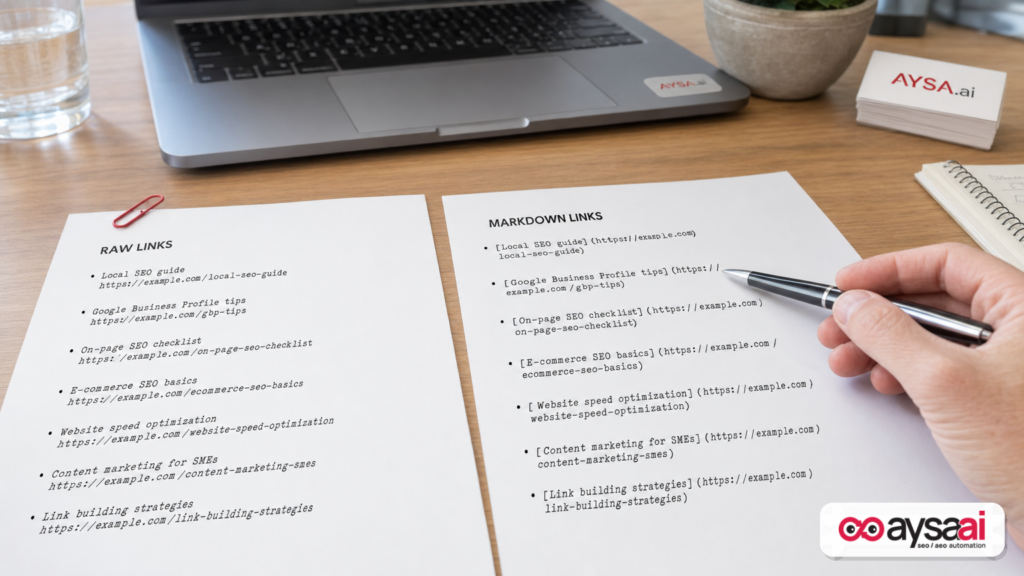
That’s the real story behind a surprising new Lighthouse behavior: Lighthouse can fail your /llms.txt file with the message “File does not appear to contain any links” even when you can see multiple working URLs—because Lighthouse is looking for markdown link syntax, not plain-text URLs.
The original report came from Search Engine Journal’s coverage of a Lighthouse 13.3 “Agentic Browsing” audit run and the five-minute fix that flipped a fail into a pass by rewriting each entry as a markdown link ([text](url)) rather than plain text. Read the source here: Search Engine Journal.
I’m Marius Dosinescu, and from an AYSA.ai perspective, this matters for one reason: it’s a preview of the operational future of SEO/AEO/GEO. The next wave of “SEO issues” will often be small formatting and structure mismatches that don’t look like classic ranking problems—but they will determine whether machines can use your content at all.
Concise summary
- Lighthouse’s llms.txt audit is primarily a parser test: it checks whether links in
llms.txtare expressed in a format Lighthouse can extract (markdown syntax), not whether your file is accurate, complete, or strategically useful. - A pass is not “AI readiness”: a thin auto-generated file can pass; a rich hand-curated file can fail if it uses plain-text URLs.
- The business risk isn’t the failing audit; the risk is publishing machine-facing artifacts that are technically compliant but wrong, stale, or misleading.
- The opportunity is operational: treat machine-readable assets (like llms.txt) as governed infrastructure—monitored, reviewed, and updated—rather than one-off tasks.
- AYSA fits as execution system: monitor these surfaces, prepare fixes, ask for approval, execute accepted changes, and keep Monitoring. Start with Monitoring and AI Search Visibility.
Key takeaways (for busy owners and operators)

- If you publish llms.txt, make it machine-parseable. Lighthouse (as reported) expects markdown link syntax. Plain-text URLs may be treated as “no links.”
- Don’t let plugins decide your “AI map” by default. Auto-generation can be convenient, but it can also publish a version of your business you didn’t approve.
- Prioritize canonical truth pages. Your policies, pricing rules, returns, shipping, booking, and support pages are often more important than any “AI file.”
- Put ownership and review cadence in place. If nobody owns it, it will drift. Drift is how AI systems start answering with outdated truth.
- Measure success in outcomes, not checkmarks. Passing an audit is hygiene. The outcome is being correctly represented and cited.
Table of contents

- What actually changed: Lighthouse added an “Agentic Browsing” category
- What the llms.txt audit is really measuring (and what it’s not)
- The .txt/markdown mismatch: why it confuses teams
- Why markdown links matter to parsers and agents
- The important nuance: parseable doesn’t mean useful
- Should you care about Lighthouse Agentic Browsing as a business?
- The bigger shift: machine-first architecture is becoming SEO infrastructure
- An SME scenario you can relate to: a local clinic and an ecommerce brand
- How to implement llms.txt without creating risk (a practical spec)
- What agencies should rethink: from deliverables to governance
- What to monitor after you ship (and why most teams stop too early)
- Where AYSA fits: monitored, approved execution for AI + SEO changes
- What to do next (action list)
- Sources and further reading
What actually changed: Lighthouse added an “Agentic Browsing” category
Lighthouse has been a mainstream way to audit performance, accessibility, and general SEO hygiene for years. What’s new, per the SEJ report, is Lighthouse 13.3 adding an Agentic Browsing category with multiple audits, including one focused on llms.txt. The category is scored as a pass ratio rather than a single 0–100 score—an implicit admission that the ecosystem’s standards are still moving.
You don’t have to be deep in the “agentic web” to understand why this matters. Browser vendors and toolchains are anticipating a world where:
- Agents navigate sites to accomplish tasks (find policies, compare products, understand eligibility, submit forms).
- Machines need consistent structure and predictable interfaces.
- Validation shifts from “is this page pretty and fast?” to “is this site operable and interpretable by software?”
In classic SEO, you could often “get away with” messy structure as long as Google could crawl and users could convert. In AI Search and agentic experiences, messy structure isn’t just inefficient—it can be non-functional. A parser can’t “kind of” understand your intent. It either extracts the right link or it doesn’t.
More SEJ coverage and context lives in their SEO section: SEJ SEO.
What the llms.txt audit is really measuring (and what it’s not)
Let’s be blunt: the Lighthouse llms.txt check (as described in the SEJ report) is not a quality audit. It’s not judging your strategy. It’s not validating whether your file helps an AI system answer correctly. It is—largely—testing whether your file is formatted in a way Lighthouse can parse reliably.
That distinction is the editorial point, because businesses will misinterpret the “pass” as “we’re AI ready.” They’re not. A pass tells you this:
- Your llms.txt exists and is discoverable (at least to the tool).
- The tool can extract links using its expected syntax rules.
A pass does not tell you:
- Whether those links represent your most important business surfaces.
- Whether those pages are canonical, current, and consistent.
- Whether the content is written in a way a model can summarize without errors.
- Whether the file is maintained and won’t go stale after a redesign.
It’s a classic technical-SEO trap: teams fix what’s easy to validate, not what’s important to outcomes. Lighthouse can validate syntax. It can’t validate business truth.
The .txt/markdown mismatch: why it confuses teams
The SEJ story highlights something that will keep happening as “machine web” conventions expand: file extensions and MIME types don’t always match the implied parsing expectations.
Many business owners see llms.txt and think:
- “It’s a text file; I’ll write text.”
- “If I put URLs in it, they’re links.”
But the spec referenced in the SEJ piece (llms.txt as a markdown-structured document) implies a different assumption: “This is a markdown document stored in a .txt file.” In that model, the difference between:
- Homepage: HTTPS://example.com- [Homepage](https://example.com): …
isn’t cosmetic. It’s the difference between “a human sees a URL” and “a machine can deterministically parse a link object.”
From an operational standpoint, here’s the lesson: when a tool fails a new audit, don’t assume your content is wrong. First ask: what is the parser expecting? In this case, it appears to be markdown link syntax.
Why markdown links matter to parsers and agents
Non-technical teams often underestimate how fragile automated extraction is. Humans read “Homepage: /” and infer the destination. Machines don’t infer; they match patterns. And pattern matching is brittle.
Plain-text URLs are easy to detect in the simplest case (a full https:// URL on one line). But real business files quickly become messy:
- Relative URLs like
/pricingor/returns - Wrapped lines and indentation
- Different separators (
-,—,:) - Parentheses and punctuation
- Notes, variants, and conditional rules
Markdown link syntax solves a practical problem: it provides a consistent boundary around the link text and URL. It’s not “better writing”; it’s better parsing.
That’s why, in the SEJ report, a “five-character per link” edit (adding [, ], (, ), plus swapping a separator) flipped the audit result. The content didn’t become more truthful. It became more machine-readable to that specific parser.
Now expand that logic beyond llms.txt. The same principle applies to:
- Schema markup (machines prefer explicit properties over implied meaning).
- Consistent page templates (machines “learn” where to look for key facts).
- Stable internal linking (machines follow predictable routes).
This is why “AI search visibility” is fundamentally structural. AYSA frames it this way: make the site understandable to machines, then keep it that way through monitoring and controlled execution. See: AI Search Visibility.
The important nuance: parseable doesn’t mean useful
Here’s my contrarian take: the biggest risk with llms.txt isn’t that it’s ignored by major platforms (which may or may not happen). The biggest risk is that it becomes a new place businesses publish misinformation by accident.
Why? Because llms.txt is “machine-facing,” and machine-facing assets tempt teams to automate. Automation without governance is how wrong truth spreads.
Consider two files:
- File A (curated, plain text): 30 carefully selected destinations that represent what the business actually wants an agent to use—pricing rules, eligibility, returns, shipping, appointment booking, support, warranty, and top categories. It fails Lighthouse due to syntax.
- File B (auto-generated, markdown compliant): 200 links that include tag pages, internal search, thin archives, and outdated endpoints. It passes Lighthouse because it uses markdown links.
Which file is better for real-world AI answers? File A. Which file gets a green check? File B.
This is why you need an internal rule: we optimize for parseability, but we govern for usefulness.
So treat Lighthouse’s llms.txt audit like a smoke alarm. It can tell you something’s not in the expected format. It can’t tell you whether your building is designed well.
Should you care about Lighthouse Agentic Browsing as a business?
You should care—but care in the right way.
Care because it signals the direction of travel
Browser tooling doesn’t add categories lightly. Even if individual checks change, the direction is clear: more “agent compatibility” checks will appear, and more teams will be measured on them.
That affects you whether you’re a local business, ecommerce, SaaS, or publisher because:
- Agencies will start including these audits in reports.
- Clients and stakeholders will ask why a site “fails AI audits.”
- Plugins and vendors will auto-enable features to claim “AI readiness.”
Don’t care as a vanity metric
A Lighthouse pass is not revenue. It’s not even necessarily discoverability. It’s a technical compliance indicator in a fast-evolving space.
In traditional SEO terms, it’s closer to “valid structured data” than it is to “ranking improvements.” You do it because broken structure creates unnecessary risk—and because fixing it is usually cheap.
Use it to start the right conversation internally
If you’re an operator, your best use of this audit is to trigger governance questions:
- Who owns machine-readable assets (schema, feeds, llms.txt)?
- Who approves changes before they ship?
- What is our update cadence?
- How do we detect drift (overwrites, redirects, broken pages, template changes)?
This is exactly the category of work AYSA is designed to systematize: monitor → propose → approve → execute → verify. Learn more: AI SEO Tools.
The bigger shift: machine-first architecture is becoming SEO infrastructure
It’s tempting to see llms.txt as “just another file.” I don’t. I see it as a symptom of a broader transition: SEO is moving from page-level optimization to information system design.
Historically, many businesses treated their website as a marketing brochure with a blog attached. The web was mostly consumed by humans in browsers, and the search engine’s job was to interpret. In that world, you could win with great copy, decent crawlability, and a link profile.
Now, a growing portion of discovery and decision-making is mediated by systems that:
- Extract facts from multiple sources.
- Summarize and synthesize.
- Choose which sources to cite.
- Navigate interfaces on behalf of users.
In that environment, “truth” is operational. It’s the sum of what your site consistently publishes across pages, templates, and machine-readable formats—not the best-written paragraph on your homepage.
So the strategic question for SMEs isn’t “Should we add llms.txt?” It’s:
Do we have a stable, maintained, machine-readable representation of our business?
If the answer is no, llms.txt is not the starting point. The starting point is your core content surfaces:
- Services/products
- Pricing model (even if you don’t publish exact prices, publish the rules)
- Policies (returns, shipping, cancellation, warranty)
- Eligibility (service area, age requirements, insurance, compliance)
- Contact and support workflows
Then—and only then—use files like llms.txt to point agents at those canonical surfaces.
An SME scenario you can relate to: a local clinic and an ecommerce brand
Let’s ground this in two scenarios where “machine-facing truth” directly affects revenue and operations.
Scenario 1: Local clinic (high trust + high compliance pressure)
A clinic doesn’t just want traffic; it wants correct representation. The cost of wrong answers is real: patient frustration, appointment no-shows, and reputational damage.
Common questions AI systems may try to answer about a clinic include:
- “Do they accept my insurance?”
- “How do I book—online or by phone?”
- “What’s the cancellation policy?”
- “What are the hours for this location?”
Now imagine the clinic publishes llms.txt and it passes Lighthouse. But the file links to:
- The homepage
- A blog category page
- A generic contact page
- An outdated PDF intake form
That’s technically “links.” It’s not operational truth. The agent can parse, but it can’t answer.
What a better llms.txt would include for the clinic:
- Booking page (with clear instructions and requirements)
- Insurance and billing page (with what’s accepted and what to do if unsure)
- Cancellation policy page
- Locations page with per-location hours
- Urgent care vs appointment rules (if applicable)
The Lighthouse fix (markdown syntax) is necessary for tooling compliance, but the business win is selecting the right canonical truth pages.
Scenario 2: Ecommerce brand (high churn + high competition)
Ecommerce is where AI answers can directly impact purchasing decisions. When policies and product constraints are misrepresented, you get returns, chargebacks, and support load.
Common AI questions about an ecommerce brand:
- “Do they ship to my country/state?”
- “What’s the return window?”
- “Are these items compatible with X?”
- “Is this model discontinued?”
If an ecommerce store ships an auto-generated llms.txt that passes syntax checks but includes:
- hundreds of low-signal pages (tags, filters, internal search URLs),
- and misses returns/shipping/warranty pages,
then agents waste time on noise and may answer from the wrong pages. Worse, the file may become stale after a seasonal policy change.
What a better llms.txt would include for ecommerce:
- Shipping policy
- Returns policy
- Warranty policy
- Customer support
- Top categories
- Best sellers / core products (stable, evergreen)
- Compatibility guides / sizing guides (if relevant)
Again: syntax is table stakes; selection and governance are the differentiators.
How to implement llms.txt without creating risk (a practical spec)
If you decide to publish llms.txt, do it like an adult organization—not like a growth hack.
Important constraint: I’m not claiming llms.txt is used by any specific search product as a ranking factor. The SEJ report itself points to uncertainty across products. Treat llms.txt as a compatibility and clarity layer, not a guaranteed growth lever.
Step 1: Define the purpose of your llms.txt
Write a one-paragraph internal spec. For most SMEs, the purpose should be:
- Help automated systems quickly find your canonical “truth” pages.
- Reduce ambiguity by pointing to stable, maintained destinations.
- Prevent agents from wasting time on low-value archives or duplicates.
If your internal purpose is “list every URL,” stop. That’s what sitemaps do. llms.txt should be curated.
Step 2: Keep it short and high-signal
A reasonable starting range for SMEs is often 10–40 links, depending on site size and complexity. Enough to cover:
- Primary categories / services
- Policies and support
- Conversion endpoints (booking, quotes, pricing rules)
- Trust pages (about, contact)
If you’re tempted to include 200+ links, you probably have an information architecture problem: you don’t know what your canonical truth surfaces are.
Step 3: Use markdown link syntax consistently
Based on the SEJ report, Lighthouse expects markdown link syntax. A conservative approach is:
- Each item is a bullet
- Each bullet starts with a markdown link
[text](url) - Optional description follows after a colon
Example pattern (illustrative):
- [Shipping policy](https://example.com/shipping): Delivery timelines, regions, and carriers- [Returns policy](https://example.com/returns): Window, conditions, and how to start a return- [Pricing](https://example.com/pricing): Plans and what’s included
Whether your server returns text/plain or another content type, the file can still contain markdown formatting. The key is what parsers expect.
Step 4: Prefer canonical, stable URLs (avoid “marketing drift”)
Use URLs you intend to keep. Avoid:
- Campaign URLs with UTM parameters
- Temporary promo landing pages
- Internal search results pages
- Filtered category pages with querystrings
These are the pages that change constantly and are most likely to mislead an agent later.
Step 5: Write descriptions as operational notes, not ad copy
“Best in town” and “award-winning” aren’t useful for machines. What helps machines is constraints and definitions:
- What the page is
- What questions it answers
- Any scope boundaries (region, eligibility, time window)
That’s how you reduce incorrect summarization: by making the truth explicit, not implied.
Step 6: Establish governance and ownership
Here’s a simple governance model that works for SMEs:
- Owner: marketing lead or operations manager (someone close to business truth)
- Editor: SEO/agency/technical role who implements formatting and ensures validity
- Approver: business owner or department owner (who can confirm policies and claims)
This is exactly how AYSA is designed to operate: changes are prepared and proposed, then approved, then executed. That approval step is not bureaucracy; it’s how you prevent machine-readable misinformation.
Step 7: Treat redesigns and CMS migrations as “machine surface” events
Most llms.txt failures won’t come from typos. They’ll come from site changes:
- A new theme changes URL structure
- A plugin overwrites generated files
- Policies move behind a new slug
- A section is consolidated or renamed
So whenever you change navigation, slugs, or templates, you should review machine-facing surfaces: llms.txt, sitemaps, schema patterns, and key internal links.
What agencies should rethink: from deliverables to governance
If you’re an agency, you’re about to get a wave of new “deliverables” clients think they need:
- llms.txt
- AI readiness audits
- Agentic browsing compliance
- Schema at scale
It will be tempting to sell these as one-time tasks. That’s the old SEO model: audits, recommendations, maybe implementation, then move on.
But in a machine-first world, the value is not “we created the file.” The value is:
- We created the file and kept it aligned with business truth.
- We ensured it remains parseable as tools evolve.
- We caught drift before it caused misinformation or lost visibility.
Agencies should productize:
- Governance: who can change what, and how it’s reviewed
- Monitoring: detecting breakage and overwrites
- Approved execution: shipping changes safely and repeatably
This is where AYSA’s approach is practical for agencies too: it’s not just a checklist generator. It’s an operational workflow that helps you turn recommendations into controlled changes. Start exploring from the product surfaces: AI SEO tools and Monitoring.
What to monitor after you ship (and why most teams stop too early)
Most SEO teams are good at shipping fixes and bad at ensuring fixes remain true.
In the “agentic” era, monitoring is not optional. It’s the difference between “we did it once” and “we have an operating system.”
If you publish llms.txt, monitor the following:
1) Availability and status codes
- Does
/llms.txtreliably return HTTP 200? - Is it being redirected (301/302), chained, or blocked?
- Did a security rule or CDN behavior change how it’s served?
2) Content drift and overwrites
The SEJ report mentions ecosystem behavior like plugin-generated files. Whether or not you use a plugin, the risk is the same: a deployment overwrites your curated version.
Monitoring should detect when a file changes unexpectedly—because that’s often how low-quality auto-generated content sneaks in.
3) Link integrity and target relevance
- Do linked pages still exist?
- Did they become “thin” due to template changes?
- Did the canonical URL change?
- Did the page stop being the real source of truth (e.g., policy moved to a new page)?
4) Validation drift (the tool changes)
Even if you do everything right today, Lighthouse and other validators will evolve. A pass today can become a fail tomorrow for reasons unrelated to your business.
This is exactly why you need a monitoring program rather than an “audit once” habit.
5) Outcome signals (not just technical signals)
Many SMEs don’t have perfect visibility into AI citations or referrals yet. Don’t fake it. If you can’t measure citations directly, measure what you can:
- Branded search stability
- Support ticket topics (do you see more confusion around policies?)
- Conversion rate for key pages
- Consistency across your own site (policy conflicts, duplicated statements)
AYSA’s model is built around this loop: monitor issues, propose changes, get approval, execute, then monitor again. Learn more: AYSA Monitoring.
Where AYSA fits: monitored, approved execution for AI + SEO changes
This Lighthouse llms.txt issue is a perfect micro-case for why “SEO advice” is not enough anymore.
Traditional workflow looks like this:
- A tool reports a failure.
- An SEO writes a ticket.
- Engineering puts it in a backlog.
- Weeks later it ships (maybe).
- No one checks again until the next audit.
In the agentic era, that’s too slow and too fragile—especially when a fix is genuinely small, but the consequences of not fixing it are unclear and evolving.
AYSA is designed to compress and govern that loop:
- Monitor: detect issues and drift (files, templates, structured signals). Start here: Monitoring.
- Prepare: draft the fix (e.g., convert llms.txt links into markdown syntax) with clear context and proposed changes.
- Ask for approval: ensure the business owner approves what the file claims and where it points.
- Execute: apply changes safely, with the ability to validate and iterate.
- Verify continuously: because tools and sites change.
That’s what we mean by “approved execution.” Not automation for its own sake—automation that stays accountable to business truth.
If you’re trying to operationalize AI search visibility, don’t start by chasing new files. Start by building a system that can keep truth consistent across your site over time: AI Search Visibility.
If you want to understand how AYSA’s workflow turns into day-to-day capability, explore:
What to do next (action list)
Here’s a practical 30-day plan that doesn’t require you to bet your business on any single emerging standard.
Week 1: Baseline and decide scope
- Decide whether you will maintain llms.txt. If you can’t maintain it, treat it as risk—not as progress.
- Run Lighthouse (including Agentic Browsing if available in your environment) and record the result for
llms.txt. - Inventory your canonical truth pages: pricing rules, returns/shipping/cancellation, warranty, contact, booking/quote, support, top categories/services.
Week 2: Implement a minimal, high-signal llms.txt
- Write or revise llms.txt using markdown link syntax (
[text](url)) so parsers can extract links. - Limit it to what matters (typically 10–40 curated links for SMEs).
- Use canonical, stable URLs and avoid parameters and temporary campaign pages.
Week 3: Governance review (non-SEO approval)
- Have an operations/business owner review it. Ask: “If an agent used only these links, would it understand our business correctly?”
- Confirm policy accuracy. This is where most failures happen: the file is syntactically correct but points to pages with outdated terms.
- Re-run Lighthouse and document the before/after so you understand what the tool is measuring.
Week 4: Monitoring and drift prevention
- Set monitoring for availability, changes, and broken links.
- Watch for overwrites after plugin updates, theme updates, or deployments.
- Create a recurring review cadence: quarterly for stable service businesses; monthly for ecommerce with frequent policy changes.
If you want to systematize this without turning it into a project that dies after two sprints, start with AYSA’s monitoring-first approach: AYSA Monitoring.
Sources and further reading
- Search Engine Journal: Lighthouse Fails Your Llms.txt Without Markdown Links
- Search Engine Journal: SEO coverage (broader context)
- Search Engine Journal: Latest news (to track evolving standards)
- AYSA: AI Search Visibility
- AYSA: Monitoring
- AYSA: AI SEO tools
- AYSA: Pricing
- AYSA: Blog
Verification note: The specific Lighthouse behavior described here is based on the SEJ report and its described test results. These audits are new and may change. Use them as diagnostics—not as permanent, universal truth.
Continue the AI search topic inside AYSA.
Use these pages to connect the article with AI SEO tools, AI visibility monitoring, AI Overviews and approved website execution.
Turn this topic into a website action plan.
Use these AYSA hubs to move from reading to technical fixes, AI visibility monitoring, research, glossary context and approval-first SEO execution.

