
Bruce Clay’s Lasting SEO Legacy: Why Siloing Still Matters In The AI Search Era (And How SMEs Should Execute Now)
Bruce Clay helped define modern SEO—down to the term itself and the practice of content siloing. Here’s what his legacy teaches businesses navigating AI-driven search today: structure, intent, and disciplined execution beat hype—especially when you can monitor, approve, and ship changes continuously.

Bruce Clay’s passing is a moment to pause—not just to acknowledge one of the founding figures of SEO, but to reassess what still matters when search is being reshaped by AI. His ideas weren’t flashy. They were operational: organize information, make it findable, make it understandable, and build systems that scale.
That’s why his work—especially content siloing and the early discipline around website structure—still shows up everywhere, from ecommerce navigation to knowledge-base hubs to the way modern teams talk about topical authority. In 2026, we’re entering an era where “being found” is less about a single ranking and more about being chosen as an answer, cited as a source, and trusted across multiple interfaces.
From my perspective (Marius Dosinescu, AYSA.ai), Bruce Clay’s legacy is a reminder that the fundamentals aren’t old; they’re durable. But durability doesn’t mean autopilot. The playbook is changing: you need stronger structure, better evidence, and a tighter execution loop. The winners will be the businesses that can monitor what’s changing, prepare the right fixes, ask for approval, and execute continuously—without turning SEO into a never-ending internal debate.
Concise summary
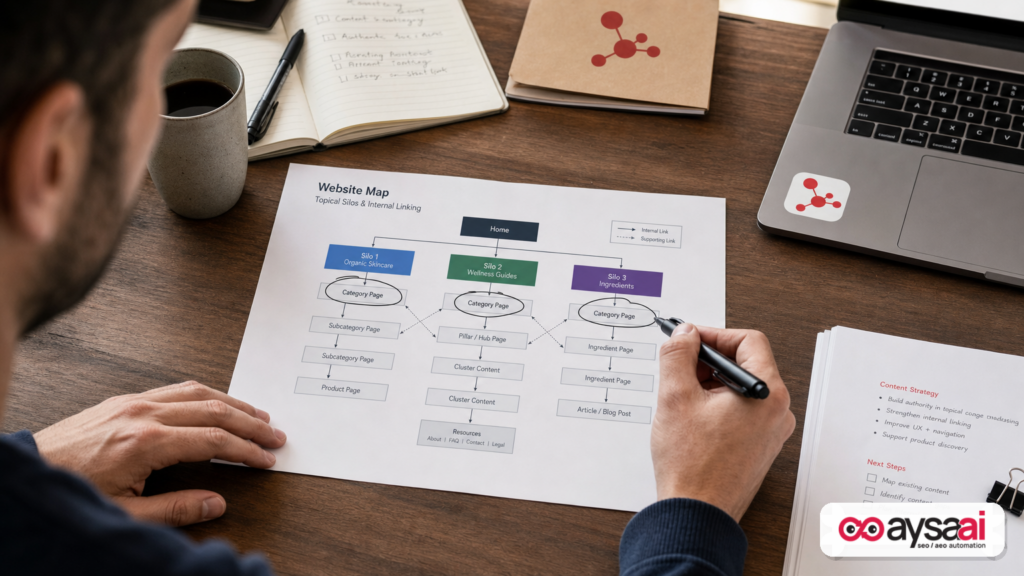
Bruce Clay helped define SEO and popularized concepts like content siloing. As search shifts toward AI-driven answers, his core lesson—structured information wins—matters more than ever. Businesses should (1) tighten Site architecture around topics and intent, (2) publish content designed to be cited and verified, (3) measure beyond “rankings,” and (4) close the execution gap with an approval-based workflow. AYSA fits here as an execution system: it monitors, prepares changes, requests approval, and implements accepted updates on your site.
Key takeaways

- Structure is strategy. Content siloing isn’t a “technical detail”—it’s how you communicate meaning to users and machines.
- AI Search rewards clarity and evidence. If your site can’t be confidently summarized, it won’t be confidently cited.
- Traditional SEO metrics are incomplete. You still need Search Console and GA4, but you also need visibility tracking for AI answers and citations.
- The execution gap is the real competitive gap. Most companies know what to do; few can ship consistently.
- Approved Execution is the new standard. Fast iteration with governance beats slow consensus and endless backlogs.
Table of contents

- Why Bruce Clay’s legacy matters right now
- The Bruce Clay idea that still runs the web: structure beats cleverness
- What changed: from “10 blue links” to answer engines
- Content siloing in 2026: what people get wrong (and how to do it right)
- From keywords to entities to authority: the modern interpretation of “relevance”
- AEO/GEO reality: winning citations is the new “ranking #1”
- Technical SEO still decides whether your content is eligible
- Why AI content stopped working (and what to do about it)
- A concrete SME scenario: a local clinic competing in AI answers
- What to measure now: moving past vanity metrics without flying blind
- The execution gap: why most SEO programs fail in 2026
- Where AYSA fits: monitor → prepare → approve → execute
- What to do next (a practical action list)
- Sources and further reading
Why Bruce Clay’s legacy matters right now
Search Engine Journal reported the news of Bruce Clay’s death and highlighted how deeply his terminology and concepts still influence the field today—especially content siloing and the early formation of SEO as a discipline (Search Engine Journal). The tributes emphasized not only his technical influence, but his role as a teacher and an industry builder.
Why bring this up in a business editorial about the future?
Because the industry is again at an inflection point. AI is changing how people search, how platforms present results, and how brands win attention. In periods like this, it’s tempting to chase novelty: new prompts, new tools, new hacks. Bruce Clay’s career is a counterweight to that impulse. He represents a kind of SEO that is:
- Systems-driven (architecture, repeatable processes)
- User-first (clarity, navigation, comprehension)
- Education-oriented (document what works, teach it, iterate)
That approach is exactly what most SMEs and agencies need right now: not more complexity, but better execution of the fundamentals—adapted for AI-first discovery.
The Bruce Clay idea that still runs the web: structure beats cleverness
Let’s talk about siloing like a business owner, not like an SEO forum debate.
In plain terms, a silo is a way to organize a website so that:
- People can predict where information lives
- Search engines can understand what each section is “about”
- Your internal links reinforce topical relationships instead of scattering authority randomly
That sounds basic—and it is. But it’s also the missing piece in many content strategies today.
Most companies don’t have a content problem. They have a structure problem:
- They publish 200 blog posts but have no hubs, no hierarchy, no intentional Internal linking.
- They have 800 products but categories are built around internal org charts, not customer intent.
- They have a “Resources” section that’s a junk drawer, not an information architecture.
Siloing isn’t about forcing every page into a rigid taxonomy. It’s about making your expertise legible.
Why this matters for business outcomes (not just rankings)
A good siloed structure improves:
- Conversion: users find answers faster, bounce less, trust more.
- Sales enablement: your product and solution pages become navigable narratives.
- Customer support: fewer repetitive questions when knowledge content is structured.
- AI readiness: models can summarize and cite content that’s clearly scoped and internally consistent.
In other words: structure is not a “Technical SEO task.” It’s the operating system for how your site communicates value.
What changed: from “10 blue links” to answer engines
Classic SEO was built around a simple bargain: you create a page, Google ranks it, users click, and your site gets the traffic. That bargain is no longer guaranteed. Even without inventing any numbers, any business owner can feel the shift: more zero-click behavior, more summaries, more “answers” before the click.
That doesn’t mean SEO is dead. It means the target moved.
Today, you’re competing across at least three layers:
- Traditional organic listings (still critical for many queries)
- SERP features (local packs, “people also ask,” etc.)
- AI-driven answers (summaries, conversational search, assistant-style responses)
If your content is not structured and attributable, it’s harder for any system—human or machine—to confidently use it.
Visibility isn’t one metric anymore
In the old world, you could tell leadership: “We’re #3 for ‘best running shoes’.” In the new world, the more useful questions are:
- Are we showing up when AI systems answer “What should I buy?”
- Are we being cited as a source, or are other publishers taking that role?
- Are we present across local intent and transactional intent, or only one?
That’s the strategic backdrop for why Bruce Clay’s emphasis on organization and clarity is newly relevant.
Content siloing in 2026: what people get wrong (and how to do it right)
Because “siloing” became popular, it also became misunderstood. Many teams implement it as a diagram—not as a living system.
What siloing looks like when it’s wrong
- Overly rigid folders: every URL must match a taxonomy, even when it hurts UX.
- Internal linking that’s too restrictive: pages refuse to link across silos even when users need it.
- Hubs that are just index pages: no editorial value, no narrative, no decision support.
- “Silo pages” without intent clarity: category pages that don’t answer anything.
What siloing looks like when it’s right
A modern silo is a topic ecosystem with a clear purpose:
- A hub page that defines the topic and routes users to subtopics
- Subtopic pages that go deep and match specific intents
- Support content (FAQs, comparisons, how-tos) that addresses real questions
- Internal links that make sense to a human (not just an algorithm)
For an ecommerce brand, a silo might be “Running Shoes” → “Trail Running Shoes” → “Best trail running shoes for wet weather,” with comparison guides and sizing advice linked appropriately. For a clinic, it might be “Back Pain” → “Sciatica” → “Treatment options” with provider bios, safety disclaimers, and appointment pathways.
The AI search angle: silos increase “summarizability”
AI systems are constantly trying to answer: “What is this page about, and should I trust it?” Clear architecture helps in two ways:
- Context: related pages reinforce meaning and scope.
- Evidence: a well-structured cluster often contains definitions, steps, caveats, and references—exactly what answer engines need.
In practice, silos make it easier for machines to understand that you’re not a one-off post—you’re a coherent source.
From keywords to entities to authority: the modern interpretation of “relevance”
SEO veterans remember the era when keyword placement and density were over-weighted. Then came the long era of “content marketing”: publish more, rank more. Now we’re moving into “authority engineering”: you need a site that demonstrates competence in a domain, not a site that merely contains words.
This isn’t a call to chase jargon like “entities” if you’re an SME. It’s a call to map your site to how customers think.
A practical way to build authority: mirror the customer journey
For almost any business, customers move through:
- Problem recognition (“Why does my back hurt?”)
- Option exploration (“Is physical therapy better than surgery?”)
- Vendor selection (“Best clinic near me”)
- Trust verification (“Reviews, credentials, outcomes, policies”)
Many websites only serve one layer (usually “vendor selection”) and then wonder why they don’t show up earlier, where AI answers often begin.
Authority is built when you cover the full journey with consistency, structure, and proof.
AEO/GEO reality: winning citations is the new “ranking #1”
As search becomes more answer-oriented, two related disciplines matter more:
- AEO (Answer Engine Optimization): optimizing content so systems can extract and present answers accurately.
- GEO (Generative Engine Optimization): shaping how generative systems represent your brand, products, and expertise.
These aren’t replacements for SEO; they’re extensions. And they’re not magic. They are still built on fundamentals: clarity, structure, and credibility.
What it takes to be “citable”
To be cited, your content usually needs:
- Clear claims (not vague marketing language)
- Support (methods, sources, definitions, caveats)
- Attribution hooks (author info, organization info, updated dates)
- Consistency across your site (no contradictions between pages)
If your “About” page is thin, your team pages are missing, your policies are unclear, and your content contradicts itself, you’re asking an answer engine to take reputational risk on your behalf. It won’t.
Why siloing helps citations
When your site is organized into topic ecosystems, you make it easier for systems to:
- find the canonical page for a topic
- confirm claims across related pages
- trace context and reduce ambiguity
That’s “Bruce Clay SEO” applied to AI search: build information architecture that reduces confusion.
Technical SEO still decides whether your content is eligible
There’s a tempting narrative that AI search will “understand anything.” In practice, technical issues still block discovery and distort understanding.
Technical SEO isn’t about chasing scores. It’s about removing friction between your content and the systems trying to access it.
The non-negotiables (SME-friendly list)
- Crawlability: important pages should be reachable through internal links, not buried behind filters or scripts.
- Indexation clarity: avoid accidental noindex, canonicals pointing to the wrong pages, or duplicate messes.
- Performance basics: slow sites lose users; speed is a business metric even before it’s a ranking factor.
- Structured data where it genuinely applies: not spam—accurate markup that reflects real content.
To keep this editorial honest: we’re not citing a specific list of technical ranking factors or update impacts because the supplied research context doesn’t include those primary sources. The practical point stands regardless: if bots can’t reliably fetch and interpret your content, you can’t win in any search paradigm.
Siloing and technical SEO are connected
Good silos often improve technical health indirectly by:
- reducing orphan pages
- consolidating duplicative content
- creating clear canonical “hub” pages
- making internal link distribution intentional
That’s why the best “technical SEO” work often starts with content architecture.
Why AI content stopped working (and what to do about it)
Many businesses rushed into AI-generated content with a simple expectation: more pages = more traffic. The problem is that the web is now saturated with low-effort sameness, and search systems—human and machine—are adapting.
The fix isn’t “don’t use AI.” The fix is “use AI with governance, editorial judgment, and a structure-first plan.”
Where AI content typically fails businesses
- It’s generic: reads like every other page and doesn’t add unique value.
- It’s unverified: claims without evidence or with subtle inaccuracies.
- It’s misaligned: created for keywords rather than customer decisions.
- It’s disconnected: published without internal links, hubs, or a clear role in the site.
What to do instead: publish fewer pages, but make them more “complete”
Completeness doesn’t mean longer for the sake of longer. It means the page answers the real questions a customer has. A “complete” page often includes:
- definition and who it’s for
- options and tradeoffs
- process or steps
- pricing or cost factors (even ranges or drivers, if you can’t publish exact pricing)
- risks, contraindications, limitations, or when it’s not a fit
- clear next step
Then, you connect it to the rest of the silo.
The editorial gate that most teams don’t have
If you’re using AI to draft, you need an approval gate that checks:
- factual accuracy and brand safety
- original perspective (what do we know or do that others don’t?)
- conversion clarity (what should the user do next?)
- internal linking and placement in the silo
This is one of the core reasons AYSA’s model is “prepare changes, ask for approval, then execute.” It aligns with how responsible businesses actually operate.
A concrete SME scenario: a local clinic competing in AI answers
Consider a realistic local clinic: a physical therapy practice in a mid-sized American city. They don’t need to “beat the internet.” They need to win a set of high-intent queries that lead to booked appointments.
The problem they face in 2026
Prospective patients search like this:
- “Why does my knee hurt going downstairs?”
- “Is this meniscus tear or runner’s knee?”
- “How long does PT take for ACL rehab?”
- “Best physical therapist near me for back pain”
They may get an AI summary, a local pack, a few organic results, and content from large publishers. The clinic may never be clicked if it only has a thin homepage and a “services” page.
A silo-based solution (simple, scalable)
The clinic creates three main silos:
- Back pain (sciatica, herniated disc, posture, workplace ergonomics)
- Knee pain (runner’s knee, meniscus, ACL rehab, strengthening)
- Sports rehab (return-to-play timelines, injury prevention, assessments)
Each silo has:
- a hub page that explains the category and routes to subtopics
- 2–5 deep subtopic pages that match common questions
- FAQs that address safety and when to seek urgent care
- clear “book an appointment” CTAs and provider credibility signals
What makes this AI-ready (without gaming anything)
- The content is scoped: each page has a clear purpose and avoids mixing unrelated issues.
- The site offers verification: provider bios, practice information, policies, updated dates.
- The internal linking reinforces meaning: “knee pain” pages reference each other in a helpful way.
This is how an SME competes: not by outspending national publishers, but by becoming the best local source with structured expertise.
What to measure now: moving past vanity metrics without flying blind
When leadership asks, “Is SEO working?” the wrong answer is a screenshot of rankings. The wrong reaction is also, “Rankings don’t matter anymore.”
The truth is operational: you need a measurement stack that captures both classic discovery and emerging AI discovery.
Core measurement (still essential)
At minimum, most businesses should have:
- Google Search Console for queries, clicks, impressions, indexing signals (we’re referencing the product generally; the supplied context doesn’t include a specific GSC link).
- GA4 for engagement and conversions (again referenced generally; the source context mentions GA4 in navigation, but doesn’t provide primary links).
AI visibility measurement (the missing layer)
What’s new is the need to track:
- where your brand appears in AI answers across platforms
- whether you’re cited, and for which topics
- how changes to site structure and content affect those outcomes over time
This is exactly the kind of monitoring that should be ongoing rather than quarterly. That’s why we built dedicated monitoring and AI search visibility capabilities at AYSA:
The goal isn’t to worship new metrics. It’s to avoid being blindsided while customer behavior changes.
The execution gap: why most SEO programs fail in 2026
Most SEO failures aren’t caused by ignorance. They’re caused by organizational drag.
Here are the patterns I see repeatedly across SMEs and even larger organizations:
Common failure modes
- Too many recommendations, too few deployments. Audits become PDFs that die in a shared drive.
- SEO depends on “one busy engineer.” Everything competes with product roadmaps.
- Approvals are unclear. Nobody knows who can sign off on content, templates, or redirects.
- Measurement is delayed. Teams can’t connect changes to outcomes fast enough.
- Content is produced without integration. Writers publish, but no one updates internal links or hubs.
Why this gets worse in an AI search world
AI accelerates the rate of change in three ways:
- more competitors can publish “good enough” content faster
- search surfaces shift quickly, so you must iterate
- brands need stronger verification and consistency, which requires cross-team execution
If you can’t ship improvements weekly (or at least continuously), you don’t have an SEO strategy—you have SEO intentions.
Where AYSA fits: monitor → prepare → approve → execute
AYSA is built around a simple reality: businesses don’t just need advice; they need outcomes. And outcomes come from a reliable execution loop.
The model we believe in looks like this:
- Monitor: track technical health, content opportunities, and AI search visibility trends.
- Prepare: generate a concrete set of recommended changes—specific pages, specific links, specific edits.
- Ask for approval: governance is non-negotiable. Humans own the brand and the risk.
- Execute: once approved, implement changes on the site—fast and consistently.
This is the difference between “SEO as a quarterly project” and “SEO as an operating system.”
If you want to explore what that looks like in practice, start here:
How AYSA supports siloing and structure (without the theater)
A practical execution system should help you:
- identify thin or duplicate pages inside a topic
- recommend internal links that strengthen hubs and subtopics
- flag orphan content and broken pathways
- prepare edits for titles, headings, and on-page clarity to align with intent
- ship the improvements once approved
That’s how you honor the spirit of foundational SEO: make the site better, not just louder.
What to do next (a practical action list)
If you’re an SME, a marketer, or an agency lead, here’s the fastest way to translate these ideas into action—without turning it into a six-month “replatforming” project.
1) Pick 3–5 core topics that actually drive revenue
Not “we want traffic.” Revenue topics. For ecommerce: your money categories. For local services: your highest-margin service lines. For SaaS: the problems you solve best.
2) Build (or fix) one silo at a time
For each silo, create:
- a hub page that is genuinely useful
- subtopic pages mapped to real questions
- internal links that make navigation obvious
3) Add credibility signals that AI systems can safely rely on
- clear authorship where appropriate
- organization details (who you are, where you operate)
- policies, support, and contact paths
- updated timestamps and maintenance
4) Replace “publish more” with “ship improvements weekly”
Weekly improvements can include:
- adding internal links
- consolidating duplicate pages
- upgrading a hub page to better route intent
- fixing indexation and canonical problems
- clarifying copy and CTAs for conversion
5) Measure what moves—and stop reporting what doesn’t
Pick a small set of KPIs you can trust (conversions, qualified leads, revenue proxies) and pair them with visibility monitoring across search surfaces. Avoid drowning the business in charts that no one can act on.
6) Operationalize governance with approved execution
Don’t let “risk” be an excuse for paralysis. Create an approval workflow that’s fast, documented, and repeatable.
What to do next
- Audit your top 20 pages: do they fit into a clear silo, or are they isolated?
- Create one hub page for your most valuable topic and link it to the best supporting pages.
- Fix internal linking: add 5–10 high-intent internal links that reduce user friction.
- Set up monitoring: track technical issues and AI visibility shifts so you’re not reacting late.
- Adopt an execution cadence: choose a weekly shipping target (even if small).
If you want a system to support that cadence, explore AYSA’s approach to monitoring and execution:
Sources and further reading
- Search Engine Journal: Bruce Clay, One of the Founding Figures of SEO, Has Died
- Search Engine Journal: SEO section (for ongoing context)
- Search Engine Journal: Google Algorithm Updates hub (context on search evolution)
- Search Engine Journal: On-Page SEO section
- Search Engine Journal: Enterprise SEO section
Note: The supplied research context references additional topics (GA4, AI agent frameworks, testing methodologies) via Search Engine Journal navigation elements, but it does not provide primary documentation links for those claims. Where this article discusses AI search measurement and content governance, it does so as analysis and practical guidance rather than as a claim of specific third-party features or metrics.
Continue the AI search topic inside AYSA.
Use these pages to connect the article with AI SEO tools, AI visibility monitoring, AI Overviews and approved website execution.
Turn this topic into a website action plan.
Use these AYSA hubs to move from reading to technical fixes, AI visibility monitoring, research, glossary context and approval-first SEO execution.

