
Google’s Spam Update Hits AI Answers: The New Line Between Being Cited And Being Manipulative
Google now explicitly treats attempts to manipulate generative AI answers in Search as spam—and the June spam update is enforcing that stance. Here’s what changed, why enforcement is messy, how “AI citations” can be poisoned through user-generated content, and what SMEs and agencies should do next (with an execution plan built for approved, measurable changes).

Google’s June spam update is more than another routine enforcement cycle. It’s a clear signal that the rules of search spam now apply to a new surface area: generative AI answers inside Google Search. In other words, the tactics used to “get mentioned by AI” are now officially in the same compliance conversation as traditional spam tactics.
As the founder of AYSA.ai, I look at this change less as a scare tactic and more as an overdue reality check: AI visibility is becoming measurable, monetizable, and therefore manipulable. That combination always triggers enforcement—eventually.
This editorial unpacks what changed, why enforcement is genuinely difficult, what can go wrong for ordinary businesses, and what a safe, scalable playbook looks like for earning AI citations without drifting into manipulation.
Concise Summary
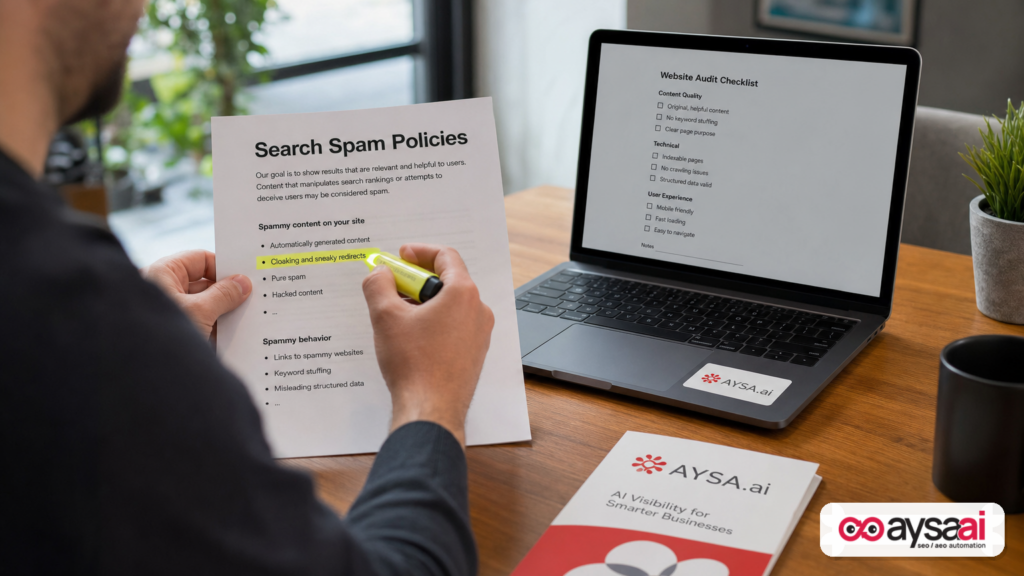
- Google clarified that attempts to manipulate generative AI responses in Search violate its spam policies—and the June spam update is enforcing those policies.
- Research suggests AI research agents can be influenced by small “planted” text on user-generated or community pages, making enforcement and Attribution challenging.
- The line between being cited and being engineered is getting redrawn. Brands and agencies need new operating discipline: evidence-first content, controlled distribution, and Monitoring.
- SMEs face two risks: (1) losing mentions to competitors or scammers, and (2) unknowingly participating in tactics that become spam violations.
- AYSA fits here as an Approved Execution system: monitor AI Search visibility, prepare recommended changes, request approval, and execute changes with accountability.
Key Takeaways (What To Do If You Only Read One Section)

- Stop thinking “AI mentions” are a nice-to-have PR win. Treat them like a channel with fraud risk and compliance risk.
- Optimize for being the best source, not the loudest name. AI systems increasingly reward evidence, specificity, and consistency across the web.
- UGC is a double-edged sword. It can help you earn citations—and it can be used to poison recommendations.
- Measure what you can, document what you do. If your agency can’t explain how a mention was earned, assume it can be questioned later.
- Use a controlled execution loop. Monitoring → recommendations → approval → implementation → impact review. This is the safest way to scale.
Table of Contents

- Context: Search Is Becoming An Answer Engine
- What Actually Changed: Spam Policy Now Explicitly Covers AI Answers
- Why This Is Happening Now (And Why It’s Not Just “SEO Drama”)
- What The Research Suggests: How AI Research Agents Get Poisoned
- Why Enforcement Is Hard: The Web Is Messy And Retrieval Is Concentrated
- The New Line: Earning Mentions vs. Engineering Mentions
- A Concrete SME Scenario: The “Best Plumber” Answer That Costs You Calls
- What Agencies Must Rethink: From Rankings To AI Presence (With Compliance)
- The Practical Playbook: How To Earn AI Citations Without Crossing The Line
- Monitoring: The Missing Dashboard Problem (And How To Operate Anyway)
- Where AYSA Fits: Approved Execution For AI Search Visibility
- What To Do Next (Action List)
- Sources And Further Reading
Context: Search Is Becoming An Answer Engine
Traditional SEO trained everyone to compete for blue links. AI answers change the unit of competition from “ranking position” to “recommendation space.” Instead of ten links, the user may see a single synthesized answer, plus a small set of citations—or sometimes no obvious citations at all.
For businesses, that shift changes the incentives:
- Less room at the top means every mention matters more.
- Attribution is inconsistent, so you might not know you won—or lost.
- Manipulation becomes attractive, because the payoff is a direct recommendation.
This is exactly the environment where spam thrives: high stakes, low transparency, and a measurable business outcome (calls, bookings, sales).
Google is responding by making its position explicit: if you try to manipulate AI answers, it’s spam.
What Actually Changed: Spam Policy Now Explicitly Covers AI Answers
According to reporting from Search Engine Journal, Google clarified that its spam policies cover attempts to manipulate generative AI responses in Google Search—and that the June spam update is enforcing that documented policy.
This matters because it removes plausible deniability. For years, some marketers treated “AI Optimization” as a gray zone adjacent to SEO. Now, Google is telling you: AI answers are part of Search. Search has spam policies. Those spam policies apply.
What’s not fully clear (and what makes this editorial necessary) is where Google will draw the operational line between:
- Legitimate optimization (publishing accurate, well-structured, evidence-backed content that is naturally cited), and
- Manipulation (seeding, poisoning, or engineering mentions primarily to influence AI outputs).
Why This Is Happening Now (And Why It’s Not Just “SEO Drama”)
When AI answers become a primary interface, the economic pressure shifts. The incentive to “manufacture a mention” rises when:
- AI answers reduce Clicks to websites (a widely discussed industry concern, even when exact numbers vary by query type and vertical).
- Citations increasingly concentrate among a smaller set of sources (including platform-owned properties and major aggregators), reducing opportunities for smaller publishers and SMEs.
- Businesses can’t easily verify whether they’re included in AI answers, which makes the channel feel like a black box.
SEJ’s coverage also highlighted a measurement gap: many businesses simply don’t have a dashboard that says “you were cited” or “you were excluded.” That’s a perfect breeding ground for shady tactics because it’s hard to audit outcomes.
So the question is not whether manipulation attempts will happen. They already are. The question is whether search platforms can meaningfully enforce rules without breaking the usefulness of AI answers.
What The Research Suggests: How AI Research Agents Get Poisoned
SEJ cited a Cornell Tech preprint (picked up by 404 Media) examining a vulnerability in “deep research” style AI agents: systems that generate an answer by issuing multiple sub-queries, retrieving documents, then assembling a report with citations.
The high-level takeaway is intuitive but important: if an AI system repeatedly retrieves the same community pages across many sub-queries, then small changes on those pages can disproportionately influence outputs.
In the study described by SEJ, the researchers tested open-source research agents in a simulated environment (meaning: they didn’t poison the live web). They found that relatively small “planted” text could insert an entity recommendation into the agent’s final report in a meaningful share of sessions when the poisoned page was retrieved.
You don’t need to be a machine learning engineer to grasp why this matters for business:
- AI answers are only as trustworthy as the sources they retrieve.
- User-generated content (UGC) is often helpful—but also easier to tamper with.
- The manipulation can appear as “normal advice,” making it hard to filter reliably.
And this is where the story becomes uncomfortable: the same tactics that can help a brand become “discoverable” (getting mentioned across the web) can be used to plant a brand into AI answers—even if the brand didn’t earn it.
Why Enforcement Is Hard: The Web Is Messy And Retrieval Is Concentrated
Google can define “manipulating generative AI responses” as spam. But catching it at scale is another problem entirely.
Here are the core enforcement challenges implied by the SEJ coverage and the research it referenced:
1) UGC Is Valuable, And Removing It Breaks Usefulness
Community discussions often contain the details people want: real experiences, edge cases, local recommendations, “what to avoid,” and comparative advice. If an AI system excludes UGC, it may become less helpful—especially for consumer and local queries.
2) Planted Text Can Look Like Legitimate Advice
The closer manipulation looks to normal writing, the harder it is to detect with simple filters. It’s not always a link farm or obvious keyword stuffing. Sometimes it’s a sentence in a thread.
3) Attribution Is Murky
If a bad actor posts a recommendation on a third-party site, whose fault is it?
- The platform hosting the comment?
- The brand being mentioned?
- The AI system retrieving it?
This is why enforcement is hard: the mechanism of manipulation can travel through normal retrieval pipelines.
4) Defenses Have Tradeoffs
SEJ summarized the researchers’ attempts to mitigate the issue: excluding UGC, screening sources with a language model, or auditing the final report. Each approach can degrade results, increase costs, or fail in edge cases.
From a business perspective, the point is not whether the defense is perfect. The point is: Google is still going to enforce something, and if you’re using tactics that resemble manipulation, you’re taking on platform risk.
The New Line: Earning Mentions vs. Engineering Mentions
Let’s get practical. Most businesses do not want to “spam Google.” They want visibility. But the incentives can push teams toward the wrong playbook.
I like to frame the new line like this:
Earning: Build sources AI wants to cite
- Publish original, specific information you can stand behind.
- Back claims with evidence (policies, methods, pricing ranges, service areas, constraints).
- Make pages easy to parse (clear headings, structured Q&A, definitions).
- Use structured data where appropriate.
- Be consistent across your owned properties and key third-party profiles.
Engineering: Alter the retrieval environment to force mentions
- Seeding the same recommendation language across many UGC threads purely to trigger retrieval.
- Coordinated comment campaigns that read like “real advice” but are organized placement.
- Creating thin third-party pages that exist mainly to be cited.
- Incentivizing posts or reviews with specific phrasing intended to influence AI outputs.
The difficulty is that some tactics can be framed either way. A founder answering questions on Reddit could be legitimate community participation—or it could be a coordinated seeding campaign. Intent and pattern matter, and Google’s enforcement systems don’t read intent; they read signals.
So the safest operating principle is:
If you would be uncomfortable explaining the tactic publicly—or to a platform reviewer—don’t scale it.
A Concrete SME Scenario: The “Best Plumber” Answer That Costs You Calls
Imagine a realistic small business: a plumbing company in a mid-sized U.S. city. They’ve invested in:
- a solid website,
- local SEO basics,
- good reviews,
- and they show up in the map pack for many queries.
Now the user asks an AI-driven search experience: “Who is the best emergency plumber near me for a burst pipe?” The AI answer lists three businesses. Your company is not included.
What happened?
Possibility A: You genuinely weren’t the best source
Maybe your site is missing critical trust details AI systems look for:
- emergency hours,
- service area specificity,
- license and insurance info,
- clear pricing policy (even a range and how it’s determined),
- refund/warranty terms,
- or a page that answers common “burst pipe” questions.
Possibility B: A competitor got cited because they were mentioned repeatedly on a community page
A local forum thread or neighborhood group page becomes a recurring retrieval source. A competitor is recommended there—maybe legitimately, maybe through subtle manipulation.
Possibility C: Someone injected a scam listing into UGC
This is the darker scenario implied by the research: a scammer slips a name into discussions that get retrieved. The AI answer repeats it. Your brand loses calls, and the user loses money.
In all three cases, the business owner’s reality is the same: AI answers are now a funnel input. If you ignore them, you’re not “staying out of the hype.” You’re leaving risk unmanaged.
What Agencies Must Rethink: From Rankings To AI Presence (With Compliance)
Agencies have traditionally sold measurable outputs: rankings, traffic, and leads. AI answers complicate that because:
- Visibility can increase while traffic decreases (users get answers without clicking).
- Citations can appear/disappear without obvious ranking changes.
- Attribution is inconsistent across tools and query types.
Now add spam enforcement aimed at AI manipulation. Agencies face a new professional risk: selling “AI visibility” as a service may tempt teams into tactics that look like engineered mentions.
If you run an agency, here’s what I believe you need to change immediately:
1) Build a written “AI visibility policy” for your own team
Define what you will and won’t do. Not as a moral stance—as risk control. If you can’t explain a tactic cleanly, don’t scale it across clients.
2) Shift deliverables from “placements” to “assets + evidence”
Instead of promising “we’ll get you cited,” promise:
- pages that are citation-ready,
- entity and fact consistency,
- structured content improvements,
- monitoring of AI surfaces,
- and documented changes.
3) Treat UGC like reputation infrastructure
UGC isn’t just social proof anymore. It’s training and retrieval material. That means you need policies for:
- review acquisition ethics,
- responding to misinformation,
- and reducing the surface area for impersonation.
4) Make “approved execution” the default
AI-era SEO is too fast and too risky for untracked changes. Agencies should operate with:
- a change log,
- approvals,
- tests,
- and rollback plans.
This is exactly where automation can be helpful—if it’s controlled.
The Practical Playbook: How To Earn AI Citations Without Crossing The Line
Here’s a practical, conservative playbook designed for SMEs and agencies that want durable results, not short-term hacks.
1) Get your “entity fundamentals” right (everywhere)
AI answers often behave like an entity resolution problem: “Which business is this, what does it do, where does it serve, and is it trustworthy?”
Minimum checklist:
- Consistent business name, address, phone (where applicable) across key profiles.
- Clear About page with ownership, credentials, and service scope.
- Contact and support details that match reality.
- Policies (returns, cancellations, warranties) that reduce ambiguity.
In AYSA terms, this is the kind of work we want to systematize: monitor for inconsistencies, propose edits, and implement only after approval. See: AYSA Monitoring.
2) Build “citation-ready” pages, not just blog posts
Many sites publish content that ranks but isn’t cite-worthy: generic, rewritten, or lacking proof. AI answers favor content that reads like a reference.
What citation-ready looks like:
- Specificity: precise service areas, constraints, product specs, steps, timelines.
- Evidence: standards followed, certifications, methodology, photos, documented policies.
- Comparisons: when to choose option A vs. option B (with caveats).
- Maintenance: last updated dates and visible change history when appropriate.
If you’re serious about AI visibility, build “best answer” pages for the exact decision moments customers have: “which product,” “which service,” “what to do if,” “how much does it cost,” “how to choose.”
Related AYSA resources you can use to operationalize this:
3) Use structure that machines can reliably interpret
I’m not going to claim “schema makes you show up in AI answers.” That’s not a promise anyone can responsibly make. But structure does reduce ambiguity and improves machine readability.
Focus on:
- Clean headings (H2/H3) aligned to real questions.
- Short definitions and bullet lists where appropriate.
- Tables for comparisons (with plain-language summaries).
- Relevant structured data for your content type. If you need a canonical reference, use Schema.org.
4) Treat UGC as both an asset and an attack surface
UGC is increasingly part of what AI systems retrieve, especially for “best X” and “what should I buy” questions. That means you should:
- Earn real reviews through legitimate service excellence and ethical requests.
- Respond to reviews with clarifications that are useful to humans (and therefore also to retrieval).
- Monitor brand mentions in key communities where misinformation could spread.
What you should not do is orchestrate fake conversations or seed repeated recommendation phrases across many threads. That behavior increasingly resembles the manipulation Google is calling out.
5) Build authoritative references that can’t be “comment poisoned”
One lesson from the research: if a system leans heavily on pages with editable comments, attackers can inject text. So build and promote assets that are hard to tamper with and easy to cite:
- your own documentation pages,
- your own policies and knowledge base,
- published guides with named authors,
- and reputable third-party coverage where editorial standards exist.
This is not about chasing backlinks for their own sake. It’s about building a citation graph that has stable, verifiable sources.
6) Document your intent and your actions
If you operate in regulated industries (health, finance, legal), documentation is already part of life. AI-era search extends that mindset to marketing operations.
Maintain:
- a content change log,
- a distribution log (where you posted and why),
- and a decision record for tactics that touch communities.
This is also how you protect yourself if a competitor tries to frame your normal marketing as manipulation.
Monitoring: The Missing Dashboard Problem (And How To Operate Anyway)
SEJ’s coverage made a key point: many businesses don’t have clear reporting for whether they appear in AI answers. I agree. And that reality creates a dangerous operational gap: teams optimize blindly.
Until the ecosystem matures, a pragmatic approach looks like this:
1) Build a stable query set
Pick 25–100 queries that reflect real buying intent and customer support needs. Examples:
- “best [service] near me”
- “how much does [service] cost”
- “[product] vs [product]”
- “what to do if [problem]”
2) Track outcomes over time, not one-off screenshots
AI answers can vary. You need repeat observation and notes: what changed, what sources were cited, and what your brand’s presence looked like.
3) Monitor brand+category associations
Even if you can’t see every citation, you can watch whether the web is increasingly associating your brand with the right entities and topics.
This is where AYSA’s approach becomes valuable: monitor, propose, approve, execute rather than “make changes and hope.” Learn more: AI Search Visibility and AYSA Monitoring.
Where AYSA Fits: Approved Execution For AI Search Visibility
When spam enforcement expands into AI answers, the biggest operational mistake is letting “AI optimization” become an ungoverned playground.
AYSA is designed to prevent that kind of chaos. The model is simple:
- Monitor your visibility signals (including AI search surfaces where possible) and site health.
- Prepare recommended changes: content improvements, technical fixes, structured enhancements, and clarity upgrades.
- Ask for approval before execution—so changes don’t happen in the dark.
- Execute accepted website changes consistently and maintain a record of what changed and why.
This is the right posture for the moment we’re in:
- AI answers are high-impact.
- Attribution is imperfect.
- Spam definitions are expanding.
In practice, that means using AYSA to operationalize conservative wins:
- Turn your best-performing pages into the most cite-worthy pages.
- Eliminate ambiguity and inconsistency across critical business facts.
- Strengthen trust assets (policies, authorship, credentials, service scope).
- Ship improvements as an ongoing system, not a once-a-quarter SEO project.
If you want to understand how this fits your team size and budget, start with AYSA Pricing and browse operational guidance on the AYSA blog.
What To Do Next (Action List)
- Write your “AI visibility boundaries” in one page. What’s allowed, what’s not, and what requires review.
- Pick 25–100 real customer queries and start a recurring observation routine.
- Create (or upgrade) 5–10 citation-ready pages tied to high-intent decisions and common problems.
- Audit UGC risk: where could someone insert misleading recommendations about your category or brand?
- Improve entity consistency across your site and top profiles (name, scope, locations, policies).
- Adopt an approved execution workflow so every change is intentional, reviewable, and reversible.
- Implement monitoring + change logs so you can connect visibility shifts to specific actions.
Sources And Further Reading
- Search Engine Journal: Google’s Spam Update Now Reaches AI Answers. Enforcement Is Hard
- Schema.org (structured data reference)
- Search Engine Journal: Google algorithm updates history (context)
- Search Engine Journal: SEO News
- Search Engine Journal: SEO (category)
AYSA internal resources:
Note: The SEJ source references a Cornell Tech preprint and separate reporting by 404 Media, but those primary URLs were not included in the supplied research context. To avoid inventing links, I’m citing the SEJ article directly for those details. If you add the Cornell/404 URLs later, we can expand the Sources section with primary references.
Continue the AI search topic inside AYSA.
Use these pages to connect the article with AI SEO tools, AI visibility monitoring, AI Overviews and approved website execution.
Turn this topic into a website action plan.
Use these AYSA hubs to move from reading to technical fixes, AI visibility monitoring, research, glossary context and approval-first SEO execution.

