Build vs. Buy for SEO Automation in the AI Search Era: A Practical Decision Framework for SMEs and Agencies
AI makes it tempting to build everything in-house. But SEO tools aren’t just code—they’re reliability, data, security, and ongoing maintenance. Here’s a practical build-vs-buy framework, what to automate first, and how AYSA turns decisions into approved execution.

By Marius Dosinescu, AYSA.ai
SEO teams and business owners are staring at the same uncomfortable truth: AI makes it easier than ever to build something—but it’s also easier than ever to build the wrong thing, underestimate the real costs, and end up with a brittle workflow that nobody trusts.
The “build versus buy” debate isn’t new, but the AI Search era changes the stakes. The old question was: “Can this tool help us rank?” The new question is: “Can this tool keep our data reliable, our costs predictable, our security intact, and our execution consistent—while search behavior keeps shifting under our feet?”
This editorial is a practical, opinionated framework for SMEs and agencies making tool decisions in 2026—grounded in the build-versus-buy guidance published by Search Engine Land (source) and expanded into a real operating model: what to automate, what to outsource, what to keep in-house, and how to turn choices into shipping improvements on your website.
Concise summary
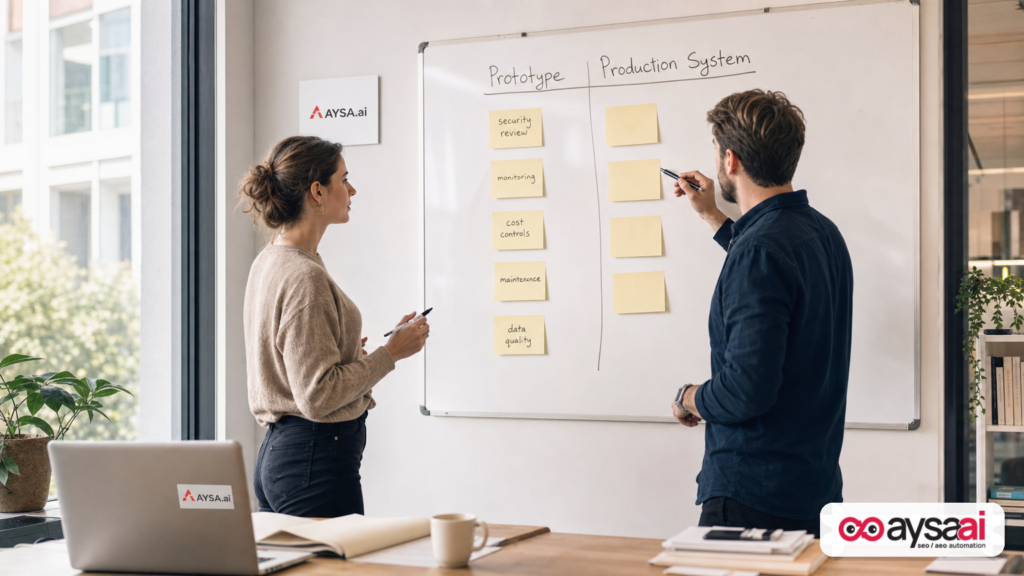
- AI lowered the barrier to prototypes. It did not lower the barrier to reliable systems (security, Monitoring, cost controls, maintenance, and auditability still matter).
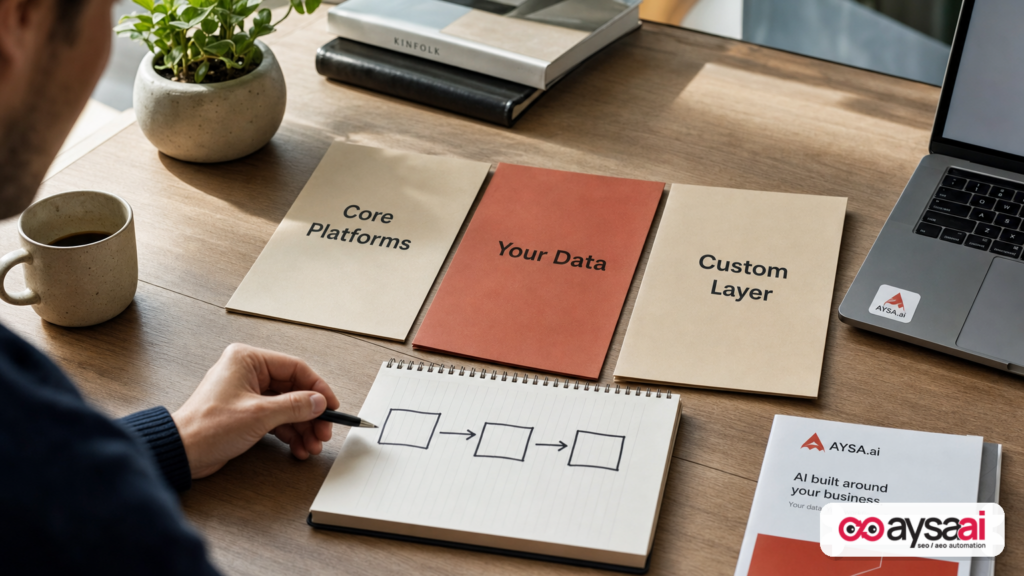
- Most businesses should buy “infrastructure” tools (Crawling, tracking, core monitoring) and build a custom layer where their proprietary data and workflows create advantage.
- Hidden costs are real: token/API usage, engineering time, security reviews, and the cost of broken automation when a vendor changes something upstream.
- Hybrid wins in most real cases: connect paid tools + first-party data + a controlled execution system.
- AYSA fits after decisions are made: AYSA monitors, prepares recommended changes, requests approval, and executes accepted updates—closing the gap between insight and implementation.
Key takeaways (what changed and why it matters)
- “We can build it with AI” became a default reflex. That reflex is now a business risk if it replaces scoping and governance.
- AI search visibility (AEO/GEO) created new monitoring needs. Many teams are experimenting with prompt tracking and AI visibility, but early DIY solutions often fail on consistency and trendability over time.
- Execution is now the bottleneck. Most organizations don’t lose in SEO because they lack ideas. They lose because they can’t ship enough safe, approved changes fast enough.
Table of contents
- The build-vs-buy trap in 2026: AI made prototypes easy, not systems reliable
- Define what you actually need (tool, workflow, custom layer, or agent)
- A decision framework you can actually use (without pretending you’re a software company)
- Reliability is the real feature (and why SEO tools are different)
- The hidden cost stack: tokens, APIs, engineers, security, and “breakage”
- Where hybrid wins: buy the “systems,” build the “advantage”
- What to automate first: repetitive, context-rich work
- What you should almost never build from scratch
- Security, privacy, and MCP-style connectivity: powerful, but not casual
- Agency angle: stop selling dashboards—sell shipped outcomes
- The SME scenario: “I don’t want another tool—I want fewer headaches”
- Where AYSA fits: from monitoring to approved execution
- What to do next (30/60/90-day action list)
- Sources and further reading
The build-vs-buy trap in 2026: AI made prototypes easy, not systems reliable
AI is a superpower for experimentation. You can spin up a custom assistant, write scripts, connect a few APIs, and suddenly you have something that looks like a product. That’s the good news.
The bad news is that many teams confuse a prototype with a production system. A prototype answers: “Is this idea useful?” A production system answers: “Will this work every week, with consistent data, under security constraints, with predictable cost, and with maintenance owned by someone who will still be here next quarter?”
Search Engine Land framed this well: AI encourages teams to believe they can automate everything, but it introduces new complexity—security, maintenance, data access, internal capabilities, workflow fit, and whether the solution remains reliable six months from now (Search Engine Land).
My take: the build-vs-buy decision is no longer primarily a procurement decision. It’s an operating model decision. If you don’t decide who owns reliability, budgets, and change management, your “automation” becomes another source of chaos.
Define what you actually need (tool, workflow, custom layer, or agent)
Most businesses start with the wrong question (“Should we build or buy?”) instead of the right one: “What exactly are we trying to make easier, more reliable, or more scalable?”
In practice, SEO “automation” usually falls into four buckets (the labels vary, but the shapes are consistent):
1) A custom tool
A real internal system: database, logic, UI, permissions, error handling, monitoring, documentation, and an owner. This is software engineering with SEO goals.
2) A custom workflow
A repeatable process combining tools: templates, prompts, spreadsheets, scheduled exports, and simple automations. Useful, fast to build, but still needs maintenance. Search Engine Land highlighted these as common wins for teams: persona checks, translations, reporting summaries, and turning meeting recordings into briefs (source).
3) A custom layer on top of SaaS
You buy core platforms (crawlers, rank tracking, analytics connectors) and build a thin layer that merges with your first-party data (GA, Search Console, CRM, product catalog, inventory, margin, call tracking). This is where differentiation usually lives.
4) A true agent (autonomous-ish)
A system that can take actions: create tickets, nudge owners, draft content updates, propose technical fixes, or trigger a workflow based on detected events. This is powerful—and risky—without approval gates.
One reason teams waste money is simple: they call all four of these “an AI agent,” then budget and staff them like a spreadsheet macro. That mismatch is where timelines and trust go to die.
A decision framework you can actually use (without pretending you’re a software company)
If you’re an SME or an agency, here’s the decision framework I’d use before you request budget, start coding, or sign a one-year contract.
Step 1: Write the problem in one sentence
Not “We need an AI tool.” Instead:
- “We don’t know which pages are declining until revenue drops.”
- “We can’t ship technical fixes without engineering help, so issues linger for months.”
- “We publish content, but we don’t refresh it, so rankings decay.”
- “We can’t measure AI search visibility consistently, so we can’t improve it.”
Step 2: Scope the workflow (not the features)
Define:
- Users: who touches it weekly?
- Inputs: what data sources are required (GSC, GA, CRM, call logs, inventory)?
- Outputs: what decisions/actions should it trigger (tickets, content edits, redirects)?
- Cadence: daily/weekly/monthly?
- Governance: who approves changes, and how are changes rolled back?
Step 3: Test the market first
This is one of the most important points from the Search Engine Land piece: even if you intend to build, you should test what already exists so you understand what you truly need (source).
Why? Because your “must-have 10 features” often collapses to “we need 3 core things and reliable history.”
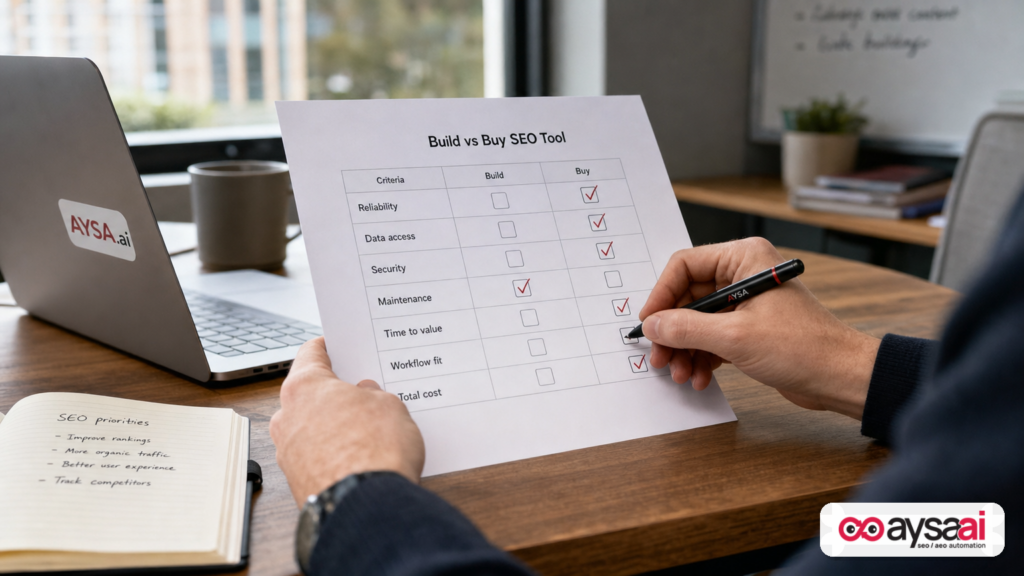
Step 4: Score build vs buy vs hybrid
Use a simple scoring model (1–5) for each:
- Reliability requirements (uptime, history, trendability, alerts)
- Security & privacy (data sensitivity, vendor access, internal controls)
- Data access (APIs, exports, integrations)
- Total cost of ownership (not just license price)
- Time to value (weeks, not quarters)
- Workflow fit (does it map to how your team actually works?)
- Maintenance ownership (who fixes it when it breaks?)
Step 5: Decide what you’re optimizing for
Most teams can’t optimize for everything. Choose:
- Speed (get value in weeks)
- Control (customization, data residency, internal governance)
- Cost predictability (avoid usage-based surprises)
- Execution throughput (ship more improvements safely)
My bias: in SEO, throughput and reliability usually win, because compounding requires consistent execution over months.
Reliability is the real feature (and why SEO tools are different)
SEO is not a one-time project. It’s ongoing measurement and iterative change. That makes reliability—consistent data collection, stable reporting definitions, and historical continuity—the most underrated “feature.”
When you build an internal tool, reliability becomes your problem. And SEO has specific failure modes:
- Upstream changes: APIs, platforms, or LLM behaviors change; your tool quietly degrades.
- Data drift: tracking logic changes and your historical trends become apples-to-oranges.
- Silent failures: automations stop running; nobody notices until results drop.
- Maintenance debt: “temporary scripts” become core infrastructure with no owner.
Search Engine Land gave a concrete example: a DIY prompt tracking tool worked initially but became a maintenance burden when external changes required fixes, pushing the team toward a specialized platform instead (source).
That story repeats constantly. It’s not that internal tools are bad—it’s that many organizations don’t staff them like systems.
The hidden cost stack: tokens, APIs, engineers, security, and “breakage”
One of the most dangerous myths in modern SEO operations is: “If we build it internally, it’s free.” It’s not free; it’s just paid differently.
The Search Engine Land article called out the hidden costs: token usage, API calls, infrastructure, engineering time, security reviews, and maintenance. It also referenced reporting about “AI sticker shock” and usage-based budget surprises (source).
Here’s the cost stack I want every founder and agency owner to internalize:
1) Engineering time (even if it’s “just a little”)
Time to build the first version is rarely the problem. Time to support it—debugging, refactoring, onboarding, documenting—becomes the tax.
2) Security reviews and data governance
As soon as you connect internal knowledge, customer data, or proprietary research into AI workflows, you trigger risk management. Even if you’re comfortable, your company might not be. And they shouldn’t be.
3) Usage-based AI costs
Token costs, API calls, and model usage can scale unpredictably if you succeed. Cost predictability matters as much as “does it work.”
4) Breakage cost (the expensive one nobody budgets)
When your automation breaks, you pay twice: you pay to fix it, and you pay in opportunity cost while your team stalls. For SEO, stalled execution often means lost compounding gains.
My rule: if the workflow touches revenue-critical monitoring or site health, you should assume breakage will happen and plan for it like an adult—alerts, backups, rollback paths, and ownership.
Where hybrid wins: buy the “systems,” build the “advantage”
The most durable approach I see for SMEs and agencies is hybrid:
- Buy the foundational systems that must be reliable (tracking, crawling, core reporting).
- Build the thin layer that makes those systems specific to your business (prioritization, merging with first-party data, internal workflows, approvals).
- Execute through an approval-gated mechanism that ships changes consistently.
Search Engine Land recommended a version of this: buy the crawler, rank tracker, or AI visibility platform, then connect data sources and create unified reports using your own context (source).
Why hybrid is the default best answer
- Vendors specialize in reliability. That’s what you pay for.
- Your advantage is context. Your margins, inventory, customer questions, sales objections, seasonality, and brand constraints.
- Your bottleneck is execution. A hybrid approach is the easiest to connect insights to shipping changes.
A simple hybrid example (non-SEO owner friendly)
Imagine a local clinic:
- They buy reliable monitoring and technical checks.
- They build a lightweight workflow that merges: appointment availability + services + location pages + common patient questions.
- They execute</strong updates (titles, FAQs, schema, internal links, page improvements) on a controlled cadence with approvals.
This is not about fancy AI. It’s about not dropping the ball week after week.
What to automate first: repetitive, context-rich work
AI shines when tasks are repetitive but still require context. That’s where you get leverage without handing the keys to the website to a black box.
Good early automation candidates:
Content QA against brand and customer context
Use AI-assisted checks to flag “generic” writing, missing pain points, missing proof, missing internal links, outdated sections, or mismatched intent. Search Engine Land described using a custom GPT to evaluate whether content matches personas and pain points (source).
Monthly reporting and weekly summaries
Summaries that combine notes, tasks, and status updates are boring—and therefore perfect to semi-automate. The win isn’t the summary; it’s the reduction in dropped follow-ups.
Turning internal knowledge into briefs
Transform meetings, call transcripts, sales notes, and support tickets into structured briefs. This is where AI is genuinely useful because the raw inputs are messy.
Content refresh workflows
Most SMEs publish and forget. Refresh is where gains come from: update outdated comparisons, add FAQs, improve internal links, tighten intent, and ensure pages answer questions that AI search experiences might summarize.
What I would not automate early: anything that publishes changes to the site without an approval gate.
What you should almost never build from scratch
There are categories where building from scratch is a trap for most SMEs and even many agencies—because reliability and long-term consistency matter more than novelty.
1) Site crawling and technical auditing foundations
Crawling at scale involves edge cases: JavaScript rendering, canonical logic, robots directives, faceted navigation, parameter handling, internationalization, and more. Buying is usually smarter unless crawling is your business.
2) Rank tracking as a system of record
Rank tracking isn’t hard to hack together. It’s hard to make stable across geographies, personalization, SERP features, and time. And it’s even harder to keep definitions stable so trends remain meaningful.
3) AI visibility / prompt tracking as a long-term dataset
This is new territory for many teams. But the lesson from the source is important: DIY tools may work briefly, then become unmaintainable when upstream behaviors change (source).
If you do build experiments here, treat them as experiments. Don’t make them the single source of truth unless you’re staffing them properly.
Security, privacy, and MCP-style connectivity: powerful, but not casual
Modern SEO automation increasingly means connecting systems: analytics, Search Console, project management tools, knowledge bases, CRMs, and AI assistants. The source article mentioned MCP connections (Model Context Protocol) as an open standard to connect AI apps to external systems and workflows (Search Engine Land).
I’m not going to pretend we can validate MCP implementation details from the provided context alone. But we can state the operational implication safely: the more systems you connect, the more your SEO stack becomes a security surface area.
Ask these questions before connecting anything
- What data is being sent to external services?
- Is customer data involved (even indirectly)?
- Who can access outputs and logs?
- How are credentials stored and rotated?
- Can we audit what the automation did and why?
- Can we disable it quickly if it behaves unexpectedly?
If you can’t answer these, you don’t have an automation plan—you have a risk.
Agency angle: stop selling dashboards—sell shipped outcomes
Agencies are under pressure from two directions:
- Clients want results faster and cheaper.
- AI makes “analysis” easier to commoditize.
So here’s the uncomfortable agency truth: your value is not the dashboard; it’s the execution throughput you can safely produce.
In the build-vs-buy conversation, agencies often make two mistakes:
Mistake #1: Building internal tools that become unbillable maintenance
You build a custom system to impress clients. Then Google changes something, a vendor changes an endpoint, or your team turns over—now you’re paying an internal tax just to keep your “differentiator” alive.
Mistake #2: Buying too many tools that don’t map to delivery
Tool sprawl looks like sophistication but often produces fragmentation: more logins, more exports, more conflicting priorities, more time spent explaining instead of shipping.
A better model for agencies
- Standardize on a small set of reliable measurement systems.
- Build reusable workflows/templates (briefs, refresh checklists, internal linking rules, technical fix playbooks).
- Use an approval-gated execution engine to implement changes across client sites consistently.
This is where “approved execution” becomes a strategic advantage: you can move quickly without creating client trust issues.
The SME scenario: “I don’t want another tool—I want fewer headaches”
Let’s make this real with a scenario I see constantly.
Scenario: a mid-sized ecommerce brand with 5,000 SKUs
The owner says:
- “We used to get traffic from Google. It’s inconsistent now.”
- “Our team publishes content sometimes, but it’s hard to know what matters.”
- “Developers are busy; SEO changes take forever.”
- “Someone suggested we build an AI system to optimize everything.”
Here’s what I’d do before buying or building anything:
Step 1: Define outcomes
- Detect declining categories and pages early.
- Fix technical issues that block crawling/indexing.
- Refresh top money pages quarterly.
- Improve internal linking to push authority to margin-driving products.
Step 2: Choose hybrid
- Buy reliable monitoring and auditing.
- Build lightweight prioritization rules: combine search data with margin and inventory.
- Execute</strong changes through approvals: titles, meta, internal links, content sections, schema, redirects.
Step 3: Set a shipping cadence
One of the biggest differences between winners and losers is cadence. Not “big SEO projects,” but small, safe, approved changes shipped every week.
That is exactly why “build vs buy” must include: who will maintain it, and who will execute outputs on the site.
Where AYSA fits: from monitoring to approved execution
Most SEO stacks have a gap: they can identify issues and opportunities, but they can’t reliably turn them into shipped improvements. That’s where businesses stall.
AYSA is designed to close that gap as an execution system:
- Monitors your site and visibility signals (AYSA Monitoring).
- Prepares changes (technical, content, internal linking, structured improvements) based on what matters.
- Asks for approval before anything goes live (governance by design).
- Executes accepted website changes consistently, so you’re not stuck with “recommendations only.”
In a build-vs-buy framework, AYSA helps in two ways:
1) AYSA supports the hybrid model
You can still buy best-in-class measurement tools. AYSA becomes the operational layer that turns insights into approved implementation—especially valuable when your bottleneck is engineering availability.
2) AYSA aligns with AI search realities (AEO/GEO)
As search evolves beyond ten blue links, execution becomes more granular: updating entities, clarifying answers, improving page sections, keeping content current, and structuring information so it can be understood and reused in AI-driven experiences. AYSA supports that ongoing cycle through monitoring and controlled iteration.
If you’re evaluating how your brand appears in AI-driven results, start here: AYSA AI Search Visibility. If you’re comparing tool approaches, see: AYSA AI SEO Tools.
What to do next (30/60/90-day action list)
This is the part most editorials skip. Here’s the operating plan.
Next 30 days: scope and stabilize
- Map your workflow: from detection → prioritization → implementation → measurement.
- List your recurring SEO tasks and mark which are repetitive + context-rich.
- Inventory your data sources: GA, GSC, CRM, support tickets, product catalog.
- Pick 1–2 “must-be-reliable” systems you will not DIY.
- Set approval rules for any automation that touches the site.
Days 31–60: choose hybrid and ship quick wins
- Test existing tools in your category before building.
- Build one lightweight workflow (content QA, reporting summary, brief generation).
- Ship quick wins: fix obvious technical blocks, refresh a top page, improve internal links.
- Implement monitoring and alerts so failures are visible, not discovered late.
Days 61–90: turn execution into a cadence
- Establish a weekly shipping cadence (even small changes compound).
- Connect first-party business data to SEO prioritization (margin, leads, inventory, LTV).
- Formalize governance: approvals, rollback, audit trail.
- Consider an execution system to close the gap between insight and implementation (this is where AYSA typically pays for itself in operational leverage).
To explore how this looks in an execution-first system, start with: Monitoring, browse the AYSA blog for operational playbooks, and review pricing only after you’ve scoped your workflow so you can compare cost to total cost of ownership.
Common failure modes (so you can avoid them)
Whether you build or buy, these are the traps I see repeatedly:
Buying because the demo was impressive
Demos are optimized for feature breadth, not workflow fit. If it doesn’t reduce steps in your real process, it becomes shelfware.
Building without an owner
If nobody owns maintenance and reliability, your tool becomes a time bomb.
Not treating “history” as a first-class requirement
SEO is trend-driven. If your data definitions keep changing, you can’t learn.
Collecting insights with no path to execution
This is the most common. You “know what to do,” but nothing ships. An approved execution model is not a luxury; it’s the difference between strategy and results.
My point of view: AI didn’t replace SEO work—it rearranged it
AI didn’t eliminate the need for SEO. It changed where effort matters:
- Less time gathering and summarizing.
- More time deciding what matters and shipping improvements.
That’s why build-vs-buy should be evaluated through one primary lens: Will this increase the rate at which we ship safe, approved, high-impact changes?
If the answer is yes, you’re probably making a good decision. If the answer is “It gives us more reports,” be skeptical.
Sources and further reading
- Search Engine Land: How to approach build-versus-buy decisions for SEO
- Search Engine Land: How to scale SEO content updates with Claude Code (workflow/automation research lead from the provided context)
- Search Engine Land: How prompt injection puts your brand and AI workflows at risk (security research lead from the provided context)
- Search Engine Land: Ghost citations: Why AI search cites your content, not your brand (AI search visibility research lead from the provided context)
- Search Engine Land: Google Search Console Platform properties are now globally live (measurement research lead from the provided context)
- Search Engine Land: ChatGPT gains access to Yelp reviews, ratings, and photos (local discovery research lead from the provided context)
Note: The links above are included because they were provided in the source context as relevant research leads. This editorial does not claim additional verification beyond that context, and it intentionally avoids introducing unverified statistics or vendor performance claims.
What to do next
- Write your one-sentence workflow problem (not a tool request).
- Decide if you need a tool, workflow, custom layer, or agent—don’t mix categories.
- Test the market so you learn what “reliable” looks like and what you truly need.
- Commit to hybrid by default: buy reliability, build advantage.
- Choose an execution system that can turn insights into approved website changes—otherwise your SEO will remain stuck in analysis.
If you want to see how AYSA approaches this end-to-end—monitoring → recommendations → approval → execution—start with Monitoring and AI Search Visibility.
Continue the AI search topic inside AYSA.
Use these pages to connect the article with AI SEO tools, AI visibility monitoring, AI Overviews and approved website execution.
Turn this topic into a website action plan.
Use these AYSA hubs to move from reading to technical fixes, AI visibility monitoring, research, glossary context and approval-first SEO execution.