ChatGPT Citations Are Not Stable: What Hidden Retrieval Pipelines Mean for SEO, AEO, and Real Business Attribution
New analyses show ChatGPT can silently switch between different “hidden” web-retrieval pipelines, changing which sites it fetches and cites even when the prompt stays the same. Here’s what that means for AI search visibility, brand attribution, and the practical steps SMEs and agencies should take to win—and measure—visibility in the new search layer.

AI Search visibility is entering an uncomfortable phase: the citations you see in ChatGPT can change even when the prompt stays the same. Not because the web changed overnight, but because the system behind the answer can quietly route your request through different web-retrieval “pipelines.”
That’s not a small technical nuance. It changes how we should interpret citations, how we measure “visibility,” and how businesses should prioritize SEO, AEO (Answer Engine Optimization), and GEO (Generative Engine Optimization). It also changes what “winning” looks like: it’s less about a single ranking position and more about being consistently retrievable, readable, and citable across multiple retrieval routes.
In this editorial, I’ll break down what the new research implies for real businesses, what can go wrong if you treat AI citations as stable, and how to build an execution system that can keep up. I’ll also show where AYSA fits: Monitoring, preparing changes, asking for approval, and executing accepted improvements—because in AI search, insight without implementation is just trivia.
Concise summary

- ChatGPT citations aren’t stable. New analyses found citations can change when ChatGPT silently switches its underlying web Retrieval Pipeline.
- There are “hidden” source-selection labels behind the scenes (e.g., “Labrador,” “Bright,” “Oxylabs,” “SERP”) that can influence which URLs even enter consideration.
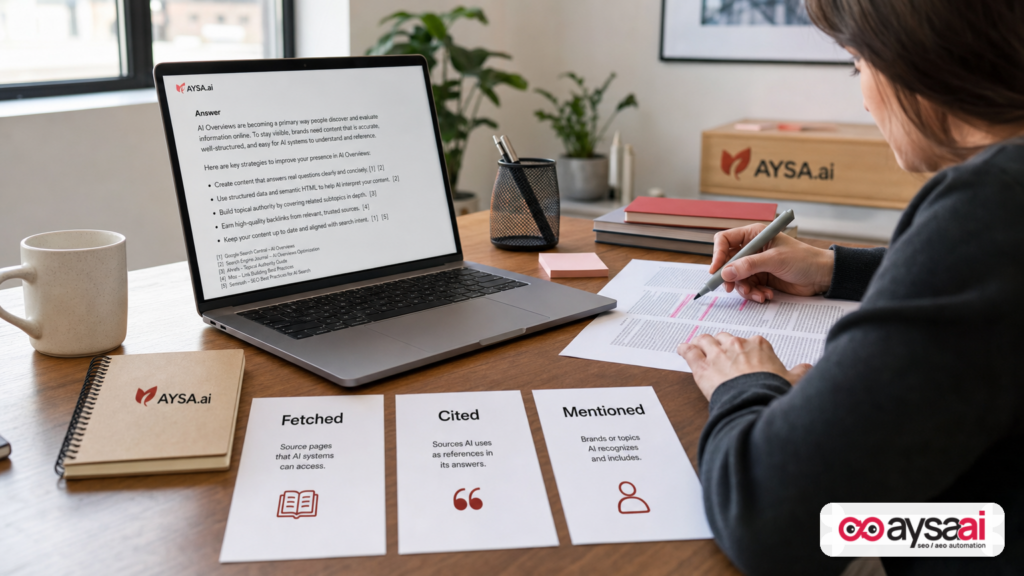
- Visibility has three states: your page can be fetched, cited, or merely mentioned—each has different business value and different optimization levers.
- Attribution will be messy. You need repeatable monitoring and proxy KPIs (not just “we got cited once”).
- Practical advantage goes to readable pages: plain HTML, accessible pricing/specs, and strong third-party coverage that supports claims.
- Execution matters more than dashboards. The winners will be the teams that detect changes, propose fixes, and ship improvements safely and consistently.
Table of contents
- What changed: citations can switch when hidden retrieval pipelines switch
- Why this happens: the AI answer is the final layer, not the whole process
- The problem: ChatGPT can change sources without changing the answer
- Fetched vs. cited vs. mentioned: the three visibility states you must separate
- Why attribution gets harder (and what to measure instead)
- What tends to win across pipelines: retrievability, readability, and claim support
- Technical implications: JavaScript, rendering, and “can the AI read it?”
- Content implications: how to write for citation-worthy claims without writing for “robots”
- Authority implications: third-party pages as “claim validators”
- A realistic SME scenario: why your citations keep changing (and revenue follows)
- What agencies should rethink: deliverables, reporting, and the new baseline
- How AYSA.ai operationalizes approved execution for AI visibility
- What to do next: a practical action list
- Sources and further reading
What changed: citations can switch when hidden retrieval pipelines switch

The underlying story comes from a report published by Search Engine Land, summarizing two independent analyses that inspected how ChatGPT retrieves web sources for answers.
The important point isn’t that ChatGPT cites sources—that’s already familiar. The important point is that the same prompt can trigger different retrieval systems, and those systems can return different sets of URLs/domains. That means two people (or the same person on a different run) may see different citations even if the generated answer looks broadly similar.
Search Engine Land summarized findings from Chris Green and Suganthan Mohanadasan indicating:
- ChatGPT appears to use internal retrieval “labels” (observed examples included “Labrador,” “Bright,” “Oxylabs,” and “SERP”).
- When the retrieval label switched, URL/domain overlap dropped materially across repeated runs—meaning the citation pool can change substantially.
- Some prompts can be classified in ways that skip web search entirely, meaning no page has any chance to be fetched or cited.
- In more complex prompts, ChatGPT may run multiple searches, including rewritten queries and site-specific probes, changing the input set that determines the final answer.
- A page can be fetched into context and still not be cited. A brand can be mentioned without being used as evidence.
This is a big deal for anyone trying to track “AI visibility,” justify budgets, or build a repeatable playbook. If the retrieval layer is variable and sometimes hidden, your visibility needs to be modeled as a probability distribution, not a screenshot.
Why this happens: the AI answer is the final layer, not the whole process
Most business owners see an AI answer like a finished product: question in, answer out, citations attached. But the answer is the end of a process that can include routing decisions, retrieval decisions, filtering decisions, and summarization decisions.
Traditional search already does something similar: you type a query, Google decides which index shards to query, which vertical results to blend (news, local, images), which personalization signals matter, and which results get shown. The difference is that in classic search, marketers have decades of tooling and shared mental models to work with (imperfect, but real).
In AI answer engines, we are still building those shared models. The analyses described in the Search Engine Land coverage highlight a key missing piece: the system may switch its retrieval provider or pipeline in ways the user cannot see from the final citation cards.
For the business operator, the implication is straightforward: if you only look at the final citations, you’re seeing the tip of the iceberg. If you want repeatable growth, you need an operational approach that can handle variability.
The problem: ChatGPT can change sources without changing the answer
Here’s what makes this uniquely frustrating: in many cases, the user experience doesn’t scream that anything changed. The answer may remain structurally similar, and the citations may look like a handful of cards at the end. But behind the scenes, the retrieval pipeline might switch—changing which pages are eligible to be used as evidence.
If you’re a founder or marketing lead, that creates three practical problems:
- False confidence: “We got cited once, so we’re good.” You might be visible in one pipeline and invisible in another.
- Misleading diagnostics: When you lose a citation, you may assume your SEO declined—when the retrieval route simply changed.
- Budget friction: When leadership asks “what did we get for this spend?”, a single screenshot of a citation is not defensible.
In classic SEO, ranking volatility is normal, but the mechanism (ranking systems, index updates, competitors) is at least conceptually consistent. With hidden retrieval routing, you can face source volatility without a clear ‘why’ in the UI. That pushes businesses toward process maturity: monitoring, sampling, and execution discipline.
Fetched vs. cited vs. mentioned: the three visibility states you must separate
One of the most useful distinctions highlighted in the Search Engine Land summary is the idea that there are different “states” of AI visibility:
- Fetched: The system retrieves your page and loads it into context, but the user never sees it.
- Cited: The system uses your page as evidence for a claim and displays your URL/domain as a citation.
- Mentioned: The brand name appears in the answer, but it may not be used as evidence for the claim.
Why does this matter? Because each state maps to a different business outcome:
- Fetched is a leading indicator. It means you’re in the candidate set. If you’re never fetched, you can’t win citations.
- Cited is the strongest visibility outcome for trust and downstream traffic (when citations are clickable or influence decision-making). It’s also the hardest to earn consistently.
- Mentioned can still matter commercially (brand recall), but it’s the easiest to misinterpret. You can be “mentioned” in a negative context, or mentioned because the model “knows” you, not because your site is authoritative on the point at hand.
This is why “AI visibility” cannot be a single metric. A useful tracking system needs to separate these states and treat them differently in reporting and optimization.
Why attribution gets harder (and what to measure instead)
In 2026, many teams are still trying to force AI answers into a 2016 measurement framework: rankings, clicks, sessions. That framework is breaking for three reasons:
- Citations vary across runs when retrieval pipelines vary.
- Some queries skip web retrieval, meaning there are no citations to “win.”
- User journeys are fragmenting: users may decide based on AI answers without clicking at all, or they may search again with your brand name after seeing you cited/mentioned.
So what should you measure?
Measurement principles that survive AI citation volatility
- Use sampling, not snapshots: run a defined prompt set repeatedly over time (and across user contexts when possible) to estimate visibility frequency.
- Track at the domain + page-type level: product pages, pricing pages, location pages, comparison pages, “best of” pages. AI systems often cite specific page types for specific claim types.
- Separate intent classes: informational, commercial, local, “best” lists, troubleshooting. Retrieval behavior can differ by intent.
- Use proxy KPIs: branded search lift, direct traffic lift, lead form mentions (“I found you on ChatGPT”), and conversion rate changes on landing pages that are commonly cited.
Why proxy KPIs are not a cop-out
In business, you almost never get perfect attribution. You get decision-grade signals. In a world where retrieval and citations can vary run-to-run, the goal is to build a measurement stack that provides directional truth and supports action, not one that pretends uncertainty doesn’t exist.
If your leadership team demands “exact ROI from ChatGPT citations,” the honest answer is: we can build a measurement model, we can prove correlations over time, and we can reduce uncertainty through better monitoring—but we can’t treat AI answers like a single deterministic ranking list.
What tends to win across pipelines: retrievability, readability, and claim support
Based on the Search Engine Land summary, both analyses point toward a practical truth: AI systems cite what they can retrieve and read, and they support claims with sources that are easy to parse and credible for the specific statement.
That pushes optimization toward three “R” priorities:
- Retrievability: Can your pages be fetched consistently across different retrieval routes?
- Readability: Once fetched, does the page expose the needed facts in plain text/HTML?
- Reasonable claim support: Are there third-party or authoritative pages that corroborate your claims so the model can cite them for recommendations?
In other words: AI visibility is not only “write great content.” It’s “publish information in a format machines can reliably use, and make your claims easy to validate.”
Technical implications: JavaScript, rendering, and “can the AI read it?”
One of the most practical insights in the Search Engine Land coverage is that pages with critical info hidden behind heavy JavaScript or non-text interfaces can be harder for retrieval systems to use. If pricing, specifications, availability, or key service details aren’t clearly accessible, the system may fall back to third-party sources that are readable—even if those sources are less accurate or out of date.
For SMEs, this usually shows up in a few common patterns:
- Pricing behind interactive widgets that don’t expose text cleanly.
- Product specs only in images (like a spec sheet JPG) without a text equivalent.
- Location/service details spread across sliders, tabs, or PDFs that are hard to parse.
- Video-first explanations (YouTube embeds) without transcripts on the page.
A technical baseline for AI retrievability
Without pretending we know every retrieval system’s exact capabilities, a conservative baseline that generally helps includes:
- Ensure critical facts are present in server-rendered HTML (not only injected client-side).
- Use clear headings and consistent page structure so facts are easy to locate.
- Provide text equivalents for tables, images, and PDFs when they contain decision-critical info.
- Keep pages accessible without requiring logins, geofencing, or aggressive bot blocking that may inadvertently block retrieval.
These aren’t “AI tricks.” They’re solid technical SEO and usability principles—now with higher stakes because the AI layer may choose alternative sources if yours is difficult to parse.
Content implications: how to write for citation-worthy claims without writing for “robots”
When an AI system cites, it’s often because a sentence in its answer needs support. That means your content strategy should include claim-ready blocks: short, factual, unambiguous passages that can safely be used as evidence.
What “claim-ready” content looks like
- Concrete statements with context: “Our clinic offers same-day appointments Monday–Friday” is clearer than “fast appointments.”
- Structured comparisons: “Plan A includes X, Plan B includes Y” in text, not only in a fancy UI table.
- Explicit definitions: explain terms you own (especially in SaaS and services).
- Proof artifacts: policies, warranties, shipping timelines, refund terms—written plainly.
What to avoid
Don’t turn your site into an “AI bait” factory. Overly repetitive phrasing, keyword stuffing, or unnatural Q&A blocks can reduce trust and harm user experience. The goal is to publish human-first content that happens to be machine-legible and evidence-friendly.
In practice, the best content for AI citation is often the best content for customers: clear, specific, and complete.
Authority implications: third-party pages as “claim validators”
One of the most misunderstood elements of AI visibility is the role of third-party sources. Many businesses assume: “If we publish it on our site, we’ll be cited.” But AI systems often prefer third-party corroboration for broader recommendation claims—because it reduces the risk of relying on self-promotional statements.
From the Search Engine Land summary, vendor pages may be used for vendor-controlled facts (like pricing/specs), while third-party sources can be used to support comparative or evaluative statements.
What businesses should do about it
- Invest in earned coverage that is readable and specific (not just a brand mention).
- Build “reference-grade” pages on your own site for facts you control, then make them easy to cite.
- Improve your presence where retrieval systems look: industry publications, forums, and platforms that expose text. (Be careful: you can’t control how you’re portrayed there.)
This isn’t a call for spammy PR. It’s a call for durable authority building: the kind that helps in classic SEO, in AI search, and in human trust.
A realistic SME scenario: why your citations keep changing (and revenue follows)
Let’s make this concrete with a scenario I see constantly across SMEs.
Scenario: a regional home services company (HVAC) competing on “best” recommendations
Imagine a mid-sized HVAC company in Phoenix. They’ve invested in a great website, service pages, and a pricing estimator tool. They start hearing customers say, “ChatGPT recommended you.” Great, right?
Then the marketing manager tries to verify it and finds something confusing:
- In one run, ChatGPT cites a local directory and a review site.
- In another run, it cites a regional news article about heat safety and mentions the HVAC company only in passing.
- In a third run, it doesn’t cite anyone and gives generic advice.
The team’s first instinct is to treat this like classic rank tracking: “We dropped.” But the deeper reality may be:
- The prompt was routed through a different retrieval pipeline.
- The system rewrote the query or ran site probes that changed the candidate set.
- The company’s own pricing estimator is JavaScript-heavy, so it’s not a clean source for factual claims.
- Third-party pages are being used to validate “best HVAC” recommendations.
Business impact
In home services, a small shift in recommendations can change call volume quickly. If your business is “sometimes visible,” you’ll see volatility in:
- branded search queries (“CompanyName HVAC Phoenix”)
- direct traffic (people typing your URL after seeing you mentioned)
- call center scripts (“I saw you on ChatGPT”)
- lead mix and close rates
And that’s the point: citation volatility is not just a nerd problem. It’s a pipeline problem. The businesses that treat it as an operational system—monitoring + execution—will build more stable demand capture.
What agencies should rethink: deliverables, reporting, and the new baseline
If you run an agency or you manage external partners, this shift forces a hard conversation: what exactly are we selling when we sell “AI optimization”?
Stop selling screenshots
A single “we got cited” screenshot is a vanity artifact. It’s not reproducible, not defensible, and not stable under pipeline switching.
Agencies should move toward:
- Prompt sets and sampling methodology (what prompts, how often, what contexts)
- Visibility distribution reporting (how often cited, by intent class)
- Actionable root-cause hypotheses (retrievability/readability/authority)
- Execution pipelines that can ship changes safely
The new retainer is “monitor + ship”
The most valuable work won’t be “monthly reporting.” It will be the ability to detect changes and implement improvements quickly—especially technical fixes that reduce readability issues, or content revisions that clarify key facts.
This is where many agencies will struggle: they can identify problems, but they can’t ship changes without long dev queues or client friction. AI search rewards operational speed and consistency.
How AYSA.ai operationalizes approved execution for AI visibility
This is the gap we built AYSA to address.
Most “AI visibility” tools stop at monitoring. They show you a chart, maybe a list of citations, and then they hand you a to-do list. But SMEs don’t need more to-do lists. They need a system that turns monitoring into safe implementation—without sacrificing control.
AYSA’s model is simple:
- Monitor what matters (prompts, visibility signals, technical signals) over time: AYSA Monitoring
- Prepare recommended site changes (content, technical, structured data where appropriate) based on observed gaps and opportunities.
- Ask for approval before anything goes live—because businesses need control and accountability.
- Execute accepted changes and track the impact through monitoring loops.
If you’re specifically focused on AI search visibility, you can start by understanding your baseline and where you show up: AI Search Visibility
And if you want a broader view of AI SEO tools that support these workflows: AI SEO Tools
Why “approved execution” matters more when citations are unstable
When the environment is noisy, teams tend to overreact. They change headlines weekly, rewrite pages constantly, and chase whatever citation they saw yesterday.
Approved execution creates discipline:
- Changes are proposed with rationale.
- Stakeholders approve what goes live.
- Improvements are tracked over time via monitoring—not vibes.
This is how you build compounding advantage in AI search: fewer random acts, more consistent iteration.
Where AYSA fits in the workflow (practically)
In the context of hidden retrieval pipelines and unstable citations, AYSA helps teams:
- Build repeatable monitoring so you’re not chasing one-off outcomes.
- Identify “readability blockers” (e.g., critical facts hidden behind JavaScript patterns) and propose remediations.
- Upgrade key pages (pricing, product, service, location) into “reference-grade” sources that are easier to cite.
- Maintain governance with approvals and change history, which matters in regulated industries and multi-location businesses.
If you want to explore whether this is a fit for your business size and pace, pricing and packaging are here: AYSA Pricing
And for more operational playbooks, you can browse additional editorials and guides: AYSA Blog
What to do next: a practical action list
If you’re an SME, ecommerce operator, local business, SaaS team, or an agency, here’s a practical plan you can implement without pretending the AI layer is deterministic.
1) Build a prompt set that reflects real buyer intent
- Include informational prompts (“What is…”, “How do I…”)
- Include commercial prompts (“Best…”, “Top…”, “Alternatives to…”, “Compare…”)
- Include local prompts if relevant (“near me”, city + service)
- Include support/troubleshooting prompts if you sell products
2) Run the prompts repeatedly and record outcomes
You’re looking for stability patterns:
- How often are you cited?
- Which page types get cited?
- Which competitors appear consistently?
- Do citations swing across runs for the same prompt?
3) Separate fixes by visibility state
- Not fetched? Work on technical access, discoverability, and authority signals.
- Fetched but not cited? Improve clarity of facts, structure, and “claim-ready” passages.
- Mentioned but not cited? Strengthen reference-grade pages and third-party corroboration.
4) Upgrade “money pages” into AI-readable reference pages
Prioritize pages that map to high-value decisions:
- Pricing pages
- Product spec pages
- Service detail pages
- Location pages
- Comparison pages
- Returns/warranty/shipping pages
5) Build third-party validation intentionally
Identify the claims you want to win (“best for X,” “fastest shipping,” “specialist in Y”) and build a plan to earn third-party coverage that supports those claims. The goal is not just “links”—it’s readable, specific, credible support.
6) Put execution on rails
This is the make-or-break step. Monitoring without execution is where most teams stall.
Create a cadence:
- Weekly: review monitoring alerts and citation shifts
- Biweekly: approve and ship prioritized updates
- Monthly: review visibility distribution trends and adjust the roadmap
If you don’t have internal bandwidth to do this consistently, that’s exactly where an approved execution model can help—especially when you’re trying to keep up with an environment where the retrieval layer can shift.
AYSA perspective: the real lesson is operational, not mystical
When people hear “hidden pipelines,” they sometimes jump to conspiracy-mode: “It’s all random.” I don’t agree.
The better takeaway is operational maturity:
- AI answers are a product of multiple systems, not one deterministic ranking list.
- Your job is to maximize the chance you’re eligible for retrieval and citation across those systems.
- The businesses that win will treat AI visibility as an ongoing execution loop, not as a one-time optimization project.
That’s why we position AYSA as an execution engine, not a dashboard. The new search layer rewards teams that can monitor, decide, and ship—over and over.
Sources and further reading
- Search Engine Land: ChatGPT citations change when hidden search pipelines switch
- Search Engine Land: How AI search gives old negative content new life
- Search Engine Land: How to build an AI-powered content gap analysis workflow
- Search Engine Land: Visual semantics: The missing piece of topical authority
- Search Engine Land: Why agentic commerce will matter more than ChatGPT ads
Related AYSA resources:
Continue the AI search topic inside AYSA.
Use these pages to connect the article with AI SEO tools, AI visibility monitoring, AI Overviews and approved website execution.
Turn this topic into a website action plan.
Use these AYSA hubs to move from reading to technical fixes, AI visibility monitoring, research, glossary context and approval-first SEO execution.