Claude Fable 5’s Return (With Limits) Is A Wake-Up Call For AI Search: Build For Classifiers, Not Just Keywords
Anthropic reintroduced Claude Fable 5 with temporary usage limits and a revamped safety classifier that may create false positives. That sounds like “AI product news,” but it’s really a preview of how AI gateways—classifiers, routing, quotas, and policy layers—will shape what gets generated, published, and ultimately recommended in AI-driven discovery. Here’s the business playbook to build classifier-resilient SEO/AEO/GEO systems and keep execution moving even when tools change weekly.

AI models don’t “ship” like normal software. They return, disappear, come back, get throttled, get rerouted, and sometimes start refusing perfectly legitimate requests because a safety layer got tightened overnight.
That’s why the reintroduction of Anthropic’s Claude Fable 5—with temporary usage limits and a revised safety classifier that may trigger false positives—isn’t just model gossip. It’s a preview of the operating conditions every business will face as AI becomes embedded in search, content creation, customer support, product research, and even website change management.
Search Engine Journal reported that Fable 5 is back globally with usage limits and an improved safety classifier intended to block a reported bypass attempt, while acknowledging that benign requests may be flagged—especially in routine coding and debugging scenarios—and that blocked requests may be routed to a fallback model instead. Read the source coverage here: Search Engine Journal.
My perspective—wearing the operator hat, not the AI fan hat—is simple: AI access layers are becoming the new gatekeepers of marketing execution. And in AI Search, execution is strategy.
Concise summary (read this if you only have 60 seconds)
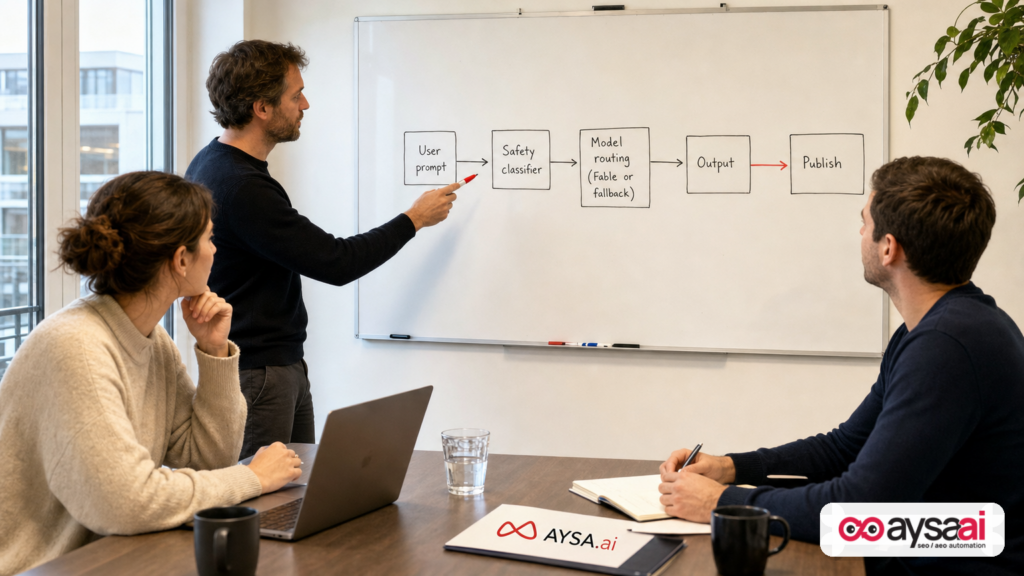
- What changed: Claude Fable 5 was reintroduced with temporary usage limits and an upgraded safety classifier that may produce false positives, plus model routing behavior when requests get blocked (per SEJ’s reporting).
- Why it matters beyond Claude: Every major AI platform is converging on a similar structure: policy + classifiers + routing + quotas. Your workflow must assume constraints.
- What breaks for businesses: content throughput drops, outputs become inconsistent, legitimate tasks get blocked, and teams waste time “prompt wrestling” instead of shipping improvements.
- What to do: build classifier-resilient content systems: publish source-of-truth pages, structure decision content, standardize prompts/briefs, and maintain an approval + execution pipeline.
- Where AYSA fits: AYSA is an execution system for AI-era SEO/AEO/GEO: it monitors, prepares website changes, asks for approval, and executes accepted updates—so your site keeps improving even when AI tools change weekly.
Table of contents

- What Actually Changed With Claude Fable 5 (And Why It’s Not Just An AI News Item)
- The Bigger Pattern: “AI Gateways” Are Replacing Simple Model Access
- Why This Hits SEO Hard: AI Search Rewards Clarity, Not Content Volume
- The New Failure Modes: False Positives, Quiet Refusals, And Invisible Model Switching
- SME Scenario: A Local Clinic, An Ecommerce Brand, And An Agency—Same Problem, Different Costs
- A Practical Playbook For SMEs: How To Build “Classifier-Resilient” Content And Site Architecture
- AEO/GEO In Plain English: How AI Systems Choose What To Cite And Recommend
- Content Ops In 2026: Build A Publishing Supply Chain, Not A Prompt Habit
- What Agencies Should Rethink: Scope, SLAs, And Governance Under Quotas
- What To Monitor Weekly (So You Don’t Get Surprised By AI-Driven Demand Shifts)
- Approved Execution: The Competitive Advantage Nobody Wants To Budget For (But Everybody Needs)
- Where AYSA Fits: Monitoring → Prepared Changes → Approval → Execution (The Only Loop That Scales)
- What to do next (Action List)
- Sources and further reading
What Actually Changed With Claude Fable 5 (And Why It’s Not Just An AI News Item)
Based on the supplied research (SEJ’s reporting), the story includes three operational details that are easy to miss if you only skim headlines:
- A new safety classifier was trained to detect and block a reported bypass behavior, with an expectation of high catch rates—but also with an explicit warning that benign requests may get flagged (false positives), particularly during routine coding and debugging.
- Usage limits apply during the initial availability window (reported as up to 50% of weekly usage limits through a specific date), after which a different pricing/usage mechanism applies.
- Routing behavior may occur when a request is blocked (SEJ mentions requests being routed to a fallback model), meaning the user experience and output may change even if a user thinks they’re using one model consistently.
Those three details—classifier + quotas + routing—are the real headline for business operators.
Why? Because they describe an AI production environment, not just a model. And your marketing, SEO, and content systems must operate inside that environment.
The Bigger Pattern: “AI Gateways” Are Replacing Simple Model Access
Ten years ago, most SEO workflows were “tool → recommendation → human implements changes.”
In the last few years, many teams flipped into “AI → drafts → human pastes.”
Now we’re entering a new, stricter phase: AI gateways stand between your intent and the output you need. These gateways include:
- Safety classifiers (is the request allowed?)
- Policy layers (what kind of language is required, forbidden, or constrained?)
- Model routing (if not allowed or not available, route to another model, mode, or capability)
- Quotas and throttles (how much can you do this week?)
- Vendor platform constraints (cloud availability, plan tiers, enterprise allowlists)
From a business standpoint, that means:
- You can’t plan production as if AI is infinite and consistent.
- You can’t assume every legitimate request will go through.
- You can’t assume the “same prompt” yields the same quality every time.
So if you’re building an SEO or content strategy for AI search, the strategy can’t be “we’ll generate more pages.” It has to be “we’ll ship the right changes reliably.”
Why This Hits SEO Hard: AI Search Rewards Clarity, Not Content Volume
AI search is changing two things at once:
- Discovery behavior: users ask broader questions and expect synthesized answers, not ten tabs.
- Supply behavior: businesses can generate content fast—but platforms increasingly constrain that generation through safety and usage systems.
That creates a paradox for SMEs: you can publish more than ever, but it’s harder than ever to publish consistently and reliably and in a way AI systems feel confident summarizing.
AI search surfaces (and classic search features) tend to reward content that is:
- Structured (clear headings, scoped sections, unambiguous definitions)
- Grounded in stable facts (specs, policies, documented processes)
- Decision-oriented (comparisons, constraints, trade-offs, “who it’s for”)
- Consistent across the site (no contradictions between pages)
- Maintainable (easy to update without rewriting everything)
When a tool’s classifier starts producing false positives, or when quotas cut your throughput, the only sustainable approach is to have a Site architecture and editorial system that makes each update “count.”
This is also why we focus on AI search visibility at AYSA, not just traditional Rank tracking. In AI search, “visibility” is a blend of being discoverable, being citable, and being the obvious next click after an AI summary.
The New Failure Modes: False Positives, Quiet Refusals, And Invisible Model Switching
Let’s translate the Fable 5 pattern into failure modes you can recognize in your own operations—whether you use Claude, ChatGPT, Gemini, or any other system.
1) False positives: legitimate work gets blocked
SEJ’s summary highlights Anthropic’s warning that benign requests may be flagged during routine coding/debugging. That should ring bells for any business doing:
- Technical SEO fixes (robots directives, redirects, canonical rules, sitemap behaviors)
- security and privacy documentation (cookie policies, compliance language)
- integration troubleshooting (API calls, webhook retries, authentication errors)
- health/finance adjacent writing (where language can look “high risk” if phrased carelessly)
What does this look like day-to-day? The content manager asks for a “step-by-step debug checklist,” the tool refuses, and now the team either wastes time rephrasing or ships nothing.
Business cost: delays compound. A blocked request doesn’t just cost minutes; it often breaks a sprint plan.
2) Quiet refusals: outputs become vague, sanitized, or incomplete
Even when a system doesn’t fully block a request, safety layers can silently change output. You’ll see:
- generic advice instead of specific steps
- missing examples (“I can’t help with that”) in sections where examples are needed for customer clarity
- hedged language that weakens conversion copy
SEO cost: pages become less useful, less complete, and less cite-worthy.
Conversion cost: customers don’t get the concrete information they need, and they bounce or call support.
3) Invisible model switching: tone and accuracy drift
SEJ reported routing behavior when requests are blocked (sent to a fallback model). If you run a content operation, that’s not a footnote—that’s a governance issue.
When a workflow quietly switches models, you can get:
- tone drift (brand voice inconsistency across pages)
- format drift (some pages are schema-ready; others are prose blobs)
- policy drift (disclaimers included on one page, missing on another)
- accuracy drift if the fallback model handles nuance differently
Governance cost: review becomes harder, because editors are reviewing inconsistent material. Teams start blaming “the AI,” instead of fixing the pipeline.
4) Throttling and quotas: throughput collapses at the wrong time
A usage cap sounds harmless until you map it onto your calendar:
- new product launches
- seasonal promos
- site migrations
- policy updates (shipping, returns, pricing)
If your plan assumes unlimited AI capacity, a temporary cap forces ugly trade-offs: either you ship lower quality, ship later, or ship nothing.
5) The hidden failure: teams optimize “generation,” not “publication”
The most common AI-era failure I see is that teams become excellent at generating drafts and terrible at updating the website.
AI doesn’t create growth by itself. Growth comes from:
- shipping clearer pages
- improving Internal linking so important pages are understood
- adding structured data where it helps machines interpret your content
- removing contradictions and thin pages that dilute trust
This is why AYSA is built around a loop of monitoring and execution—not just content ideation.
SME Scenario: A Local Clinic, An Ecommerce Brand, And An Agency—Same Problem, Different Costs
Here are three realistic scenarios that illustrate how “classifier + quota” conditions play out in the real world.
Scenario A: A local clinic trying to be safe and helpful
A multi-location clinic publishes patient education pages and service pages. The team uses AI to draft:
- pre-visit instructions
- aftercare FAQs
- service comparisons (“urgent care vs. ER” style pages)
Now a classifier starts flagging benign health-related instructions because the wording resembles prohibited medical advice. The marketing lead spends hours rewriting prompts and still can’t get consistent drafts.
Cost: not just traffic loss. Patients get less clarity, call volume rises, and front-desk load increases.
Fix: reduce ambiguity. Build a “source-of-truth” hub with approved disclaimers and standardized sections (“When to call us,” “When to seek emergency care,” “What to bring,” “What we can’t diagnose online”). The more you standardize, the less you rely on ad-hoc generation.
Scenario B: An ecommerce brand drowning in SKU complexity
An ecommerce store has thousands of SKUs and uses AI for variant descriptions, compatibility notes, and comparison tables.
A usage limit hits during a seasonal refresh. The team can’t generate new copy at the planned pace. They react by publishing thin pages just to get the catalog live.
Cost: returns increase because customers didn’t understand compatibility or sizing; SEO suffers because pages aren’t helpful; AI summaries that compare products use competitor sources that are clearer.
Fix: shift from “write unique copy for every SKU” to “publish structured decision content.” Use templates that expose the facts AI systems can safely cite: dimensions, compatibility, warranty, shipping, and “who it’s for.” You can do this with less text and more structure.
Scenario C: An agency scaling content across clients
An agency uses AI to accelerate deliverables. Then a platform changes quotas or the agency’s chosen model becomes inconsistent due to routing. The agency misses a content schedule, and the client blames the agency.
Cost: margin loss, strained client trust, endless rework.
Fix: stop selling volume. Sell an “execution loop” with clear priorities: top money pages, decision content, structured FAQ coverage, internal linking, and technical hygiene. Build the retainer around outcomes and maintenance, not raw page counts.
A Practical Playbook For SMEs: How To Build “Classifier-Resilient” Content And Site Architecture
Let’s make this practical. “Classifier-resilient” does not mean “how to bypass safety.” It means: how to design your content production and site architecture so legitimate business work reliably passes through modern AI gateways—and remains useful even if the writing tool changes.
1) Start with a “source-of-truth layer” on your site
Most SME sites are missing stable, cite-worthy pages that answer the questions humans and AI systems care about:
- shipping timelines and exceptions
- returns and refunds with examples
- warranty coverage and exclusions
- pricing logic and what’s included
- service boundaries (“what we do / don’t do”)
These pages do three things:
- They reduce ambiguity for customers.
- They reduce hallucination risk in AI summaries because the facts live on your domain.
- They give you building blocks for internal linking across product and service pages.
If you do nothing else this quarter, do this.
2) Write “decision-first” content, not “keyword-first” content
Traditional SEO trained people to write to keywords. AI search pushes you to write to decisions.
For a service page, that means sections like:
- Who this service is for (and who it’s not for)
- How to choose between options (tiers, packages, alternatives)
- Constraints and prerequisites (availability, eligibility, timelines)
- What to expect (process steps, outcomes, limits)
- FAQs grounded in your actual policies
For ecommerce category pages, it means:
- comparison tables driven by specs
- compatibility notes and exceptions
- buying checklists (“measure X before ordering”)
- maintenance or care notes (if relevant)
When AI systems synthesize answers, they prefer content that is already structured like an answer.
3) Build standardized outlines and reusable “approved language” blocks
If you’re in a sensitive category (health, finance, legal-adjacent, security-adjacent), don’t improvise. Maintain approved blocks:
- disclaimers
- claims limitations (“results vary,” “not medical advice,” “not a guarantee”)
- eligibility boundaries
- policy references
This reduces risk and reduces false positives because your content becomes consistent and clearly legitimate.
4) Separate drafting from publishing with a clear QA checklist
AI makes drafting cheap. Publishing is where businesses get sued, misquoted, or lose trust.
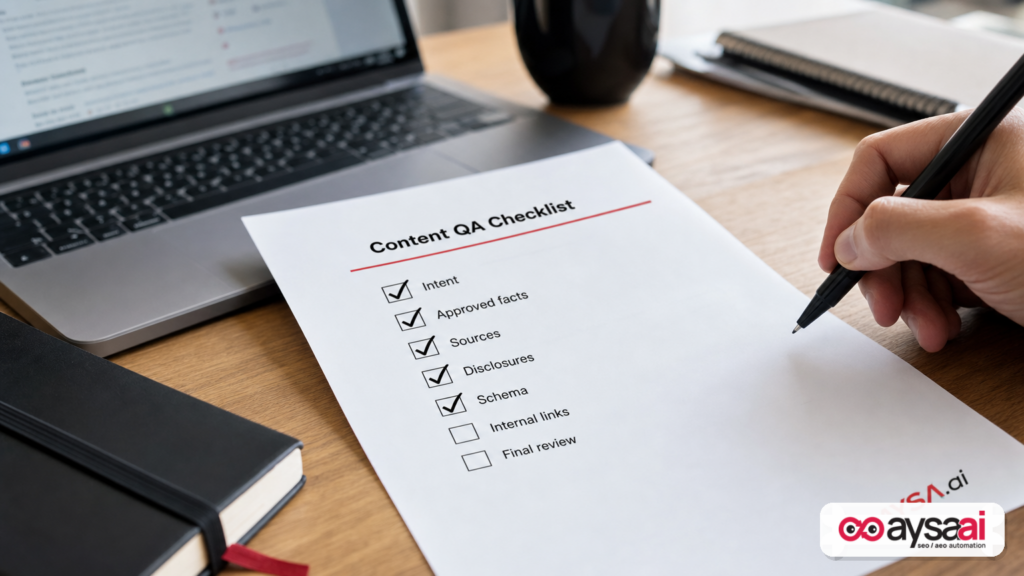
Use a checklist before anything goes live:
- Does it match your actual policy?
- Is every claim supportable by a page on your site?
- Are disclaimers present where needed?
- Is the page internally linked from relevant hubs?
- Is it formatted for skimming (headings, bullets, clear definitions)?
This is also where a system like AYSA can keep the process moving: propose changes, request approval, and then execute only what is accepted.
5) Optimize the “unit of work” to survive quotas
When quotas hit, you want each unit of work to be high-leverage. Here’s what that looks like:
- update a high-intent page (pricing, category, top service page) rather than publishing a new low-intent blog post
- create a comparison hub page rather than ten thin comparison posts
- build a FAQ component used across multiple pages rather than rewriting FAQs repeatedly
Quotas force prioritization. Treat that as a feature: it pushes you toward the content that actually drives revenue.
6) Use internal linking as your “AI comprehension layer”
AI systems—and human users—understand your business better when your site connects the dots.
Examples:
- Every product page should link to shipping, returns, and warranty pages.
- Every service page should link to pricing logic and “how it works.”
- Every comparison page should link to the primary service/product pages it compares.
This isn’t a “nice to have.” It’s how you reduce misinterpretation and improve citation quality over time.
7) Make content maintainable: modular, templated, and measurable
AI search is not static. You’ll update pages more often. So build templates and modules:
- spec blocks
- policy blocks
- FAQ blocks
- pros/cons blocks with scoped language
Maintainability is the difference between a site that keeps up and a site that falls behind.
AEO/GEO In Plain English: How AI Systems Choose What To Cite And Recommend
Let’s demystify the acronyms:
- AEO (Answer Engine Optimization): designing content so it can be directly used as an answer—clear, scoped, structured, and grounded.
- GEO (Generative Engine Optimization): increasing the odds that generative systems choose your site as a source, cite it, and represent your business accurately.
In practice, AI systems tend to cite sources that look like:
- the original manufacturer
- the official provider (clinic, vendor, platform)
- a page with clear definitions and constraints
- a page with well-structured sections that match the query intent
That’s why “keyword targeting” alone is losing power. A page can rank and still not be cite-worthy if it’s vague, salesy, or missing constraints.
If you want the deeper framework we use at AYSA to connect SEO to AI search outcomes, start here: AI Search Visibility.
Content Ops In 2026: Build A Publishing Supply Chain, Not A Prompt Habit
Most teams treat AI as a writing assistant. The better mental model is: AI is a variable supplier in your publishing supply chain.
Suppliers get delayed. They ship inconsistent quality. They change pricing. They update compliance rules. That’s normal.
So you build a supply chain that can absorb shocks. Here’s what that looks like for SEO/AEO/GEO:
Step 1: Define your “money pages” and “decision pages”
Money pages are where conversions happen: category pages, product pages, service pages, pricing pages.
Decision pages help the user choose: comparisons, buying guides, “how it works,” compatibility hubs, FAQs.
If you can only update 10 pages this month, update these—not random blog posts.
Step 2: Build content briefs that are tool-agnostic
Your brief should work whether you use Claude, ChatGPT, Gemini, a human writer, or a hybrid.
A tool-agnostic brief includes:
- intent and audience
- the specific decision the page helps with
- approved facts (specs, policies, constraints)
- required disclaimers
- internal links that must be included
- format requirements (headings, FAQ section, table, etc.)
This reduces dependency on “the perfect prompt” and makes you resilient to model differences and routing.
Step 3: Use an approval gate that doesn’t slow you down
Approval gates fail when they’re manual, ad hoc, and dependent on one person’s inbox.
Approval gates work when changes are proposed in a consistent format and reviewers know exactly what to check: facts, claims, compliance, brand voice.
This is a core reason AYSA exists: prepare concrete website changes, request approval, and execute only what’s accepted. (More on that below.)
Step 4: Publish changes with instrumentation
Every published change should be measurable:
- did the page’s conversion rate improve?
- did support tickets drop?
- did the page gain visibility for high-intent queries?
Marketing without instrumentation becomes theater. AI can generate theater at scale. Don’t do that.
What Agencies Should Rethink: Scope, SLAs, And Governance Under Quotas
Agencies are uniquely exposed to “classifier + quota” volatility because they multiply tool risk across multiple clients.
If you still sell SEO as “X blog posts per month,” you’re selling a commodity that can be disrupted by throttling, refusals, and inconsistent output quality.
Instead, agencies should reposition around four deliverables that remain valuable under constraints:
1) Information architecture and internal linking
AI search thrives when the site is navigable and self-explanatory. Agencies should own:
- hub pages
- decision funnels
- internal link patterns
This is high leverage and not dependent on generating infinite new text.
2) Source-of-truth content and policy clarity
Most clients have policies and constraints hidden in emails or PDFs. Bring them to the site, with proper review.
That is durable value and reduces downstream risk.
3) Update loops and maintenance, not one-off campaigns
AI changes weekly. Your retainer should fund:
- weekly monitoring
- priority updates
- technical hygiene
- content decay refreshes
That is what keeps AI visibility compounding.
4) Governance systems clients can trust
The biggest fear clients have about AI isn’t “will it write?” It’s “will it publish something wrong?”
Agencies that win will be the ones who can show a clear, auditable workflow: proposed changes → review → approved execution.
If you’re an agency evaluating whether a tool like AYSA fits, the key question is whether it helps you ship more improvements per month without sacrificing governance. Explore the concept in our tool overview: AI SEO Tools.
What To Monitor Weekly (So You Don’t Get Surprised By AI-Driven Demand Shifts)
In a shifting AI ecosystem, “we’ll check rankings monthly” is too slow.
Weekly monitoring doesn’t mean you chase every spike. It means you catch meaningful drift early—before it becomes a quarter-long revenue problem.
Here’s a practical weekly monitoring set for SMEs:
1) Performance of top revenue pages
Monitor your key category/service/pricing pages for:
- traffic changes
- conversion rate changes
- engagement proxies (scroll, time on page, add-to-cart initiation)
If your blog grows while these pages stagnate, your strategy is upside down.
2) Brand and product query mix
Watch what people are searching for:
- are queries becoming more comparison-oriented?
- are people asking “best for X” more often?
- are they asking policy questions (returns, warranty, shipping)?
Those shifts often indicate AI summaries are shaping user behavior and pushing them toward decision content.
3) Content decay indicators
Identify pages where performance steadily declines. Decay is often caused by:
- outdated steps or specs
- missing sections that competitors added
- thin answers to evolving customer questions
AI answers amplify decay because they surface the most current and structured explanations.
4) Operational signals: support, refunds, call volume
This is my favorite “non-SEO” monitoring signal: if customer confusion rises, your content is failing, even if traffic looks stable.
If after updating a shipping policy page your “where is my order?” tickets drop, that’s real ROI.
5) Execution velocity
Track your own production system:
- how many site changes did you ship this week?
- how long did approvals take?
- how much rework did you do due to inconsistency or blocked AI drafts?
Execution velocity is a leading indicator of future visibility.
AYSA’s perspective is that monitoring is only useful if it becomes action. That’s why monitoring is integrated into an execution loop: AYSA Monitoring.
Approved Execution: The Competitive Advantage Nobody Wants To Budget For (But Everybody Needs)
Most businesses underinvest in execution because execution feels “operational” rather than “strategic.”
But in AI search, strategy without execution is a slide deck.
Here’s the uncomfortable truth: AI has made ideas cheap. Everyone can generate a content plan, a list of keywords, a set of FAQs, and 30 drafts in an afternoon.
What AI hasn’t made cheap is:
- publishing accurate, approved, compliant pages
- keeping those pages consistent across your site
- updating them at the pace the market changes
- measuring what works and iterating
That’s why I believe “approved execution” is the next competitive moat for SMEs. Big companies have governance and release cycles; SMEs can win by being faster without being sloppy.
Where AYSA Fits: Monitoring → Prepared Changes → Approval → Execution (The Only Loop That Scales)
AYSA.ai is built for the reality this Fable 5 story represents: constant change in the AI layer, and constant pressure to keep your website accurate, structured, and decision-useful.
Here’s how the loop works in plain English:
- Monitor: We track signals tied to visibility and performance so you know where to focus. Learn more: Monitoring.
- Prepare: We translate signals into concrete website changes (content improvements, structural updates, technical items where appropriate).
- Approve: Nothing gets pushed live without human approval. That’s the governance layer most AI workflows are missing.
- Execute: Accepted changes are implemented on the site, so strategy turns into reality.
This matters specifically in a “classifier + quota” world because it reduces dependence on endless draft generation. Your team can focus on prioritization and approvals, while the system keeps execution moving.
If you want the product context, start here:
My operator POV: the winning stack is “workflow + governance + execution,” not “best model”
Model quality matters. But in business, reliability matters more:
- Can your team ship the update this week?
- Can you keep policy pages accurate?
- Can you update top pages when demand shifts?
- Can you do it without brand/compliance risk?
Fable 5’s return with safeguards and limits is a reminder that your “AI stack” is not a tool choice. It’s an operational discipline.
What to do next (Action List)
- Inventory your AI dependencies. List where AI supports writing, coding, support macros, product research, and SEO updates. Ask: what breaks if outputs are blocked or throttled?
- Build your source-of-truth layer. Publish clear pages for shipping, returns, warranty, pricing inclusions, and service boundaries. Make them easy to link to from every money page.
- Prioritize money pages over content volume. Under quota constraints, update what drives revenue: category, product, service, and pricing pages, plus decision hubs.
- Standardize templates and approved language blocks. Reduce risk, reduce rework, and improve consistency across pages.
- Implement weekly monitoring with an execution loop. Don’t just look at metrics. Turn them into prepared updates, approvals, and shipped changes. Start here: AYSA Monitoring.
- Adopt approved execution. Speed without governance is a liability. Use a system that proposes changes, requests review, and executes only what’s accepted.
- For agencies: rewrite your offer. Sell continuous improvement and governance, not page counts. Build retainers around maintenance of decision content and money pages.
Sources and further reading
- Search Engine Journal: Anthropic’s Claude Fable 5 Is Back With New Usage Limits And Safeguards
- Search Engine Journal – Latest News
- Search Engine Journal – SEO
- AYSA: AI Search Visibility
- AYSA: AI SEO Tools
- AYSA: Monitoring
- AYSA: Pricing
- AYSA: Blog
Editorial sourcing note: The supplied research context references an Anthropic announcement and U.S. government commentary but does not provide direct primary links within the extracted text. To avoid inventing or misattributing specifics, this editorial limits hard claims to what is attributed in the cited Search Engine Journal coverage and focuses on operational implications that apply broadly across AI-assisted workflows.
Continue the AI search topic inside AYSA.
Use these pages to connect the article with AI SEO tools, AI visibility monitoring, AI Overviews and approved website execution.
Turn this topic into a website action plan.
Use these AYSA hubs to move from reading to technical fixes, AI visibility monitoring, research, glossary context and approval-first SEO execution.