
Cloudflare’s “Disallow AI Training” Changes the Rules: How to Protect Your Content Without Sacrificing Search
Cloudflare’s new “Disallow AI Training” control is a meaningful shift: it can publish AI-training opt-outs in robots.txt while still allowing key mixed-use crawlers (Googlebot, Applebot, Bingbot) to access your site for search—if they’re deemed “Accountable.” Here’s what changed, why it matters for SMEs, publishers, and agencies, and a practical plan to implement and monitor it without accidental traffic loss.
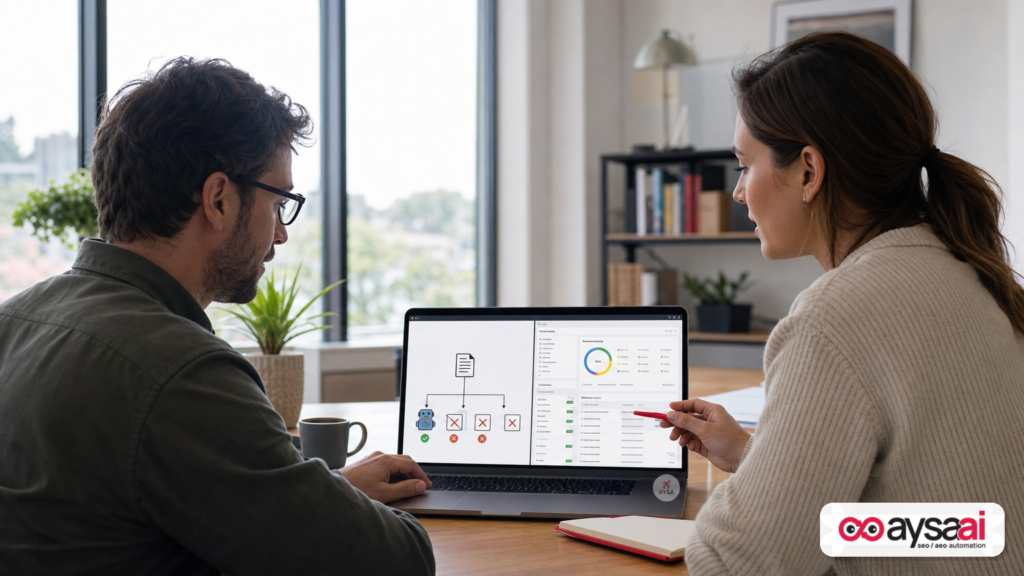
AI Search has changed the incentive structure for every website: your content can be crawled for discovery, for Indexing, for citations in AI answers, and for training future models. Until recently, many businesses tried to solve this with a blunt instrument—blocking bots. That approach often creates a second problem: if the crawler is “mixed-use” (used for both search and training), you risk blocking the very discovery channel you still rely on.
Cloudflare’s new Disallow AI Training control is one of the first mainstream infrastructure-level moves that acknowledges that reality. It’s designed to let publishers and businesses say “no” to training without automatically saying “no” to search Crawling—at least for the major mixed-use crawlers, and only when they meet accountability requirements.
This article explains what changed, why it matters, where it can go wrong, and what SMEs and agencies should do next. I’ll also outline how AYSA fits as the execution layer: we monitor, prepare recommended changes, ask for approval, and then implement accepted updates so you don’t create invisible technical debt with one rushed toggle.
Concise summary
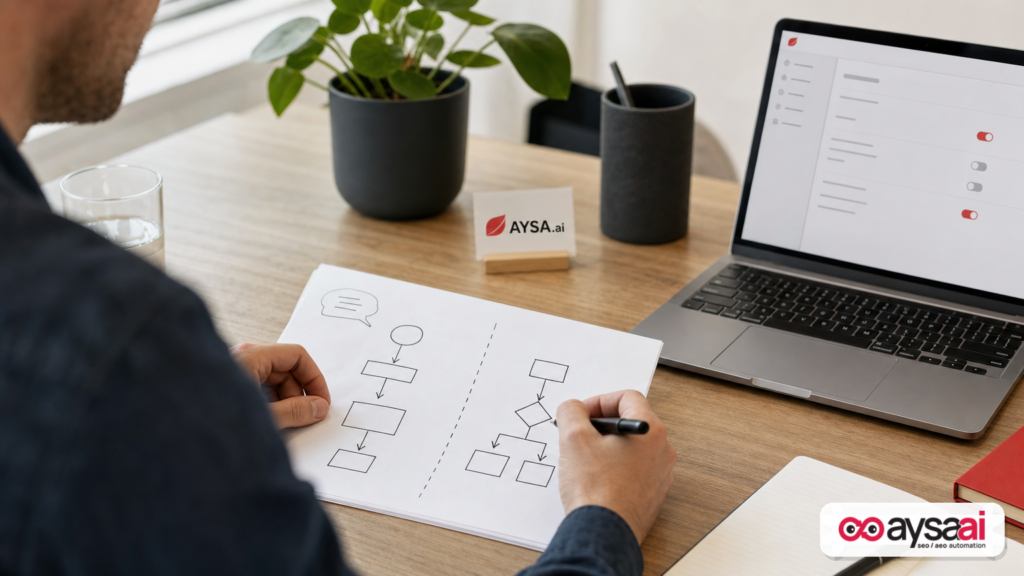
- Cloudflare introduced “Disallow AI Training” as a new setting that publishes training opt-outs in
Robots.txtwhile still allowing key search crawlers to crawl for search. - “Block” now means block: if you choose Block, Cloudflare says Googlebot, Applebot, and Bingbot can be stopped entirely—including for search—because they are mixed-use.
- Google and Apple already support robots-based training opt-outs (via Google-Extended and Applebot-Extended). Bing’s robots.txt training opt-out support is pending; Microsoft currently references a different mechanism.
- The operational risk is real: a policy meant to limit training can become an indexing and revenue issue if your settings and meta tags are inconsistent, untested, or applied without change control.
- Businesses need a governance plan—not just a stance—covering crawler access, AI answer inclusion, Monitoring, and rollback.
Table of contents

- What Cloudflare Changed (And Why September 15 Matters)
- The New Vocabulary: Search Crawling vs Training vs AI Summaries
- “Accountable” Crawlers: The Key Concept Most Teams Will Miss
- How This Maps to Google, Apple, and Bing (And What’s Still Missing)
- The Real Business Risk: Accidentally Blocking Search While Trying To Block Training
- Who Benefits Most (SMEs, Publishers, Agencies, SaaS)
- What You Should Monitor Now (Because AI-era SEO Isn’t Just Rankings)
- A Practical Implementation Plan (SMEs + Agencies)
- Concrete SME Scenario: Ecommerce Brand Protects Training Without Killing Growth
- Where AYSA Fits: Monitoring, Recommendations, And Approved Execution
- Common Pitfalls and How to Avoid Them
- What to do next
- Sources and further reading
What Cloudflare Changed (And Why September 15 Matters)

Cloudflare announced a new setting called Disallow AI Training within its training controls, aimed at one problem: how to stop your content from being used for AI model training without losing search visibility.
Here’s the operational change that matters most:
- Disallow AI Training publishes a training opt-out preference in
robots.txtbut keeps certain mixed-use crawlers allowed for search crawling. - Block is now positioned as the “hard stop” that can block key mixed-use crawlers entirely—including traditional search crawling—because those crawlers may be used for both search and training.
Cloudflare also indicated it will migrate many existing customer configurations so that sites that previously used blocking settings for training get moved to the new Disallow AI Training path (rather than inadvertently blocking discovery). That’s a telling signal: even Cloudflare believes most businesses don’t actually want to nuke search access while trying to limit training.
Primary source for this update: Search Engine Journal coverage of Cloudflare’s Disallow AI Training announcement.
The New Vocabulary: Search Crawling vs Training vs AI Summaries
Most business owners think in a simple model: “bots either help SEO or they steal content.” That model is outdated.
In 2026, you have at least three different “uses” of crawling and content access:
1) Search crawling (indexing and ranking)
This is what most SMEs depend on: being discoverable when someone searches on Google or Bing. Blocking search crawling is the fastest way to reduce future organic visibility.
2) Training use (model improvement)
This is the contentious one: your content may be used to train generative models. Some companies are fine with that; others want to opt out due to brand, IP, or business model concerns.
3) AI summaries / AI answers (surface-level output)
This includes whether your content can be quoted, summarized, or used to answer a user’s question directly in an AI interface. This can drive citations and Clicks—but it can also reduce clicks if answers satisfy users without a visit. The controls for this are not always the same as training opt-outs.
Cloudflare’s move is significant because it attempts to separate (1) and (2) at an infrastructure level. It also hints at a future where (3) becomes centrally manageable, which Cloudflare itself has suggested as a next focus (per the SEJ report).
“Accountable” Crawlers: The Key Concept Most Teams Will Miss
Cloudflare’s Disallow AI Training approach depends on an internal designation: “Accountable” crawlers.
The idea is straightforward: some organizations operate crawlers that have mixed purposes. Cloudflare says it will keep mixed-use crawlers allowed under Disallow AI Training only if the crawler operator meets (or commits to meeting) certain requirements. The SEJ report describes requirements including:
- a way to opt out of training via
robots.txtor similar standards, - a way to opt out of AI summaries (with operator support now, and through Cloudflare in the future),
- URL-level visibility into what was made available for training and how content appeared in search,
- assurance that training opt-out won’t affect traditional search results.
This is bigger than one Cloudflare toggle. It’s the emerging shape of a new contract between publishers and AI/search operators:
- Consent signals (robots directives, meta tags, settings)
- Transparency (URL-level reporting)
- Non-retaliation (training opt-out doesn’t punish rankings)
As an operator, you should treat “Accountable” as a dynamic list—not a permanent truth. Your governance process should assume it can change, and your monitoring should be able to tell you when behavior changes.
How This Maps to Google, Apple, and Bing (And What’s Still Missing)
Cloudflare’s setting is only as useful as the downstream platforms that honor the signals it publishes.
Google: training opt-out via Google-Extended
According to the SEJ report, Cloudflare’s Disallow AI Training maps to a Disallow rule for Google-Extended, which is Google’s token for opting content out of Gemini model training. Crucially, Google’s public position (as referenced in the source) is that Google-Extended does not affect inclusion or ranking in Google Search.
Separate from training is whether content can appear in certain generative experiences, which the SEJ report notes is controlled through a Search Console setting (and that this is distinct from training).
If you’re an SME, translate that into plain English:
- You can say “don’t use my content to train models” (Google-Extended).
- That is not the same as “don’t show my content in AI summaries.”
- You may need multiple controls, managed in different places.
Apple: training opt-out via Applebot-Extended
Per the SEJ coverage, Apple’s equivalent is Applebot-Extended. The distinction Apple makes is that this extended crawler isn’t used for search ranking.
The SEJ report also indicates Apple uses the nosnippet meta tag to keep content out of certain AI-generated answers to broad knowledge questions in Siri and Search. That’s a separate lever from “training.”
Bing: robots.txt training opt-out support pending
This is where the story gets operationally messy. Cloudflare’s Disallow AI Training does not (yet) send a robots-based no-training signal that Bing will honor, because Microsoft support is still in progress (as described in the SEJ report). The report also mentions Bing’s current training opt-out mechanism via a meta tag (NOARCHIVE), and that it has implications for link inclusion in Bing’s AI experiences.
The practical takeaway: one Cloudflare setting will not harmonize your policy across all ecosystems today. You still need a multi-operator map of controls—and you need to know the business tradeoffs of each one.
The Real Business Risk: Accidentally Blocking Search While Trying To Block Training
If you want the unvarnished business truth: most “AI policy” debates online ignore the fact that implementation mistakes are what cost money.
Cloudflare making Block more absolute is a double-edged sword:
- It gives you a clear, enforceable “do not crawl” stance.
- It also increases the chance that a well-intentioned setting change turns into a search visibility event.
Here’s how it happens in the real world:
- A founder hears “block AI bots” and assumes it’s safe.
- A developer toggles Block at the CDN layer because it’s fast.
- Indexing slows, then drops. Brand search holds for a while, but non-brand discovery erodes.
- Sales flatten, then decline. The company blames “Google updates” or “seasonality.”
- Weeks later, someone notices crawl errors or fewer indexed pages.
That’s not an SEO theory problem—it’s change management.
For SMEs, the cost is usually opportunity cost and revenue. For publishers, it can be catastrophic if search is a major acquisition channel. For agencies, it becomes a credibility and retention problem because the client doesn’t care why it happened—they care that it happened.
Who Benefits Most (SMEs, Publishers, Agencies, SaaS)
This update matters differently depending on your business model.
Publishers and content-first businesses
If your business model depends on content access—subscriptions, ad revenue, affiliate revenue—training use can feel like value leakage. But you still rely on search for discovery. The Disallow AI Training approach is attractive because it aims to protect training rights while preserving the top-of-funnel.
However, you still need to answer a strategic question: are AI citations and AI answer inclusion a net positive for you? For some publishers, citations are incremental. For others, AI answers are a click sink. Your stance should be based on measurement, not ideology.
SMEs (local services, ecommerce, clinics, hotels)
Most SMEs should not start with “Block everything.” They should start with:
- Maintain search accessibility.
- Decide training policy intentionally (opt out or not).
- Measure whether AI citations drive qualified traffic.
In other words: protect the channel you already know works (search), while you test and learn the economics of AI search.
SaaS
SaaS companies often want to limit training usage of documentation, help center content, and proprietary workflows—especially if the content encodes product differentiation. But SaaS also needs discoverability for category and problem keywords.
For SaaS, the right approach is usually granular:
- Keep marketing pages fully crawlable.
- Decide how to handle docs and knowledge base content.
- Align your stance with your support deflection goals.
Agencies and consultants
This update is a reminder that “SEO” now includes infrastructure-level policy: CDN controls, robots directives, meta tags, and platform settings (like Search Console). Agencies that win in the next phase won’t just audit—they’ll operationalize governance and execution.
That’s exactly the gap AYSA is built to fill: recommendations plus controlled, approved execution.
What You Should Monitor Now (Because AI-era SEO Isn’t Just Rankings)
If you take one thing from this editorial, make it this: your bot policy is only as good as your monitoring.
At minimum, SMEs and agencies should monitor:
1) Crawl and index health
- Are key sections of the site still being crawled?
- Are important pages still indexable?
- Are you seeing sudden changes in crawl patterns after policy updates?
2) Search Console signals (when applicable)
The SEJ report notes that Google’s training opt-out is separate from a Search Console setting related to AI experiences. Whether you choose to participate in those experiences or not, Search Console is where operational reality shows up—coverage, indexing issues, and visibility trends.
3) AI citations and referral traffic
This is the new frontier: where your brand gets cited, how often, and whether those citations produce clicks that convert. Even if you opt out of training, you still need to understand the impact on discovery and demand capture.
AYSA’s AI search visibility work is designed for exactly this: helping teams see where they appear in AI-driven experiences and what to fix next. See: AYSA AI Search Visibility.
4) Change monitoring and rollback readiness
Most traffic losses aren’t “mystery algorithm updates.” They’re changes. Someone changed something.
If you can’t answer “what changed?” quickly, you don’t have an SEO program—you have hope.
This is why AYSA emphasizes monitoring and controlled execution: AYSA Monitoring.
A Practical Implementation Plan (SMEs + Agencies)
Here’s a practical, low-drama plan to implement a training opt-out while protecting search visibility. This is written for teams that want control, not chaos.
Step 1: Decide your policy in plain English
Write a one-paragraph policy your team can understand:
- Do we allow search crawling? (Almost always yes.)
- Do we allow training use? (Maybe yes, maybe no—decide intentionally.)
- Do we want to appear in AI summaries/answers? (Test and measure; decide per section if needed.)
Step 2: Inventory your controls (CDN, robots.txt, meta tags, platform settings)
List what actually governs access:
- Cloudflare controls (training/search/agent controls as referenced in the SEJ report).
robots.txtdirectives.- Page-level meta tags (e.g.,
nosnippet,noarchivewhere applicable, per the SEJ report’s platform notes). - Google Search Console settings related to AI experiences (separate from training, per the SEJ report).
The point isn’t to use every lever. The point is to stop pretending one lever controls everything.
Step 3: Choose “Disallow AI Training” unless you truly want to block search crawling
Based on Cloudflare’s framing in the SEJ report, Disallow AI Training is the default for businesses that still want to be discovered in search.
Choose Block only if you are comfortable with search impact or have an alternative acquisition engine (email, app install base, direct traffic, paid media) and you’ve made a deliberate decision to reduce crawl-based exposure.
Step 4: Make it a staged change with verification
Operationally:
- Document the before state.
- Apply the setting.
- Verify robots output and crawler access behavior.
- Watch crawl/index signals for at least 1–2 weeks depending on site size.
If you don’t have a release process, create a lightweight one: change request → approval → implementation → verification → monitoring.
Step 5: Decide what you’ll do about AI summaries separately
This is where most teams get confused: training opt-out and AI summaries opt-out are not the same thing.
Per the SEJ report:
- Google handles AI experience inclusion with a Search Console setting (distinct from training).
- Apple has a mechanism (like
nosnippet) for limiting certain AI-generated answers. - Microsoft’s current approach uses a different tag mechanism for training opt-out (and has other downstream effects).
You should treat AI summaries as a separate policy decision with its own measurement plan.
Concrete SME Scenario: Ecommerce Brand Protects Training Without Killing Growth
Let’s make this real.
Scenario: A mid-sized ecommerce brand sells specialty home goods. Organic search drives a meaningful share of new customers. The founder is uncomfortable with product guides and comparison content being used to train models that might later answer “best X for Y” without sending traffic back.
What they’re tempted to do: Turn on “Block AI Bots” broadly at the CDN level and call it done.
What can go wrong: If that “block” setting affects mixed-use crawlers, the site may become less discoverable in traditional search over time. The brand doesn’t notice immediately because returning customers still arrive via email and direct traffic. Four to eight weeks later, new customer acquisition softens—and the team blames paid media costs or competition.
A safer approach using the Cloudflare change described by SEJ:
- Use Disallow AI Training so search crawling can continue (for the mixed-use crawlers Cloudflare allows for search).
- Keep product pages and category pages fully crawlable (these drive revenue).
- Decide on a content-by-content approach for long-form guides: keep them in search, but opt out of training where supported.
- Measure AI citations and referral traffic to see whether AI answers are helping or hurting.
Where AYSA comes in:
- Monitor search visibility and AI search visibility so the team sees impact early: AI Search Visibility
- Track ongoing site changes and technical signals: AYSA Monitoring
- Prepare recommended updates (robots, meta tags, internal content structure), request approval, and then execute accepted changes—so there’s an audit trail and a rollback plan.
Where AYSA Fits: Monitoring, Recommendations, And Approved Execution
Most SEO tools stop at “insights.” In the AI-era, that’s not enough—because the risk is in execution.
When crawler policy and AI controls are changing fast, the winning operating model looks like this:
- Monitor what’s happening (visibility, indexing health, AI citations).
- Prepare recommended changes (clear rationale + expected impact).
- Ask for approval (so business owners control risk).
- Execute accepted changes consistently and safely.
That’s exactly how AYSA is designed to operate: an execution system for SEO/AEO/GEO work—not just an analysis layer.
- For teams exploring AI-era SEO: AYSA AI SEO Tools
- For monitoring and early warnings: AYSA Monitoring
- For understanding AI search visibility: AYSA AI Search Visibility
- For pricing and fit: AYSA Pricing
- For additional operational guidance: AYSA Blog
In practice, this means you can treat crawler policy changes as managed production updates—not “set it and forget it.” That’s how you protect your acquisition engine while still enforcing your content policy.
Common Pitfalls and How to Avoid Them
Based on how these systems typically fail, here are the failure modes to plan for.
Pitfall 1: Assuming robots.txt is the only layer that matters
CDN controls, robots directives, meta tags, and platform settings all matter. Cloudflare is publishing preferences into robots.txt, but the downstream behavior depends on the operator honoring those signals (and on your other settings not contradicting them).
Pitfall 2: Conflating “training opt-out” with “AI answer opt-out”
Per the SEJ report, Google treats these separately: Google-Extended is about training, and a Search Console setting controls participation in certain generative experiences. If you want a coherent policy, you need to manage both.
Pitfall 3: Making a high-impact setting change without a rollback plan
Even if you’re “just flipping a switch,” the downstream effects can take time to appear. Keep notes, keep timestamps, and define what signals will trigger a revert.
Pitfall 4: Over-blocking third-party “agent” crawlers and breaking your own tooling
Many sites rely on legitimate tools that crawl (performance monitoring, QA, marketing audits). If you broadly block anything that looks like an automated agent, you can break internal workflows. Separate “training crawlers” from “business-critical crawlers” deliberately.
Pitfall 5: Treating this as a one-time compliance task
Cloudflare’s roadmap and the SEJ report both suggest more changes are coming (especially around AI summaries and transparency). This is a program, not a checkbox.
What to do next
- Confirm your Cloudflare stance: If your goal is “no training but yes search,” align to Disallow AI Training rather than Block.
- Write a simple policy statement: search crawling, training, AI summaries—decide intentionally.
- Inventory current controls: CDN,
robots.txt, meta tags (nosnippet,noarchivewhere relevant), Search Console settings. - Implement with change control: document before/after, validate outputs, watch for crawl/index changes.
- Start AI visibility monitoring: track AI citations and referral patterns alongside traditional SEO.
- Operationalize execution: use a system (like AYSA) to monitor, propose, require approval, and execute changes with an audit trail.
Sources and further reading
- Search Engine Journal: Cloudflare Lets Sites Disallow AI Training Without Blocking Googlebot
- Search Engine Journal: AI Search coverage
- Search Engine Journal: Technical SEO coverage
- Search Engine Journal: SEO coverage
- AYSA: AI Search Visibility
- AYSA: Monitoring
- AYSA: AI SEO Tools
- AYSA: Pricing
- AYSA: Blog
Note on primary documentation: The SEJ source references official mechanisms such as Google-Extended, Applebot-Extended, Search Console settings, and Bing’s NOARCHIVE guidance. This editorial intentionally avoids reproducing operator documentation links not included in the provided research context. When publishing, we recommend adding direct links to the relevant official documentation pages for Google, Apple, and Microsoft for maximum accuracy and reader utility.
Continue the AI search topic inside AYSA.
Use these pages to connect the article with AI SEO tools, AI visibility monitoring, AI Overviews and approved website execution.
Turn this topic into a website action plan.
Use these AYSA hubs to move from reading to technical fixes, AI visibility monitoring, research, glossary context and approval-first SEO execution.

