Competitor Conquesting Without the Waste: Demand Gen + Negative-Intent Search for Real Buyers
Traditional competitor keyword bidding is often a high-CPC vanity play. Here’s a more efficient approach: use Demand Gen to reach competitor-aware audiences earlier, and use negative-intent search campaigns to capture buyers actively looking for an alternative—then validate your promise with landing pages that actually convert.

Competitor campaigns are one of the oldest plays in paid search: bid on a rival’s brand, show up when a buyer is “ready,” and siphon demand.
In practice, that approach often turns into a tax: expensive Clicks, low conversion rates, and a constant feeling that you’re paying a premium to interrupt someone else’s decision.
This editorial explains a more efficient way to win competitor-aware buyers using two tactics highlighted in Search Engine Land’s coverage of Demand Gen and negative-intent conquesting—but expanded into a complete, standalone operating guide for small businesses and agencies.
Concise summary
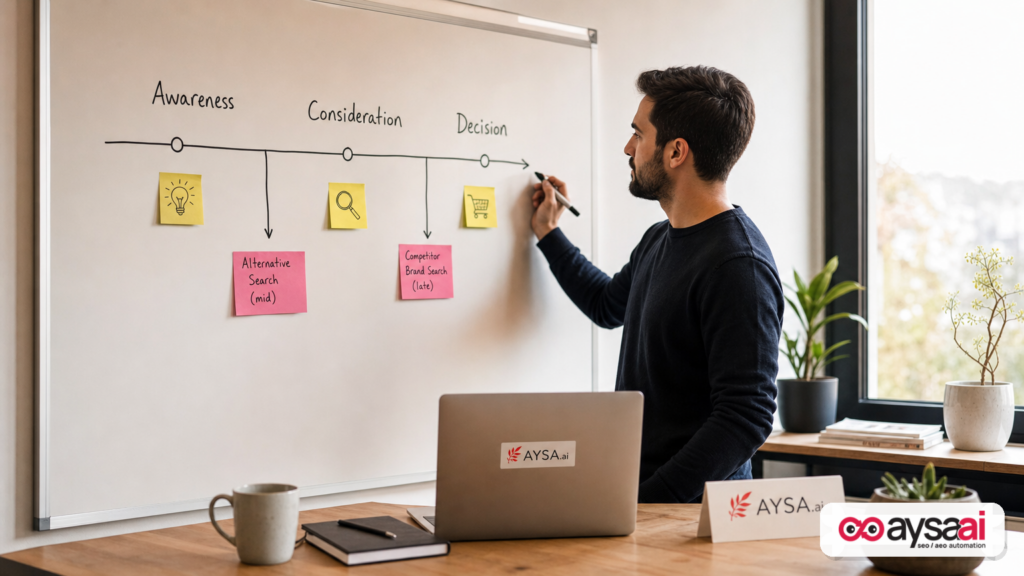
Instead of defaulting to competitor brand bidding, use:
- Demand Gen conquesting to reach competitor-aware audiences earlier (YouTube/Discover/Gmail) using custom segments and lookalikes, supported by strong creative and “why us” landing pages.
- Negative-intent conquesting in Search to capture users who are actively reconsidering a competitor (alternatives, cheaper, cancel, complaints, refund, “dupe”).
Both approaches reduce wasted spend by aligning with intent timing—and both succeed or fail based on post-click execution: landing pages, proof, tracking, and iteration.
Key takeaways (read this if you’re busy)

- Competitor brand keywords are late-stage and often overpriced. You’re buying the most contested click at the moment the buyer is least open to switching.
- Demand Gen can “conquest” without paying competitor-brand CPCs. Target people who searched competitor terms, but meet them earlier with differentiation and proof.
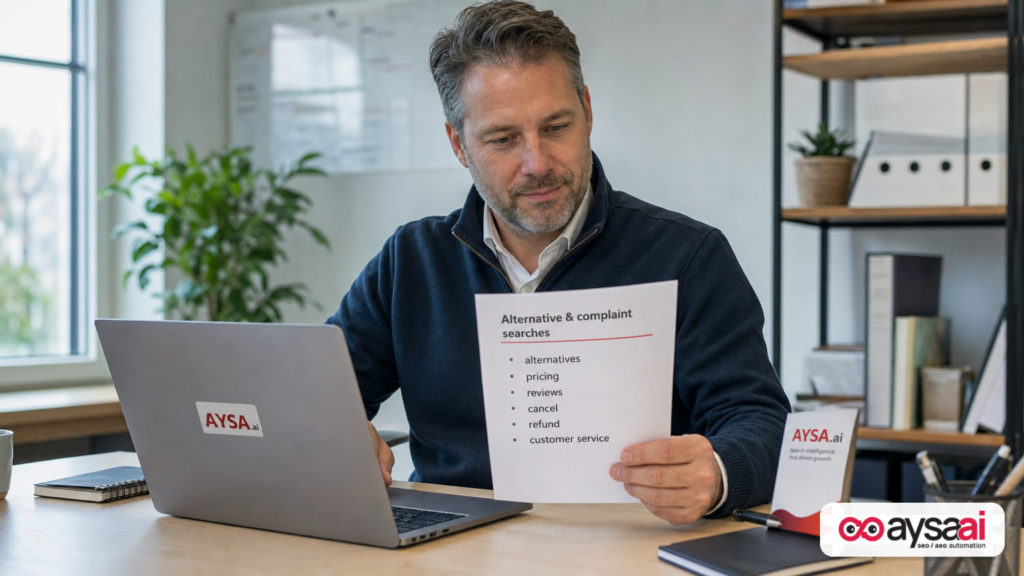
- Negative-intent queries are where switching happens. “Alternatives to…,” “cancel…,” “pricing vs…,” “reviews,” “complaints,” “customer service” are signals of doubt and active evaluation.
- Landing pages decide profitability. If your ad promises a fix for a competitor weakness, the page must validate it immediately.
- Execution beats theory. Most teams don’t lose on strategy—they lose on slow iteration, weak measurement, and unmaintained pages. That’s where an execution system matters.
Table of contents
- Why “bid on competitors” is usually the wrong default
- What changed: the new conquesting reality across Search + feeds
- Demand Gen conquesting: reach competitor-aware audiences earlier (and often cheaper)
- Demand Gen targeting that actually maps to competitor awareness
- Creative: the missing half of conquesting
- Negative-intent conquesting in Search: capture the “I’m unhappy with them” moment
- Keyword themes and ad group structure (with examples you can copy)
- Landing pages for conquesting: don’t promise what the page can’t prove
- Measurement: how to know if conquesting is working (without fooling yourself)
- A concrete SME scenario: the local clinic competing with a national chain
- Agency and in-house pitfalls (and how to avoid them)
- Where AYSA.ai fits: conquesting needs approved, continuous execution
- What to do next (action list)
- Sources and further reading
Why “bid on competitors” is usually the wrong default
Competitor campaigns sound logical because they target “high intent.” Someone searches a brand name, so they must be ready to buy—right?
But competitor brand intent is not the same as category intent. It’s often decision intent—the buyer is confirming a choice, looking for login pages, checking reviews, or trying to find pricing for a product they already selected. Your ad becomes a speed bump.
That leads to three predictable outcomes:
- You pay more per click. Competitor terms are contested, quality signals can be harder to earn, and you’re bidding into a crowded auction with weak relevance.
- You convert less often. The user didn’t ask for “alternatives.” They asked for that brand.
- You struggle to scale profitably. If your only lever is “bid higher,” you’re trapped.
Search Engine Land’s piece makes this point bluntly: traditional competitor campaigns can be expensive and ineffective—and it proposes two alternatives: Demand Gen conquesting and negative-intent conquesting. That’s the right direction, but it’s only the start. The bigger lesson is: timing beats targeting.
Conquesting works when you catch a buyer during an open-minded moment—either before they commit or when they start doubting their choice.
What changed: the new conquesting reality across Search + feeds
If your mental model of “Google Ads” is still mostly Keyword search, you’re behind the way buyers actually move today.
Modern buyers:
- Discover products in feeds (YouTube, Discover, social).
- Jump between research and entertainment.
- Ask for comparisons and “best of” lists.
- Re-check reviews after a bad experience (shipping delay, support issue, cancellation friction).
That creates two conquesting windows that are more efficient than brand bidding:
- Pre-decision competitor awareness (they’ve heard of the competitor, or even searched for them, but haven’t committed).
- Reconsideration / dissatisfaction (they’re actively looking for a way out: alternatives, cheaper, refund, cancel, “dupe”).
Google is also pushing more AI-driven campaign types and placements. Search Engine Land separately notes “Google gives Demand Gen new AI creative and reporting tools” (Read the source article on searchengineland.com), which is a reminder that feed-based conquesting will only get easier to launch—and easier to waste money on if your creative and landing pages are weak.
Finally, the conquesting conversation now overlaps with AI-era visibility (AEO/GEO): who gets mentioned and recommended by AI layers. Even if your immediate plan is paid conquesting, your site clarity, entity signals, and proof influence both paid conversion rates and broader discovery. (If you’re tracking this, start with AYSA’s AI Search Visibility.)
Demand Gen conquesting: reach competitor-aware audiences earlier (and often cheaper)
Demand Gen is designed to create and capture demand across visually rich placements. What makes it useful for conquesting is not magic—it’s the ability to target competitor-aware users without paying competitor-brand CPCs.
Search Engine Land’s core recommendation is practical: build custom segments based on users who searched for competitor terms, then reach them across Demand Gen placements. That’s the right move when:
- You can produce solid images/video (or at least strong static creative).
- Your category benefits from demonstration, proof, or storytelling.
- You want more scale than competitor keyword volume allows.
What many teams miss: Demand Gen conquesting is not “set it and forget it.” It is closer to performance creative + audience strategy than classic search management. Your competitive advantage comes from iteration velocity.
If you’re an SME, this is good news: big brands are often slow to update creative, slow to align landing pages, and slow to operationalize learnings. You can win with discipline.
Demand Gen targeting that actually maps to competitor awareness
Conquesting fails when targeting is either too broad (wasting spend) or too narrow (no learning, no scale). A clean approach is:
1) Custom segments based on competitor searches
As the source article suggests, create custom segments around people who searched competitor terms. Don’t stop at the obvious brand names. Consider:
- Competitor brand
- Competitor product name(s)
- Competitor “pricing” searches
- Competitor “reviews” searches
- Category comparisons (“X vs Y”) if volume exists
Operational note: avoid stuffing every idea into one segment. Create 2–4 segments that reflect different mindsets (e.g., “reviews,” “pricing,” “alternatives”), so you can see which type of competitor awareness converts.
2) Lookalikes for scalable conquesting
Lookalikes help expand beyond the exact competitor-search audience. This matters because the cheapest conversions often come from “nearby” users—people with similar behavior patterns who haven’t searched the competitor yet.
Use lookalikes carefully:
- Start with your best customers (not all customers).
- Separate high-LTV from low-LTV cohorts if you can.
- Watch lead quality closely before scaling budget.
The common mistake: targeting competitor interest with generic creative
If your creative is “We’re great, click here,” you’ll pay for Impressions and clicks without earning the switch.
Conquesting creative must answer one question fast: Why should a buyer who’s considering someone else choose you instead?
Creative: the missing half of conquesting
Conquesting is not a keyword trick. It’s a persuasion problem.
Here are creative angles that tend to work when you’re trying to pull someone away from a competitor—without naming them:
Angle 1: “The switching cost is lower than you think”
- “Migrate in a day.”
- “We’ll import your data.”
- “White-glove onboarding included.”
This is especially effective in SaaS and services where inertia is the biggest barrier.
Angle 2: “Proof, not promises”
- Show real policies (shipping, returns, response time) clearly.
- Highlight certifications, guarantees, or process transparency.
- Use testimonials carefully and ethically (no invented quotes).
Angle 3: “Price clarity” (not just “cheaper”)
Many buyers aren’t hunting for the lowest price—they’re avoiding surprise fees, forced bundles, or confusing tiers.
- “Transparent pricing.”
- “No required add-ons.”
- “Cancel anytime.”
Angle 4: “Service experience”
Search Engine Land calls out competitor weaknesses like customer service. This is a real lever because it’s emotional and memorable—people switch after a bad support experience.
- “Talk to a human.”
- “Same-day support.”
- “Dedicated account manager.”
Important: don’t make claims you can’t operationally support. Conquesting amplifies scrutiny.
Negative-intent conquesting in Search: capture the “I’m unhappy with them” moment
If Demand Gen conquesting is about earlier influence, negative-intent conquesting is about timely interception.
People don’t always search “alternative to [brand]” because they’re casually browsing. Often they’ve hit friction:
- Support didn’t respond
- Shipping is late
- Pricing jumped
- Cancellation is painful
- The product didn’t match expectations
Those moments produce high-signal queries that are not strictly competitor-brand bidding, but are still competitor-driven demand. That’s the “negative intent” angle described in the source article.
This tactic is especially attractive for SMEs because it can be executed with:
- Text ads and a solid landing page
- Clear differentiators and proof blocks
- A measurable offer (demo, quote, booking, trial)
You don’t need a full creative studio. You need sharp positioning and fast iteration.
Keyword themes and ad group structure (with examples you can copy)
Negative-intent conquesting is not “bid on competitor + complaints” and hope for the best. You need a structure that keeps control.
Theme buckets to research
Start by listing competitor names and then exploring these modifiers (only bid where there is meaningful volume and relevance):
- Alternatives: “alternatives to [brand]”, “companies like [brand]”, “similar to [brand]”
- Price pressure: “cheaper than [brand]”, “pricing vs [brand]”, “cost of [brand]”
- Regret / cancellation: “cancel [brand]”, “refund [brand]”, “return policy [brand]”
- Service friction: “customer service [brand]”, “support [brand]”, “contact [brand]” (be careful: many are navigational)
- Quality concern: “reviews [brand]”, “is [brand] worth it” (some are research, some are decision-confirming)
- Substitute intent: “dupe for [brand]” (common in consumer goods/beauty)
Search Engine Land notes that not all of these will be biddable due to volume. That’s fine. The research still teaches you what your market worries about.
A simple structure that stays controllable
- Campaign: “Competitor Alternatives (Negative Intent)”
- Ad groups:
- Alternatives
- Cheaper / pricing
- Cancel / refund
- Support / complaints
Why this matters: each ad group maps to a different landing page promise. If you mix them, your page will feel generic and Conversion rate will suffer.
Ad copy guardrails (including trademark reality)
The source article advises avoiding mentioning competitors by name in ad text due to trademark policy risk. That’s a practical guardrail, and even when policy allows certain uses, the business risk remains: you don’t want your brand associated with a competitor in a way that feels petty or misleading.
Better pattern:
- Mirror the problem (“Need faster support?”)
- Offer a verifiable solution (“Same-day response, clear SLAs”)
- Reduce switching friction (“Migration help included”)
- Use a clean CTA (“Get a quote,” “Book a consult,” “See pricing”)
Landing pages for conquesting: don’t promise what the page can’t prove
Conquesting is won after the click. If your landing page is your generic homepage, you’re paying for attention and then squandering it.
Whether you’re running Demand Gen or negative-intent search, your landing page must do four jobs quickly:
- Confirm relevance: “Yes, you’re in the right place.”
- State the differentiator: one primary reason to switch.
- Prove it: policies, process, credentials, demos, reviews, examples.
- Close the loop: one clear CTA that matches the ad’s promise.
Landing page templates by negative-intent theme
1) Alternatives page (consideration-stage)
- Headline: “A simpler alternative for [category]”
- 3 differentiators (speed, support, price clarity, features)
- “Switching made easy” section
- FAQ: migration, contracts, cancellation, timeline
- CTA: “See pricing” or “Get a demo”
2) “Cheaper / pricing” page (price anxiety)
- Show pricing ranges or a transparent estimator if possible
- Explain what’s included and what’s not
- Call out “no surprise fees” (only if true)
- CTA: “Get an exact quote”
3) “Support / complaints” page (trust repair)
- Describe your support model (hours, channels, response time)
- Show proof: published SLAs, support stats (only if real), or process
- Testimonials about service quality (real, permissioned)
- CTA: “Talk to support-first team” or “Book onboarding call”
What can go wrong (and usually does)
- Overpromising: you claim “24/7 support” but can’t deliver. Refunds and reputation damage follow.
- Vague differentiation: “Best quality” means nothing against an established brand.
- Misaligned CTAs: ad offers “pricing,” page forces “book a call.”
- No proof: you ask them to trust you immediately—hard when they were just burned by someone else.
Measurement: how to know if conquesting is working (without fooling yourself)
Conquesting performance is easy to misread because the buyer journey often spans multiple touches. If you only measure last-click conversions, you will undervalue Demand Gen influence. If you only measure view-through or soft metrics, you will overvalue it.
Keep measurement grounded and operational:
1) Set a baseline before you scale
- Current conversion rates by channel
- Current CAC/CPA targets
- Lead quality notes from sales/support (even if informal)
2) Track two layers: efficiency and quality
Efficiency signals
- CTR and CPC trends (directional)
- Conversion rate (by ad group and landing page)
- Search terms (for negative-intent campaigns)
Quality signals
- Lead-to-qualified rate (even a manual tag in CRM helps)
- Refund/cancellation rate for conquested customers (if measurable)
- Support burden (are you attracting chronic complainers?)
3) Ask the hard question: are you stealing demand or creating it?
Competitor campaigns can look good on paper while doing little incrementally:
- You may be capturing people who would have found you anyway.
- You may be paying to intercept navigational traffic that never converts.
That’s why negative-intent and Demand Gen conquesting are attractive: they’re designed to meet users in more flexible intent states, where persuasion and education can actually change outcomes.
A concrete SME scenario: the local clinic competing with a national chain
Let’s make this real.
Scenario: A local physical therapy clinic competes with a national chain. The national brand dominates “brand name” searches and can outbid smaller clinics easily. The local clinic tried bidding on the chain’s name and got clicks, but bookings were weak.
What the clinic does instead:
1) Demand Gen conquesting for early influence
- Custom segment: people who searched for the national chain + “appointment,” “reviews,” and “near me” type terms (category-safe)
- Creative: short videos/photos showing the clinic experience—real staff, scheduling ease, one clear outcome (“Get back to running”)
- Landing page: “A patient-first PT experience” with transparent scheduling, insurance clarity, and proof (credentials, process)
2) Negative-intent search for reconsideration moments
- Keywords: “alternatives to [chain]”, “cancel [chain] appointment”, “reviews [chain]” (only where intent is truly evaluative)
- Ad copy: focuses on fast scheduling, continuity of care, and responsive communication—without naming the competitor
- Landing page: “Need a faster appointment?” with a clear booking CTA, plus FAQ addressing switching
Why this works
- It avoids paying the “brand tax” at the most expensive moment.
- It matches real buyer emotions: uncertainty, urgency, frustration.
- It treats landing pages as conversion assets—not as an afterthought.
Agency and in-house pitfalls (and how to avoid them)
If you’re an agency or a lean in-house marketer, here are the traps I see most often when teams attempt conquesting.
Pitfall 1: Confusing “presence” with performance
Showing up on a competitor’s name feels good. It’s visible. Stakeholders notice it.
But visibility is not profit. Your job is to create a system that earns switches at a sustainable cost.
Fix: treat competitor brand bidding as a controlled experiment, not a default always-on campaign.
Pitfall 2: One landing page for every message
If “cheaper alternative” and “better support” point to the same page, you force the user to do the mental work. They won’t.
Fix: build 2–4 modular landing pages aligned to your negative-intent themes.
Pitfall 3: Not capturing the voice of the customer
Negative-intent conquesting is fueled by real complaints. If you don’t know what people dislike about the competitor—or what they fear—you’ll write generic ads.
Fix: mine reviews, sales calls, support tickets, and on-site search logs. Even a simple spreadsheet of objections becomes a creative engine.
Pitfall 4: Slow iteration cycles
Conquesting is competitive. If it takes you three weeks to change a headline, you’ll lose to someone who iterates weekly.
Fix: implement a workflow where changes are proposed, approved, and shipped quickly—especially on landing pages.
Where AYSA.ai fits: conquesting needs approved, continuous execution
Conquesting is not just a media buying problem. It’s an execution problem across:
- Content and landing pages
- Technical performance (speed, UX, tracking reliability)
- Clarity of differentiation (proof blocks, FAQs, policies)
- Ongoing iteration based on real queries and lead feedback
This is where AYSA’s model matters: monitor what’s happening, prepare specific improvements, ask for approval, and execute accepted website changes—continuously.
Practical ways AYSA supports conquesting workflows:
- Monitoring: keep an eye on the pages you drive paid traffic to, so you don’t waste spend on broken UX, outdated messaging, or missing proof. Start here: AYSA Monitoring
- AI search visibility alignment: conquesting pages should be clear, structured, and trustworthy—useful for both conversions and AI-era discovery. See: AI Search Visibility
- Execution system: build and iterate landing pages and supporting content without the usual backlog bottlenecks. Explore tools: AI SEO Tools
- Governance: the approval step matters—especially when conquesting touches sensitive claims (support promises, pricing clarity). AYSA prepares changes, you approve, then it executes.
If you’re an agency, AYSA can also reduce the “we recommended it but it never shipped” problem. Conquesting is won by the teams that publish improvements, not just talk about them.
If you want to understand how AYSA is packaged, start with pricing, and for ongoing guidance see the AYSA blog.
What to do next (action list)
- Audit your current competitor spend. Separate “competitor brand terms” from “alternative/complaint” terms. If you can’t separate them, restructure first.
- Pick one conquesting hypothesis. Example: “Buyers switch because of support response time.” Build a negative-intent ad group + a matching landing page.
- Create 2–4 landing pages that map to intent themes. Alternatives, pricing clarity, support experience, switching friction.
- Launch Demand Gen only if you can support it with credible creative. If not, run Search negative-intent first while you build assets.
- Build a weekly review ritual. Search terms, lead quality feedback, and landing page engagement—then ship one improvement per week.
- Implement monitoring so paid traffic never hits a broken or stale page. Use a system like AYSA Monitoring to keep execution tight.
Sources and further reading
- Search Engine Land: How to win competitor traffic with Demand Gen and negative-intent conquesting
- Search Engine Land: Google gives Demand Gen new AI creative and reporting tools
- Search Engine Land: Google Ads updates target-based bidding for budget-limited campaigns
- Search Engine Land: Google Ads API v24.2 adds AI transparency, stronger security and new reporting
- Search Engine Land: Google Search Console AI performance reports rolling out
- Search Engine Land: How to use Google query expansion to improve content visibility
- Search Engine Land: The paid brand mention problem in GEO
AYSA resources
Continue the AI search topic inside AYSA.
Use these pages to connect the article with AI SEO tools, AI visibility monitoring, AI Overviews and approved website execution.
Turn this topic into a website action plan.
Use these AYSA hubs to move from reading to technical fixes, AI visibility monitoring, research, glossary context and approval-first SEO execution.