Emergency Brand Audits for AI Search: How Multi‑Location Businesses Can Control What ChatGPT and Google Say (Without Gaming It)
AI answers are becoming the first (and sometimes only) impression of your brand’s locations. Here’s a practical, repeatable emergency brand audit to measure what AI says today, identify which inputs are shaping those answers, and execute fixes safely at scale—with an approval-first system like AYSA.ai.

AI didn’t “replace” local search. It compressed it.
In a growing share of journeys, customers don’t scan ten blue links, compare map pins, and click through to your website. They ask a full question—sometimes in a chat interface, sometimes directly in a search engine’s AI summary—and accept the answer they’re given.
That change is especially brutal (and especially actionable) for multi-location businesses. Because the “answer” isn’t just about your brand. It’s about each location’s hours, categories, services, customer experience signals, and public reputation. One location with stale info can distort the brand narrative everywhere.
This article is an editorial playbook for an emergency brand audit for AI Search: how to measure what AI systems say about your locations today, why those answers vary, which inputs are most likely shaping them, and how to fix the underlying data and content so you’re not rolling the dice every time a customer asks.
This is inspired by a recent recap from Search Engine Journal about GatherUp’s approach to auditing AI answers for locations (source). I’m not rewriting that piece—I’m building a standalone, operator-grade resource that’s designed to be used by founders, marketing leads, and agencies who need outcomes, not theory.
Concise summary

- AI answers are now a first impression layer for local discovery—often before your site gets a visit.
- In multi-location brands, the unit of truth is the location; inconsistent listings and weak location pages create contradictory AI narratives.
- Star rating alone is no longer the whole story; what AI repeats tends to be more about specific claims and themes than a single average number.
- AI outputs vary across users and sessions. You need a Monitoring-and-execution loop, not one-off spot checks.
- Execution speed matters, but governance matters more: you need a system that can propose changes, request approval, and implement safely at scale.
Key takeaways (the executive version)
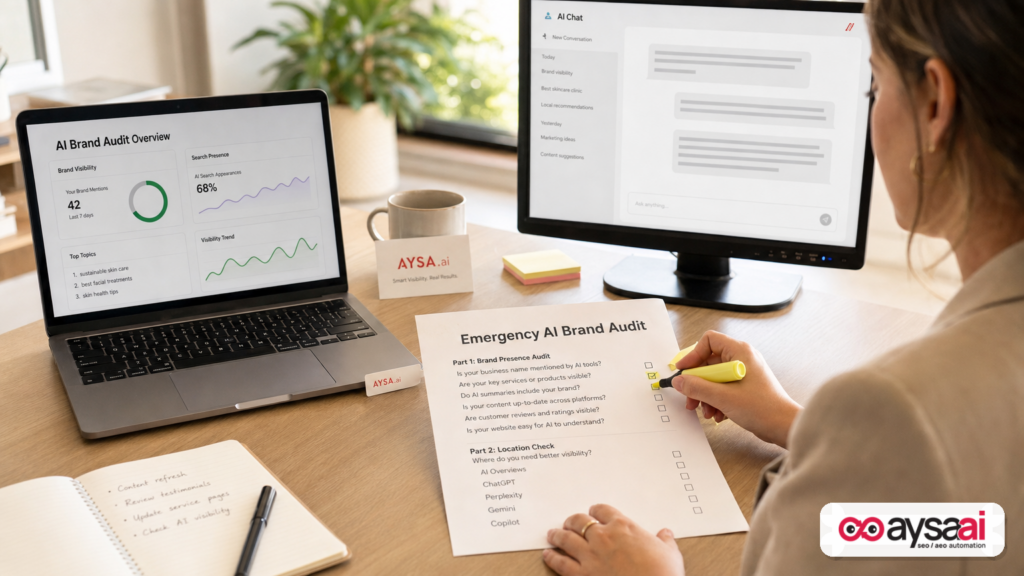
- Run an AI brand audit like a real audit: fixed prompts, documented outputs, and scheduled reruns—not “I asked once and didn’t like the answer.”
- Correct and standardize your location data first (hours, phone, services, categories, accessibility, appointment policies). AI can’t summarize what isn’t consistent.
- Publish first-party proof for claims you want AI to repeat: services, pricing ranges (if possible), policies, expertise, and location-specific FAQs on your site.
- Make reviews usable beyond directories by republishing testimonials ethically and with permission where required; AI systems can only use text they can access.
- Measure “presence” and “narrative consistency,” not rank. If AI is a slot machine, you’re optimizing the probability distribution—not one spin.
Table of contents

- What Changed: From “Local SEO Rankings” to “Local AI Answers”
- Why Multi‑Location Brands Get Hit Harder (and Can Win Faster)
- The Emergency Audit: A Repeatable Workflow to See What AI Says About Each Location
- Why AI Gives Different Answers (and How to Measure It Without Losing Your Mind)
- What AI Answers Are Probably Built From: The Inputs You Control
- Reviews In AI Search: What’s Actually Used (And What Often Isn’t)
- Does Star Rating Still Matter? The More Useful Way to Think About Reputation Signals
- Location Pages That Train AI: The Anatomy of a Page That Gets Repeated
- A Concrete SME Scenario: A 12‑Location Clinic Network With Conflicting AI Answers
- What Agencies Should Rethink: New Deliverables, New KPIs, New Risk
- How AYSA.ai Helps: Monitor, Prepare, Approve, Execute (At Multi‑Location Scale)
- What to do next (Action list)
- Sources and further reading
What Changed: From “Local SEO Rankings” to “Local AI Answers”
For years, local search was an interface problem. You competed to appear in a list, then convinced the searcher to click, call, or request directions.
AI compresses that flow into a different product:
- Customers ask full questions (“Does this place fit an SUV?” “Is it open late?” “Is parking easy?” “Do they take walk-ins?”) rather than short fragments (“dentist near me”).
- The interface returns a synthesized answer that may include one or a few recommended businesses.
- Your website is no longer guaranteed to be visited. The “decision” can happen on the AI layer.
This is why “brand audits” are becoming urgent. If AI summaries are the new storefront window, you can’t afford to not know what’s in the glass.
Search Engine Journal’s recap frames it well: AI systems assemble location descriptions from listings, public web mentions, and other signals, then repeat that description to customers (SEJ recap). Whether you agree with every detail, the operational reality is clear: the summary layer exists, customers are using it, and it influences outcomes.
Why Multi‑Location Brands Get Hit Harder (and Can Win Faster)
If you run one location, your problems are mostly “is the info correct?” and “is our reputation healthy?”
If you run 10, 100, or 1,000 locations, your problems multiply:
1) AI answers are location-specific, but brand damage is brand-wide
A customer might ask about “Brand X near me,” but the AI output often references the closest location—or the location it believes matches the query context (time, distance, attributes). If that location is messy, the answer is messy. And the customer’s conclusion is about you, not about that one manager’s outdated phone number.
2) Inconsistency becomes “contradiction,” and AI hates contradiction
When your site says one thing, your listings say another, and third-party sites say a third, AI models don’t politely email you for clarification. They summarize the conflict. The result can be hedged language (“may offer,” “reportedly,” “customers mention…”)—which is the opposite of conversion-ready certainty.
3) The fix is often boring—and therefore winnable
The good news: many “AI narrative” issues are not advanced. They’re basics done at scale: correct listings, complete location pages, clear service menus, accessible review proof, and fewer content gaps.
That’s why I think this is a real opportunity for SMEs and mid-market operators. Big brands often have more complexity than competence in this layer.
The Emergency Audit: A Repeatable Workflow to See What AI Says About Each Location
If you only take one idea from this article, take this: AI visibility needs an audit loop, not a one-time spot check.
Your goal is to create a baseline you can track, then improve through controlled changes.
Step 0: Set rules so your audit is valid
- Use temporary chat / incognito modes where possible, so the tool isn’t heavily biased by your prior context.
- Document the exact prompt, date/time, location context (if applicable), and the tool used.
- Capture the answer and the citations (if citations are shown). If there are no citations, note that too.
- Repeat prompts at least 3 times across sessions to observe variance. Don’t overfit to one output.
Step 1: Start with the brand narrative prompt
Ask a simple, brand-level question that a customer would ask, but make it outcome-oriented:
- “What is [Brand] known for in [City/Region]?”
- “Is [Brand] good for [specific need]?”
- “What are the pros/cons of [Brand]?”
What you’re looking for: repeated themes (positive and negative), claims you wouldn’t want to stand behind, and missing differentiators you do want repeated.
Step 2: Ask the “location selection” prompt
Now force the AI to choose, the way a consumer wants it to:
- “Which [Brand] location is best for [need] in [City]?”
- “Recommend a [service type] from [Brand] open after [time] near [landmark].”
What you’re looking for: whether the AI reliably selects the right location(s), and what attributes it uses to justify the pick (hours, parking, services, pricing, “popular,” etc.).
Step 3: Run a “fact check” prompt per location
For each location you care about (start with top revenue and worst reputation), ask:
- “What are the hours, phone number, and services of [Location Name + Address]?”
- “Does [Location] offer [specific service]?”
- “What should I know before visiting [Location]?”
What you’re looking for: wrong hours/phone, outdated offerings, confusing policies (“walk-ins,” “appointments”), and hallucinated services you don’t offer.
Step 4: Run a “reputation narrative” prompt per location
- “What do customers say about [Location]?”
- “What are common complaints about [Location]?”
- “Is [Location] worth it?”
What you’re looking for: the specific claims AI repeats (wait times, friendliness, cleanliness, upselling, billing) and whether those claims align with reality.
Step 5: Build an “AI answer inventory” spreadsheet
This doesn’t need to be fancy. But it must be consistent. Track:
- Prompt
- Tool
- Timestamp
- Location referenced
- Answer themes
- Citations / sources (if available)
- Accuracy notes
- Fix owner (marketing, ops, franchisee, agency)
- Fix type (listings / website / reviews / PR mentions)
Why AI Gives Different Answers (and How to Measure It Without Losing Your Mind)
One of the most important (and most misunderstood) aspects of AI search is variability. The same question can produce different outputs across sessions, accounts, locations, and devices.
SEJ’s recap uses a useful metaphor: AI can behave like a slot machine—similar inputs, similar data, but different outputs (SEJ recap).
Instead of fighting that, measure it.
Stop treating “position” as the KPI
In classic SEO, you could reasonably care about position for a Keyword. In AI answers, a “position” is often not stable or even visible.
Better measurement questions:
- Presence rate: In how many runs does our brand appear at all?
- Location correctness: When we appear, does it name the right location(s)?
- Narrative consistency: Are the same strengths repeated? Are the same weaknesses repeated?
- Claim accuracy: Are hours/services/policies correct?
- Source diversity: Does the answer appear supported by multiple sources or a single brittle citation?
Make “monthly reruns” your default
If your locations change (hours, staffing, promotions, services), your AI narrative changes too. A monthly rerun cadence is a pragmatic starting point for most SMEs and mid-market brands; higher volatility businesses may need more frequent checks.
This is also where systems matter. Manual audits don’t scale when you have dozens of locations, multiple services, and seasonal policies.
What AI Answers Are Probably Built From: The Inputs You Control
You can’t control the model. You can control the inputs it sees.
In practice, the AI summary layer tends to draw from some mix of:
- Your website: location pages, service pages, FAQs, policy pages, contact pages.
- Structured data and page semantics: clear headings, consistent NAP (name/address/phone), and machine-readable markup where appropriate.
- Listings/directories: business profiles across platforms (and inconsistencies between them).
- Public web mentions: local news, event pages, community sites, sponsorships, “best of” lists, chambers of commerce, supplier/manufacturer locators.
- Publicly accessible reviews/testimonials: not just star averages, but written claims—when the text is available to be used.
Notice what’s missing: “your intent.” AI doesn’t care what you meant to communicate. It summarizes what is most defensible from what it can see.
The operator’s mindset: reduce ambiguity
If you want AI to say you offer a service, don’t bury it in a PDF menu. Put it on a Location page with clear wording. If you want AI to stop implying you’re closed early, fix hours everywhere and make them consistent.
Local AI visibility is often less about creativity and more about removing ambiguity at scale.
Reviews In AI Search: What’s Actually Used (And What Often Isn’t)
Here’s the nuance many business owners miss: your reviews can influence outcomes in multiple ways, but not all review text is equally reusable by AI systems.
The SEJ recap highlights an important operational point: major directories may restrict automated access to review content, and AI tools may rely on other “crawlable” surfaces where reviews are republished (SEJ recap).
I’m deliberately cautious here: I’m not going to claim to know exactly what any one model can or cannot access at any moment. Platforms change. Policies change. Crawling changes. But from a business execution perspective, the safest assumption is:
- If you want review text to shape your AI narrative, you should also publish it on surfaces you control (where appropriate and permitted).
- Relying on a single directory as your “reputation database” is fragile in an AI-first world.
What to do (ethically) with review content
Practical options that don’t require gaming:
- First-party testimonials page(s) organized by location and service line.
- Location page review snippets that are clearly attributed and updated regularly.
- Case studies (for B2B or high-consideration services) that turn “we’re great” into verifiable specifics.
- Social proof highlights (where policy allows) that quote short excerpts with context.
Important: follow the rules of the platform where the review originated, respect customer privacy, and don’t fabricate or over-edit testimonials. The goal is clarity and availability, not manipulation.
Does Star Rating Still Matter? The More Useful Way to Think About Reputation Signals
Business owners often ask: “If my rating is high, why isn’t AI recommending me?” Or the opposite: “How is a lower-rated business getting chosen?”
SEJ’s recap shares a telling example where the AI answer prioritized query match (the customer’s specific needs) above the star rating (SEJ recap).
My take: rating is a proxy; specificity is a weapon.
AI summaries often try to answer the question asked. If the question is “Which place fits an SUV and is open late?” then the presence of clear, consistent attributes can beat a slightly higher average score—especially if the AI layer believes the match is more relevant.
A better framework than “rating”
Instead of obsessing over a single number, operationalize reputation around:
- Recency: Is your most recent feedback aligned with the experience you deliver today?
- Specificity: Do reviews mention the attributes customers ask about (wait time, cleanliness, staff expertise, parking, kid-friendly, pet-friendly, etc.)?
- Volume and consistency: Do you have a steady pattern of feedback across locations, or spikes and silence?
- Response quality: Are you addressing issues in a way that signals accountability and policy clarity?
Even if an AI tool doesn’t “quote” a star rating directly, these factors shape the story the public web tells about your brand.
Location Pages That Train AI: The Anatomy of a Page That Gets Repeated
If you run multiple locations, you likely already have location pages. The problem is that many are built for a pre-AI era: thin templates, minimal unique detail, and a map embed.
In AI search, your location page should function like a structured briefing that answers common questions clearly and consistently.
What every location page should include (the practical checklist)
- Consistent NAP: name, address, phone—matching your authoritative listings.
- Hours (including exceptions): holidays, seasonal hours, last appointment time.
- Services offered at this location: not “what the brand offers,” but what this address offers.
- Service constraints: size limits, appointment requirements, age requirements, insurance accepted (for clinics), delivery radius (for florists), etc.
- “Before you visit” FAQs: parking, accessibility, what to bring, typical wait times, cancellation policy.
- Proof and trust: certifications, staff credentials, awards (only if real and current), testimonials.
- Clear calls to action: book, call, get directions—plus tracking so you can measure outcomes.
What to avoid (because it can backfire)
- Copy-paste location pages with swapped city names. That’s a fast path to “thin content” and confused summaries.
- Generic AI-generated filler that says nothing specific. It doesn’t persuade customers, and it can create quality risk if it’s inaccurate.
- Hidden critical details in images, PDFs, or obscure widgets. If it’s important, make it readable text.
Where Google’s guidance fits (without overclaiming)
Google regularly publishes documentation and guidance for how its search systems work and how to provide helpful content. A good starting point for understanding Google’s approach to AI in Search is Google’s own Search documentation and blog channels. If you’re building for long-term resilience, prioritize clarity, accuracy, and helpfulness over tricks. (If you want a single hub for Google Search documentation, start here: Google Search Central.)
A Concrete SME Scenario: A 12‑Location Clinic Network With Conflicting AI Answers
Let’s make this real with a scenario I see constantly in the market.
Business: A 12-location physical therapy clinic network across two metro areas.
What the owner believes: “We’re known for sports rehab and fast scheduling.”
What AI answers say (audit findings):
- AI consistently describes the brand as “general physical therapy,” not sports rehab.
- Two locations are described as “walk-in available,” which is false (appointment only).
- One location is repeatedly cited as “open Saturdays,” but Saturday hours ended months ago.
- When asked “best clinic for runners,” AI recommends a competitor because the competitor’s pages explicitly mention “running gait analysis” and “runner injury programs” on multiple crawlable pages.
Why this happens
- Location pages are thin: they list address and a generic paragraph about physical therapy.
- Service differentiation is trapped in PDFs and intake forms.
- Listings are inconsistent: Saturday hours are updated in one place, not in others.
- Reviews mention “great staff” but not “sports rehab” or “running.”
The fix (what we’d do operationally)
- Listings normalization across all platforms the brand is present on: hours, appointment policy, phone, categories.
- Upgrade location pages with location-specific services and constraints: sports rehab, runner programs, typical availability, and clear appointment language.
- Publish first-party proof: a sports rehab hub page and a “for runners” page that can be referenced by multiple locations (with location-specific sections).
- Review strategy update: ask for feedback that elicits specifics ethically (“What service did we help you with?” “What made you choose us?”) rather than coaching ratings.
- Re-run audit monthly and track whether AI answers become more consistent and accurate.
This isn’t about “convincing the AI.” It’s about fixing the public record so the best available summary aligns with reality.
What Agencies Should Rethink: New Deliverables, New KPIs, New Risk
If you’re an agency, the AI layer is both a threat and an opportunity.
Threat: reporting that doesn’t match the interface anymore
Classic reports focus on rankings, traffic, and sometimes conversions. But if the customer’s decision happens in the AI summary layer, you’ll see:
- Brand demand that doesn’t correlate with clicks the way it used to.
- More “zero-click” behavior where the customer calls directly from the SERP or navigates via maps.
- Confusion from clients: “We’re visible, so why aren’t we getting picked?”
Opportunity: an “AI narrative” deliverable clients will pay for
Most businesses don’t have an internal process for:
- Auditing AI outputs per location
- Identifying source inputs
- Executing changes quickly and safely
- Monitoring drift over time
An agency that can do this becomes a strategic partner, not just a content vendor.
Risk: low-quality automation can create penalties and brand harm
SEJ’s recap mentions Google detecting low-value AI-generated content and treating it negatively (SEJ recap). Regardless of the exact mechanism, the business risk is real: publishing generic, inaccurate, or duplicative AI content can:
- confuse customers,
- create compliance problems (especially in healthcare, finance, legal),
- and degrade organic performance over time.
The winning agency posture is not “publish more.” It’s “publish clearer, location-true content—and keep it correct.”
How AYSA.ai Helps: Monitor, Prepare, Approve, Execute (At Multi‑Location Scale)
Here’s my bias: strategy is cheap. Execution is the bottleneck.
Most brands can identify what’s wrong (hours, services, inconsistent pages). The hard part is:
- seeing issues early,
- turning findings into specific fixes,
- getting approvals from the right stakeholders,
- and implementing changes without breaking the site or creating compliance risk.
That’s the lane where AYSA.ai fits naturally—as an approved execution system for SEO/AEO/GEO work.
1) Monitor what matters
AI-era local visibility requires monitoring, not guesswork. AYSA can support continuous oversight so you can catch:
- location page drift (outdated hours/services),
- content gaps versus competitor coverage,
- technical issues that block crawling,
- and changes that need governance.
Start here: AYSA monitoring.
2) Prepare changes that map to the audit findings
After you run an emergency AI audit, you typically end up with a list of fixes. AYSA helps convert “we should improve location pages” into specific, implementable updates—without forcing you to do it manually location by location.
Learn how AYSA approaches AI-driven SEO execution: AYSA AI SEO tools.
3) Require approval before anything goes live
Multi-location businesses often need approvals from operations, legal, and local managers. “Move fast and break things” is not acceptable when you’re updating medical services, warranty language, or pricing policies.
AYSA’s model is designed around asking for approval before executing accepted changes—so you can scale speed without losing control.
4) Execute accepted changes safely
When you approve changes, the system should implement them cleanly and consistently—especially on large sites where manual publishing becomes a quality risk.
If you’re evaluating whether this fits your org, see: AYSA AI search visibility and AYSA pricing.
5) Operationalize the loop (this is where most teams fail)
The “emergency audit” is the beginning, not the end. The durable advantage comes from repeating the cycle:
- Audit AI answers
- Identify inputs that likely shaped them
- Propose fixes
- Approve
- Execute
- Re-audit
This is also why we publish ongoing frameworks and operational guidance on the AYSA blog: AYSA blog.
What to do next (Action list)
If you want a practical checklist you can start this week, use this:
Week 1: Establish your baseline
- Pick 5 locations: top 2 by revenue, bottom 2 by reviews, and 1 “average.”
- Run the 4 prompt types (brand narrative, location selection, fact check, reputation narrative).
- Document answers, citations, and accuracy gaps.
Week 2: Fix the highest-leverage “facts”
- Normalize hours, phone, categories, and services across your authoritative listings.
- Update your website location pages so the same facts are clearly stated in crawlable text.
- Remove contradictions (e.g., “walk-ins” vs “appointment only”).
Weeks 3–4: Build narrative proof
- Add location-specific FAQs that answer the questions customers ask AI.
- Publish first-party testimonials/case studies that support your differentiators.
- Implement a review request process that captures detailed written feedback (without coaching outcomes).
Ongoing: Set your cadence
- Re-run the audit monthly for priority locations.
- Track presence rate, correctness, and narrative consistency.
- Use an approval-first execution system to keep fixes moving without creating risk.
Sources and further reading
- Search Engine Journal (recap, GatherUp webinar): Emergency Brand Audit: What AI Says About Your Locations
- Google Search Central (official documentation hub): developers.google.com/search
- SEJ Local Search category (context and continuing coverage): Search Engine Journal – Local Search
- SEJ SEO category (broader organic search context): Search Engine Journal – SEO
AYSA internal resources
Author: Marius Dosinescu / AYSA.ai. Perspective: practical, approval-first execution for SEO/AEO/GEO in an AI-first discovery layer.
Continue the AI search topic inside AYSA.
Use these pages to connect the article with AI SEO tools, AI visibility monitoring, AI Overviews and approved website execution.
Turn this topic into a website action plan.
Use these AYSA hubs to move from reading to technical fixes, AI visibility monitoring, research, glossary context and approval-first SEO execution.