
Gemini Notebook Can Scrape Your Content Without Attribution: What Changed, Why It Matters, and the Practical Playbook for SMEs
Google’s NotebookLM rebrand to Gemini Notebook comes with a new user agent that can fetch your pages via user-triggered requests that don’t follow robots.txt. If you previously blocked or tracked NotebookLM, you may be exposed again unless you update firewall or server rules. Here’s the business-first, technical playbook—and how AYSA helps you monitor, prepare, approve, and execute changes safely.
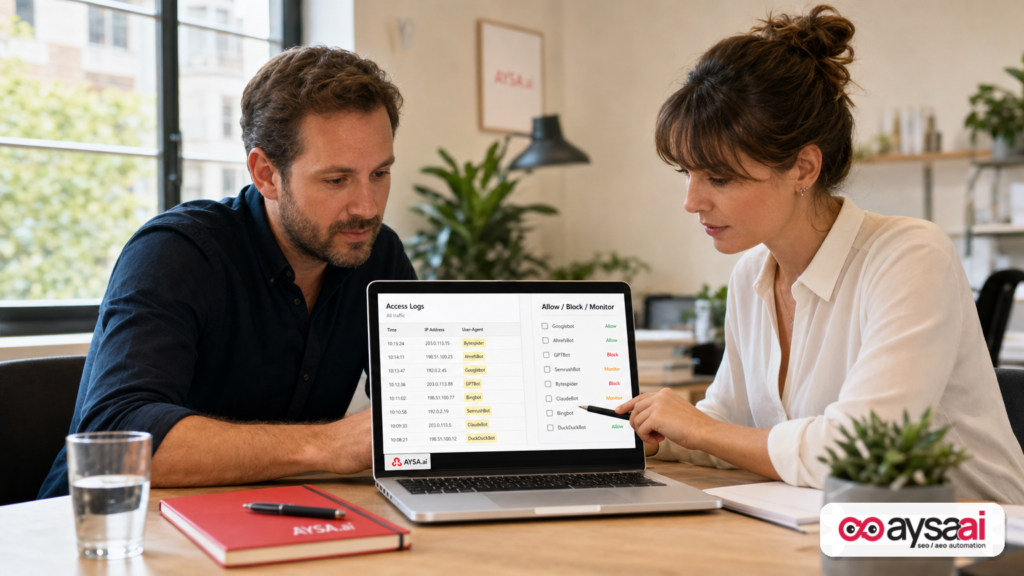
Google’s NotebookLM rebrand to Gemini Notebook looks harmless on the surface. It’s not. For many sites, it’s the kind of “tiny change” that quietly re-opens the door to AI-driven scraping—especially if you previously blocked NotebookLM by hardcoding its old user agent. And because Gemini Notebook uses user-triggered fetchers, Robots.txt alone may not protect you.
This is not a theoretical, future-facing debate about “AI and the open web.” This is an operational problem with a near-term deadline: if you’re blocking or tracking the old NotebookLM identifier, you have a limited grace period before it stops working (per Google’s documentation referenced in reporting from Search Engine Journal).
In this editorial, I’ll break down what changed, what it means for real businesses (not just publishers), how to decide whether you should block/allow/shape access, and how to put Monitoring plus Approved Execution around it—so you don’t accidentally break important traffic while trying to stop a scraper.
Concise summary
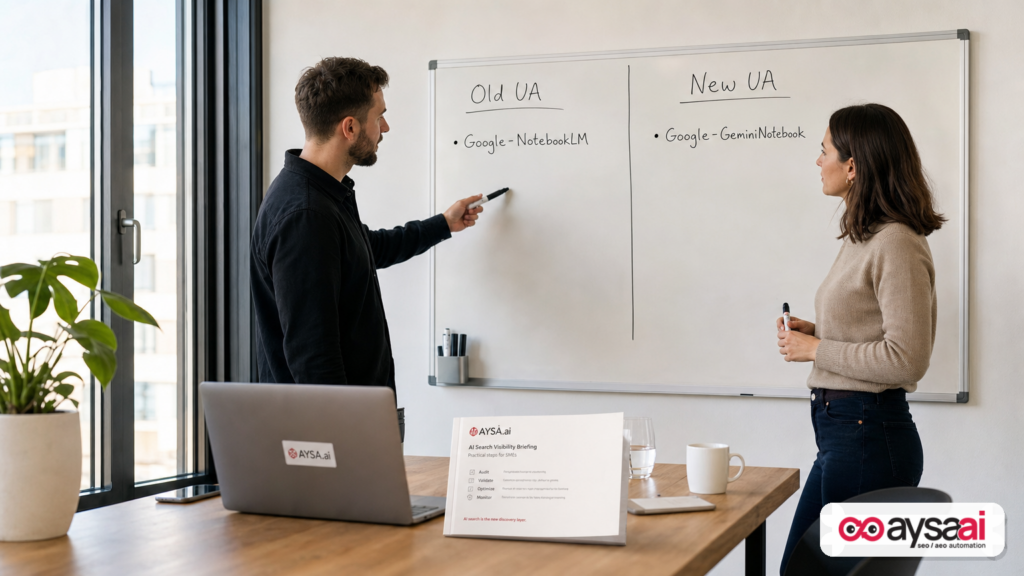
- NotebookLM is now Gemini Notebook, with a new user agent (
Google-GeminiNotebook), while the oldGoogle-NotebookLMagent is only temporarily supported. - Gemini Notebook can fetch pages on behalf of users (e.g., pasted URLs or “Discover sources”), then summarize or remix content with no guaranteed Attribution and no referrals (as described in the source reporting).
- User-triggered fetchers may not obey robots.txt. If you want to restrict access, you likely need firewall/WAF/CDN rules or server-level blocking (e.g., .htaccess / Nginx).
- For SMEs, the right answer is not always “block everything.” The right answer is: decide what you can give, what you must protect, and what you need to measure.
- AYSA fits here as an execution system: monitoring what’s happening, preparing recommended changes, asking for approval, and executing accepted updates safely (without “one-line fixes” that cause collateral damage).
Table of contents

- What Changed: NotebookLM → Gemini Notebook (and Why That Small Rename Is a Big Deal)
- Why It Matters: AI Summaries Without Referrals Change the Economics of Content
- The Real Issue: “User-Triggered Fetchers” and Why robots.txt Isn’t Enough
- Who Should Care (and Who Might Not): A Reality Check for SMEs
- A Practical Decision Framework: Block, Allow, or Shape Access
- How to Block (or Rate-Limit) Gemini Notebook Without Breaking Your Site
- How to Verify It’s Happening: Logs, Patterns, and “False Certainty” Traps
- SME Scenario: A Local Clinic That Publishes Condition Pages (and Suddenly Competes With Summaries)
- What Agencies Should Rethink: Deliverables, Risk, and the New “Attribution Gap”
- Content Strategy in an AI Scraping World: Give the Model Something, Keep the Business Value
- Where AYSA Fits: Monitoring + Approved Execution (Without Breaking Your Site)
- What to do next (action list)
- Sources and further reading
What Changed: NotebookLM → Gemini Notebook (and Why That Small Rename Is a Big Deal)
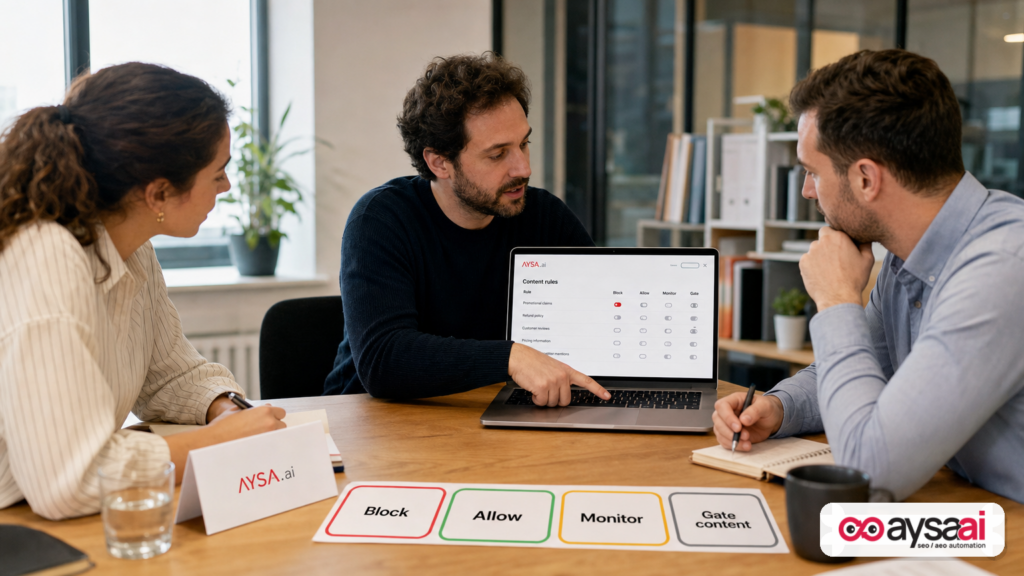
The change that matters is not branding. It’s identification—the string your server sees in a request header that determines whether you allow or block access.
According to reporting by Search Engine Journal, Google updated its documentation for user-triggered fetchers to reflect the rename and introduced the updated user agent Google-GeminiNotebook, while continuing temporary support for the former Google-NotebookLM user agent through a transition window (the report notes support until August 2026).
Here’s the practical implication:
- If you previously blocked “Google-NotebookLM” in a firewall, CDN, WAF, or server rule and you don’t update the rule, you may no longer be blocking anything meaningful once the old user agent is retired.
- If you monitor traffic by user agent to understand AI-related fetching, you may lose visibility unless you update monitoring patterns and alerts.
That’s why this is an “operations” story more than a “news” story. When identifiers change, hardcoded rules fail silently. And silent failures in security/controls are where risk lives.
Why It Matters: AI Summaries Without Referrals Change the Economics of Content
Most businesses publish content for one of three reasons:
- Demand capture (rank for searches that have intent).
- Trust building (prove expertise, reduce anxiety, answer objections).
- Support cost reduction (FAQs and self-serve documentation).
AI systems that ingest your pages and output:
- a summary,
- a “podcast-style” overview, or
- a video explanation,
…can deliver the user experience without sending the user back to you. The Search Engine Journal coverage highlights precisely this concern: scraping up to multiple sources, summarizing, remixing, and producing no referrals—and potentially competing with the original content in derivative forms.
For a publisher, that’s existential. For an SME, it depends:
- If your content is the product (media, research, paid newsletters), “zero referral” is catastrophic.
- If your content is lead generation, you might still win—if your brand, offerings, and entity signals are strong enough that the AI output points to you or reflects your differentiation.
- If your content is support documentation, summarization might even help—if it’s accurate and you can maintain canonical truth.
The key is not panic. The key is control + measurement.
The Real Issue: “User-Triggered Fetchers” and Why robots.txt Isn’t Enough
A lot of business owners have been trained to believe:
- “If I don’t want a bot, I’ll block it in robots.txt.”
That’s incomplete. In the Search Engine Journal report, Gemini Notebook’s fetchers are described as user-triggered and not required to obey robots.txt. The article also emphasizes a crucial concept: robots.txt is not a “directive” that must be obeyed in all contexts; it’s an instruction file that certain crawlers voluntarily follow.
From a practical standpoint, that means:
- robots.txt is not an access control system; it’s a crawler guidance mechanism.
- If a system fetches a page on behalf of a user action, it may treat that request differently than a normal Indexing crawler does.
- If you need enforceable control, you use authentication, authorization, WAF rules, rate limiting, IP controls, or server rules.
Google maintains developer documentation about crawlers and fetchers, and the Search Engine Journal coverage points to Google’s Crawling documentation for the Gemini Notebook user agent details. If you rely on any allow/deny logic, your truth should be the official doc plus your own logs—not what you remember implementing 12 months ago.
Official reference (primary source): Google’s crawling documentation for Gemini Notebook user agent is linked from the user agent itself in the SEJ excerpt (developers.google.com). You should verify the latest wording and behavior there: Google crawling docs: Gemini Notebook fetcher.
Who Should Care (and Who Might Not): A Reality Check for SMEs
Not every business needs to sprint to block every AI fetcher. But every business should at least answer a few questions:
High-risk profiles (act now)
- Publishers / content-first companies: your pages are your inventory.
- Marketplaces with unique listings or pricing intelligence.
- SaaS companies whose documentation and comparison pages drive signups (and can be repackaged into “best tool” answers).
- Local services and clinics with high-value informational pages (treatments, conditions, pricing explainers) that power lead gen.
- Agencies producing strategy content and templates—anything that can be “summarized into a competitor’s deliverable.”
Lower-risk profiles (still monitor)
- Businesses with minimal informational content and mostly transactional pages.
- Sites where content is already broadly syndicated or non-differentiated.
Even in the lower-risk group, you should still monitor because: rebrands and user agent changes can create unexpected load, unexpected caching behavior, and data leakage via pages you forgot were public.
This is where a system like AYSA matters: you don’t want a quarterly “SEO audit.” You want ongoing visibility into how AI systems are interacting with your site. Start here: AYSA AI Search Visibility and AYSA Monitoring.
A Practical Decision Framework: Block, Allow, or Shape Access
“Should we block Gemini Notebook?” is the wrong question. The right questions are:
- What business value do we lose if our content is summarized elsewhere?
- What business value do we gain if we’re included in AI outputs?
- Do we have a measurement plan?
- Do we have operational capacity to enforce rules safely?
Use this decision framework:
Option A: Block (full deny)
Best for: content monetization, paywalled material, unique research, original reporting, proprietary data.
Pros: strongest protection against repurposing; reduces server load from fetches.
Cons: you may reduce the chance your brand is referenced in AI research workflows; you may also block legitimate user value if a customer is using the tool to understand your product documentation.
Option B: Allow (open access)
Best for: brands that win on operations, fulfillment, services, and reputation more than informational scarcity.
Pros: maximum discoverability in research contexts; easiest operationally.
Cons: you risk commoditization of your content; you may see “answer theft” without attribution; you may lose top-of-funnel visits.
Option C: Shape access (the most practical SME approach)
Best for: most SMEs with lead gen or ecommerce objectives.
Shaping access means you selectively expose what’s safe and high-signal, while protecting what’s costly or easily repackaged:
- Allow general access to pages that establish entity truth (about page, service pages, location pages, policies).
- Protect high-effort content that is your differentiation (deep guides, templates, pricing intelligence, comparison matrices).
- Gate certain resources behind email capture or login.
- Rate-limit aggressive fetch patterns to prevent bulk extraction.
In 2026, “content strategy” isn’t just about what to publish. It’s about what to expose by default to systems that can remix your work into competing outputs.
How to Block (or Rate-Limit) Gemini Notebook Without Breaking Your Site
Let’s get practical. If you decide to block Gemini Notebook (or temporarily block while you assess), you need controls that operate at the right level.
1) Update any existing user agent rules
If you previously blocked Google-NotebookLM, update your rules to include Google-GeminiNotebook as well—during the transition, you may need both.
The Search Engine Journal article provides an example of an Apache .htaccess approach (via mod_rewrite) that denies requests matching the user agent. Treat that snippet as a conceptual starting point, not something to copy blindly into production. Your environment (Apache vs Nginx vs CDN) changes the correct implementation.
2) Prefer WAF/CDN rules when possible
For most SMEs, server-level .htaccess edits are risky if you don’t have strong release discipline. A CDN/WAF rule tends to be:
- easier to audit,
- reversible without redeploying your site,
- more consistent across multiple origins.
Important: blocking by user agent is imperfect because user agents can be spoofed. But it can still reduce exposure to honest/declared fetchers and reduce load.
3) Use rate limiting to prevent bulk extraction
If your fear is “someone will use Discover Sources to vacuum our whole learning center,” you can rate limit patterns that look like extraction (high volume, deep Pagination, repeated hits across many URLs) rather than blocking entirely.
This is often a better compromise for SMEs: you maintain accessibility for normal users while discouraging bulk scraping behavior.
4) Gate content that must not be repurposed
When the content is truly valuable (templates, calculators, pricing logic, proprietary methodology), technical blocking is not enough. The best protection is to require authentication or at least put key assets behind a controlled flow.
5) Don’t confuse “blocking a fetcher” with “winning AI search”
Even if you block Gemini Notebook, you still need an AI visibility plan for other systems and surfaces. AI discovery is bigger than any single user agent string.
AYSA can help you separate these concerns: tool-specific mitigations vs broader AI search readiness. Start with: AYSA AI SEO tools and AI Search Visibility.
How to Verify It’s Happening: Logs, Patterns, and “False Certainty” Traps
One of the most dangerous positions a business can take right now is: “We updated robots.txt, so we’re good.” Another is: “We added a block rule, so it’s handled.”
You need to verify. That means measurement at three layers:
Layer 1: Server/CDN logs
- Look for requests with
Google-GeminiNotebook(and during transition,Google-NotebookLM). - Check frequency, URL diversity, and time-of-day clustering.
- Identify whether requests target “high-value” pages (pricing, comparisons, deep guides) vs generic pages.
Layer 2: Site performance and cost signals
- Unexpected spikes in origin requests (especially if caching is bypassed).
- Bandwidth anomalies.
- Application-level slowdowns during fetch spikes.
Layer 3: Business outcomes
- Are you seeing fewer informational page sessions but stable branded demand?
- Are leads declining for queries your content used to capture?
- Are customer service questions rising because AI summaries are wrong?
Note the trap: if Gemini Notebook produces “no referrals,” you won’t see it in GA4 as a referrer. That’s why log-level monitoring matters.
If you want a system—not a one-time investigation—this is exactly the kind of ongoing monitoring AYSA is designed for: AYSA Monitoring.
SME Scenario: A Local Clinic That Publishes Condition Pages (and Suddenly Competes With Summaries)
Let’s make this real with a scenario many SMEs will recognize.
Business: a multi-location physical therapy clinic.
Content strategy: the clinic publishes pages like “What causes shoulder impingement?”, “How long does rotator cuff rehab take?”, and “Dry needling: risks and benefits.” These pages rank locally, build trust, and drive calls/bookings.
What changes in an AI scraping world:
- A user uses a research tool that fetches 5–10 sources and generates a summary, potentially including a “podcast-style” explanation.
- The user may never click through, because they got “enough.”
- If the tool’s output becomes shareable content elsewhere, the clinic now competes with a derivative explainer that’s built on the clinic’s work.
What the clinic should do (practical steps):
- Decide what’s “public good” vs “business value.”
- Keep basic informational answers accessible (they build trust).
- Move highly conversion-oriented assets (pricing bundles, downloadable rehab plans, appointment prep checklists) behind a light gate.
- Implement controlled access.
- If they choose to block Gemini Notebook, do it at the WAF/CDN or server layer and update for the new user agent.
- If they choose to allow, rate-limit suspicious patterns and monitor.
- Strengthen “entity truth.”
- Ensure about pages, clinician bios, location pages, and service pages are accurate and structured so AI outputs reflect the clinic correctly.
- Measure outcomes.
- Track whether bookings from informational pages change over time, and use log monitoring to detect increased fetch activity.
This is a “shape access” approach: you’re not trying to stop the internet. You’re protecting the pieces that are easiest to commoditize and hardest to replace.
What Agencies Should Rethink: Deliverables, Risk, and the New “Attribution Gap”
Agencies are caught in the middle: clients still ask for more content, more rankings, more traffic—while AI experiences compress clicks and sometimes remove attribution.
The Gemini Notebook rebrand is a useful forcing function for agencies to update their playbook:
1) “Robots.txt updates” are no longer a sufficient deliverable
When user-triggered fetchers don’t follow robots.txt, a robots-only deliverable gives clients a false sense of security. The new baseline is:
- WAF/CDN rule plan
- Server rule plan (where appropriate)
- Monitoring plan (logs + performance + business metrics)
- Rollback plan
2) Agencies need to sell “access governance” as part of SEO/GEO/AEO
In 2026, SEO expands into governance:
- What content is accessible to which classes of agents?
- How do we validate what was fetched?
- How do we prevent accidental exposure during rebrands?
3) The attribution gap requires new reporting language
If AI systems produce answers with limited or inconsistent referrals, reporting must include:
- visibility (are we being referenced?),
- accuracy (is the brand described correctly?),
- outcomes (calls, forms, sales),
- and defensive posture (is our premium content being extracted?).
This is exactly why AYSA is built as an “execution system,” not a slide deck generator. Agencies and in-house teams need a loop: monitor → propose → approve → execute. Learn more at AYSA AI Search Visibility and AYSA AI SEO tools.
Content Strategy in an AI Scraping World: Give the Model Something, Keep the Business Value
If you only take one strategic idea from this editorial, take this:
You can’t just “publish more.” You have to publish smarter—by separating “truth signals” from “value capture.”
Truth signals: content that should be widely accessible
- Who you are, what you do, where you operate
- Policies, guarantees, return/refund practices
- Core service pages and category pages
- Case studies (with appropriate permissions)
- Clear FAQs that reduce friction and support accuracy
Value capture: content you should protect, gate, or differentiate
- Templates, calculators, playbooks, internal methodologies
- Original datasets, benchmarks, and pricing intelligence
- Deep comparisons that took months to produce
- Content that becomes a direct substitute for buying from you
Don’t rely on “hope-based attribution”
“Maybe the AI will cite us” isn’t a strategy. If a channel can produce zero referrals, you need a plan that still wins:
- Make sure the AI summary—if it happens—contains the right brand facts (entity truth).
- Build branded demand so people search you directly.
- Protect what is easily extractable and expensive to create.
AYSA’s role in this layer is to help you continuously improve what AI systems see and say about your business, while keeping your website changes safe and approved. Start with: AI Search Visibility and browse implementation thinking in the AYSA blog.
Where AYSA Fits: Monitoring + Approved Execution (Without Breaking Your Site)
This Gemini Notebook user agent transition highlights a broader truth: most businesses don’t lose in AI search because they lack ideas. They lose because they lack execution discipline.
Here’s where execution breaks down in the real world:
- Someone changes a WAF rule and blocks real customers.
- Someone edits .htaccess and causes redirect loops.
- A hosting migration resets prior bot rules.
- Marketing asks dev to “block a bot,” dev is busy, and nothing ships for 6 weeks.
- Everyone assumes robots.txt controls things it doesn’t.
AYSA is built for the missing middle: the layer between insights and production changes.
Practically, that means:
- Monitor what AI-related access and visibility looks like over time: Monitoring.
- Prepare recommended technical and content updates (e.g., access governance, page-level improvements, structured updates).
- Ask for approval before touching production—so stakeholders understand tradeoffs.
- Execute accepted changes reliably, with a reversible trail.
If you want to see how this fits your team size and risk tolerance, review AYSA pricing. If you’re still mapping your AI + SEO workflow, start with AI SEO tools.
What to do next (action list)
- Inventory existing blocks and monitors. Search your WAF/CDN rules, .htaccess, Nginx config, and any log alerting for
Google-NotebookLM. - Add/confirm the new Gemini Notebook user agent string. Update rules to include
Google-GeminiNotebook(and keep the old string during the transition window). - Decide your posture. Block, allow, or shape access. Don’t guess—tie the decision to business value and content type.
- Implement safely. Prefer WAF/CDN changes with fast rollback. If you must use server config, stage and test.
- Verify via logs. Don’t rely on GA4 referrers. Confirm whether requests are happening and whether rules are working.
- Protect premium assets. Gate templates, deep comparisons, and proprietary methodology. Rate-limit extraction patterns.
- Build an ongoing loop. AI access patterns will keep changing. Put monitoring + approved execution in place so you can adapt without disruption.
Sources and further reading
- Search Engine Journal: Google NotebookLM Rebrand May Expose Your Site To More AI Scraping (editorial reporting and context)
- Google Developers: Gemini Notebook fetcher documentation (primary reference for user agent details)
- AYSA: AI Search Visibility
- AYSA: Monitoring
- AYSA: AI SEO tools
- AYSA Blog
- AYSA Pricing
Continue the AI search topic inside AYSA.
Use these pages to connect the article with AI SEO tools, AI visibility monitoring, AI Overviews and approved website execution.
Turn this topic into a website action plan.
Use these AYSA hubs to move from reading to technical fixes, AI visibility monitoring, research, glossary context and approval-first SEO execution.

