
Google Says AI Search Sends “Billions of Clicks.” Here’s the Problem: You Can’t Verify It (Yet)—So Measure What You Can Control
Google claims AI features in Search send “billions of clicks” to websites each week—but offers no verifiable methodology, and Search Console’s AI reporting currently omits clicks. This editorial breaks down what changed, why it matters, and how SMEs and agencies can build a measurement and execution system that works even when the platform won’t share the data.

Google’s leadership is now putting big, rounded numbers behind a message that matters to every business that depends on Organic traffic: AI features in Search still send people to websites.
The claim itself might be directionally true. But the bigger issue is operational: most businesses can’t verify it, compare it to their own performance, or use it to make budget decisions. At the same time, Google’s own reporting for AI features in Search (as described publicly to date) is incomplete—showing Impressions but not Clicks—so marketers are being asked to trust an aggregate number while making real-world tradeoffs in content, SEO, and analytics.
This editorial is my practical take on what changed, why it matters, and what to do next—especially if you’re an SME (small or mid-sized business) or an agency accountable for pipeline and revenue. I’ll also show where AYSA fits as an execution system: monitor what AI Search is doing, prepare the changes that matter, ask for approval, and implement accepted updates continuously.
Concise summary
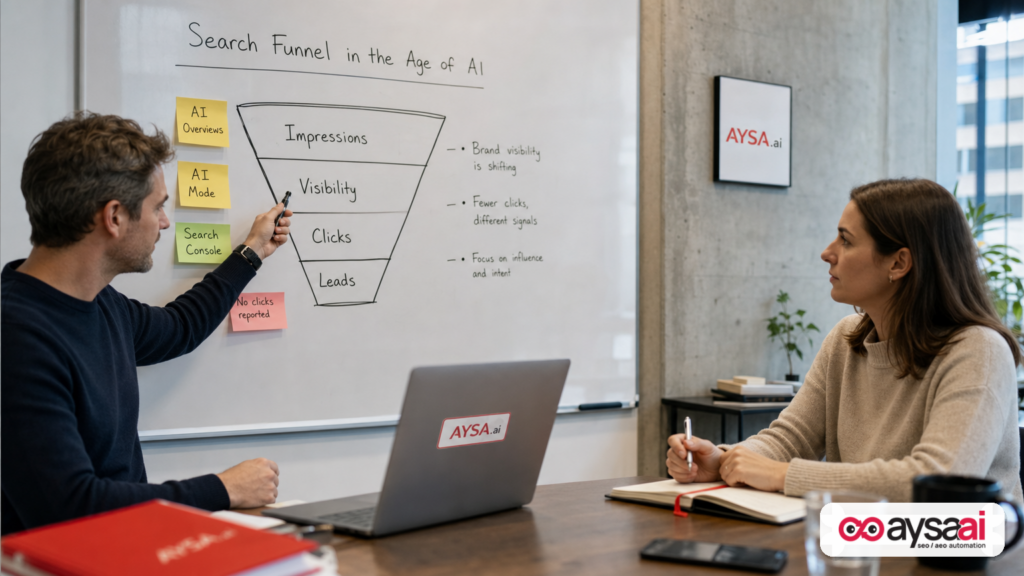
- Google says AI features in Search send “billions of clicks” to websites weekly, but the methodology and breakdown aren’t provided publicly, so you can’t validate the claim on your own.
- Search Console AI reporting (as described publicly) includes impressions and breakdowns, but not clicks—limiting your ability to quantify traffic impact.
- For SMEs and agencies, the solution isn’t to argue about the aggregate. It’s to build a measurement and execution loop that works under uncertainty: tests, proxy KPIs, conversion instrumentation, and content/technical changes shipped fast.
- AI search is pushing SEO toward AEO/GEO: earning inclusion in answers, citations, and recommendations—not just “ranking #1.”
Key takeaways (print this)

- Don’t anchor on platform-wide numbers you can’t audit. Anchor on your own outcomes: leads, sales, calls, bookings, signups.
- Expect more “visibility without clicks.” Your brand may be mentioned, summarized, or used as a source while fewer people visit your site.
- Shift reporting from sessions to influence. Track assisted conversions, branded demand, and downstream actions, not only last-click organic.
- Build content that is quotable and attributable. AI systems cite the clearest, most structured, most trustworthy pages—often not the longest.
- Execution speed is now a competitive advantage. The winners will be the teams that detect changes early and ship improvements weekly.
Table of contents
- The “Billions of Clicks” Claim: What Google Said, and What We Still Don’t Have
- Why This Matters to SMEs: The Hidden Cost of “Trust Us” Metrics
- What Actually Changed in Search: From Links to Answers to Actions
- Impressions Without Clicks: The Reporting Gap and the Real Operational Impact
- The New KPI Stack: What to Measure When Click Data Is Missing
- A Practical Measurement Framework for AI Search (Even Without Click Data)
- Content That Wins in AI Answers (AEO/GEO): What to Build, Update, and Remove
- Technical Foundations That Make Your Site “AI-Friendly” Without Chasing Buzzwords
- A Concrete SME Scenario: The Local Clinic That “Lost Clicks” but Grew Bookings
- What Agencies Should Rethink: Deliverables, Reporting, and Retainers in the AI Era
- Where AYSA Fits: Monitoring, Preparing Changes, Getting Approval, Executing—Repeat
- What to do next (action list)
- Sources and further reading
The “Billions of Clicks” Claim: What Google Said, and What We Still Don’t Have
In mid-2026, Google’s Nick Fox, SVP of Knowledge and Information, shared a claim that AI features in Google Search send billions of clicks to websites each week, while Search overall sends billions of clicks to the web each day. The framing is clearly meant to answer a worry many publishers, ecommerce brands, and local businesses have voiced: if the answer is on the SERP, why would anyone click?
Search Engine Journal covered the statement and highlighted the key limitation: neither number comes with a baseline, denominator, methodology, or dataset you can independently check. The weekly “AI features” number is also not broken out in a way that lets you understand what share of total Search clicks it represents, how it’s trending, or how it varies by query type (informational vs. transactional vs. local).
Here’s the SEJ coverage (useful context and timeline): Google Puts A Number On AI Search Clicks, Without The Data.
To be clear: I’m not arguing the claim is false. I’m saying it’s not actionable. For a business owner deciding whether to invest $5,000/month in content, an agency deciding whether to staff up for “AI SEO,” or a publisher modeling revenue, unverifiable aggregates are not decision-grade inputs.
What would make it decision-grade?
- A definition of “AI features” (AI Overviews, AI Mode, Gemini-powered experiences, etc.).
- Time range and geography coverage.
- Breakdowns by query category (local, ecommerce, medical, finance, news).
- Click attribution rules (what counts as a click “from” AI features?).
- Trends over time and comparisons to non-AI SERPs.
Until we have that, the only responsible stance for operators is: assume AI is changing click behavior, and build measurement + execution systems that don’t rely on one platform’s PR-friendly headline numbers.
Why This Matters to SMEs: The Hidden Cost of “Trust Us” Metrics
If you’re running a small ecommerce brand, a dental practice, a home services company, or a B2B SaaS startup, the stakes aren’t philosophical. They’re practical:
- Budget allocation: Do you invest in SEO, paid search, social, email, marketplaces, or partnerships?
- Staffing: Do you hire content writers, technical SEO help, or analytics support?
- Forecasting: Can you predict leads and revenue based on traffic patterns?
- Survival: For many SMEs, organic search is the cheapest scalable acquisition channel—until it isn’t.
When Google says “billions of clicks,” the message is: “the web ecosystem is fine.” But your P&L doesn’t run on ecosystem averages. It runs on your conversion rates, your lead quality, your brand demand, and your margins.
The uncomfortable reality: AI search can be simultaneously true at both levels:
- Google can send billions of clicks to the web.
- Your site can still lose a meaningful share of clicks on the queries you depend on.
This happens because AI features do not reduce clicks evenly. They compress some query classes more than others. If your business lives on “how-to” and “what is” content, the SERP can answer enough that fewer people need to visit. If your business lives on “best [product] for [use case]” or “near me” queries, AI can reshape the path users take before they choose a provider.
The cost of “trust us” metrics is that they encourage passivity. They tempt teams to wait for clarity rather than building advantage while the market is unsettled.
What Actually Changed in Search: From Links to Answers to Actions
For two decades, most SEO playbooks were built on a simple mental model:
- User searches.
- Google ranks links.
- User clicks a result.
- Website converts the visitor.
AI Overviews and related generative experiences shift that model. The SERP is no longer only a list of options; it’s increasingly a synthesis engine. Even when it does cite sources, the user’s first interaction is with the answer layer, not the publisher.
This pushes search behavior in a few directions that matter operationally:
1) Click compression on some informational queries
If a user gets “good enough” guidance in an overview, fewer will click. Not zero—just fewer. That reduction can be devastating if you built a traffic model on high-volume informational queries.
2) Rerouting: fewer top-of-funnel sessions, more mid-funnel decisions
AI can pre-qualify the user. When they do click, they may be closer to taking action—if your landing pages are built to capture that intent quickly.
3) More multi-touch journeys
Users may see your brand in an AI answer, then later search your brand name, then convert via direct or email. If you only report last-click organic sessions, you’ll miss the influence.
4) Trust becomes the ranking factor people forget to operationalize
In generative answers, the system needs sources that reduce risk. Clear authorship, transparent policies, accurate local info, consistent product specs, and credible citations all become practical levers—not “nice-to-haves.”
Impressions Without Clicks: The Reporting Gap and the Real Operational Impact
SEJ reported that Google is rolling out AI performance reporting in Search Console for a limited set of site owners, and that these reports include impressions and breakdowns (page, country, device) similar to standard performance reporting—but do not include click data (at least as described at the time of reporting).
That omission isn’t a minor analytics inconvenience. It blocks three essential workflows:
- Incrementality measurement: You can’t determine whether AI visibility caused additional visits or just shifted how impressions are counted.
- Content prioritization: You can’t distinguish pages that generate traffic from pages that merely appear.
- ROI modeling: Without clicks (and without query detail in many AI contexts), tying work to outcomes becomes harder.
Now add the human layer: stakeholders don’t fund “impressions.” They fund revenue, pipeline, and bookings. If your reporting can’t show cause-and-effect, your program becomes vulnerable—especially when budgets tighten.
This is the moment many SEO teams will lose internal trust. Not because SEO stopped working, but because the reporting stopped matching how search works now.
So what do we do? We stop waiting for perfect platform metrics and build an independent measurement stack that answers the only question leadership cares about:
Did our changes increase the number of customers and the profit per customer?
The New KPI Stack: What to Measure When Click Data Is Missing
When the platform withholds key metrics—or provides them in a way you can’t reconcile—your KPIs need to move “downstream.” That doesn’t mean guessing. It means choosing metrics you can observe and influence.
Tier 1: Business outcomes (non-negotiable)
- Leads (form submits, calls, chats)
- Bookings (appointments, reservations)
- Sales (transactions, trials, upgrades)
- Revenue and margin
Tier 2: Conversion mechanics (what you can improve weekly)
- Landing page conversion rate (by intent group)
- Speed/Core Web Vitals (because AI-qualified visitors bounce fast if you’re slow)
- Offer clarity (above-the-fold value prop, pricing transparency where appropriate)
- Trust signals (policies, reviews, credentials, guarantees)
Tier 3: Demand and brand influence (the “AI visibility” proxies)
- Branded search growth (your name + product/service)
- Direct traffic trends (interpreted cautiously)
- Email signups and returning visitor rate
- Share of voice for high-intent topics (measured via controlled query sets)
Tier 4: Platform indicators (useful, but not sufficient)
- Search Console impressions (standard + AI where available)
- Average position (directional, not absolute)
- Index coverage and crawl health
Notice what’s missing: “total organic sessions” as the hero KPI. Sessions still matter, but in an AI-mediated world, sessions are an intermediate artifact, not the outcome.
A Practical Measurement Framework for AI Search (Even Without Click Data)
Here’s a framework I recommend for SMEs and agencies that need to make decisions now, not after the reporting catches up.
Step 1: Define your “money queries” and your “influence queries”
Split your target queries into two buckets:
- Money queries: high-intent queries that historically convert (e.g., “emergency plumber [city]”, “buy [product]”, “pricing”, “book”).
- Influence queries: research queries that shape preference (e.g., “best [category] for [use case]”, “is [treatment] worth it”, “how to choose [service]”).
This matters because AI features tend to hit influence queries harder. If you don’t separate them, you’ll misread what’s happening.
Step 2: Create a controlled query set and track outcomes weekly
Pick 20–50 queries you care about (more if you’re enterprise; fewer if you’re very small). Track them on a schedule, with consistent location and device assumptions. Your goal is not to recreate Google’s internal metrics; it’s to detect directional change and correlate it with your own conversions.
If you’re doing this manually, be consistent and document it. If you’re using tooling, use the same settings each week.
Step 3: Instrument conversions like you actually need them
If your analytics setup is weak, AI search will expose it fast. Make sure you can answer:
- What counts as a conversion?
- What channels assist it?
- What landing pages start the journey?
- What pages close the journey?
Google Analytics 4 (GA4) is the common baseline for many teams, but the exact setup depends on your stack. The point is: you need a conversion truth source you control.
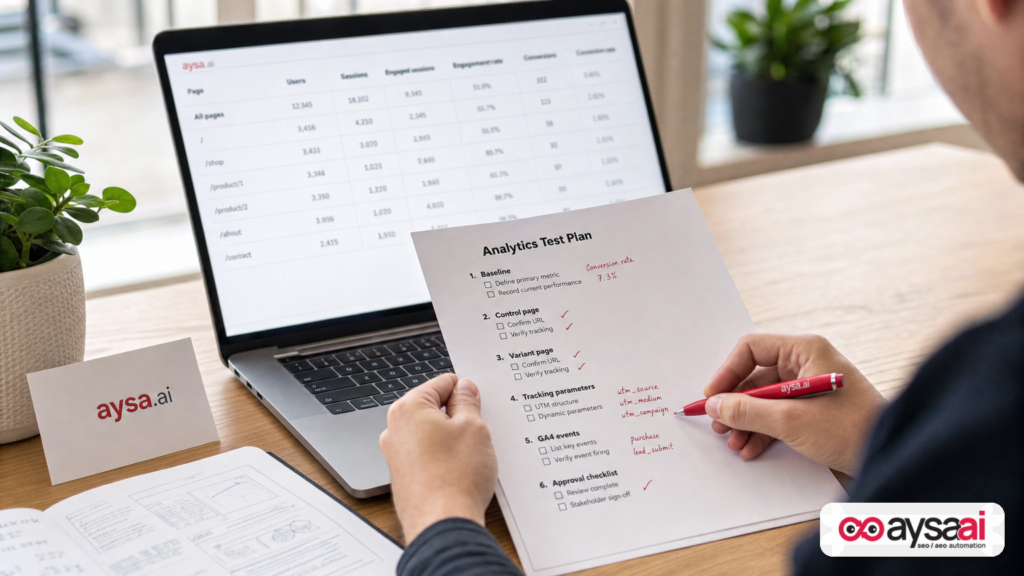
Step 4: Run page-level experiments, not site-wide “SEO projects”
When a new search experience rolls out, the temptation is to “optimize the site for AI” with a big, vague initiative. Don’t. Instead:
- Pick a page that targets a money query.
- Create a variant: improve structure, clarity, schema, internal linking, and conversion elements.
- Ship it.
- Measure conversions and assisted conversions over a defined period.
In other words: treat SEO like product optimization. Small batches, clear hypotheses, measurable outcomes.
Step 5: Use proxy indicators for AI visibility—carefully
If Search Console provides AI impressions but not clicks, use them as a visibility signal, not a performance result. Combine with:
- Branded search growth
- Conversion lift on pages that were updated
- Lead quality changes (sales notes, call logs, chat transcripts)
Proxy metrics aren’t perfect. But in aggregate, they can tell a coherent story—especially if you run controlled content changes.
Content That Wins in AI Answers (AEO/GEO): What to Build, Update, and Remove
AI search pushes us toward AEO (Answer Engine Optimization) and GEO (Generative Engine Optimization). The goal isn’t just “rank.” It’s:
- Be eligible to be used as a source.
- Be summarized accurately.
- Be chosen when the user decides to act.
Here’s what that looks like in practice—especially for SMEs.
1) Write quotable sections, not just long articles
AI systems often extract short, clear explanations. Help them:
- Use crisp definitions (“X is…”)
- Add “when to choose X vs Y” comparisons
- Include bullet points and tables where it clarifies decisions
- Answer the obvious follow-ups on the same page
2) Build “decision pages” that map to real buying choices
Many SMEs have blogs but lack pages that close the sale. Create pages like:
- “[Service] pricing in [city]” (with ranges and what affects cost)
- “[Product] vs [Product] comparison” (your product included, honestly)
- “Best [category] for [use case]” (with a clear recommendation framework)
These pages can win both traditional organic clicks and AI citations because they reflect real decision-making.
3) Make entity facts consistent across the site
AI experiences are sensitive to entity-level inconsistencies: addresses, service areas, product specs, policies, and brand positioning. If your “About,” “Contact,” footer, and location pages disagree, you’re feeding the model contradictions.
This is where monitoring and systematic fixes matter more than heroic one-time rewrites.
4) Remove or consolidate content that exists only for traffic
In the link-list era, thin top-of-funnel pages could still bring sessions. In an AI-answer era, those pages may become liabilities: they dilute topical authority, confuse internal linking, and waste crawl budget.
Audit for:
- Duplicate “what is” pages
- Outdated how-tos
- Location pages with copy-paste text
- Posts that no longer match your product or service reality
Technical Foundations That Make Your Site “AI-Friendly” Without Chasing Buzzwords
There’s no magic “AI SEO” tag you can add. But there are technical fundamentals that reliably increase your odds of being understood, trusted, and cited—by both classic search and AI features.
1) Crawlability and indexability: boring, essential
If key pages aren’t consistently crawlable, nothing else matters. Keep templates clean, avoid accidental noindex, manage faceted navigation, and ensure canonicalization makes sense.
2) Structured data where it clarifies meaning (not where it’s decorative)
Schema doesn’t guarantee inclusion, but it helps systems interpret entities and relationships. Use it where you can do it accurately (products, organization, local business, FAQs where appropriate).
3) Internal linking as your “training wheels” for topical authority
AI systems and ranking systems both benefit when your site clearly expresses:
- Which pages are most important
- How topics connect
- What the preferred destination is for a given intent
4) Performance and UX: AI-qualified traffic is impatient
If AI reduces the number of clicks, the clicks you get are more valuable. Don’t waste them with slow pages, confusing CTAs, or walls of text before the user sees the next step.
A Concrete SME Scenario: The Local Clinic That “Lost Clicks” but Grew Bookings
Let’s make this real with a scenario I’ve seen variants of many times.
Business: a multi-location physical therapy clinic.
Old SEO approach:
- Publish lots of educational blog posts: “what is sciatica,” “stretches for knee pain,” etc.
- Rank for informational queries.
- Rely on those sessions to eventually convert into appointments.
New AI-search reality:
- Users search “what causes sciatica pain” and get an AI overview with basic advice and “when to see a professional.”
- Fewer users click the blog post.
- Meanwhile, a subset of users skip to “physical therapist near me” or search the clinic brand later.
What goes wrong for the clinic (common):
- They only monitor blog traffic.
- They conclude “SEO is dying.”
- They cut content and technical maintenance.
What the clinic should do instead:
- Keep the educational pages, but restructure them to be quotable, accurate, and medically responsible.
- Create or improve decision pages: “When to see a PT for sciatica,” “Sciatica treatment options,” “What to expect in your first visit,” “Insurance and pricing.”
- Strengthen location pages: services, availability, clinician credentials, reviews, clear calls to book.
- Track bookings and calls as the primary KPI, not blog sessions.
The outcome you’re aiming for: even if top-of-funnel clicks compress, bookings can rise because the traffic that does arrive is more qualified and the site converts better.
This is why I keep repeating: the argument is not about whether Google sends “billions of clicks.” The argument is whether your website turns attention into revenue efficiently in the new journey.
What Agencies Should Rethink: Deliverables, Reporting, and Retainers in the AI Era
If you run an agency, AI search is not only a channel shift. It’s a business model stress test.
Deliverables that will feel outdated
- Monthly rank reports with minimal business context
- “We published 4 blog posts” without conversion mapping
- Large one-time audits that never get implemented
Deliverables clients will pay for
- Measurement design: conversion tracking, definitions, and dashboards tied to revenue
- Test plans: control vs. variant content/landing pages
- Execution capacity: shipping improvements continuously
- AI visibility monitoring: what AI answers say about the brand, products, and locations
The opportunity: agencies that become operators (not just advisors) will win. The risk: agencies that can’t ship will get squeezed between platform opacity and client skepticism.
Where AYSA Fits: Monitoring, Preparing Changes, Getting Approval, Executing—Repeat
AI search has made one thing painfully obvious: knowing what to do isn’t the bottleneck—doing it is.
That’s the gap AYSA is designed to close.
AYSA is an approved SEO/AEO/GEO execution system: it monitors, prepares changes, asks for approval, and executes accepted website changes. That workflow matters because in many SMEs:
- The owner wants control and oversight.
- The marketing team is stretched thin.
- Development resources are limited.
- Changes get stuck in “audit PDFs” and never ship.
Here’s how I think about AYSA in the AI-search era:
1) Monitor what AI search is doing to your visibility
If your visibility shifts and your KPIs change, you need early warning. Start with monitoring so you can detect patterns before revenue drops.
Explore: AYSA Monitoring
2) Treat AI visibility as a managed surface area (not a mystery)
AI search visibility isn’t one metric. It’s a set of surfaces where your brand, products, and expertise can appear. The job is to understand where you show up, what you’re associated with, and where inaccuracies or competitor recommendations creep in.
Explore: AI Search Visibility
3) Use AI SEO tools, but keep humans in the approval loop
Automation without approval is risky for brand voice, compliance, and accuracy—especially in regulated categories and local businesses with nuanced service rules.
Explore: AI SEO Tools
4) Make execution a predictable line item
Whether you’re an SME budgeting internally or an agency packaging services, execution needs to be priced like an ongoing capability, not a one-off event.
Explore: AYSA Pricing
5) Keep your team educated as the landscape changes
AI search is moving fast. Staying current is part of the job.
Explore: AYSA Blog
The meta-point: when platform data is incomplete, your advantage comes from disciplined iteration. AYSA’s approved-execution model is built for that rhythm.
What to do next (action list)
- Pick your KPI truth: define 1–3 primary conversions (calls, bookings, purchases) and make sure they’re tracked cleanly.
- Create your controlled query set: list your top money and influence queries; track them weekly with consistent settings.
- Audit your decision pages: do you have pages that help users choose and act (pricing, comparisons, “best for,” location/service pages)?
- Fix entity consistency: ensure your business facts match across the site (locations, services, policies, product specs).
- Run one test this month: pick one page, improve it with a clear hypothesis, and measure conversion impact.
- Set up monitoring: don’t wait for a traffic drop—watch for changes in visibility and messaging now.
- Build an execution cadence: weekly or biweekly shipping beats quarterly “SEO projects.”
Sources and further reading
- Search Engine Journal: Google Puts A Number On AI Search Clicks, Without The Data (primary reporting used as research input)
- Search Engine Journal: Latest news (ongoing context on AI search changes)
- Search Engine Journal: SEO section (broader SEO context)
Note: The SEJ piece references prior statements by Google leadership and mentions Search Console AI reporting limitations. In this editorial, I’m intentionally not adding new “official numbers” beyond what is contained in the supplied research context. If Google publishes a detailed methodology or expands Search Console AI reporting with clicks and query data, your measurement model should be updated accordingly.
Final perspective
Google’s “billions of clicks” framing is designed to calm a market that’s rightly anxious. But calm is not a strategy.
The strategy is: measure what you can control, design for the new journey, and build an execution machine that ships improvements continuously. In the AI search era, the winners won’t be the teams with the loudest opinions about platform claims. They’ll be the teams with the tightest feedback loops.
Continue the AI search topic inside AYSA.
Use these pages to connect the article with AI SEO tools, AI visibility monitoring, AI Overviews and approved website execution.
Turn this topic into a website action plan.
Use these AYSA hubs to move from reading to technical fixes, AI visibility monitoring, research, glossary context and approval-first SEO execution.

