
Google’s Gemini Book-Training Lawsuit Is Bigger Than Copyright: It Exposes The Real Risk In “Opt-Out” AI And What Businesses Must Do Now
A new class action claims Google trained Gemini on books and journal content supplied for Google Books, Play Books, and Scholar—plus copies found through scraping—without permission. Even if you block AI bots, this case highlights a bigger issue: distribution channels, contracts, and “data already possessed” can bypass crawler controls. Here’s what changed, why it matters to SMEs, publishers, and agencies, and how to build AI search visibility without losing control.

Author: Marius Dosinescu (AYSA.ai)
Editor’s note: This is an analysis and operational playbook based on reported allegations in a newly filed lawsuit. Nothing here is legal advice. If you need legal guidance, consult counsel in your jurisdiction.
A Lawsuit About Books—And A Wake-Up Call For Every Business Using The Web
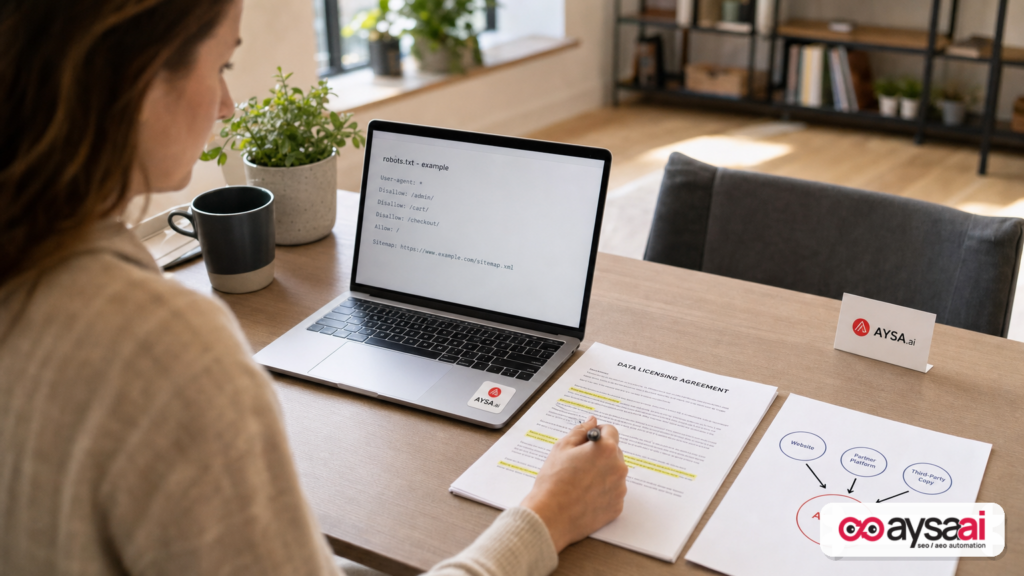
When people hear “AI training lawsuit,” they often translate it into one question: “Did a bot crawl my site?”
But the class action filed by major publishers and novelist Scott Turow against Google over alleged use of books and journal articles to train Gemini (as reported by Search Engine Journal) surfaces a much bigger operational reality: content doesn’t only move through crawlers. It moves through contracts, uploads, distribution partners, platform libraries, third-party mirrors, and data sets you didn’t know existed.
And that changes what “control” even means.
The complaint (again: allegations, not a court finding) claims that works supplied to Google via services such as Google Books, Play Books, and Scholar were used to train Gemini without permission—plus additional copies allegedly obtained via web scraping routes that could include pirated or paywalled sources. If those claims ultimately prove true, the consequences aren’t limited to publishers. The implications hit every operator whose business depends on content: ecommerce brands, clinics, SaaS teams, hotels, local services, and agencies that publish at scale.
Here’s the practical takeaway: AI Search visibility and AI training governance are now business functions—not “something SEO handles when we have time.”
Concise Summary
- A proposed class action alleges Google used books and journal articles provided through specific Google services—and potentially additional scraped copies—to train Gemini without permission. No court has ruled on these claims. (Primary reporting: Search Engine Journal.)
- Even perfect crawler blocking (robots.txt tokens like Google-Extended) may not address content obtained through platform agreements or third-party hosting.
- Businesses should treat AI-era search as an execution problem: monitor how AI systems represent you, fix the inputs, and ship improvements consistently—while auditing where your content is distributed.
- AYSA.ai fits here as an Approved Execution system: it monitors, prepares changes, asks for approval, and executes accepted updates—so your AI search strategy actually ships.
Key Takeaways (Business-First)

- Opt-out controls are narrow. They’re useful, but only for certain acquisition paths (like crawler-based collection).
- Distribution is destiny. If your content is in partner platforms, libraries, PDFs, marketplaces, or mirrors, the “source of truth” may not be your site.
- AI search visibility is not purely SEO anymore. It’s a mix of Technical SEO, content governance, entity consistency, and brand risk management.
- Execution beats strategy decks. The winners will be the teams that ship small, approved changes continuously and measure outcomes.
Table of Contents
- What Changed: Why This Gemini Case Hits Different
- What The Complaint Alleges (And What We Actually Know So Far)
- The Hidden Lesson: “Block The Bot” Is Not A Data Governance Strategy
- Permission vs. Fair Use: Two Different Questions Businesses Keep Blending
- How Content Enters AI Systems: The Channels Most Teams Ignore
- Why This Matters Even If You Don’t Care About Publishing
- What Can Go Wrong: Real-World Business Failures In AI Search
- SME Scenario: A Local Clinic, A Content Agency, And A New Kind Of Liability
- What Agencies Should Rethink Now
- What SMEs Should Monitor Weekly (Not Quarterly)
- A Practical 60-Day Action Plan
- Where AYSA.ai Fits: Approved Execution For AI Search
- What To Do Next
- Sources & Further Reading
What Changed: Why This Gemini Case Hits Different
We’ve had a steady drumbeat of AI copyright fights. What makes this one operationally important is the alleged pathway:
- Not just “public web Crawling.” The complaint describes content that may have arrived through direct supply routes (Google Books/Play Books/Scholar) and also through scraped copies hosted elsewhere.
- Not just “a bot you can block.” If content is provided by agreement or hosted on third-party domains, a publisher’s robots.txt policies on their own website don’t control those copies.
- Not just a technical issue. This turns into contract interpretation, licensing scope, and data governance—areas many marketing teams don’t own.
This is exactly why I keep telling operators: the AI search era will punish siloed teams. The “SEO person” can’t solve a content supply chain problem alone.
What The Complaint Alleges (And What We Actually Know So Far)
According to Search Engine Journal’s reporting on the filing, the plaintiffs (publishers and author Scott Turow and his company) brought claims that, in summary:
- Google copied millions of books and journal articles to train Gemini, including works supplied via Google Books, Play Books, and Scholar.
- The works were provided for specific purposes (search, discovery, sales, research access), and AI training was allegedly outside that scope.
- The complaint also alleges Google copied works obtained from web scraping routes, including copies that allegedly came from pirate sites and paywalled libraries.
- The complaint includes a DMCA-related allegation around copyright management information.
Important constraints:
- No court has ruled on these claims.
- We have only what’s described in the complaint and in reporting, not the underlying evidence.
- Google had not commented in the Search Engine Journal report at publication time.
If you want the factual baseline for this editorial, start with the original reporting: Search Engine Journal.
The Hidden Lesson: “Block The Bot” Is Not A Data Governance Strategy
Most businesses discovered AI training bots the same way they discovered GDPR: too late, with a half-formed checklist.
So they did the obvious thing: block bots in robots.txt, add a few headers, maybe stop unknown user agents at the CDN, and call it “handled.”
That’s not irrational. It’s just incomplete.
Search Engine Journal’s piece highlights a core limitation: crawler controls only govern crawling of your domain by that crawler. They don’t govern:
- Content you uploaded to a platform via an agreement.
- Content syndicated through partners, aggregators, feeds, resellers, or “we’ll host it for you” services.
- Content copied and reposted on another domain (authorized or unauthorized).
So the question becomes: what are you actually trying to do?
- If your goal is “reduce the chance my web pages are used for training via crawling,” bot controls can help.
- If your goal is “control how my content can be used across all channels,” you need a content distribution audit, contract review, and ongoing Monitoring.
That is not a marketing task. It’s an operational governance task that marketing, legal, product, and IT need to align on.
Permission vs. Fair Use: Two Different Questions Businesses Keep Blending
The reporting draws a useful distinction that many teams blur:
- Permission (contract/license): did the provider have permission for this specific use?
- Fair use (legal doctrine): even without permission, is the use protected under fair use?
These questions can point in different directions. You could have no explicit permission but still argue fair use. Or you could have a contract that arguably covers one use but not another, regardless of fair use arguments.
From a business perspective, the key is this: you can’t “SEO” your way out of licensing ambiguity.
If you operate a content-heavy business (publisher, course platform, community, research database, SaaS knowledge base), you should know:
- Where your content is distributed.
- What rights you granted at each distribution point.
- What “derivative uses” are permitted (or prohibited), and how that language is evolving in the AI era.
How Content Enters AI Systems: The Channels Most Teams Ignore
Let’s simplify the AI content supply chain into understandable lanes. The lawsuit reporting focuses attention on two lanes that bypass standard crawler controls, but businesses should think in a wider set.
Lane 1: Crawling Your Website (The One Everyone Talks About)
This is the classic channel: a bot visits your pages and ingests text. You can influence this lane with:
- Robots.txt directives and user-agent-specific rules (scope depends on the bot honoring them).
- Indexing controls (noindex) that affect search visibility, but do not necessarily control training use in every context.
- Rate limits, bot mitigation, and access controls.
Google has publicly discussed machine-readable controls for certain uses (Search Engine Journal references Google-Extended). I’m not going to over-claim what any one control guarantees, because policies and implementations shift. The operational point stands: this lane is only one lane.
Lane 2: Content You Provide Under Agreement (Platforms, Libraries, Feeds)
This is where the Gemini book-training allegations become instructive. If you supply content into a platform—by upload, feed, API, reseller agreement, or library licensing—your “control” is the contract plus platform policy.
Businesses do this constantly:
- Ecommerce brands upload product data to marketplaces.
- Hotels and local businesses feed inventory/pricing/availability to OTAs.
- SaaS companies syndicate docs into partner portals.
- Publishers distribute catalogs to libraries, schools, and subscription platforms.
In AI terms, this matters because data “already possessed” can be treated differently than data “collected from the public web,” at least in internal decision-making. That’s a governance problem.
Lane 3: Third-Party Copies (Mirrors, Scrapes, Piracy, “Helpful” PDFs)
Even if you do everything right, copies can appear elsewhere:
- Scraped articles republished on low-quality sites.
- PDFs of your guides shared in forums.
- Paywalled research uploaded to file-sharing sites.
If a dataset (for example, a crawl corpus) indexes those third-party domains, your robots.txt on your main domain won’t touch it. That’s the uncomfortable truth. Search Engine Journal’s reporting mentions Common Crawl in this context; for background, see Common Crawl. (I’m linking to the organization, not asserting what any dataset contains.)
Lane 4: User Inputs (Your Customers Copy/Paste You Into Prompts)
Your customers copy your policies, your pricing, your medical advice pages, your warranty text—into ChatGPT prompts and support tickets. You don’t control that. But you can:
- Make your canonical policies unambiguous and easy to quote correctly.
- Ensure your public-facing pages contain the right context so that partial excerpts don’t mislead.
Lane 5: Your Own Tools (The Ones You Turned On Without Thinking)
Many teams paste confidential content into AI tools, connect knowledge bases, or enable “helpful” integrations. I’m not claiming anything about any specific vendor. I’m saying this: your internal AI adoption is part of your content governance footprint.
Why This Matters Even If You Don’t Care About Publishing
“Okay, publishers are suing. I sell furniture / run a dental clinic / own a landscaping company. Why should I care?”
Because the same two forces reshape your world:
- AI changes discovery behavior. Users are increasingly comfortable getting a single synthesized answer rather than ten blue links.
- AI changes representation risk. If an AI system summarizes your policies, services, or safety information incorrectly, it’s not an SEO problem. It’s a revenue, compliance, and trust problem.
Whether training was authorized or fair use is a court question. But your business exposure is present either way:
- Customers will trust AI summaries.
- Competitors will try to be the “recommended option” in AI answers.
- Bad data will get repeated.
This is why we built AYSA’s approach around monitoring + execution, not just reporting. If AI search says something wrong about you, you need a system to correct the inputs and ship fixes—fast.
What Can Go Wrong: Real-World Business Failures In AI Search
Here are failure modes we’re already seeing across the market. I’m not attaching numbers or claiming they happened to specific named companies—this is category-level risk that you can recognize instantly.
1) Wrong Policies, Wrong Prices, Wrong Hours
AI summaries are only as accurate as the most “available” version of your truth. If outdated PDFs or third-party listings contradict your site, AI may cite the wrong one.
Business impact: lost bookings, customer service load, refunds, negative reviews.
2) Your Content Strategy Accidentally Promotes Competitors
If your content is vague, generic, or missing differentiators, AI will fill in the blanks—sometimes with competitor-friendly recommendations.
Business impact: you become the “category explainer,” your competitor becomes the “best choice.”
3) Entity Confusion: You Get Merged With Someone Else
Common in local SEO and multi-location brands: similar names, duplicated listings, inconsistent addresses, messy citations.
Business impact: calls go to the wrong place, wrong directions, misattributed reviews.
4) Compliance And Safety Risk (Clinics, Finance, Regulated Markets)
If an AI system paraphrases medical or financial content without proper context, you may end up with advice that’s incomplete or inappropriate.
Business impact: reputational risk and potential regulatory exposure.
5) Licensing Blowback For Content-Heavy Brands
If you license, syndicate, or distribute content, the scope of rights in those agreements matters more than ever.
Business impact: contract disputes, takedown demands, and strategy whiplash.
SME Scenario: A Local Clinic, A Content Agency, And A New Kind Of Liability
Let’s make this real with a scenario that mirrors how small businesses actually operate.
The business: a 3-location physical therapy clinic.
The setup:
- They publish blog posts about back pain, sports injuries, and recovery timelines (written by an agency).
- They have downloadable PDFs for post-op exercises.
- They syndicate some educational content into a partner wellness portal through a simple “content sharing” agreement signed years ago.
The AI-era problem:
- A customer asks an AI assistant: “How long until I can run after an ACL repair?”
- The assistant produces a confident answer and cites a mix of sources, including an old PDF and a partner portal page that hasn’t been updated.
- The summary includes a timeline that the clinic no longer endorses and doesn’t include the clinic’s standard disclaimers.
The clinic’s first instinct: “Let’s block AI bots.”
But blocking bots won’t fix:
- The partner portal copy (not on their domain).
- The outdated PDF that’s being shared and mirrored.
- The inconsistent location data that confuses local intent queries.
What actually fixes it:
- Audit all distribution points and update/replace outdated assets.
- Ensure the canonical page has the right structured signals and clear disclaimers.
- Monitor AI representations of the clinic weekly (not annually).
- Ship small corrections continuously: hours, services, “who we serve,” and policy clarifications.
This is precisely where an execution system matters. Strategy is easy. Shipping consistent improvements is the hard part.
What Agencies Should Rethink Now
Agencies are about to get a wave of client questions that sound like legal questions but are actually operational questions:
- “Can you stop our content from being used to train AI?”
- “Can you guarantee we won’t show up in AI answers?”
- “Can you guarantee AI won’t say something wrong about us?”
The honest answer is: no agency can guarantee outcomes across every AI system and every acquisition channel. Anyone who promises that is selling comfort, not capability.
What agencies can do—and should productize immediately:
Deliverable #1: AI Visibility Monitoring (Brand + Locations + Products)
This is not traditional rank tracking. It’s “what do AI systems say about us?” monitoring.
AYSA’s monitoring is built for this direction of travel: AYSA Monitoring
Deliverable #2: AI Search Input Hygiene
Keep the inputs clean:
- Entity consistency (names, addresses, services).
- Canonical policies and updated content.
- Structured data where appropriate.
Start with an AI search visibility posture: AI Search Visibility
Deliverable #3: Approved Execution
The biggest agency bottleneck is not insight. It’s shipping changes through approvals, dev cycles, and client indecision.
AYSA’s model—monitor, prepare, approve, execute—exists to turn recommendations into live fixes without chaos. See tools and approach: AI SEO Tools
Deliverable #4: Distribution & Licensing Inventory (Non-Legal, Operational)
Agencies shouldn’t practice law. But they can absolutely help clients inventory where content is distributed and flag “unknowns” for counsel review:
- Platforms where content is uploaded.
- Syndication partners.
- PDF/document libraries and stale assets.
- Third-party mirrors that outrank the original.
What SMEs Should Monitor Weekly (Not Quarterly)
In the AI search era, “set it and forget it” becomes “set it and get misrepresented.” Here’s what I want SMEs watching on a weekly cadence.
1) Brand Answer Accuracy
- Does AI describe what you do correctly?
- Does it list your top services/products accurately?
- Does it invent policies, prices, or claims?
2) Location Consistency (If You’re Local Or Multi-Location)
- Hours and holiday hours
- Address formatting
- Phone numbers
- Service areas
3) “AI Snippet” Sources (Where The Model Might Be Pulling From)
You may not be able to see training data. But you can often see what pages are ranking, what pages are being cited, and which versions of your content are most discoverable.
4) Competitor Inclusion In “Best X” Queries
If AI lists “top options” in your category, track:
- Are you included?
- Which competitors appear and why?
- What differentiators are being repeated?
5) Content Drift And Staleness
If your site has outdated pages, PDFs, and duplicated “about” text across locations, AI will inherit that confusion.
A Practical 60-Day Action Plan (No Legal Jargon)
If you’re an SME or agency and you want a plan you can execute without forming a task force, here it is.
Days 1–7: Build Your Content Supply Chain Map
- List every place your content exists: your website, PDFs, partner portals, marketplaces, app stores, docs sites, learning platforms.
- Identify which assets are “canonical” and which are duplicates.
- Assign an owner per channel (marketing, ops, product, partnerships).
Days 8–14: Establish Your “Truth Pages”
- Create/update the canonical pages that define: services, pricing approach (if appropriate), policies, hours, locations, contact.
- Make them easy to parse: clear headings, bullet lists, FAQs where helpful.
- Remove or update outdated PDFs—or add strong canonical references pointing back to the updated page.
Days 15–30: Fix Entity Consistency + Technical Hygiene
- Resolve duplicate location pages.
- Standardize NAP (name/address/phone) everywhere.
- Add/verify structured data where appropriate (don’t spam; be accurate).
Days 31–45: Start AI Search Monitoring And Baseline Reports
- Document what AI systems say about your brand and locations today.
- Track changes weekly; treat it as reputation monitoring, not vanity metrics.
If you want a productized path, start here: AI Search Visibility
Days 46–60: Operationalize Execution
- Create a change pipeline: suggested fix → prepared draft → approval → deployment.
- Define approval rules (who can approve what).
- Ship improvements weekly, not quarterly.
This is where AYSA is designed to sit: monitor, prepare, ask for approval, execute accepted changes—so improvements are consistent and auditable. Explore: AI SEO Tools
Where AYSA.ai Fits: Approved Execution For AI Search
Most “AI search” conversations are still stuck in the strategy phase: prompts, predictions, hot takes, and fear. But businesses don’t win with theories. They win with repeatable execution.
AYSA is built around a simple operational model:
- Monitor how you appear across search and AI answers (brand, products, locations).
- Prepare recommended changes (content, technical fixes, structured improvements, local consistency tasks).
- Approve changes with clear accountability—nothing goes live without your sign-off.
- Execute accepted updates so the strategy becomes reality.
Start with monitoring: AYSA Monitoring
See the broader AI SEO toolset: AI SEO Tools
Review pricing options (SMEs and agencies have different needs): AYSA Pricing
More practical guidance in our editorial library: AYSA Blog
What To Do Next
- Stop treating AI as “just a bot problem.” List every non-crawler channel where your content lives.
- Pick 5–10 high-risk pages/assets (policies, pricing, medical/financial guidance, returns, hours) and make them unambiguous and current.
- Audit duplicates and stale PDFs that may outrank or out-circulate your canonical pages.
- Start weekly AI search monitoring for brand and top-intent queries.
- Operationalize approvals and execution so fixes actually ship.
- If you distribute content via agreements, flag “AI training / derivative use” language for counsel review.
Sources & Further Reading
- Search Engine Journal: Google Faces Class Action Over Books Used To Train Gemini
- Common Crawl (official site)
- AYSA.ai: AI Search Visibility
- AYSA.ai: Monitoring
- AYSA.ai: AI SEO Tools
- AYSA.ai: Pricing
- AYSA.ai Blog
Transparency note: The central lawsuit details in this editorial are based on the supplied Search Engine Journal report and quoted allegations within it. Where the legal record or underlying evidence is not available in the provided context, I’ve treated it as unverified and framed it as analysis rather than fact.
Continue the AI search topic inside AYSA.
Use these pages to connect the article with AI SEO tools, AI visibility monitoring, AI Overviews and approved website execution.
Turn this topic into a website action plan.
Use these AYSA hubs to move from reading to technical fixes, AI visibility monitoring, research, glossary context and approval-first SEO execution.

