
International SEO Isn’t About Pages Anymore: Build Global Knowledge Integrity For AI Search
AI search is changing international SEO from “serve the right page” to “protect the right answer.” Here’s how to prevent cross-market knowledge contamination with a practical Global Knowledge Integrity program—and how AYSA helps you monitor, prepare, approve, and execute fixes at scale.

International SEO used to be a routing problem: make sure Google shows the German page to Germany, the U.S. page to the U.S., and the French page to France. In AI Search, that’s no longer the hard part. The hard part is making sure the right market-specific facts survive retrieval and get synthesized into the answer a user sees—before they ever click your site.
That means the new core competency isn’t “international SEO tricks.” It’s global knowledge integrity: the operational discipline of keeping your public-facing facts consistent, locally valid, machine-readable, and governable across every market and content format. If you don’t, AI systems can blend claims, prices, policies, and even compliance statements across regions—creating what Bill Hunt calls cross-market knowledge contamination.
This editorial expands on that idea with a practical playbook for SMEs, agencies, and enterprise teams—and shows how AYSA turns the work into an execution system: monitor changes, prepare fixes, ask for approval, then execute the accepted updates on your website.
Concise summary

- What changed: AI search increasingly retrieves, summarizes, and cites information—often blending multiple sources—before a click happens.
- Why it matters: International SEO is no longer only “serve the right page.” It’s “protect the right answer,” including market-specific compliance, pricing, availability, and policies.
- New risk: Cross-market knowledge contamination—when AI mixes facts from different regions because your web footprint isn’t governed as a coherent knowledge system.
- What to do: Build a Global Knowledge Integrity program, score risk with a matrix, fix high-impact pages and documents first, and implement ownership + review cycles.
- Where AYSA fits: AYSA helps you continuously monitor, prepare, approve, and execute updates that keep market truth consistent across content and technical signals.
Table of contents
- The shift: from “right page in the right country” to “right answer in the right context”
- Why this is happening now (and why “GEO tactics” won’t save you)
- Cross-market knowledge contamination: what it is, why it happens, and why it’s risky
- Who should care: SMEs, agencies, and enterprises (different risks, same physics)
- Common failure modes: where global brands (and growing SMEs) leak the wrong facts
- The Global Knowledge Integrity Matrix (GKIM): a practical scorecard any team can use
- Information architecture for AI retrieval: make “market truth” legible
- Governance that works: ownership, reviews, escalation, and change propagation
- A concrete SME scenario: an ecommerce brand expands from the U.S. into the EU
- What agencies should rethink: from deliverables to durable knowledge systems
- Where AYSA fits: turn governance into approved, repeatable execution
- What to do next (action list)
- Sources and further reading
The shift: from “right page in the right country” to “right answer in the right context”

Traditional international SEO was built for a world where search engines mostly acted like directories: a user searches, a results page shows links, and the user Clicks a page. Your job was to help the engine choose the correct URL for that user’s location and language—often using:
- Market-specific URLs and site structure
Hreflangannotations- Localized Keyword targeting
- Translation quality and regional content nuance
- Canonicalization and duplicate management
None of those are obsolete. But they were designed for a page selection problem.
AI-driven search experiences (including chat-based assistants and AI-enhanced SERP Features) create a different problem: answer integrity. Increasingly, systems retrieve passages from multiple documents, compress them into a short response, and sometimes cite a handful of sources. Your content is no longer just competing to rank; it’s competing to be used—accurately.
That is the core insight from Bill Hunt’s argument for a global knowledge integrity strategy (and the reason I’m writing this editorial now). Read the original on Search Engine Journal here: Why International SEO Needs A Global Knowledge Integrity Strategy.
In this new environment, international SEO success looks less like “we ranked #1 in France” and more like:
- When a user in France asks an AI assistant about your warranty, it answers with the French warranty terms, not the U.S. policy.
- When a user in Germany asks about ingredients or safety claims, the response reflects Germany/EU-valid statements, not your most aggressive marketing copy from elsewhere.
- When a user in Canada asks about pricing, the answer reflects CAD pricing and availability and doesn’t blend in a U.S. price from a stale PDF.
International SEO has become international knowledge management—except the “knowledge consumers” are machines that synthesize.
Why this is happening now (and why “GEO tactics” won’t save you)
There’s a flood of advice right now that treats AI search optimization (often called GEO, AEO, or “AI SEO”) as a formatting exercise: add an FAQ, write more conversational headings, include schema, publish “AI-friendly summaries,” or add an llms.txt file.
Some of these tactics can help extraction and comprehension. But they’re not a strategy—and they don’t address the hardest part of global search in the AI era: conflicting facts across markets and formats.
Here’s the practical reason those tactics top out:
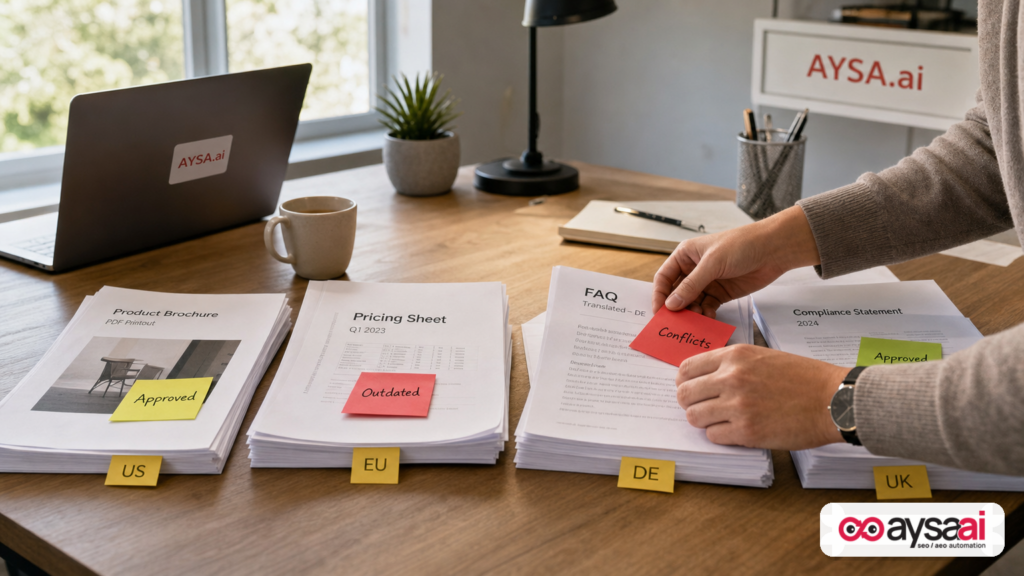
- Schema can’t fix contradictions. If your U.S. page says “free returns for 30 days” and the UK page says “returns within 14 days,” schema makes both claims easier to extract. It doesn’t decide which one is valid for which user.
- FAQs can’t override a conflicting PDF. If an old downloadable brochure remains indexable, retrieval systems may still use it as “evidence.”
- Formatting doesn’t create governance. AI systems don’t care how your org chart is drawn. They care what’s publicly accessible and semantically similar.
So yes: improve structure. But don’t mistake structure for truth-control.
The operational shift is this: your website is no longer just a marketing channel. It’s a public knowledge infrastructure. And AI systems increasingly treat it that way.
At AYSA, we see the same pattern across businesses that are growing internationally: teams are great at publishing new pages but weak at maintaining a coherent “answer layer” across all touchpoints. That’s not a content writer problem. It’s an operating system problem.
Cross-market knowledge contamination: what it is, why it happens, and why it’s risky
Cross-market knowledge contamination happens when AI systems blend information from multiple markets without preserving the context that originally made those facts true.
That contamination can show up as:
- Mixed pricing: a U.S. price and an EU VAT statement combined into one answer
- Wrong availability: products or services described as available in a country where they’re not
- Compliance bleed: claims that are legal in one market but restricted in another
- Policy drift: returns, shipping, warranty, or cancellation terms pulled from the wrong locale
- Unit confusion: inches vs. centimeters, Fahrenheit vs. Celsius, dosage formats, etc.
Why does it happen?
- AI retrieval is not bound by your internal boundaries. You think in websites and markets. Retrieval systems think in entities, passages, and similarity.
- Old assets don’t “expire” on the internet. PDFs, legacy subdomains, campaign landing pages, and help-center articles can stick around and remain retrievable.
- International duplication is common. Many “localized” pages are near-identical translations. If the only difference is language, not market-specific facts, the system has less signal to separate them.
- Geo blocking doesn’t necessarily protect you. Even if you redirect users, crawlers and AI systems may retrieve content from centralized infrastructure. (Implementation details vary by platform, so treat this as a risk to test rather than a guarantee.)
Why is it risky?
- Brand risk: customers lose trust when answers are inconsistent across channels.
- Revenue risk: wrong pricing and availability create conversion friction and support load.
- Operational risk: support teams handle “but your site said…” conflicts at scale.
- Compliance risk: in regulated industries (health, finance, legal), a blended answer is not just “incorrect,” it can be actionable misinformation.
This is why Bill Hunt frames it as governance, not tactics. He’s right. The hard part is not building more pages. It’s ensuring your global footprint doesn’t contradict itself.
Who should care: SMEs, agencies, and enterprises (different risks, same physics)
SMEs: you don’t have “global complexity,” until you do
SMEs often assume this is an enterprise problem. It’s not. SMEs just hit the wall later—usually when they add:
- a second currency
- a second warehouse or shipping policy
- a second language
- a second legal jurisdiction
- a marketplace presence plus a direct-to-consumer site
SMEs are also the most vulnerable to “quiet contamination” because they tend to have fewer process controls: a freelancer updates one page, a plugin outputs another version, and nobody owns consistency across the whole footprint.
Agencies: your deliverable is now a system, not a set of optimizations
Agencies that win in AI search won’t be the ones who ship a checklist of “GEO tweaks.” They’ll be the ones who build client operating systems:
- inventory of market facts
- change control
- content lifecycle rules
- testing and monitoring
- execution velocity with approvals
Enterprises: you already have the problem—you’re just not measuring it
Enterprises have the most surface area: multiple domains, teams, CMS instances, translation vendors, and legal rules. Many enterprise organizations are “compliant” internally but inconsistent publicly. AI makes that inconsistency visible—and scalable.
Common failure modes: where global brands (and growing SMEs) leak the wrong facts
If you want to prevent cross-market contamination, start by recognizing where it typically originates. These are the most common leak points we see in real-world operations (and they align with the kinds of risks discussed in the SEJ source article):
1) PDFs and downloadable assets that outlive their truth
Brochures, spec sheets, pricing catalogs, installation manuals, and compliance docs are frequently updated in one market and forgotten elsewhere. AI systems can retrieve a PDF as easily as HTML.
What to do:
- Create an inventory of public PDFs by market.
- Add clear effective dates and market scope on the first page.
- Use canonical “latest version” pages and retire or redirect old assets where appropriate.
2) Global templates with local exceptions
Many companies run “one template, many markets.” That’s efficient until local exceptions pile up: return windows, delivery carriers, tax handling, certification requirements, and product variants.
What to do: separate “global baseline” from “local facts,” and ensure local facts are explicit, not implied.
3) Near-duplicate localized pages that don’t contain local truth
If a localized page is just a translation with no market-specific detail, it gives AI fewer signals to keep answers separated. This increases blending risk.
What to do: add market-specific fields that machines can latch onto: currency, address, availability, shipping regions, standards, certifications, phone formatting, legal entity names, and region-relevant FAQs.
4) Legacy subdomains, campaign pages, and “temporary” landing pages
Temporary pages become permanent. And once they’re indexed (or linked externally), they can remain retrievable long after you stop caring about them.
What to do: enforce a lifecycle: publish → monitor → retire/redirect → confirm de-indexing where needed.
5) Inconsistent entity naming and product identifiers
AI systems reason over entities. If your product is called “Pro,” “Pro+,” and “Professional” depending on market, you’re inviting ambiguity.
What to do: standardize product identifiers across markets, and map aliases explicitly in your internal systems and on-page content.
6) Support content and knowledge bases updated out of sync with marketing pages
Support and marketing are often managed by different teams with different priorities. AI doesn’t respect that separation. It will quote either if it looks relevant.
What to do: treat support articles as first-class “answer assets” with ownership, review dates, and market scope.
The Global Knowledge Integrity Matrix (GKIM): a practical scorecard any team can use
Bill Hunt proposes a framework he calls the Global Knowledge Integrity Matrix (GKIM) to evaluate markets and content across critical dimensions. I like this because it’s not a “new acronym for SEO.” It’s a governance lens you can operationalize.
Here’s a practical version you can run inside any company—from a 10-person ecommerce brand to a multinational.
GKIM dimension 1: Market accuracy
Question: Is the information correct for the user’s country/language/currency/regulatory environment and availability?
What to check:
- pricing currency and tax/VAT language
- availability by country/region
- shipping timelines and carriers
- warranty/returns/cancellations
- regulated claims and disclaimers
GKIM dimension 2: Entity clarity
Question: Are products, services, locations, and organizations clearly identified and connected across pages and data?
What to check:
- consistent product naming, SKUs, model numbers
- legal entity naming by region (if applicable)
- clear location/address signals where relevant
- internal linking that reinforces market context
GKIM dimension 3: Content uniqueness (local value)
Question: Does each region’s content provide genuine local value, or is it a near-duplicate translation?
What to check:
- local examples, policies, case studies, constraints
- country-specific FAQs that reflect reality
- localized imagery/measurements/units (when relevant)
GKIM dimension 4: Machine extractability
Question: Can search engines and AI systems quickly identify the answer, its scope, and its freshness?
What to check:
- clear headings and answer blocks
- visible effective dates and “last updated” timestamps
- structured data where appropriate (without using it as a crutch)
- clean crawl paths and indexability controls
GKIM dimension 5: Governance confidence
Question: Does someone own this information, review it, and know how to update it everywhere it appears?
What to check:
- owner (name/role), review cadence, escalation path
- single source of truth per market for key facts
- change propagation plan (web pages, PDFs, feeds, help docs)
How to score GKIM without creating bureaucracy
Use a simple 1–5 score for each dimension per asset category (not per page) per market. For example:
- Product pages (US, UK, DE)
- Pricing & plans (US, UK, DE)
- Shipping & returns (US, UK, DE)
- Support KB (US, UK, DE)
- PDF downloads (US, UK, DE)
The goal isn’t a perfect spreadsheet. The goal is identifying where “wrong answers” are likely to be synthesized.
Information architecture for AI retrieval: make “market truth” legible
Once you accept that AI systems operate on retrievable facts, not just pages, the website strategy changes. Your job becomes: make market truth legible, scannable, and hard to misinterpret.
1) Create a market truth hierarchy (what is authoritative for what)
For each major topic category—pricing, warranty, availability, compliance claims—define:
- Global baseline: what is consistent everywhere
- Market-specific truth: what differs by market
- Authoritative source: the page or system that owns the truth in that market
This is where many teams fail: they have content, but no explicit truth hierarchy. AI will create its own hierarchy based on what’s most accessible and semantically similar.
2) Put scope and freshness on the page, not only in your CMS
Humans and machines both need help understanding context. Add explicit markers like:
- “Applies to: United Kingdom customers”
- “Effective date: 2026-01-15”
- “Last updated: 2026-06-10”
This isn’t about keyword stuffing. It’s about making it harder to quote the wrong rule in the wrong market.
3) Reduce ambiguity with strong internal linking
Internal links are still one of the best ways to reinforce relationships: product → pricing → shipping → returns → warranty for the same market.
If your German product page links to the U.S. returns policy (even by accident), you’ve created a contamination pathway.
4) Use structured data thoughtfully (but don’t outsource truth to schema)
Structured data can improve machine interpretation, but it cannot reconcile contradictions by itself. Use it to reinforce:
- organization and local business identity (where relevant)
- product attributes
- offer details (where accurate per market)
- FAQ content (when it matches the on-page truth)
Important: the source article mentions common “AI-friendly” tactics (like FAQs and schema) but argues they’re insufficient without governance. I agree—and I’d go further: schema makes contradictions easier to extract, so it increases the need for governance.
5) Actively manage indexability of legacy assets
International teams often leave old PDFs and old market pages accessible because “someone might need them.” That’s fine—until AI uses them as evidence.
At minimum, implement:
- asset versioning and a “latest” canonical landing page
- planned redirects for outdated pages
- clear archival labeling (and avoid letting archived content look current)
Governance that works: ownership, reviews, escalation, and change propagation
Here’s the uncomfortable truth: most international SEO failures are not SEO failures. They’re workflow failures.
You can have perfect technical implementation and still lose if:
- no one owns the “answer”
- updates happen in one market but not others
- legal changes don’t propagate
- support content drifts away from marketing truth
The minimum viable governance model
If you want the simplest possible model that still works, define these roles:
- Market owner: accountable for market-specific truth (pricing, policies, compliance)
- System owner: accountable for how truth is published (CMS, templates, feeds, PDFs)
- Approval owner: accountable for risk-based approvals (often legal/compliance for regulated claims)
Introduce “answer changes” as a formal change type
In many companies, a “page update” is informal. In AI search, you should treat updates that could change the synthesized answer as a controlled class of change. Examples:
- returns window
- medical/financial claims
- pricing and discounts
- availability / service area
- warranty exclusions
Those changes should trigger:
- review of dependent pages
- PDF updates
- support article updates
- re-testing of AI retrieval behavior (where possible)
Why enterprises may need a “VP of Answers” (and SMEs need an owner, even if it’s part-time)
The SEJ article suggests enterprises may need a new accountability function—sometimes framed as a “VP of Answers.” The title isn’t the point. The point is this: if everybody owns the global answer layer, nobody owns it.
In SMEs, this can be a founder, a marketing lead, or an ops manager. In larger orgs, it’s likely a cross-functional leader who can coordinate SEO, content, product, legal, engineering, and regional teams.
AI search rewards organizations that can speak with one consistent voice—while still being locally correct.
A concrete SME scenario: an ecommerce brand expands from the U.S. into the EU
Let’s make this real.
You run a U.S.-based ecommerce brand selling specialty kitchen equipment. You expand into Germany and France. You do the basics:
- Translate product pages
- Add
hreflang - Create /de/ and /fr/ folders
- Set currency display to EUR
Six months later, an AI assistant answers a German user:
- It quotes your U.S. warranty (12 months) instead of your EU warranty (24 months).
- It mentions your U.S. shipping time (2–4 days) instead of your EU shipping (5–8 days).
- It pulls a U.S. price from an old PDF and states it as the current EU price.
Nothing “broke” in hreflang. The pages might even rank correctly. But the answer was synthesized from multiple assets—some of which you forgot existed.
How to fix it with a knowledge integrity approach
- Inventory high-risk facts: warranty term, returns, shipping times, taxes, pricing.
- Find where those facts appear: product pages, policy pages, PDFs, support articles.
- Choose authoritative sources per market: one canonical returns page per market; one warranty definition per market.
- Make scope explicit: “Applies to EU customers” / “Applies to U.S. customers,” with effective dates.
- Retire or relabel legacy assets: update PDFs, add “archived” labels, or remove indexability where appropriate.
- Strengthen internal links: DE product pages link to DE policies, not global or U.S. ones.
- Monitor drift: set recurring checks so it doesn’t happen again when promotions or policies change.
This is exactly the kind of work that looks “too operational” for SEO teams—until AI turns it into a visibility and revenue issue.
What agencies should rethink: from deliverables to durable knowledge systems
If you’re an agency, the AI shift is both threat and opportunity.
The threat is obvious: fewer clicks, more answers on the SERP or in assistants, and a flood of “AI SEO hacks” that commoditize advice.
The opportunity: agencies that can build knowledge integrity systems will be harder to replace. That means your offer evolves from:
- “We optimize pages” → “We govern market truth across your web footprint.”
- “We publish content” → “We manage content lifecycle and answer risk.”
- “We deliver audits” → “We implement and maintain changes with accountability.”
Agency-ready service lines (practical, sellable, and durable)
- Cross-market fact audit: find contradictions across locales, PDFs, and support docs
- Policy and pricing integrity program: unify and localize “money pages” and “risk pages”
- Entity and product clarity project: normalize naming and identifiers across markets
- Lifecycle and archival strategy: reduce retrievable outdated assets
- Monitoring + approved execution retainer: continuous oversight and deployment
That last one is where agencies typically struggle: they can find issues, but implementation is slow, risky, and blocked by approvals. Which brings us to AYSA.
Where AYSA fits: turn governance into approved, repeatable execution
Global knowledge integrity fails for one reason more than any other: execution bottlenecks.
You can know what’s wrong and still lose if updates require:
- three tools
- five stakeholders
- two sprints
- and a spreadsheet nobody maintains
AYSA is built for the reality that modern search is continuous—and so is maintenance.
AYSA’s model: monitor → prepare → approve → execute
AYSA functions as an AI-powered SEO/AEO/GEO execution system that:
- Monitors your site for changes, drift, and visibility opportunities (see Monitoring).
- Prepares recommended updates in a way teams can review (content, technical, internal linking, structured data where relevant).
- Asks for approval before making changes—critical for international and regulated contexts where local owners and legal need sign-off.
- Executes accepted changes reliably on your website, reducing the lag between insight and implementation.
For AI search and international growth, that workflow matters because “truth” is not a one-time project. It’s a maintenance program.
How AYSA supports global knowledge integrity in practice
- Detecting drift: identify when a market page changes but dependent pages don’t update.
- Scaling consistency: propose aligned updates across locale variants without forcing identical content.
- Reducing risk: approvals create a clear audit trail of who accepted market-specific changes.
- Maintaining visibility: keep your “answer assets” (policies, pricing, product facts) fresh and machine-readable.
If you want to explore how this connects to AI visibility specifically, start here: AI Search Visibility and AI SEO Tools. For operational context and examples, see the AYSA blog. If you’re evaluating systems and budgets, Pricing is the most direct reference point.
What to do next (action list)
If you’re responsible for a multi-market site (or you’re about to become responsible), here’s a practical next-30-days plan.
Week 1: Identify your highest-risk “answer categories”
- Pricing & promotions
- Shipping, returns, warranty
- Availability by region
- Regulated claims and disclaimers
- Support and troubleshooting guidance
Week 2: Inventory where those facts live
- HTML pages across locales
- PDFs and downloads
- Help center content
- Blog posts that contain “policy-like” statements
Week 3: Run a GKIM scoring workshop
- Pick 1–2 markets and 2–3 asset types to start.
- Score Market Accuracy, Entity Clarity, Local Uniqueness, Machine Extractability, Governance Confidence.
- Prioritize the bottom two dimensions first—those create the most contamination risk.
Week 4: Fix, publish, and set ongoing monitoring
- Correct contradictions across markets for the chosen asset types.
- Add scope and freshness signals (effective date, last updated, market applicability).
- Retire/redirect or clearly label outdated assets.
- Set monitoring for drift and re-test AI retrieval behaviors where possible.
Most importantly: assign ownership. Without ownership, the system decays back into contradictions.
Sources and further reading
- Search Engine Journal (Bill Hunt): Why International SEO Needs A Global Knowledge Integrity Strategy
- Search Engine Journal: International Search category (context and related research)
- Search Engine Journal: Enterprise SEO category (governance and scale context)
- Search Engine Journal: SEO section (broader context)
- Search Engine Journal: Google algorithm updates history (for change-management context)
Note on citations: The supplied research context primarily provides the Search Engine Journal article and SEJ category links. Where additional primary sources (e.g., official documentation from search engines about AI features, retrieval behavior, or crawler policies) would be helpful, they are not included in the provided context—so I’m intentionally not adding claims that would require those references.
Final thought
International SEO isn’t disappearing. It’s being absorbed into something bigger: global knowledge integrity. In a world where AI synthesizes answers, unmanaged global content isn’t just inefficient—it’s a liability.
The winners won’t be the teams chasing every new GEO trick. They’ll be the teams who treat their website as a governed knowledge system and can execute changes quickly, safely, and repeatedly.
If you want help operationalizing that—monitoring drift, preparing fixes, routing for approvals, and executing accepted changes—AYSA is built for exactly this moment: AI search visibility powered by continuous monitoring and approved execution.
Continue the AI search topic inside AYSA.
Use these pages to connect the article with AI SEO tools, AI visibility monitoring, AI Overviews and approved website execution.
Turn this topic into a website action plan.
Use these AYSA hubs to move from reading to technical fixes, AI visibility monitoring, research, glossary context and approval-first SEO execution.

