
You Rank on Google. Why AI Overviews Still Ignore You (and How to Become the Brand in the Answer)
B2B brands can rank for thousands of keywords yet show up in only a tiny fraction of Google’s AI Overviews. Here’s what changed, why it matters for SMEs and agencies, and a practical plan—built for execution—to earn citations and win demand upstream.
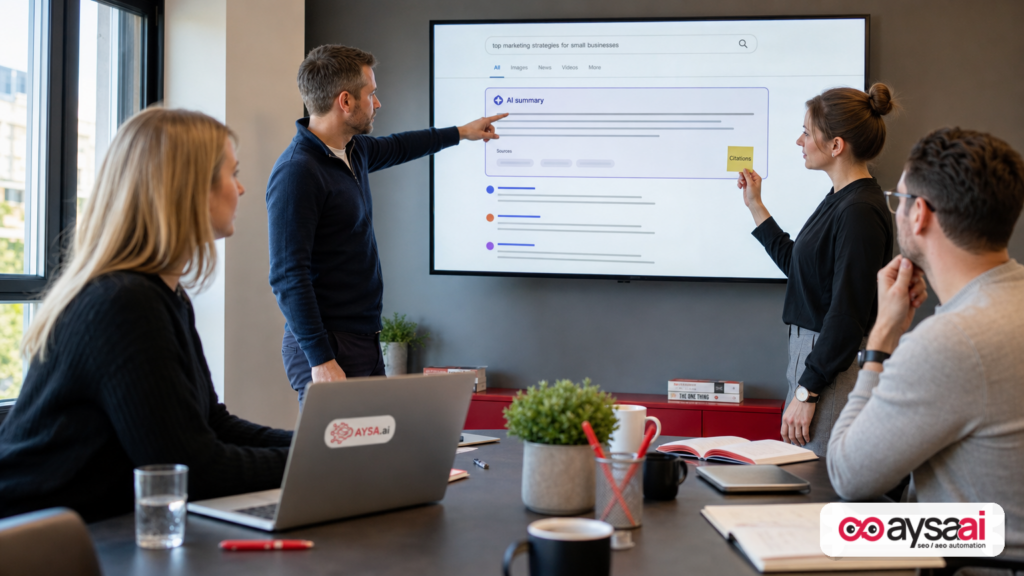
Google visibility used to mean one thing: ranking. Now it means two things: ranking and being selected as a source inside AI-generated answers. If your brand is still measuring success by Keyword positions alone, you may be winning the part of search buyers are increasingly skipping.
Recent analysis reported by Search Engine Land highlights the shift in stark terms for B2B: AI Overviews show up for roughly half of relevant searches where enterprise brands rank, but the median brand is cited in only a small fraction of those AI answers. Put differently: many brands are “in the results,” but not “in the answer.”
I’m Marius Dosinescu, and from the AYSA.ai seat, I don’t see this as an SEO curiosity. I see it as a distribution problem—and a workflow problem. You can’t strategy your way out of a system change if your team can’t measure it, prioritize it, and ship improvements to the site with speed and control.
Concise summary
AI Overviews are expanding the “answer layer” of Google. For B2B (and increasingly for SMEs), that means:
- Rankings ≠ recommendations. You can rank well and still be absent from the AI summary buyers read first.
- Citations are the new trust currency. Being cited is often the difference between being considered and being invisible.
- Depth, clarity, and structure beat breadth. Broad keyword coverage doesn’t automatically translate to AI citations.
- Execution wins. Monitoring and planning are necessary—but the brands that ship content and technical upgrades consistently will compound advantage.
Key takeaways (what to remember)
- AI Overviews can intercept demand at the moment a buyer is learning, comparing, or validating vendors—often before they click anything.
- Traditional SEO dashboards can flatter you. They may show you ranking breadth while hiding that you’re missing from the AI citations that frame the narrative.
- AI visibility needs its own KPI set: AI Overview incidence, citation inclusion rate, and topic-level coverage (not just keyword counts).
- The fix is not “more content.” It’s better content systems: buyer-question mapping, structured answers, Entity Clarity, and technical accessibility.
- AYSA fits at the operational layer: monitor AI visibility, prepare prioritized changes, ask for approval, then execute accepted updates on your website.
Table of contents
- What changed: ranking is no longer the same as being “in the answer”
- What the benchmark implies (without overreading it)
- The new visibility funnel: from ranking to citation (and where most brands fall off)
- Why keyword breadth doesn’t buy you AI citations
- How AI Overviews likely choose sources (practical, not mystical)
- Content that earns citations: templates that work for SMEs and B2B
- Technical foundations: make your expertise easy to extract and cite
- Authority in the AI era: what to build when links and brand mentions aren’t enough
- Measurement: the KPIs and workflows your dashboard is missing
- A concrete SME scenario: the “invisible” category leader
- What agencies and in-house teams must rethink
- Where AYSA.ai fits: from monitoring to approved execution
- What to do next: a practical 30–60–90 day action plan
- Sources and further reading
What changed: ranking is no longer the same as being “in the answer”
For years, the B2B playbook was straightforward:
- Pick keywords.
- Create pages targeting those keywords.
- Earn links and authority.
- Rank, then convert the click.
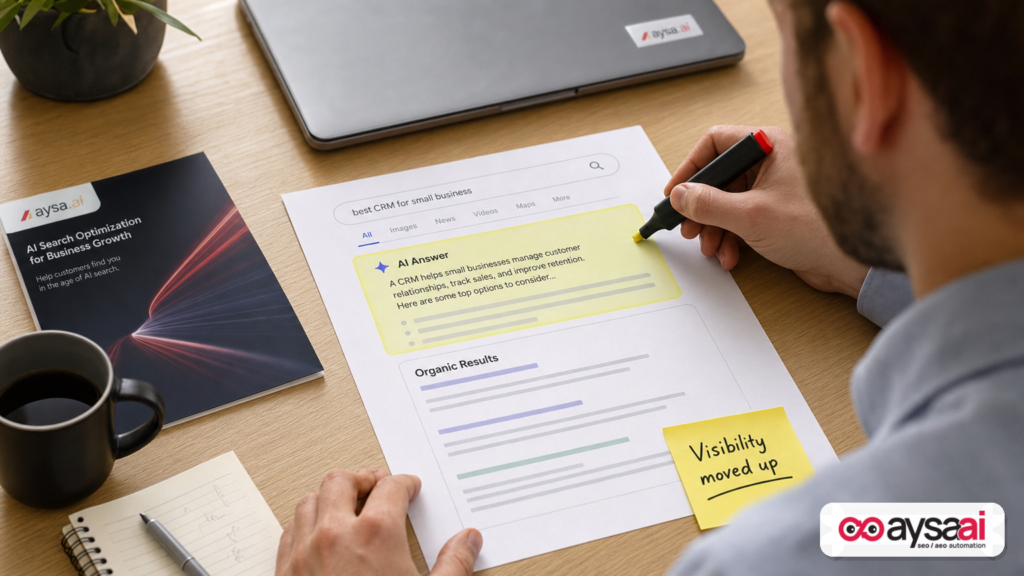
AI Overviews change the buyer’s path because they add a new step: the buyer can get a synthesized answer without clicking. This does not mean “SEO is dead.” It means organic results are increasingly downstream from a top-of-page summary that frames the category, defines the criteria, and often surfaces a shortlist of sources.
In practical business terms, the impact looks like this:
- Less patience. Buyers skim the AI summary first.
- Earlier vendor framing. The AI summary can establish which solutions and vendors are “the standard” before the buyer reaches your site.
- New winner-take-most dynamics. A handful of citations can capture a disproportionate share of mindshare.
And there’s a second-order effect that matters even more: your team’s incentives may be wrong. If everyone is paid and praised for “we rank for 15,000 keywords,” but your brand appears in almost none of the AI answers, you’re building the wrong kind of visibility.
What the benchmark implies (without overreading it)
The Search Engine Land piece summarizes a large benchmark study of enterprise B2B domains that looked at four layers of visibility: keyword coverage, how often AI Overviews appear for those queries, how often AI Overviews are present (incidence), and how often a brand is cited (citation inclusion rate).
Two implications are immediately useful for SMEs and mid-market teams—even though the dataset is enterprise:
- AI Overviews are not rare. They show up across a meaningful share of commercial research queries, especially in software and technical categories.
- Being “ranked” is not the finish line. Many brands are eligible (they rank somewhere) but are not selected as sources inside the AI answer.
One caution: benchmarks like this are directional. You shouldn’t assume your category matches the median. What you should assume is that the underlying dynamic—a narrowing from rankings to citations—is real and accelerating.
If you want a broader context thread worth following, Search Engine Land has also covered related developments, including Google Search Console’s evolving AI performance reporting (Read the source article on searchengineland.com) and the emerging concept of “teaching AI who you are” via entity understanding and LLM-era SEO (Read the source article on searchengineland.com). You don’t need to treat any single article as gospel. But the direction is consistent: search is becoming more answer-led, entity-led, and summary-led.
The new visibility funnel: from ranking to citation (and where most brands fall off)
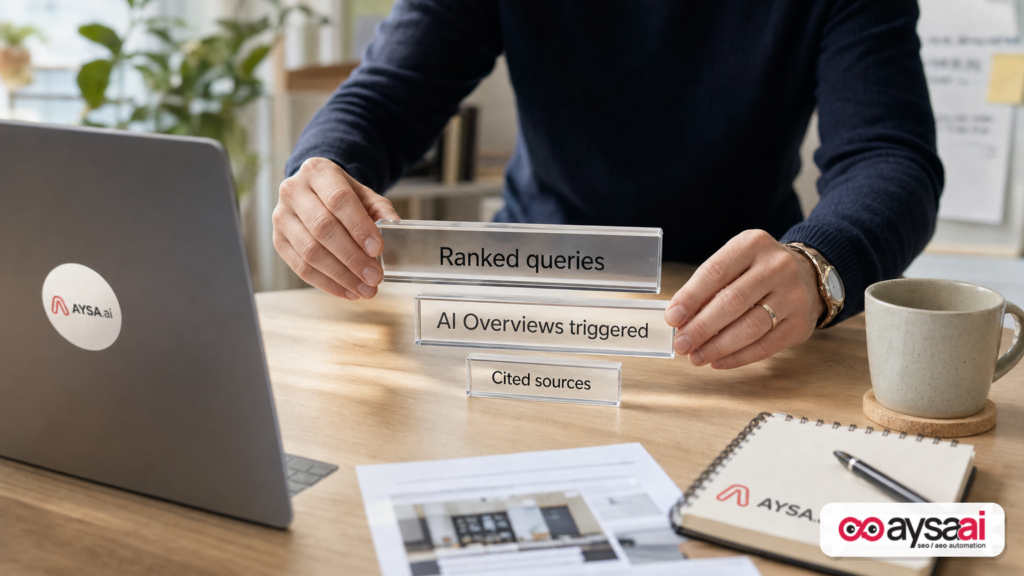
Classic SEO funnels were simple: Impressions → clicks → conversions. The AI era adds new gates before the click:
- Do you rank for the query? (You can’t be cited if you’re not even present.)
- Does the query trigger an AI Overview? (If not, it’s classic SERP territory.)
- If it triggers an AI Overview, are you cited? (This is the new visibility choke point.)
Most brands fall off at step three. That’s the “quiet loss.” You still see rankings in your tools, maybe even stable traffic on some pages, but the buyer’s first exposure is happening in a box that doesn’t mention you.
Why does this matter so much?
- AI Overviews compress evaluation time. When buyers see a summarized comparison and a handful of sources, they often anchor on those.
- Citations are proto-recommendations. Not endorsements, but strong signals of “this is a credible place to learn.”
- Missing citations can mean missing narrative control. Your category can be defined by competitors’ content and third-party sites—even if you outrank them below.
Why keyword breadth doesn’t buy you AI citations
The old instincts say: “If we rank for more keywords, we’ll be more visible everywhere.” That’s partially true for blue-link SEO, but it breaks in AI summaries for a simple reason:
AI Overviews aren’t trying to show a lot of pages. They’re trying to resolve a question.
If your site ranks because you have lots of pages, decent authority, and a solid internal linking footprint, you may show up in the top 10 or top 20 for many terms. But to be cited, your content also needs to be:
- Extractable: clear claims, definitions, steps, and comparisons that can be summarized without distortion.
- Specific: directly answering what the query is asking (not what you wish the buyer asked).
- Consistent: supported by multiple pages that reinforce the same topic area with depth rather than thin repetition.
From an editorial standpoint, this is a healthy correction. For years, too much B2B content was written to “rank,” not to help. AI systems push the web (and marketers) toward clarity and usefulness. The problem is that most sites were built for the old incentives, and their content infrastructure shows it.
How AI Overviews likely choose sources (practical, not mystical)
None of us outside Google can provide a definitive ranking recipe for AI Overviews. If someone tells you they have one, be skeptical. But you can work from observable patterns and from what Google has historically rewarded in search quality: helpfulness, clarity, and authority signals.
Here are the selection dynamics that matter most in practice:
1) Entity clarity: can the system tell who you are?
If Google can’t confidently associate your brand with a topic area, product category, or set of capabilities, you’re less likely to be selected as a source in a summary that needs confident grounding.
Practically, that means your site should make these things painfully obvious:
- What your company does (in plain language, not slogan-speak).
- Who it’s for.
- What problems you solve.
- What you don’t do (useful for disambiguation).
2) Question resolution: does your page actually answer the query?
AI Overviews are biased toward content that reads like an answer key: definitions, criteria, steps, trade-offs, and examples. Pages that are mostly product marketing copy, vague positioning, or gated PDFs often underperform here.
3) Structure: can the system extract the answer cleanly?
Clear headings, concise paragraphs, scannable lists, consistent terminology, and well-labeled tables make it easier for a system to summarize without losing meaning.
4) Multi-page support: do you have topical depth, not just one “hero page”?
One great page helps, but a cluster of great pages—each addressing adjacent buyer questions—signals sustained expertise. That’s the kind of footprint that turns a brand into a reliable citation candidate.
5) Trust and quality signals still matter
Even in an AI era, traditional quality signals don’t disappear. If anything, they become more important because AI answers raise the stakes for misinformation and spam. Search Engine Land’s ongoing coverage of spam and quality updates (e.g., June 2026 spam update coverage) is a reminder that Google keeps tightening the rules of the road.
Takeaway: don’t chase “AI tricks.” Build a site that makes it easy to understand you, trust you, and cite you.
Content that earns citations: templates that work for SMEs and B2B
If your team’s content calendar is still dominated by “10 trends in X” and “What is Y?” posts written at surface level, you’ll struggle to get cited. You need a more deliberate editorial system built around buyer questions and decision criteria.
Below are content patterns that tend to be citation-friendly because they are inherently summarizable.
1) Definition + differentiation pages (the “what it is / what it isn’t” format)
Best for: categories with confused terminology (common in B2B software and services).
Structure:
- One-sentence definition (plain English).
- What it includes / excludes.
- Who needs it and when.
- Common misconceptions.
- Comparison to adjacent terms.
Why it helps: AI systems can lift the definition and key distinctions with low risk of misrepresenting you.
2) “How to choose” pages built around criteria
Best for: buyers in evaluation mode.
Structure:
- Short context paragraph: what the buyer is deciding.
- A criteria list with explanations (security, integrations, cost model, implementation effort).
- A red-flags section (“avoid vendors who…”).
- A checklist the buyer can copy.
Why it helps: Criteria lists are highly citable, and they position you as a teacher—not just a seller.
3) Process walkthroughs (implementation, migration, onboarding)
Best for: services, platforms, and anything with operational risk.
Structure:
- Step-by-step process with time estimates (if you can support them honestly).
- Roles involved (IT, finance, marketing, operations).
- Dependencies and pitfalls.
- “If you’re comparing vendors, ask this” section.
Why it helps: The AI answer can summarize steps and cite your page as an implementation reference.
4) Comparisons that don’t read like hit pieces
There’s a right way and a wrong way to do comparisons. The wrong way is self-serving listicles that pretend to be neutral but push your product. Search Engine Land has noted issues with self-serving content in AI Overviews (relevant coverage). The lesson: manipulative comparison content can backfire.
Do comparisons like this instead:
- Define the use cases where each option is a good fit.
- Be explicit about trade-offs.
- Include a “when not to choose us” paragraph (this builds credibility).
- Use consistent criteria tables and define terms.
5) FAQ hubs that are actually helpful
Most FAQ pages are garbage: tiny questions, tiny answers, no context. A citation-worthy FAQ hub is more like a mini knowledge base for decision-making. Build it around real sales calls, support tickets, and demo objections.
Rule of thumb: if a question routinely takes your salesperson 2–5 minutes to answer well, it deserves a real page, not a two-sentence FAQ.
Technical foundations: make your expertise easy to extract and cite
Content is necessary, but technical accessibility is often the hidden limiter. If AI systems struggle to crawl, parse, or interpret your pages, you’ll lose citations even with great writing.
Here are the technical foundations I’d prioritize for AI Overview eligibility and citation readiness.
1) Indexation and canonical hygiene
- Make sure the pages you want cited are indexable (no accidental
noindex). - Avoid canonical conflicts that point Google away from the “best answer” URL.
- Reduce duplicate versions (parameters, faceted nav, printer pages).
This sounds basic, but it’s where many “we have great content” teams quietly fail.
2) Information architecture that reflects how buyers think
If your navigation is organized by internal departments instead of buyer problems, your topical authority will look scattered. AI systems (and humans) benefit from clear topic clusters: overview → subtopics → supporting FAQs → implementation guides.
3) Structured data where it clarifies meaning (not as a gimmick)
Schema won’t magically force citations. But it can reduce ambiguity—especially around organization details, articles, FAQs, and breadcrumbs.
If you’re not sure what’s safe and appropriate to mark up, don’t guess. (This is where having an execution system that proposes changes and asks for approval is valuable.)
4) Performance and page experience (the unsexy multiplier)
Fast, stable pages improve crawl efficiency and user experience. Even if AI systems could cite slow pages, your buyer still has to click and convert. Treat performance as revenue infrastructure, not a technical trophy.
5) Internal linking that teaches relationships
Internal links are how you explain to Google, “This is the pillar, these are the supporting concepts, and here’s what matters most.” When internal linking is random or purely navigational, your topical clusters don’t consolidate authority.
A practical tactic: on every “pillar” page, link out to the 5–10 best supporting pages with descriptive anchor text, and ensure each supporting page links back to the pillar and to at least one sibling.
Authority in the AI era: what to build when links and brand mentions aren’t enough
Authority still matters—but AI visibility pushes you toward a more holistic definition of authority:
- Topical authority: depth and coverage across a subject area.
- Demonstrated expertise: practical details, examples, implementation nuance.
- Consistency: coherent terminology and positioning across the site.
This doesn’t mean “stop link building.” It means you can’t outsource authority to backlinks alone. If your site lacks clear, structured, decision-support content, links may lift rankings but still fail to earn citations.
For SMEs, the best “authority building” investments tend to be:
- Original how-to documentation (the stuff your team already knows but hasn’t written down).
- Transparent comparisons and trade-offs (buyers trust specificity).
- Problem-first pages (“How to reduce chargebacks in B2B billing,” not “Our billing platform”).
Measurement: the KPIs and workflows your dashboard is missing
If you can’t measure AI visibility, you can’t manage it. Many teams are still operating with an SEO KPI stack designed for 2018:
- Keyword rankings
- Organic sessions
- Conversions attributed to organic
Keep those—but add AI-era KPIs:
1) AI Overview incidence (by topic)
Track where AI Overviews appear across your keyword set. If half your “high intent” research terms now trigger AI summaries, that’s your upstream battleground.
2) Citation inclusion rate (by page and by topic)
The important breakdown isn’t just “are we cited?” It’s:
- Which topics get citations?
- Which pages earn them?
- Which competitors or publishers dominate citations?
3) Share of answer (qualitative)
Some queries will cite multiple sources. Even if you’re cited, what role do you play?
- Are you a definition source?
- A comparison source?
- A tactical “how to” source?
4) Operational workflow: monitor → decide → ship
Most teams fail here. They can produce audits and reports, but changes don’t land because:
- Engineering is busy.
- Content is understaffed.
- Approvals are slow.
- No one owns the end-to-end outcome.
This is exactly why we built AYSA as an execution engine—not just a suggestion machine. More on that below.
A concrete SME scenario: the “invisible” category leader

Let’s make this real with a scenario I see constantly (names and details generalized).
Business: a 35-person B2B SaaS serving a niche operational function (think: compliance workflows, inventory forecasting, appointment routing—something unsexy but essential).
What they’ve done right:
- They rank top 3 for several category keywords.
- They have a decent blog cadence.
- The site looks modern and converts OK.
What changes in 2026-style search behavior:
- A buyer searches “best [category] software for [industry]” or “how to choose [category] software.”
- An AI Overview appears and summarizes selection criteria.
- It cites a few third-party sources (review sites, analyst-style explainers) and maybe two competitors with stronger educational content.
- The buyer clicks one of those sources—or refines the search based on the AI criteria—without ever reaching the SME’s site.
Why the SME loses despite rankings:
- Their “category” page is mostly product marketing copy, not decision support.
- Their blog posts are broad and repetitive, not clustered and criteria-driven.
- Their best insights live in sales decks and onboarding docs, not indexable pages.
What fixes it: not a redesign. Not “more keywords.” A structured set of pages that teaches the buyer and can be cited:
- “How to choose” guide with explicit criteria.
- Implementation guide with steps and pitfalls.
- Use-case pages mapped to industries and constraints.
- FAQ pages answering the questions sales hears weekly.
- Technical cleanup to ensure indexation, speed, and internal linking clarity.
This is doable for SMEs. But it requires focus, prioritization, and the ability to execute changes without months of backlog.
What agencies and in-house teams must rethink
If you run an agency or lead in-house SEO/content, this is the uncomfortable shift: your deliverables need to evolve from “ranking improvements” to “answer-layer visibility.”
Reporting has to change
Clients still want rankings. Fine. But you need to introduce AI visibility metrics and narrative tracking:
- Which queries in your pipeline now show AI Overviews?
- Where are you cited vs competitors?
- What themes does the AI summary emphasize (price, security, compliance, ease of use)?
Content ops becomes the differentiator
In the old world, you could “do SEO” without touching the site much—publish blog posts, build links, tweak titles. In the AI world, site quality and structure become more central because the system needs to confidently extract answers.
Governance and speed matter more than genius
The teams that win won’t necessarily be the most brilliant. They’ll be the ones that can consistently ship improvements: new pages, better internal linking, schema where appropriate, pruning/consolidation, and clarity edits—without breaking things or waiting forever.
That’s why “approved execution” is so important. AI visibility is dynamic. You need a loop.
Where AYSA.ai fits: from monitoring to approved execution
AYSA is built for one reality: most businesses don’t fail because they lack ideas. They fail because they can’t execute the right ideas safely and consistently.
Here’s how AYSA fits into AI search visibility work:
1) Monitor what’s happening
Use AYSA Monitoring to keep a steady pulse on site health and search performance signals that influence visibility—then pair that with AI visibility tracking so you’re not blind to the answer layer.
2) Understand where you appear in AI search
Start with AYSA AI Search Visibility to map where AI answers are present and where your brand is (and isn’t) being pulled into the conversation.
3) Use AI SEO tools to prepare improvements
From AYSA AI SEO Tools, the goal isn’t to produce endless recommendations—it’s to turn insights into a prioritized backlog of changes that improve extractability, clarity, and topical depth.
4) Ask for approval, then execute accepted changes on your website
AYSA’s model is simple and practical: we monitor, prepare changes, ask for approval, then execute accepted website changes. That keeps humans in control while removing the operational drag that kills SEO programs.
5) Make it budget-realistic
SMEs and agencies need predictable costs. If you’re evaluating whether this fits your stack, see AYSA pricing. And if you want more tactical guidance, our ongoing writing is in the AYSA blog.
My POV: AI search is not only a content challenge or a technical challenge—it’s an execution cadence challenge. AYSA is designed to win on cadence.
What to do next: a practical 30–60–90 day action plan
If you’re an SME, a B2B marketer, or an agency trying to adapt without burning the whole playbook down, here’s a realistic plan.
Days 1–30: measure and pick battles
- Inventory your money topics: the 5–10 product/service areas that drive revenue.
- Identify which queries now trigger AI Overviews for those topics (manually at first if needed; build a repeatable list).
- Document who gets cited in those AI answers (competitors, publishers, directories).
- Pick 1–2 topic clusters where you can realistically become the best explanatory source.
Days 31–60: build citation-ready content assets
- Create or upgrade a “how to choose” page with criteria and trade-offs.
- Create or upgrade a definition/differentiation page (“what it is, what it isn’t”).
- Build 3–6 supporting pages answering buyer questions (implementation, cost model, security, integrations, common pitfalls).
- Add internal links to form a clear cluster and update nav/contextual links accordingly.
Days 61–90: fix the technical blockers and scale the workflow
- Audit indexation, canonicals, and duplication for your cluster pages.
- Improve speed/stability for the pages you want cited.
- Implement structured data where it clarifies meaning (avoid spammy markup).
- Set a weekly cadence: measure AI citations, ship improvements, iterate.
What not to do: publish 40 shallow articles hoping volume will rescue you. In an AI summary world, shallow content is the easiest to ignore and the easiest to replace.
What to do next (action list)
- Choose one revenue topic and list 25 buyer questions (from sales calls, tickets, demos).
- Check AI Overviews presence on those questions and record who gets cited.
- Rewrite your main category page to include criteria, definitions, and clear sections that answer the top questions.
- Create 3 supporting pages that go deep (implementation, cost, pitfalls).
- Fix internal linking so the cluster is obvious.
- Set up ongoing monitoring so you can see changes and react quickly (AYSA Monitoring).
- Track AI visibility alongside rankings (AYSA AI Search Visibility).
- Use an execution loop: propose → approve → ship, every week.
AYSA perspective: this is a land grab for “first impression” real estate
In every major distribution change, there’s a window where outcomes are unusually uneven. Early movers compound advantage, not because they “hack” the system, but because they build the assets the new system rewards.
AI Overviews are that kind of window.
If you’re cited, you become part of the buyer’s first impression—even before the click. If you’re not cited, you may still rank, but you’re fighting from below the fold and outside the narrative frame.
The practical response isn’t panic. It’s discipline: build a few topic clusters that are genuinely the best answers on the web, make them technically clean and easy to extract, and then run a weekly execution cadence. That’s how you turn “we rank” into “we’re the source.”
Sources and further reading
- Search Engine Land: B2B brands rank in Google but appear in just 3% of AI Overviews
- Search Engine Land: Google Search Console AI performance reports rolling out to more users
- Search Engine Land: Google’s LLM patent suggests a new goal for SEO: Teaching AI who you are
- Search Engine Land: Google releases June 2026 spam update
- Search Engine Land: Google AI Overviews cite self-serving listicles, but recommend competitors 69% of the time
Related AYSA resources:
Continue the AI search topic inside AYSA.
Use these pages to connect the article with AI SEO tools, AI visibility monitoring, AI Overviews and approved website execution.
Turn this topic into a website action plan.
Use these AYSA hubs to move from reading to technical fixes, AI visibility monitoring, research, glossary context and approval-first SEO execution.

