
Google Ads AI Max Automated Ad Copy: Where It Wins, Where It Breaks, and the New Playbook for SMEs
AI Max can generate ad assets at scale, but it’s not a “set-and-forget” upgrade. Here’s a practical, business-first framework to test automated ad copy safely, protect brand intent, and decide where humans must stay in control—especially for B2B qualification and tightly optimized campaigns.

AI-generated ad copy is moving from “nice to have” to operational default in paid search. Google Ads’ direction is clear: more automation, more system-generated assets, and more opportunities for advertisers to cover long-tail demand without manually writing hundreds (or thousands) of variants.
But the uncomfortable truth is also clear: automated copy can make your metrics look better while your business results get worse.
In this editorial, I’ll break down what’s changing with AI-driven asset generation, why it matters for ecommerce, B2B, and B2C lead gen, and how to test it in a way that protects brand intent and profitability. I’ll also explain how AYSA fits into the bigger picture—because the winners won’t be the teams that “turn on AI,” but the teams that build a closed-loop system: test → learn → improve landing pages → ship approved changes fast.
Concise summary

- Automated ad copy is best treated as a production system, not a copywriting shortcut. You need rules, review, and stop conditions.
- AI assets can help long-tail campaigns where humans don’t have time to tailor every ad group—but can underperform in heavily optimized campaigns.
- B2B is the danger zone because “good ad copy” must pre-qualify the audience; if automation broadens appeal, lead quality can collapse even as CTR rises.
- Guardrails matter more than prompts: messaging restrictions, exclusions, asset Monitoring cadence, and negative Keyword discipline.
- Best practice is a closed loop: use what you learn from ad copy tests to improve pages, FAQs, and offers—then execute changes with approval (where AYSA can help).
Table of contents

- Context: why AI-generated assets are the new battleground
- What changed with AI-assisted asset creation (and what didn’t)
- The real shift: “asset creation” becomes a production system, not a copywriting task
- Where automated ad copy tends to work best (and why)
- Where it breaks: optimized campaigns, B2B qualification, and brand precision
- What can go wrong (and why it often shows up as “great CTR, bad business”)
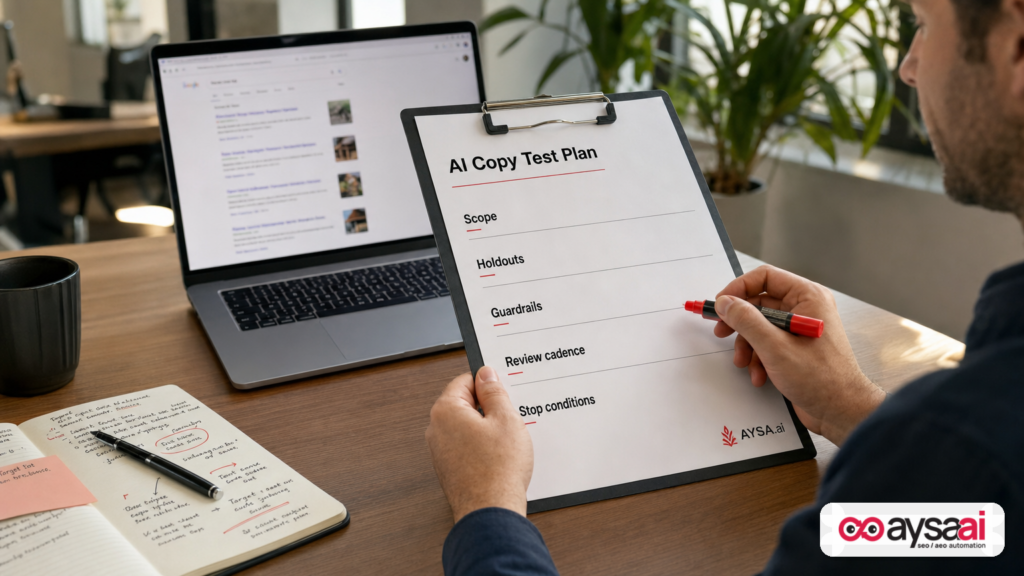
- A safe testing blueprint (you can run in a week) for automated ad copy
- Messaging restrictions and governance: the unsexy work that makes automation safe
- Measurement: attribution is not incrementality (and you need both mindsets)
- A concrete SME scenario: local services lead gen without junk leads
- What agencies should rethink in 2026+
- Where AYSA fits: connect paid search learnings to on-site execution
- What to do next
- Sources and further reading
Context: why AI-generated assets are the new battleground
Paid search used to be a game of meticulous control. You picked keywords, wrote a few ads, tested them, and over time you built a library of “winners.” That model started to shift with responsive search ads (RSAs), broader matching, and smarter bidding. Now the shift is accelerating: the platform is increasingly capable of generating and tailoring creative assets at scale.
Search Engine Land recently tested Google Ads AI Max automated ad copy across multiple business types and found a pattern that should resonate with almost every operator: AI can help, but it’s not consistently better than humans—and in some cases it can harm performance if left unsupervised. Their editorial is worth reading as a detailed case study: Putting Google Ads AI Max’s automated ad copy to the test.
My POV: this is not an “AI vs. human” debate. It’s a governance debate. The companies that win will build processes that:
- Let AI scale coverage where humans can’t keep up
- Keep humans in control where nuance drives profitability
- Turn ad learnings into website improvements quickly and safely
What changed with AI-assisted asset creation (and what didn’t)
What changed is not that Google can write copy. Tools have been generating ad text for years. The change is where the generation happens and how tightly it’s connected to delivery:
- Generation is native to the ad platform, which means it can iterate quickly and match assets to queries, ad groups, and inferred intent.
- Scale is built in: if you have 100+ ad groups, you’re no longer forced to choose between “generic” ads or weeks of manual writing and testing.
- Optimization is intertwined with bidding and targeting: asset choices are not isolated—they interact with match types, audiences, and conversion goals.
What didn’t change: you are still accountable for the business outcome. The platform can maximize a metric (CTR, conversions, conversion value) without caring about your margins, your sales team capacity, your refund rate, or whether leads are junk.
The real shift: “asset creation” becomes a production system, not a copywriting task
Most SMEs think of ad copy as writing: “come up with a strong headline.” Automation changes the job into something closer to manufacturing:
- You define what raw materials are allowed (claims, offers, tone, compliance language).
- You define what is forbidden (promises you can’t keep, products you don’t sell, prohibited phrasing).
- You run QA (review auto-created assets and remove bad ones early).
- You learn from output (which messages attract the right customers, not just more clicks).
If that sounds like “more work,” it can be at first. But it’s different work: fewer hours staring at a blank page, more time setting rules and reviewing exceptions. That’s a better use of human expertise.
Search Engine Land’s case study emphasizes this operational reality: AI assets require oversight, and they saw a meaningful share of auto-created assets removed during testing. That’s not a failure—it’s what governance looks like in real life.
Where automated ad copy tends to work best (and why)
In practice, automated asset creation tends to deliver the most value in three environments:
1) Long-tail coverage you’re currently under-serving
Most accounts have a “head” and a “tail.” The head gets attention: best landing pages, best ads, frequent optimization. The tail gets generic copy, minimal testing, and less frequent maintenance—even when it drives meaningful total volume.
Automation can improve this tail by tailoring language to the ad group intent and reducing the “one-size-fits-all” problem.
2) Large catalogs and diverse intent clusters
If you’re an ecommerce business with a broad SKU set, the user’s intent may vary wildly even within the same category. Manually writing bespoke RSAs for every cluster is expensive. Automated assets can help you get closer to “good enough” coverage faster—especially if your site experience supports searching and filtering once the user lands.
3) Creative ideation and message discovery
Even when humans ultimately write the final ads, AI can surface angles you didn’t think to test: different benefit framing, alternate objections, or phrasing that matches how customers search. The key is treating those outputs as hypotheses—not final truth.
Where it breaks: optimized campaigns, B2B qualification, and brand precision
Automation struggles when your advantage comes from nuance. That nuance usually lives in three places:
1) Highly optimized campaigns with proven messaging
If you’ve already invested months (or years) into message-market fit inside a campaign, the “best possible” ad copy is often the result of hard-won learning: what to say, what not to say, and how to sequence information.
In these cases, automated assets may be fine—but “fine” can still be a step down from “excellent.” Worse, it can introduce subtle brand drift that you don’t notice until performance degrades.
2) B2B lead gen where pre-qualification is the conversion lever
B2B ads are not only about attracting clicks. They’re about repelling the wrong clicks.
If you sell a $20,000/year SaaS platform, the best ad might intentionally reduce CTR by clarifying:
- Who it’s for (teams, not individuals)
- What it integrates with
- What it costs (or at least that it’s “enterprise”)
- What problem it solves (specific workflows, not generic “save time”)
Search Engine Land’s B2B test described a classic failure pattern: CTR jumps, conversion rates fall, and lead quality suffers because the ad becomes too broadly attractive. This is the most dangerous type of “improvement” because it looks good in platform dashboards.
3) Regulated industries, strict claims, and brand guardrails
If you’re in healthcare, finance, legal, or any category with strict compliance constraints, automated copy can increase review burden and risk. Even outside regulated industries, brand teams often have “must say” and “must not say” rules that exist for good reason: positioning, differentiation, and legal safety.
What can go wrong (and why it often shows up as “great CTR, bad business”)
When automated assets go wrong, it rarely shows up as a dramatic crash on day one. It shows up as metric confusion. Here are the most common traps I see teams fall into:
Trap #1: CTR becomes a vanity metric
CTR is not a goal; it’s a signal. AI can increase CTR by writing more emotionally appealing, less specific copy. That’s great for clicks—and terrible for qualification.
If your sales team says, “These leads are worse,” believe them. Build a feedback loop.
Trap #2: Cannibalization looks like growth
Automation can reshuffle traffic between campaigns or ad groups. You might see one campaign “win” while another loses. Net-net, the account might not improve—and may get worse.
This is why holdouts and controlled tests matter. If you don’t have a control group, you’re often just watching redistribution.
Trap #3: Offer drift and unintended promotions
Automated systems sometimes invent urgency (“limited time”), overstate guarantees, or imply offers you’re not running. Even if you catch most of it quickly, a few hours of the wrong message can create customer service issues and reputational damage.
Trap #4: Better ad copy exposes a weak landing page
Sometimes the ad gets better but conversions don’t improve because the landing page is the bottleneck. AI then “learns” that broad clicks are fine as long as it can hit conversion targets somewhere in the account. This can push you toward lower-quality segments that convert cheaply, not profitably.
Trap #5: Measurement lag makes you judge too early
Lead gen often has delayed conversion confirmation (SQLs, closed-won). Ecommerce can have returns and cancellations. If you evaluate too quickly, you optimize for what’s measurable fastest—not what’s best.
A safe testing blueprint (you can run in a week) for automated ad copy
You don’t need a perfect lab environment, but you do need discipline. Here’s a practical blueprint you can run without turning your account into a science project.
Step 1: Choose the right test scope
- Start with non-brand campaigns where messaging risk is manageable.
- Pick one “tail” campaign (lower maintenance) and one “head” campaign (highly optimized) if you want contrast.
- Avoid your most pinned / most sensitive campaigns for the first test.
Search Engine Land’s testing approach—comparing high-attention vs. low-attention campaigns—matches what I recommend operationally: it reveals where automation is truly additive.
Step 2: Define success in business terms
Before you run anything, write down:
- Primary KPI (e.g., qualified leads, revenue, contribution margin)
- Guardrail KPI (e.g., refund rate, lead-to-SQL rate, cost per qualified lead)
- Stop conditions (e.g., lead quality drops, customer complaints spike, Conversion rate collapses)
If your KPI is only “CPA in platform,” you’re inviting the system to game it.
Step 3: Build a control group
There are multiple ways to do this, depending on how your account is structured:
- Campaign split: keep one campaign unchanged as a control.
- GEO split: test in one region, hold out another (common for local services).
- Time-based split: less ideal due to seasonality, but better than nothing.
The point is to answer: “Did we grow, or did we just shift?”
Step 4: Set review cadence like a product launch
- Daily: review auto-created assets and search terms (especially in the first week).
- 2–3 times/week: review lead quality signals (CRM notes, call recordings, form fields).
- Weekly: evaluate performance vs. control, and decide what to keep/remove.
Step 5: Document learnings as “message rules”
Don’t just keep the “winning headline.” Extract principles:
- Which benefits drove qualified intent?
- Which phrases attracted unqualified clicks?
- Which offers triggered customer confusion?
Those principles become your restrictions, your templates, and your landing page updates.
Messaging restrictions and governance: the unsexy work that makes automation safe
In the Search Engine Land test, messaging restrictions were highlighted as a key mechanism to steer automated asset creation. That aligns with how serious teams should treat AI: as a junior assistant that needs a rulebook.
Here’s what “governance” looks like in plain English.
Define “must say” and “must not say”
Must say examples:
- Geographic coverage (“Serving Dallas–Fort Worth”)
- Audience qualifier (“For clinics with multiple locations”)
- Primary offer framing (“Book a consultation,” “Get a quote,” “Shop replacement filters”)
Must not say examples:
- Unverified superlatives (“#1,” “best,” “guaranteed”)
- Fake urgency (“limited time” when it’s not)
- Products/services you don’t offer
Build B2B qualification into the copy, not just targeting
Targeting is not qualification. You qualify with language. Consider embedding one qualifier in every ad combination:
- “For teams” / “for companies”
- “Request a demo” (not “sign up free” if you don’t want consumers)
- Industry-specific mention (e.g., “for logistics operations”)
Treat asset review as continuous QA
A strong process includes:
- Who reviews (named owner)
- How often (daily early, then weekly)
- How removals are logged (so you can improve restrictions over time)
This is why “turn it on and forget it” is a myth. Automation is a multiplier of both good governance and bad governance.
Measurement: attribution is not incrementality (and you need both mindsets)
One reason AI-driven changes are hard to judge is that Attribution answers “what got credit,” not “what caused new business.”
Search Engine Land has also published related thinking on measurement tradeoffs—see their piece: Attribution vs. incrementality: Why you need both. You don’t need to adopt a PhD-level experimentation program, but you do need to respect the difference:
- Attribution view: which ads/keywords/campaigns got conversions?
- Incrementality view: did we create additional conversions we wouldn’t have gotten anyway?
Practical approaches for SMEs:
- Keep a stable control (geo or campaign) during tests.
- Track downstream quality (qualified lead rate, close rate) in addition to platform conversions.
- Watch for shifting demand capture (brand search growth vs. non-brand efficiency).
A concrete SME scenario: local services lead gen without junk leads
Let’s make this real. Imagine a local, high-consideration service business: a dental clinic group with three locations offering implants and Invisalign.
They run Google Ads lead gen. Their biggest problem isn’t “getting clicks.” It’s:
- Getting inquiries from people outside their service radius
- Attracting price shoppers who can’t afford implants
- Wasting staff time on low-intent calls
Now they enable automated asset creation. Two things can happen:
How it can win
- Long-tail ad groups (“implant dentist near me,” “same day implants,” “bone graft implant”) get more tailored headlines.
- CTR rises because copy matches intent better.
- Cost per lead improves because relevance improves.
How it can lose
- AI writes broader, more emotionally persuasive copy (“Affordable smile makeover!”) that pulls in irrelevant cosmetic searches.
- CTR rises further, but lead quality drops.
- Staff gets overwhelmed; appointment rates fall; the clinic blames marketing.
The fix isn’t “turn off AI.” The fix is governance:
- Messaging restrictions: must mention locations / service area; must not claim “affordable” unless pricing supports it.
- Qualification language: “Implants consultation (financing available)” or “Adults 21+” where appropriate and compliant.
- Negatives: add patterns from search terms immediately.
- Lead scoring: tag calls/forms as qualified/unqualified so you can optimize toward quality, not volume.
What agencies should rethink in 2026+
If you run PPC for clients, automated assets change your value proposition. Clients won’t pay for “writing 50 ads.” They will pay for outcomes and risk management.
Three agency shifts matter most:
1) Sell process and governance, not copy volume
Your differentiator becomes:
- How you define messaging rules
- How you enforce compliance
- How you monitor and react
- How you connect paid insights to landing page and offer improvements
2) Build a lead quality feedback loop or you’re blind
Platform conversions are an incomplete story in lead gen. Agencies that can connect CRM outcomes to ad messaging will outperform agencies optimizing only to front-end conversions.
3) Treat creative like ops
In the old world, creative was periodic. In the new world, it’s continuous. You need:
- Standard review routines
- Clear ownership
- Rapid removal and replacement
- Knowledge base of “what not to allow”
Where AYSA fits: connect paid search learnings to on-site execution
Even though this article is about paid search, the biggest business wins usually come from what you do after you learn. Ads can tell you:
- Which benefit statements resonate
- Which objections block conversions
- Which terms signal high intent
- Which promises create confusion
But if you don’t ship changes to your website, you’re leaving money on the table—and you’re forcing Google Ads to “solve” conversion problems with traffic manipulation instead of better user experience.
AYSA’s role: approved execution for SEO/AEO/GEO improvements
AYSA is built for the part most teams struggle with: turning insights into consistent, Approved Execution. The best workflow looks like this:
- Monitor what’s happening (rankings, pages, visibility, site signals). See AYSA Monitoring.
- Prepare changes based on learnings (landing page copy refinements, FAQs that answer ad-driven questions, internal links to the right services/products).
- Ask for approval so humans stay accountable for brand and compliance.
- Execute accepted changes quickly—so you’re not stuck in backlog purgatory.
This is especially relevant as AI-driven search behavior evolves (AEO/GEO). If your paid copy reveals what people are actually asking, you should update your pages to match those questions and intents. For where that shows up, explore AI Search Visibility and AYSA AI SEO Tools.
Practical ways to turn ad learnings into site wins
- Landing page headline alignment: if “same-day shipping” drives qualified clicks, make it a primary on-page message (where true).
- FAQ expansion: convert high-intent query themes into FAQs (shipping times, eligibility, pricing ranges, what’s included).
- Service area clarity: for local lead gen, make coverage explicit to reduce unqualified calls.
- Category copy for ecommerce: address comparison intent (“X vs Y,” “best for…”), not just product listings.
- Internal linking: route high-intent pages to the right next step so you don’t rely on ads to do navigation work.
If you want to understand how AYSA is packaged for SMEs and agencies, see AYSA Pricing. For ongoing playbooks and examples, visit the AYSA Blog.
What to do next
If you’re an SME owner, in-house marketer, or agency lead evaluating AI-generated ad assets, use this checklist to move forward without gambling your pipeline.
Action list
- Pick the right sandbox: choose one tail campaign and (optionally) one head campaign. Avoid your most sensitive campaigns first.
- Write success criteria: define primary KPI + guardrails + stop conditions in business terms (not just platform CPA).
- Create a control: campaign or geo holdout so you can detect cannibalization and redistribution.
- Define messaging restrictions: must-say, must-not-say, and B2B qualification cues where relevant.
- Commit to a review cadence: daily in week one, then weekly; remove bad assets fast.
- Measure lead quality: add a lightweight rubric in your CRM (qualified / unqualified + reason codes).
- Ship website changes: update landing pages and FAQs based on winning messages so you’re not paying forever to compensate for on-site gaps.
- Operationalize the loop: use a system like AYSA to monitor, prepare, request approval, and execute changes without backlog delays.
Sources and further reading
- Search Engine Land: Putting Google Ads AI Max’s automated ad copy to the test
- Search Engine Land: Attribution vs. incrementality: Why you need both
- Search Engine Land: Google says AI Max unlocks billions of new monetizable searches
- Search Engine Land: Google rolls out AI content labels in asset studio
- Search Engine Land: Google Ads appears to separate Target CPA and Target ROAS bidding strategies
Note: This editorial is based on the testing methodology and observations reported by Search Engine Land and broader operator experience. Where platform documentation or primary sources are not provided in the supplied research context, I’ve avoided making specific product-mechanics claims beyond what’s described in those references.
Continue the AI search topic inside AYSA.
Use these pages to connect the article with AI SEO tools, AI visibility monitoring, AI Overviews and approved website execution.
Turn this topic into a website action plan.
Use these AYSA hubs to move from reading to technical fixes, AI visibility monitoring, research, glossary context and approval-first SEO execution.

